


Court in Nigeria Dismisses Case Filed by Escaped Binance Executive
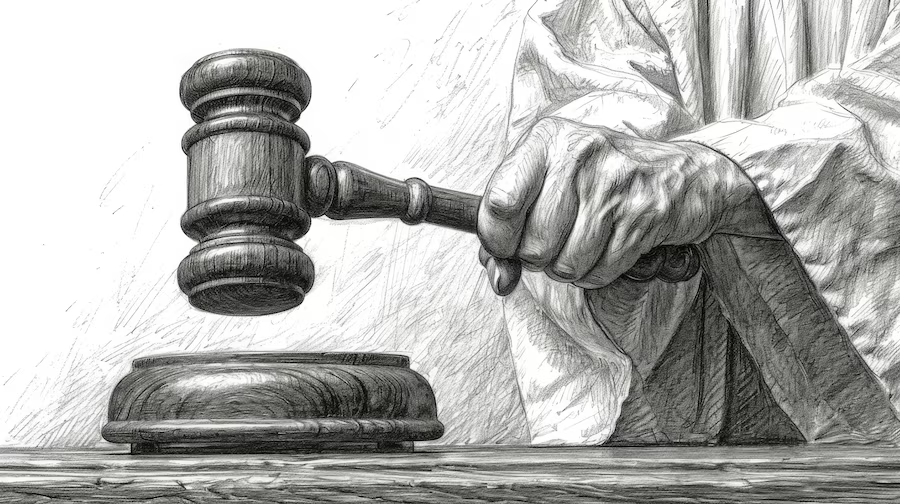
Binance recently suffered another setback in its protracted lawsuit with the Nigerian authorities, following a Federal High Court ruling to dismiss a human rights lawsuit filed against the West African nation authorities, particularly the Economic and Financial Crime Commission (EFCC) and the National Security Adviser (NSA) by Nadeem Anjarwalla. Interestingly, the new ruling is coming a few days after the Nigerian Federal Inland Revenue Service (FIRS) acquitted Anjarwalla and Tigran Gambaryan from the alleged tax evasion charges previously levied against both executives, as attention will shift solely to Binance. Anjarwalla’s Arguments Presenting his arguments, Anjarwalla asserted that the Nigerian government, through its regulatory bodies, had violated his fundamental human rights by detaining him and seizing his passport. However, On June 19, Justice Inyang Ekwo, who presided over the hearing tendered by Anjarwalla, dismissed the case, citing a lack of legal representation, as neither the escaped executive nor his legal team appeared in court, complicating the already strained relationship between the parties involved. Implications As Court Dismisses Case Presented By Binance Executive The court verdict implies that Anjarwalla remains culpable and could face confinement, especially in prison, like his fellow executive, Tigran Gambaryan. After Anjarwalla’s escape earlier this year in March, the Nigerian government has adopted stringent rules to ensure that a re-occurrence does not occur with Gambaryan. Hence, Gambaryan was transferred to Kuje Correctional Center under a potent security network, and he has been attending court proceedings from the correctional center since then. What Is Next? At the time of drafting this report, information about Anjarwalla’s whereabouts has remained scanty, despite news breaking out in the past that he faces high extradition back to Nigeria. Following the court verdict which dismissed the case presented by Anjarwalla, it becomes safe to say that the Nigerian authorities might want to intensify the process, leading to the executive’s extradition, since his arguments will no longer stand against them, meting out punishments to the escaped executive.
How Can Features of Blockchain Support Sustainable Development?
Have you ever felt like reducing environmental impacts is a never-ending battle? We hear you. Being eco-friendly can feel very difficult, and recycling isn’t always convenient. So, how can features of blockchain support sustainability efforts? Well, blockchain can track a product’s journey from source to store, ensuring adequate eco-friendly practices. Blockchain can also track resources used throughout the supply chain, exposing inefficiencies and highlighting areas for improvement. This article will cover in detail how features of blockchain can contribute to sustainability. Key Takeaways What is Blockchain? At its core, a blockchain is a distributed database or ledger shared among a network of computers (nodes). Blockchain basically creates a secure, transparent way to track information. Unlike traditional databases, which rely on a central authority for control, blockchains operate in a decentralized manner. Here are the key features that define blockchain: No single entity has control over the entire blockchain. Instead, all participants collectively maintain and validate the data. Once information is added to a blockchain, it becomes practically irreversible. Each piece of data is stored in a “block,” and these blocks are linked together using cryptographic hashes. Altering any block would require changing subsequent blocks, making it highly secure against tampering. Trust in a blockchain system is established through consensus mechanisms. Participants agree on the validity of transactions, eliminating the need for intermediaries like auditors or centralized authorities. How Does Blockchain Work? Imagine a spreadsheet where data is entered and stored. Now, picture this spreadsheet distributed across multiple machines, with each copy being identical. That’s essentially how a blockchain works. Transactions or other relevant information are collected and grouped into blocks. Each block’s data is run through an encryption algorithm, resulting in a unique hexadecimal number called a hash. This hash becomes part of the next block, creating a chain of interconnected blocks. The blocks are linked together, forming an unbroken chain. Any attempt to alter a block would require changing subsequent blocks, which is computationally infeasible. Multiple copies of the blockchain exist on different machines. For a transaction to be valid, all copies must match. This decentralized validation ensures transparency and security. Blockchain Beyond Cryptocurrency Blockchain technology has extended beyond cryptocurrency and is now recognized as a powerful tool with the potential to change various aspects of our lives. One of the most promising areas where blockchain can make a significant impact is sustainability. While blockchain technology has faced criticism for its energy consumption (especially in the case of Bitcoin and similar proof-of-work chains), it also holds immense promise for sustainability. The Urgency of Environmental Sustainability The urgency of addressing environmental challenges has never been more critical. Our planet is experiencing dramatic changes, from rising sea levels to extreme weather events, and the public is demanding greater accountability from all industries. Amid this backdrop, sustainable business practices have become central to the popular narrative. Companies rush to declare their commitment to sustainability, but transparency and verifiable impact remain difficult to track. How can Features of Blockchain Support Sustainability Efforts? Blockchain isn’t just a cool tech term; it involves some key aspects that can work together to empower sustainability initiatives. Decentralization Blockchain’s core feature of decentralization plays an important role in advancing sustainability initiatives. Here’s how: Decentralized blockchains enable transparent and tamper-proof record-keeping. Every transaction or data entry is permanently recorded across a distributed network of nodes. This transparency ensures that information related to sustainable practices—such as supply chain details, carbon emissions, or resource usage—is accessible to all stakeholders. Whether it’s tracking the origin of raw materials or verifying fair labor practices, decentralized systems empower consumers, regulators, and businesses to make informed decisions. By removing central authorities and intermediaries, blockchain fosters collaborative decision-making. Sustainable projects often involve multiple stakeholders—companies, NGOs, governments, and communities. Decentralized governance models allow these diverse actors to participate equally. Whether it’s voting on environmental policies, allocating resources, or managing conservation efforts, blockchain-based platforms facilitate consensus-building. Decisions are transparent, auditable, and resistant to undue influence. Immutability The immutability of blockchain records ensures the integrity of sustainability-related data. Here’s why it matters: Once data is added to a blockchain, it cannot be altered or deleted. This permanence is crucial for tracking sustainability metrics over time. Whether it’s carbon emissions, water usage, or renewable energy production, organizations can rely on unchangeable records. Investors, consumers, and regulators gain confidence in the accuracy and authenticity of reported data. Immutability allows for verifiable impact assessment. Companies can prove their adherence to sustainable practices by showcasing unalterable records. For instance, a fair-trade coffee producer can demonstrate the journey from farm to cup, ensuring ethical sourcing and minimal environmental impact. Similarly, renewable energy providers can validate their clean energy generation without fear of data manipulation. Smart Contracts Smart contracts, self-executing code on the blockchain, revolutionize sustainability efforts: They automate compliance with sustainability standards. For instance, when a shipment of sustainably sourced timber arrives at a port, a smart contract can trigger payment only if the documentation meets criteria (e.g., no illegal logging). This reduces administrative overhead and ensures real-time adherence. Smart contracts enhance traceability. In supply chains, they track the entire lifecycle of products—from raw materials to disposal. If a product claims to be organic or cruelty-free, the blockchain verifies each step. Non-compliance triggers penalties automatically. This accountability drives better practices. Carbon credit management with Blockchain The fight for a carbon-free environment requires a diverse set of tools. Blockchain is one of those tools. Here’s why. Secure and Transparent Carbon Credit Management Carbon credits play a crucial role in combating climate change. Blockchain can better how you manage and trade these credits: Blockchain ensures the traceability of carbon credits from creation to retirement. Each credit represents a reduction in greenhouse gas emissions. By recording these credits on a decentralized ledger, you can verify their legitimacy. Whether it’s a wind farm generating clean energy or a reforestation project sequestering carbon, blockchain provides transparency. Traditional carbon credit systems rely on centralized authorities for verification. Blockchain eliminates this dependency. Anyone can independently verify the authenticity of carbon