


Circle Announced the Circle Foundation, Seeded With 1% of Its Equity, To Back CDFIs
Circle — the issuer of the USDC stablecoin — has launched a new nonprofit branch, Circle Foundation, backed by 1 % of its equity through the corporate social‑impact program Pledge 1%. The Foundation aims to advance financial resilience and inclusion in the United States and beyond. Circle Foundation pledges to strengthen the financial systems people rely on daily. In its first phase, the focus will be on supporting small businesses in the U.S. that often struggle with access to affordable financing, digital tools, and capital needed for growth. To do this, the Foundation will distribute grants and partner with mission‑driven lenders — Community Development Financial Institutions (CDFIs) — especially those using data‑driven, technology-enabled approaches to expand access and scale impact. Why This Matters for Small Businesses Small businesses are a backbone of the U.S. economy, employing nearly half of the private‑sector workforce and contributing over 40 % of GDP. Yet many remain underserved by traditional banking and finance. By targeting CDFIs — which specialize in serving underserved communities — Circle Foundation aims to bridge those capital and service gaps. Because the funding comes from Circle’s equity rather than recurring revenue or token sales, the Foundation is positioned as a long‑term commitment. According to public filings, Circle reserved 2,682,392 shares of Class A common stock — equivalent to 1 % of outstanding capital stock at board approval — to seed this fund. Global Outreach: Beyond U.S. Borders Although the initial grants will focus on U.S. small businesses, Circle Foundation’s mandate extends globally. It intends to partner with international organizations to modernize humanitarian aid infrastructure and expand financial access for underserved populations. Through such partnerships, the Foundation hopes to improve how aid is delivered — making it faster, more secure, cost‑effective, and transparent. This global approach builds on Circle’s prior crypto‑enabled humanitarian work — for instance, using USDC to deliver aid to displaced people in Ukraine, and supporting healthcare workers in Venezuela during the COVID‑19 pandemic. Committing More Than Capital: Time, Expertise, and Governance Circle Foundation isn’t just about writing checks. As part of its Pledge 1% commitment, Circle has allocated volunteer time for its employees: each Circle employee can take up to 40 paid hours annually to contribute to nonprofits or community projects of their choice. Moreover, the Foundation is structured as a donor-advised fund housed with a third‑party asset manager, ensuring it operates independently from Circle’s commercial activities — while Circle itself covers operational costs. This design ensures that all Foundation funding goes directly toward mission-aligned impact. What to Watch Next Circle Foundation marks a significant shift in how a leading stablecoin issuer is channeling resources: from infrastructure and financial products toward systemic social impact. By supporting underserved communities, small businesses, and global humanitarian efforts — all backed by long-term equity and committed human capital — Circle aims to turn the promise of financial inclusion into tangible change.
Goldfinch User Deltatiger[.]Eth Lost About $330K in an Attack, With 118 $ETH Sent to Tornado Cash

A Goldfinch Finance user identified as deltatiger.eth has reportedly lost around $330,000 in a targeted exploit, according to blockchain security firm PeckShield. The attacker siphoned off approximately 118 ETH before routing the stolen assets through the crypto mixing protocol Tornado Cash, effectively obscuring the transaction trails on-chain. Key Takeaways A Vulnerable Smart Contract and a Repeated Drain of Funds PeckShieldAlert reported that the breach originated from an older Ethereum smart contract linked to the victim’s wallet, with the compromised address identified as: 0x0689aa2234d06Ac0d04cdac874331d287aFA4B43 The weakness was traced to the contract’s collectInterestRepayment() function — code designed for handling loan repayments within the Goldfinch ecosystem. The function allows transfers of USDC from any address that has granted token approval. In this case, the attacker reportedly began with a modest deposit of 1,000 USDC, then repeatedly withdrew more than they deposited. This was made possible by artificially inflating the smart contract’s share price, allowing withdrawals at disproportionately high valuations. PeckShield publicly advised: “revoke all approvals on the contract” as an urgent prevention measure to protect remaining funds from being drained. At the time of writing, neither Goldfinch Finance nor deltatiger.eth has issued a response. It remains unknown whether there has been any attempt by the attacker to negotiate, communicate, or demand terms following the exploit. Inside Goldfinch’s Model and Its Broader Risks Goldfinch Finance is a decentralized lending protocol backed by major industry names, including a16z Crypto and Coinbase Ventures. Unlike conventional DeFi lending models, Goldfinch does not require borrowers to post crypto collateral. Instead, borrowers present loan proposals that go through review by backers and auditors. This structure, while designed to support real-world lending, has introduced unique risk factors. Without on-chain collateral, repayment assurance relies on reputation, governance enforcement, and off-chain accountability. Goldfinch has experienced operational successes since its launch in February 2021, including: According to token terminal data aggregated by Coingecko, the Goldfinch protocol currently maintains: This is not the first time the protocol has faced internal or external financial shocks. Previous Incidents Highlight Exposure Goldfinch lending pools have absorbed significant financial losses due to borrower defaults: These incidents, while not hacks, have raised concerns over borrower reliability, governance oversight, and investor risk exposure. DeFi Exploits Continue to Surface The Goldfinch incident arrives amid a sequence of contract vulnerabilities across DeFi protocols. Recently, Yearn Finance’s yETH vault suffered a liquidity drain through an exploit involving flawed accounting mechanisms. Despite high-profile security audits and increasingly sophisticated on-chain monitoring tools, attackers continue to exploit loopholes in smart contract logic, token approval permissions, or unintended economic design side effects. What Happens Next If approvals related to the compromised wallet are not revoked, PeckShield warns that the attacker may still have the ability to siphon additional assets. Users interacting with Goldfinch or any protocol that relies on external contract calls are urged to review smart contract approvals through known tools such as: For now, all eyes will be on whether: As of the latest available information, the wallet drain occurred around 9:30 AM UTC, and the attacker continues using Tornado Cash to launder the stolen funds, making forensic tracking more difficult.
Japan Plans To Apply Flat 20% Tax on Crypto Profits, Aligning Crypto Levy With Equities and Investment Trusts

Japan is moving ahead with one of the most anticipated reforms in its digital-asset sector: a flat 20% tax on cryptocurrency trading gains, aligning crypto profits with the tax treatment of stocks and investment trusts. The shift—first reported by Nikkei and expected to be written into Japan’s 2026 tax reform framework—marks a major change from the current system that taxes crypto at progressive rates up to 55%. Key Takeaways A Move Toward Fairer Tax Treatment Under the current regime, crypto gains are treated as miscellaneous income and combined with salaries or business earnings. This structure places active traders at a disadvantage, particularly those making high-volume or short-term trades, as they can quickly fall into the maximum tax bracket. Industry critics have argued for years that the steep taxation has slowed domestic crypto trading and discouraged investors from realizing gains. The proposed change would introduce a separate tax category for digital asset earnings. The flat 20% levy would split into a 15% national tax and 5% to local prefectural and municipal governments. By putting crypto on the same footing as equities, lawmakers aim to normalize digital assets as part of the investment mainstream. A number of officials supporting the reform argue that a fairer tax structure could bring dormant trading activity back into the domestic market and ultimately strengthen government revenues through increased market participation rather than punitive taxation. Institutional Readiness and Market Positioning Japan’s shift is not only a response to retail investor demands—it is also being shaped by institutional interest. Major asset managers are already preparing new crypto-focused products ahead of the regulatory adjustment. Nomura Asset Management has formed a cross-department task force to study market strategies for a post-reform environment. Daiwa Asset Management, in partnership with Global X Japan, is reviewing ETF-related positioning for digital-asset exposure. Mitsubishi UFJ Asset Management and Amova Asset Management are evaluating both retail and institutional-grade crypto fund options. For these firms, the upcoming tax reform opens the door to broader product offerings—from crypto-themed funds to mixed-asset allocation packages that include digital tokens alongside traditional securities. However, practical challenges remain. Firms must define consistent pricing standards, ensure timely execution for investor inflows, and build deeper custodial security structures appropriate for crypto exposures. Volatility and liquidity management will also require dedicated attention. Regulatory Evolution: Treating Crypto as a Financial Product Japan’s Financial Services Agency (FSA) is simultaneously working on an expanded regulatory framework for digital assets. The agency is drafting measures to formally classify cryptocurrencies as financial products, placing them under rules typically applied to securities. This would include coverage of insider trading and market-manipulation offenses. The regulatory package would apply to the 105 cryptocurrencies currently listed on licensed Japanese exchanges, including Bitcoin (BTC) and Ethereum (ETH). The intention is to provide investor protection comparable to that of traditional markets while maintaining a regulated environment that supports innovation rather than suppresses it. A Market Already Demonstrating strong Participation Japan is not entering this reform on theoretical grounds—the country already has a robust base of crypto participants. According to data from the Japan Virtual and Crypto Assets Exchange Association, there are roughly eight million active crypto accounts in the country. Spot trading in September alone reached approximately 1.5 trillion yen (around $9.6 billion), reflecting sustained market engagement. This activity suggests a strong appetite for digital-asset investing—one that could grow significantly once taxation becomes less burdensome and institutional products expand access pathways. Expected Impact If enacted as planned, Japan’s restructured tax code will be among the most crypto-friendly frameworks implemented by a major economy in recent years. The flat-rate approach could: Japan’s crypto strategy has often been cautious but forward-looking. It was among the first major countries to legally recognize Bitcoin as a payment method in 2017, and its regulatory oversight—while strict—remains markedly clearer than many Western jurisdictions. Conclusion Japan’s move to apply a flat 20% tax on crypto profits signals not only a change in tax structure but a broader shift in financial philosophy. Digital assets are being acknowledged as legitimate investment instruments rather than fringe speculative tokens. With strong trading participation already in place and major financial institutions preparing offerings, the reform may serve as a catalyst for Japan’s next stage as a leading regulated crypto market.
Crypto ETPs Saw $1.07B in Net Inflows Last Week After 4 Weeks of Outflows
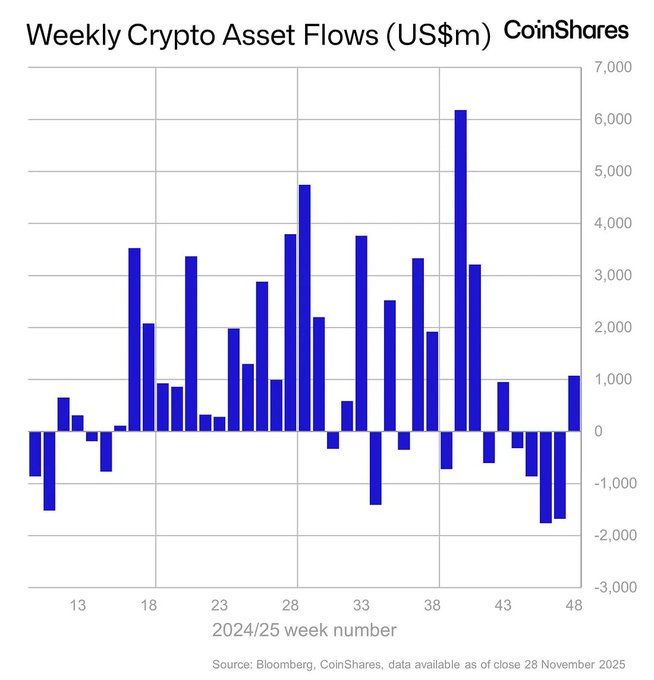
Digital asset investment products saw a sharp reversal in sentiment last week, recording $1.07 billion in net inflows, according to newly published data from CoinShares. This marks a strong rebound after a difficult stretch that included four consecutive weeks of outflows totaling $5.7 billion. The renewed interest came as Federal Open Market Committee member John Williams suggested that current monetary policy remains restrictive, fueling expectations of a potential rate cut this month — a development that historically supports risk-on assets like crypto. Trading activity did cool slightly due to the Thanksgiving slowdown, with crypto ETP volumes dropping to $24 billion, down from the previous week’s record-breaking $56 billion. Bitcoin Reclaims Investor Confidence Bitcoin investment products led the sector’s turnaround, bringing in $464 million in fresh inflows. CoinShares notes that sentiment has shifted away from bearish positioning, with investors moving out of short BTC trades. Correspondingly, short-Bitcoin products saw $1.9 million in outflows. Despite the weekly recovery, month-to-date flows for Bitcoin remain negative at $2.81 billion, reflecting the heavy selling pressure from earlier weeks. Still, the broader picture remains positive: year-to-date inflows stand at $26.78 billion, supporting a strong $142.66 billion in assets under management for BTC investment products. Performance varied by provider: The concentration of inflows at the top tier of providers suggests institutional investors are consolidating around the most liquid and reputable BTC products. XRP Posts Record-Breaking Inflows The standout of the week was XRP, which saw its largest inflow ever recorded at $289 million. This was driven in part by recent United States ETF approvals related to the asset, which appear to have strengthened institutional appetite. Over the past six weeks, cumulative XRP inflows now represent 29% of its total assets under management — a rapid growth trajectory that few altcoins have matched in 2025. XRP now sits at: While Bitcoin still received a larger absolute dollar amount, XRP’s inflows were more significant relative to its asset base — signaling aggressive accumulation and changing market perception. Ethereum, Solana, and Multi-Asset Funds Also in the Green Ethereum products recorded $309.1 million in inflows during the week, further strengthening the broader recovery. However, November’s selling pressure still lingers: month-to-date ETH flows remain negative at $1.40 billion. Even so, Ethereum holds strong fundamentals with: Solana — a favorite among high-performance smart-contract investors — added $4.4 million for the week, bringing: Multi-asset crypto investment products, which typically hold a diverse basket of coins, also saw renewed demand, attracting $26.3 million in weekly inflows and $37.2 million month-to-date. Not every asset rode the wave — Cardano saw $19.3 million in outflows, representing 23% of its total AUM, while Litecoin experienced minor outflows of $0.9 million. Sui, in contrast, quietly grew with $0.6 million in inflows. A Shift in Market Sentiment The week’s data suggests that large-scale investors are moving back into digital assets after a temporary pullback. Bitcoin dominance remains solid, but the surge in XRP and the resilience of Ethereum show that capital is not flowing into just one sector of the crypto market. If expectations of a monetary policy shift materialize — especially a near-term rate cut — risk assets could see further capital inflows, supporting stronger price stability and growth across both flagship cryptocurrencies and select altcoins. This latest surge in crypto ETP inflows may signal the beginning of a renewed accumulation phase, as institutional investors rotate capital back into digital assets ahead of the next macro-driven market catalyst.
WHALE ALERT: An Early Ethereum Whale Just Staked 40,000 $ETH Worth $120M After 10 Years of Inactivity
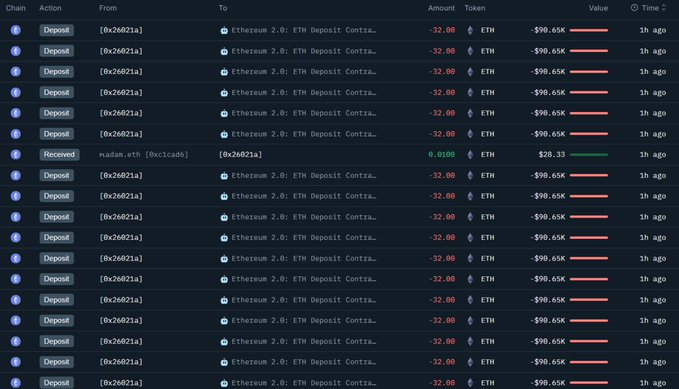
A major Ethereum wallet that has remained untouched for more than a decade has suddenly come back to life—only not to sell, but to stake. The long-dormant whale transferred 40,000 ETH, valued at roughly $120 million, into staking, signaling strong long-term conviction in Ethereum’s future. The move is drawing attention across the crypto community, especially amid fears that reactivated early holders might trigger sell-offs. Instead, this wallet did the opposite. A Whale From the ICO Era Resurfaces Blockchain analytics firm Lookonchain confirmed that the owner of this wallet was an early Ethereum participant, having obtained the ETH during the 2015 initial coin offering for approximately $12,000 total—a number that feels almost unreal today. Rather than sending the ETH to a centralized exchange—commonly understood as preparing to liquidate—the entire balance was deployed directly into a staking address. As one user remarked: “Imagine surviving every ETH narrative for a decade, and your first move is to add duration instead of derisk. Different breed.” That sentiment captures the market reaction perfectly: this is not panic, this is conviction. Contrasting Whale Behavior: Sell-Offs vs. Staking This staking decision arrives at a time when whale activity is split between accumulation and distribution. One ICO-era whale who originally held 254,908 ETH began selling on November 26, unloading 20,000 ETH and gradually reducing the position to just $9.3 million worth of ETH by December 1. Another large holder, who accumulated 154,076 ETH starting in 2017, sent 18,000 ETH to the exchange Bitstamp—typically interpreted as intended selling. Meanwhile, there have been bullish moves the other direction. Earlier this year, a Bitcoin whale who held 4,000 BTC sold it and converted the entire value into 96,859 ETH in just 12 hours. The diverging behavior has created a unique tension in the market: some whales are exiting, others are doubling down. A Confidence Play in Ethereum’s Future Ethereum staking requires participants to lock up ETH to support network consensus and security. In return, stakers earn yield denominated in ETH. Because staked funds cannot be sold immediately, staking is widely considered a long-term strategy. This whale’s choice to stake rather than sell suggests a belief that Ethereum’s value and ecosystem growth will continue over the coming years—not merely weeks or months. The timing is particularly interesting given the ongoing uncertainty surrounding price direction. According to CCN analyst Valdrin Tahiri: “If $2,800 breaks, the charts point clearly to a drop toward $1,500, completing the long-term range rotation.” At the time of the reported activity, Ethereum was trading around $2,818, hovering right near that critical level. Why This Matters A wallet idle since Ethereum’s infancy suddenly choosing to commit $120M of capital to staking is more than a private financial maneuver—it’s a market signal. Even though a single wallet cannot move the market alone, it can influence sentiment—and market psychology matters. The Road Ahead As more early wallets become active, two behaviors are emerging: Which trend prevails may influence how Ethereum behaves in the months ahead—especially if the price makes any decisive move from the current levels. For now, one thing is clear: surviving a decade of market volatility—and then staking $120M instead of cashing out—is a rare kind of conviction. This whale didn’t just return—it made a statement.