

Brazil’s Main Stock Exchange B3 Plans To Launch a Tokenization Platform and Issue Its Own Stablecoin for Token Trading and Settlements Starting in 2026

Brazil’s main stock exchange, B3, plans to launch a tokenization platform and issue its own stablecoin for token trading and settlements starting in 2026, a move that could reshape how traditional financial markets interact with digital assets. Brazil’s São Paulo‑based exchange, known officially as B3—Brasil, Bolsa, Balcão—confirmed plans to roll out a tokenization platform in 2026 that will allow a wide range of assets to be converted into tradable tokens on its trading infrastructure. Alongside this, the exchange will introduce its own stablecoin pegged to the Brazilian real to support settlement and clearing inside the tokenized ecosystem. This announcement marks one of the most direct moves by a major traditional exchange to bring blockchain‑style trading into the regulated financial system, integrating established market practices with next‑generation digital asset frameworks. Shared Liquidity and Seamless Trading A key tenet of B3’s strategy is shared liquidity. Rather than operating tokenized markets in isolation, the new platform will use the same liquidity pool as the exchange’s existing securities markets. Luiz Masagão, B3’s Vice President of Products and Clients, explained that “the token buyer won’t know they are buying from a traditional stock seller,” underscoring how the two systems will function cohesively. This unified design aims to minimize market fragmentation, letting institutional and retail participants trade tokenized and traditional instruments without navigating separate order books or liquidity silos. The approach could significantly lower barriers for mainstream investors to interact with tokenized assets. A Brazilian Real‑Linked Stablecoin To facilitate on‑chain settlements and clearances, B3 also plans to issue a stablecoin pegged to the Brazilian real. This digital currency will serve as a dedicated payment and clearing tool inside the tokenized market, streamlining transactions and reducing dependence on conventional cash settlement processes. Unlike many existing stablecoins designed for broad market use, B3’s version is positioned as internal market infrastructure — a settlement medium engineered to operate within the exchange’s ecosystem rather than as a public payments token. Linking the stablecoin to a national currency could also enhance confidence among regulators and local investors wary of price volatility in crypto markets. Expanding Crypto Derivatives In addition to tokenization and stablecoin work, B3 is broadening its suite of crypto‑linked derivatives. The exchange has submitted proposals for weekly options tied to Bitcoin, Ether, and Solana, along with event‑based contracts that would function similarly to products seen on prediction markets. These innovations are currently under review by Brazil’s securities regulator, the Comissão de Valores Mobiliários (CVM). This expansion builds on B3’s existing efforts in digital assets. The exchange introduced its first crypto exchange‑traded fund (ETF) in April 2021—ahead of similar offerings in some major markets—and now provides products tied to BTC, ETH, SOL, and broader crypto indices. Collectively, these instruments are held by roughly 600,000 investors and represent about $2.4 billion in assets under management. What This Means for Brazil’s Markets B3’s initiative comes amid a growing global interest in real‑world asset (RWA) tokenization, where physical and financial assets—like commodities or bonds—are digitized for trading on blockchain‑enabled platforms. According to industry data, the RWA tokenization market recently surpassed $18 billion, indicating accelerating demand for regulated tokenized instruments. By building token issuance and settlement directly into its core infrastructure, B3 is positioning itself to attract deep liquidity and institutional participation. The integration of tokenized assets with established trading systems could also draw international capital into Brazil’s financial ecosystem, potentially setting a model for other markets in Latin America and beyond. Challenges Ahead Despite the promise, B3’s plans hinge on regulatory approvals and market adoption. Brazil’s regulatory environment for digital assets continues to evolve, with recent policy shifts—such as the Central Bank’s classification of stablecoin transactions as foreign‑exchange operations—reflecting broader efforts to bring clarity to crypto transactions under existing financial laws. Furthermore, operational challenges remain, including the technical integration of tokenized assets within legacy systems and ensuring robust investor protections as new products launch within a regulated framework. Looking Forward As the 2026 launch date approaches, B3’s roadmap illustrates how traditional exchanges are increasingly embracing digital innovations while maintaining regulatory compliance — creating a bridge between established finance and emerging digital markets. Investors and industry observers will be watching closely as Brazil’s biggest exchange navigates the balance between innovation, regulation, and market participation.
The Coinbase Premium Gap Has Fallen to Minus $57, Indicating Heavy Selling Pressure From U.S. Traders
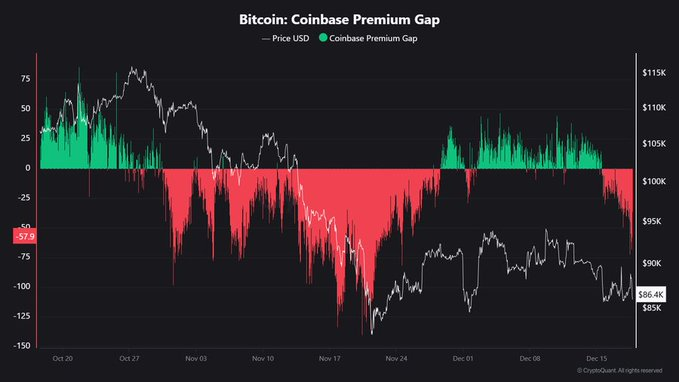
The Coinbase Premium Gap—a key indicator used to track demand from U.S.-based investors—has fallen to minus $57, signaling a notable imbalance in Bitcoin’s trading activity. This metric compares Bitcoin’s price on Coinbase, a platform dominated by American institutional and high-net-worth investors, with prices on offshore exchanges such as Binance. “The Coinbase Premium Gap has dropped to -$57, signaling aggressive selling from US investors and reduced Bitcoin demand.” A negative reading means Bitcoin is trading cheaper on Coinbase than on global exchanges. Historically, this pattern suggests that U.S. traders are distributing rather than accumulating, while demand is either stronger offshore or driven more by retail flows. Key Takeaways What the Gap Reveals About Market Sentiment The Coinbase Premium Gap is closely watched because it often mirrors institutional behavior. Positive values typically align with periods of strong U.S. buying, particularly during ETF inflows or broader risk-on market conditions. The current negative print points in the opposite direction. “A negative premium shows that Bitcoin is trading lower on Coinbase compared to global exchanges, reflecting regional sentiment.” At -$57, the gap is not at panic levels, but it clearly highlights soft demand from American institutions. This suggests that recent price action is being shaped more by selling pressure than by fresh capital entering the market. Year-End Positioning Weighs on Demand As 2025 draws to a close, the timing of the decline is notable. Market participants often rebalance portfolios toward year-end, and Bitcoin appears to be feeling the impact of that shift. “The Coinbase Premium Gap falling to -$57 signals soft US institutional demand as 2025 draws to a close.” Several factors may be contributing, including profit-taking after earlier rallies, tax-related selling strategies, and cautious positioning amid uncertain macro conditions. ETF-related flows also play a role, as reduced inflows or outright outflows can quickly translate into weaker demand on Coinbase. Implications for Bitcoin’s Near-Term Price Action While the current reading does not suggest capitulation, it does act as a warning sign for bulls. A sustained negative premium has historically limited upside momentum, as rallies struggle without participation from U.S. institutional buyers. “While not an extreme reading, the negative premium acts as a warning that upside momentum is limited until the gap turns positive.” Until the Coinbase Premium Gap flips back into positive territory, signaling renewed accumulation from U.S. investors, Bitcoin’s price may remain vulnerable to pullbacks or sideways movement. For traders and long-term holders alike, the message is clear: U.S. institutional demand is currently absent, and any meaningful recovery in market strength will likely require its return. Monitoring the Coinbase Premium Gap in the coming weeks will be critical for gauging whether selling pressure is easing or if further downside risk remains.