

Ethereum Leads the Euro Stablecoin Market, With 50% of All Tokenized Euros Issued on Ethereum
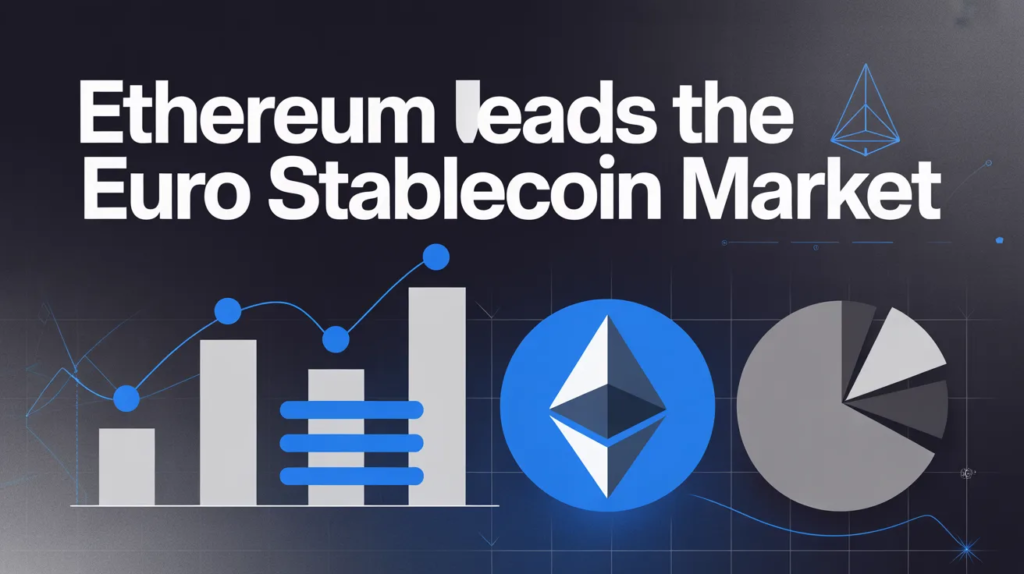
Ethereum has tightened its grip on Europe’s stablecoin market, emerging as the dominant blockchain for euro-denominated digital assets. Recent data from Barchart shows that half of all issued tokenized euros are currently deployed on the Ethereum network, reinforcing its position as the primary settlement layer for regulated stablecoins in the region. “According to Barchart data, Ethereum dominates the euro stablecoin market, with 50% of all issued tokenized euros based on the Ethereum network.” This milestone highlights Ethereum’s continued relevance in a market that is becoming increasingly competitive, especially as regulators across Europe push for compliant digital money frameworks under initiatives such as MiCA (Markets in Crypto-Assets Regulation). Why Ethereum Is Winning the Euro Stablecoin Race Ethereum’s leadership is not accidental. The network remains the most widely adopted smart contract platform, offering deep liquidity, robust security, and a mature developer ecosystem. For euro stablecoin issuers—many of whom are regulated entities—these factors are critical. Ethereum provides seamless integration with decentralized finance (DeFi) protocols, institutional-grade custody solutions, and established on-chain transparency standards. Most euro-backed stablecoins, including those issued by fintech firms and crypto-native companies, rely on Ethereum to reach users across exchanges, payment platforms, and DeFi applications. The network’s compatibility with Layer 2 scaling solutions has also helped reduce transaction costs, making euro stablecoins more practical for everyday transfers and settlements. Implications for the Broader Crypto Market Ethereum’s dominance in euro stablecoins strengthens its role as a financial infrastructure layer rather than just a platform for decentralized apps. While the U.S. dollar still commands the largest share of the global stablecoin market, growth in euro-denominated tokens signals rising demand for alternatives that align with European regulation and local payment needs. This trend could accelerate institutional adoption, particularly among European banks and payment providers exploring on-chain settlement. It also places pressure on rival blockchains attempting to capture market share by offering lower fees or faster transactions. What Comes Next As competition intensifies, Ethereum’s challenge will be maintaining its lead while scaling efficiently. Still, with 50% of all tokenized euros already issued on the network, Ethereum remains the default choice for euro stablecoins—for now. The data confirms a clear message: when it comes to euro-backed digital money, Ethereum is setting the pace.
The Trump Family’s Crypto Project World Liberty Financial Ends 2025 With Its WLFI Token Down Over 40%

World Liberty Financial, the crypto investment project backed by the Trump family, is closing out 2025 on a far weaker footing than many early supporters expected. Despite launching during one of the most favorable political and market moments for digital assets in recent U.S. history, the project’s governance token, WLFI, is now down more than 40% since it began public trading in September. The decline marks a sharp reversal from the optimism that surrounded World Liberty Financial when it was unveiled in late 2024. Announced by Donald Trump during his presidential campaign and spearheaded by his sons, Donald Trump Jr. and Eric Trump, the project was framed as both a business venture and a signal of a friendlier federal stance toward cryptocurrency. That message initially resonated with investors. As crypto markets surged through mid-2025, the Trump family’s holdings swelled dramatically, pushing the fund’s reported value into the tens of billions. But as the year draws to a close, both the token price and the portfolio’s overall valuation tell a more sobering story. Key Takeaways From Political Signal to Crypto Heavyweight World Liberty Financial officially launched in September 2024, positioning itself as a major player in digital assets almost from day one. Its first token sale, completed in October 2024, saw roughly 20 billion WLFI tokens sold at $0.015 each, raising about $300 million. A second sale followed between January and March 2025, with 5 billion tokens sold at $0.05, generating an additional $250 million. The project moved quickly to expand beyond a simple governance token. In March 2025, it introduced its own U.S. dollar-pegged stablecoin, USD1. By June, World Liberty had struck a promotional deal with PancakeSwap, the decentralized exchange linked to Binance, giving the stablecoin wider exposure within the DeFi ecosystem. The fund also pursued high-profile partnerships. In August, it entered a $1.5 billion private placement and treasury arrangement with ALT5 Sigma Corporation, exchanging 100 million shares of ALT5 stock for WLFI tokens. The deal effectively transformed ALT5 into a public company with a crypto-heavy treasury centered on World Liberty’s token. During the height of the 2025 bull market, the fund aggressively accumulated major cryptocurrencies. Its disclosed holdings included more than $21 million in Wrapped Bitcoin, large positions in Ether and Move, and exposure to Aave-related assets and Mantle. Substantial reserves of its own USD1 stablecoin also featured prominently. A Steep Drop After the Peak Public portfolio tracking for World Liberty Financial only began in September 2025, when the fund’s value was estimated at more than $17 billion. That figure coincided with peak enthusiasm across the crypto market and growing expectations that the Trump administration would push pro-crypto policies. By mid-December, however, the picture had changed dramatically. The fund’s assets were valued at just under $8 billion, representing a decline of roughly 47% in less than three months. WLFI itself has fallen about 42% since it started trading publicly. The drop reflects broader volatility in crypto markets during the final quarter of the year, but World Liberty’s high concentration in its own token and politically charged branding have amplified scrutiny. Unlike diversified asset managers, the project’s valuation is tightly linked to confidence in both its strategy and its leadership. Conflict of Interest Questions Resurface Concerns about World Liberty Financial have never been limited to price action. From the outset, critics warned that the project blurred the line between private business and public office. Historically, U.S. presidents have taken steps to distance themselves from financial interests while in office. Jimmy Carter’s decision to place his peanut farm in a semi-blind trust is often cited as a benchmark. Donald Trump has taken a different approach, remaining closely associated with ventures that could benefit from policy decisions made by his administration. In April 2025, Senator Elizabeth Warren and Representative Maxine Waters formally urged the Securities and Exchange Commission to preserve records related to World Liberty Financial. They questioned whether the president’s family ties to the company could undermine the agency’s ability to regulate the crypto sector impartially. The scrutiny intensified in November, following a report by Accountable.US alleging that WLFI tokens had been sold to individuals linked to sanctioned countries, including Iran, North Korea, and Russia. The claims triggered renewed calls for investigation. White House Press Secretary Karoline Leavitt rejected the allegations outright, saying: “Neither the president nor his family have ever engaged or will ever engage in conflicts of interest. The administration is fulfilling the president’s promise to make the United States the crypto capital of the world by driving innovation and economic opportunity for all Americans.” World Liberty Financial has also denied wrongdoing, stating that it conducted Anti-Money Laundering and Know Your Customer checks and rejected millions of dollars from buyers who failed to meet compliance standards. A Broader Crypto Footprint World Liberty Financial is only one part of the Trump family’s expanding presence in digital assets. Trump Media and Technology Group operates a fintech arm known as Truth.Fi, which in September acquired 684.4 million Cronos tokens in a deal with Crypto.com worth about $104.7 million. Separately, Donald Trump Jr. and Eric Trump are backing American Bitcoin, a mining venture that held 4,784 BTC as of December 10, according to Solid Intel. Together, these projects underscore the family’s deepening exposure to crypto markets, even as volatility tests investor confidence. Looking Ahead to 2026 Despite the sharp decline in portfolio value and ongoing controversy, World Liberty Financial is pressing forward. On December 3, co-founder Zach Witkoff announced plans to launch a suite of real-world asset products beginning in January 2026, signaling an effort to diversify beyond traditional crypto holdings. Whether that strategy can stabilize the project remains an open question. For now, World Liberty Financial ends 2025 far below its peak, with a token down more than 40% and a portfolio that has lost nearly half its value in a matter of months. The coming year will likely determine whether the project can regain momentum or becomes a cautionary tale at the intersection of politics and crypto markets.