


Online identity verification is at a crossroads. Traditional, centralized systems for proving identity online are increasingly vulnerable to data breaches, hacks, and manipulation. Users are often forced to share excessive personal information, giving them little control over how their data is stored and used.
However, a new approach is emerging—decentralized identity systems. These systems empower users to manage their own data, choosing when, how, and with whom to share their information. Imagine controlling your identity with the same ease as holding a digital wallet, sharing only the essentials without compromising privacy.
In this article, we’ll explore the key benefits, how it works, and some innovative decentralized identity projects reshaping the future of online verification.
Related Article: Top DEX (Decentralized Exchange) Statistics for 2024
Key Takeaways
- Decentralized identity systems empower users to manage their data, giving them control over when, how, and with whom they share their information.
- Decentralized Identifiers (DIDs) are at the core of these systems, serving as unique and secure digital identities linked to verifiable credentials.
- Several innovative projects are leading the way in decentralized identity, including MoveID for mobility, Ethereum Name Service (ENS) for simplified crypto addresses, and Polygon ID for secure Web3 interactions.
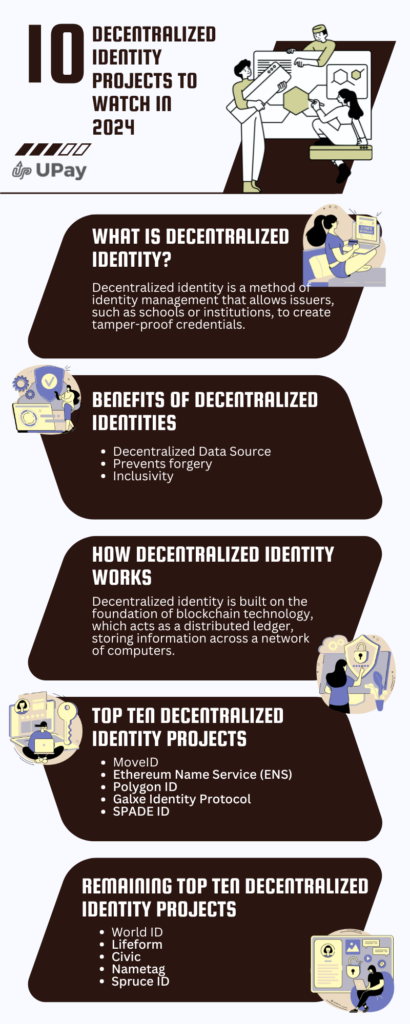
What is Decentralized Identity?
Decentralized identity is a method of identity management that allows issuers, such as schools or institutions, to create tamper-proof credentials. Verification organizations can then authenticate these credentials directly without the need for intermediaries.
By removing third-party service providers from the verification process, decentralized digital identities contain all necessary information about an individual, organization, or device. It functions like a secure digital wallet that stores your credentials safely.
When sharing information, users can control what is shared, limiting access to only the required details, rather than revealing all their personal information to service providers.
Related Article: Exploring Decentralized Identity Solutions in Cryptocurrency
Benefits of Decentralized Identities
- Decentralized Data Source: The concept of decentralized identity is founded on the principles of cryptographic security and controlled data sharing. Rather than relying on a centralized repository, credentials are distributed across a network of nodes. This enables users to share their information securely, while verifiers can access proof of identity without compromising privacy.
Storing user data in centralized systems makes them prime targets for cyberattacks.
- Prevents forgery: A potential employer, banks, and even online shops can verify your information in seconds. Imagine getting all the information you need before hiring in a few clicks. This would save organizations time and human assets from the rigors of manual verification.
- Inclusivity: In this report by the World Bank, an estimated 850 million people do not have access to proof of identity. But with the rise of smartphone usage across the globe, people can get access to basic amenities without a government-issued ID.
How Decentralized Identity Works
Decentralized identity is built on the foundation of blockchain technology, which acts as a distributed ledger, storing information across a network of computers. This decentralized approach makes it more resilient to tampering, and with cryptographic protections, only the rightful owner can control access to their identity data.
At the core of this system is a Decentralized Identifier (DID)—a globally unique identifier that serves as a secure digital identity. Your DID is linked to verifiable credentials, allowing you to prove aspects of your identity without revealing unnecessary personal information.
You can store your DID on devices like smartphones or computers, or securely in the cloud. While local storage gives you more control, cloud storage offers convenience but requires careful security measures. The key advantage of this system is that users have complete control over their identity and what information they choose to share, ensuring privacy and security.
Decentralized identity solutions put users in control of their data, allowing individuals to manage their digital identities without relying on third-party institutions. This self-sovereign approach is rapidly gaining traction as privacy and security concerns mount in the digital age
Decentralized Identity Projects
MoveID

Source: https://moveid.org/
MoveID is a project under the Gaia-X 4 Future Mobility initiative for creating a decentralized digital identity system for mobility. This system will allow vehicles, users, and city infrastructure to interact.
In practice, MoveID allows vehicles to communicate with elements in the smart city, like parking gates, charging stations, and traffic lights. This is possible with the digital identities assigned to each vehicle and infrastructure element.
These identities allow users to exchange data and make transactions, such as paying for parking or accessing services like toll gates, without human intervention.
Ethereum Name Service (ENS)

Source: https://ens.domains/
The Ethereum Name Service (ENS) is a decentralized system that simplifies long wallet addresses into simple names. For example, instead of using a long string of numbers and letters like “0xb8c2c29…”, you can use “nick.eth” to send and receive your cryptocurrencies.
Long addresses can be confusing and often, we make mistakes while copying and pasting them. With ENS, you lower the odds of losing your funds.
ENS works with a registry and resolvers. The registry is like a phone book that keeps track of all domain names (like “nick.eth”) and links them to the right address. Resolvers convert those names into the addresses behind them.
Decentralized identity projects are transforming how individuals and organizations safeguard their personal information and interact online.
Polygon ID

Source: https://www.privado.id/
Privado ID (formerly Polygon ID) is a decentralized digital identity solution for users to interact with Web3 services while keeping their data secure and under their control.
They use zkSnark technology (zero-knowledge proofs), which provides a way to verify identities without revealing sensitive information.
The release 6 of Polygon ID was in February, and it came with some incredible features like dynamic credentials for users to update expired credentials easily.
Also, they included an On-chain Revocation Service. This feature ups the verification process by indicating if a credential is still valid or revoked.
Galxe Identity Protocol

Source: https://www.galxe.com/identity
Galxe Identity Protocol is powered by zero-knowledge proof technology similar to Polygon ID. Their innovative protocol enables individuals to own, manage, and share their verifiable credentials securely and privately.
Galxe Identity Protocol’s decentralized design allows It to work seamlessly across various blockchain networks. Users can create, manage, and revoke their own digital credentials.
Additionally, the protocol enables the creation of special tokens (Soul-Bound Tokens) that securely tie credentials to their owner, enhancing verification efficiency.
SPADE ID

Source: https://space.id/
SPACE ID is another interesting web3 identity project. Space ID is a one-stop shop for discovering, registering, trading, and managing web3 domains. Users can streamline all domain management on this platform without using multiple products.
SPACE ID allows users to register web3 domains on the SPACE ID Mainnet, starting with .bnb and .eth TLDs. Additionally, the platform features a dedicated marketplace for buying and selling web3 domains with aggregated liquidity.
The platform’s Web3 Name SDK & API enable seamless integration with web3 services, eliminating compatibility issues.
World ID

Source: https://worldcoin.org/world-id
World ID is an innovative project by Worldcoin. It’s essentially a digital passport for the internet, allowing users to prove they are persons without revealing their personal information.
The problem World ID tries to solve is the growing difficulty in distinguishing real people from bots or fake accounts online. This issue leads to various problems, including the proliferation of spam and scams on social media, unfair distribution of resources in online giveaways, and challenges in creating truly democratic online voting systems.
Users simply download the World App and then visit a device known as an “Orb.” This orb scans the user’s eyes, not to store an image, but to create a unique code that proves the individual’s humanness. This code becomes the user’s World ID, which can be used online to verify their humanity without sharing personal details.
Lifeform

Source: https://lifeform.cc/
Lifeform ID is an innovative universal Decentralized Identifier solution that aims to simplify the Web3 experience for users across multiple blockchain networks. By integrating major chains such as Bitcoin, Ethereum, and Solana, Lifeform ID enables users to manage their assets and on-chain activities across different blockchains using a single domain or multiple domains.
One of Lifeform ID’s key features is its ability to facilitate cross-chain interactions and benefits. For instance, a user holding an NFT on Bitcoin could receive airdrops from Ethereum, or become eligible for user acquisition projects based on their NFT ownership, regardless of the original blockchain. This functionality opens up new possibilities for companies and projects to target and engage with users across various blockchain ecosystems more effectively.
As the first platform to support multi-blockchain domain name resolution for networks including Bitcoin, Ethereum, BNB Chain, Solana, and others, Lifeform enables cross-chain transactions, multi-chain asset inquiries, and integrated social networking features.
With over 3 million users already on board and backing from prominent investors like Binance Labs and IDG Capital, Lifeform is poised to continue growing and providing innovative, integrated blockchain-based services to an expanding ecosystem of users and companies.
Civic

Source: https://www.civic.com/
Civic is another pioneering platform in blockchain-based identity management. At the heart of Civic’s mission is the creation of a decentralized identification system that allows individuals to securely manage their personally identifiable information (PII) across multiple blockchain networks.
The company’s flagship product, Civic Pass, serves as an integrated permissions tool for businesses to secure access to their on-chain assets. This solution offers features such as Sybil and AI resistance, access control, and compliance with regulatory requirements, making it an attractive option for companies operating in the decentralized finance (DeFi) space.
Additionally, Civic allows users to manage their identity, presence, and reputation across various blockchain ecosystems, furthering the company’s goal of providing a comprehensive identity solution for the Web3 era.
Nametag

Source: https://getnametag.com/
Nametag is a cutting-edge identity verification platform that aims to revolutionize account security across the internet. Recognizing the critical vulnerabilities in current account recovery processes, Nametag has developed an innovative solution to address the widespread issues of identity theft, fraud, security breaches, and ransomware attacks. Focusing on secure account recovery, Nametag tackles a significant weak point in cybersecurity that has long been exploited.
Led by industry veterans Aaron Painter (CEO) and Ross Kinder (CTO), Nametag brings a wealth of experience and expertise to the table. Nametag’s approach to security is multifaceted, incorporating advanced technologies to prevent injection attacks, deepfakes, and presentation attacks, ensuring a robust defense against both current and future threats.
What sets Nametag apart is not just its security innovations but also its focus on user experience. Features like lifetime account protection, app-free verification through App Clips, and the ability to recover accounts even when devices are lost make Nametag a user-friendly solution.
Spruce ID

Source: https://spruceid.com/
Spruce ID is a decentralized identity project that seeks to revolutionize the way individuals manage their digital presence. By developing infrastructure for secure and private digital interactions, Spruce ID aims to give users full control over their data and identity.
Spruce ID’s technology enables the creation, issuance, and verification of digital credentials. This allows individuals to prove their identity and credentials without relying on physical documents or vulnerable digital systems. The platform’s architecture prioritizes user privacy and agency, ensuring that individuals decide how and with whom they share their information.
Notably, its partnership with government institutions has enabled the development of secure digital IDs, showcasing the potential for widespread adoption.
Conclusion
Decentralized identity projects are transforming how individuals and organizations safeguard their personal information and interact online. By offering greater control, security, and privacy, this evolving space presents numerous opportunities for innovation and protection. As decentralized identity continues to grow, it is a promising area worth exploring for those seeking enhanced security and control over their digital identity.
Frequently Asked Questions
What is decentralized identity?
Decentralized identity is a method of identity management that allows individuals to control their personal information without relying on centralized authorities. It uses blockchain technology to create tamper-proof credentials that can be verified directly without intermediaries.
How does decentralized identity differ from traditional online identity systems?
Unlike traditional systems where centralized entities store and control personal data, decentralized identity puts users in control of their data. Users can choose what information to share and with whom, enhancing privacy and security.
What is a Decentralized Identifier (DID)?
A DID is a globally unique identifier that serves as a secure digital identity. It’s linked to verifiable credentials and allows users to prove aspects of their identity without revealing unnecessary personal information.