

St. Kitts and Nevis, and Cryptocurrency
Crypto adoption in unexpected places often tells the most fascinating stories, and St. Kitts and Nevis is no exception. This tiny Caribbean nation, famous for its turquoise waters and lush landscapes, is quietly making waves in the crypto community.
This country of just about 47,000 people is embracing blockchain technology and digital currencies in ways that many larger nations haven’t yet dared. In fact, recent reports indicate that a growing number of local businesses in St. Kitts and Nevis now accept Bitcoin as a form of payment.
For St. Kitts and Nevis, crypto offers practical benefits like boosting financial inclusion, providing alternatives to traditional banking systems, and supporting its tourism-driven economy. Locals and visitors alike are finding new opportunities in blockchain, from investment options to remittance services with lower fees.
There’s also a political side to this. The government has been open to conversations about integrating crypto into the economy. But is this enthusiasm a signal of future dominance in the Caribbean’s digital finance sector? Or is it a risk too big for its small population? Keep reading to find out.
“St. Kitts and Nevis recorded a GDP growth rate of 1.96 in 2025, driven by tourism.”
Current Economic Situation in St. Kitts and Nevis
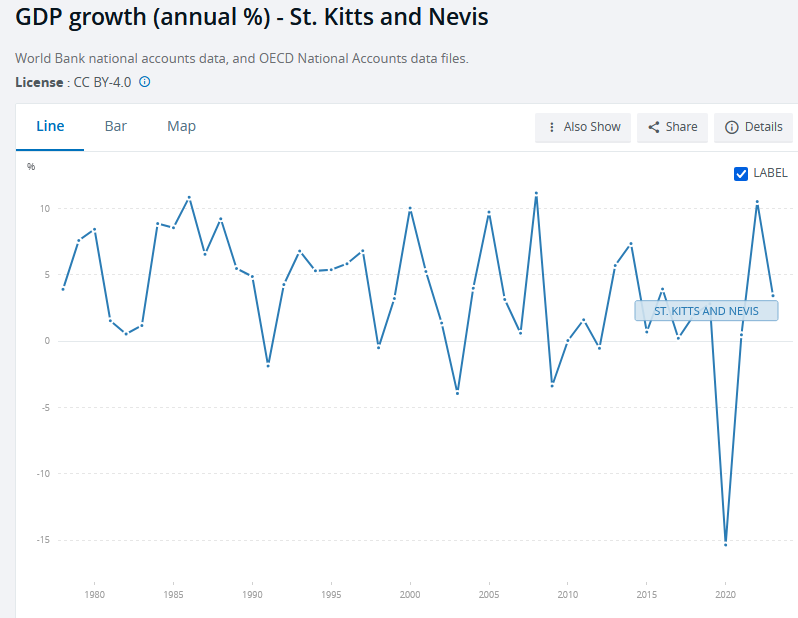
Alt Text: St. Kitts and Nevis GDP growth rate from 1978 to 2024
Source: World Bank Group
St. Kitts and Nevis, a dual-island nation in the Caribbean, has a mixed economy primarily driven by tourism, agriculture, and financial services. Its economy has experienced moderate growth, aided by its attractive citizenship-by-investment (CBI) program, which continues to draw international interest.
However, like many small island nations, it faces challenges such as vulnerability to global economic shifts and climate-related risks.
St. Kitts and Nevis has shown resilient economic growth. Following a strong post-pandemic rebound, the International Monetary Fund (IMF) projects real GDP growth to be 1.7% in 2025, with inflation also projected at 1.7%.
This growth is driven mainly by the tourism sector, which accounts for over 60% of its GDP, making the economy heavily reliant on international visitors.
This dependency, while lucrative, also exposes St. Kitts and Nevis to external shocks like global travel restrictions and economic downturns in source markets such as the United States and Europe.
The CBI program has been a cornerstone of the economy, with significant revenues generated from individuals seeking a second passport. According to the St. Kitts and Nevis Citizenship by Investment Unit (CIU) in 2023, St. Kitts and Nevis took the coveted top spot of the CBI Index.
However, there are growing calls for diversification to reduce dependency on this single revenue stream.
St. Kitts and Nevis has been investing in renewable energy to combat its reliance on imported fossil fuels. In 2022, the government announced plans for a solar energy project, SKN-100, in partnership with international firms. This is aimed at achieving 100% renewable energy.
Such initiatives align with the country’s broader goals of sustainable economic development.
Alt Text: St. Kitts and Nevis General Government Gross Debt Chart
Source: IMF
Despite these strides, the nation faces challenges in debt management. IMF reported that St. Kitts and Nevis’ General government gross debt stands at 61.9% of GDP. While this is an improvement compared to previous years, fiscal discipline remains essential to ensure long-term economic stability.
The country’s interest in cryptocurrency and blockchain technology offers a potential avenue for further economic diversification. By integrating crypto solutions into its financial system, St. Kitts and Nevis may not only reduce its reliance on traditional sectors but also position itself as a leader in digital finance in the Caribbean.
Current State of Crypto Adoption in St. Kitts and Nevis
Alt text: Bitcoin, and St. Kitts and Nevis flag
Source: Forbes India
St. Kitts and Nevis is steadily carving out a space for itself in cryptocurrency. The government’s proactive stance, coupled with grassroots enthusiasm, has positioned this small Caribbean nation as a regional force in digital finance.
A significant milestone came in November 2022, when Prime Minister Terrance Drew announced during the Bitcoin Cash 2022 Conference that the government was exploring the possibility of making Bitcoin Cash (BCH) legal tender by March 2023.
However, this goal was not met, and the initiative appears to have stalled as the government prioritizes the implementation of its comprehensive Virtual Asset Act framework instead.
In addition to government interest, local businesses are also embracing crypto.
Moreover, remittance services in St. Kitts and Nevis have begun integrating blockchain technology to offer lower transaction fees compared to traditional methods. The Eastern Caribbean Central Bank (ECCB) highlights ongoing experiments with the DCash initiative, a digital version of the Eastern Caribbean dollar.
As of 2025, the pilot program is active and moving towards “DCash 2.0,” with the ECCB focused on expanding merchant adoption and enhancing the platform’s resilience to improve financial inclusion across member states.
Citizenship by Investment (CBI) and Crypto Integration
The St Kitts and Nevis government has decided to align itself with future-thinking country’s offering immigrant investment programs by embracing the crypto industry.
Like Hong Kong’s Capital Investment Entrant Scheme, St Kitts and Nevis now accepts cryptocurrency as a partial source of wealth for applicants to secure St Kitts and Nevis citizenship by investment (CBI).
This flips the script for investors with hefty cryptocurrency holdings as they can now use them for wealth verification, expanding the pool of eligible applicants–a win-win for both the country and crypto investors.
The St Kitts and Nevis Citizenship by Investment Unit (CIU) Communications Division emailed its network of Authorized Agents to announce the change, outlining the new requirements and procedures.
To ensure transparency and compliance, applicants using cryptocurrency as a wealth source will pay extra due diligence fees and provide additional documentation to validate the authenticity and legality of the crypto holdings.
When comparing St Kitts and Nevis vs Dominica citizenship, it’s important to consider factors like investment requirements and visa-free travel benefits. Both programs offer unique advantages, but your choice depends on your financial goals and travel needs.
Investors considering St. Kitts real estate citizenship should evaluate factors like property options, holding periods, and potential returns.
CBI Sponsorship
St Kitts and Nevis widened the door to potential applicants by introducing a new provision that allows applications to be financially sponsored by the parents or children of the main applicant.
The new provision is validated with birth certificates, making it easier for families to pool resources and support an applicant’s journey to dual citizenship and a St Kitts and Nevis passport.
Sponsors, like the main applicant, will be fully vetted and obligated to submit detailed documentation, including evidence of funds origin, proof of address, bank statements, and reference letters, as well as undergo due diligence checks.
Why These Changes Matter for Applicants
Accepting cryptocurrency as a partial wealth source is a big step in modernizing citizenship by investment, a natural coincidence considering St Kitts and Nevis’s pioneering role in the industry.
Balaji Srinivasan, former CTO of Coinbase, stated back in 2022,
“Cryptocurrency will enable a new wave of digital nomads to acquire citizenship or residency in jurisdictions that accept Bitcoin.”
Executive Chairman of MicroStrategy, Michael Saylor, also shared his thoughts on integrating crypto and citizenship by investment, stating,
“Bitcoin is the ultimate passport. It grants you financial sovereignty, and soon, nations will recognize it as a legitimate means for investment migration.”
The option to secure St Kitts and Nevis dual citizenship through cryptocurrency investment will undoubtedly elevate the country’s standing in the Global Crypto-Friendly Nations Report, positioning crypto investors at the forefront of a shifting industry.
Financial sponsorship clears the way for investors to support family members in their plan B passport goals, which is attractive to wealthy families who want to ensure multiple generations secure their future without each family member going through the full investment process on their own.
“The Citizenship-by-Investment (CBI) program contributed 25% of national revenue in 2023.”
Factors Driving Crypto Adoption in St. Kitts and Nevis
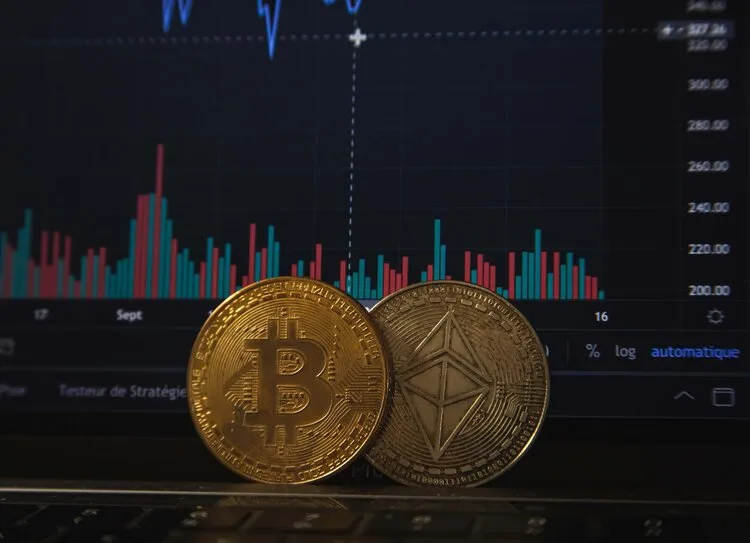
Alt text: Bitcoin and ethereum placed in front of the trading chart
Source: NTL Trust
Several key factors are fueling crypto adoption in St. Kitts and Nevis, positioning the country as a rising player in digital finance:
- Financial Inclusion: With a significant portion of the population underserved by traditional banking systems, cryptocurrency offers accessible and cost-effective financial solutions for locals.
- Tourism Dependency: The country’s reliance on tourism has encouraged merchants to accept cryptocurrencies like Bitcoin. This appeals to tech-savvy international visitors seeking seamless transactions.
- Government Support: Proactive steps, including the exploration of Bitcoin Cash as legal tender, signal strong institutional backing for crypto as part of the national economic strategy.
- Regional Initiatives: Projects like the Eastern Caribbean Central Bank’s DCash provide a gateway for citizens to engage with digital currencies. This fosters familiarity with blockchain technology.
- Lower Remittance Costs: Cryptocurrencies enable cheaper and faster cross-border transfers, a crucial benefit for a nation with a large diaspora sending money home.
“St. Kitts and Nevis hosted the Bitcoin Cash Conference in November 2022, spotlighting its growing crypto interest.”
Cryptocurrency Usage in Various Sectors
In St. Kitts and Nevis, cryptocurrency is finding its way into diverse sectors, reshaping traditional operations:
- Tourism: Hotels, restaurants, and tour operators increasingly accept Bitcoin and Bitcoin Cash. This enhances convenience for international visitors.
- Retail: Local shops are adopting crypto payments, offering seamless alternatives to cash and card transactions.
- Remittances: Crypto is revolutionizing cross-border money transfers, reducing fees and processing times for the large diaspora population.
- Finance: Blockchain technology is being explored for more transparent and efficient banking services, complementing the digital Eastern Caribbean dollar initiative.
Cryptocurrency Regulation in St. Kitts and Nevis
Cryptocurrency regulation in St. Kitts and Nevis is comprehensive and evolving, built upon a solid legal framework.
The foundational law is the Virtual Asset Act, 2020 (Act No. 1 of 2020), which sets the requirements for registration, compliance, and supervision of virtual asset service providers (VASPs).
This framework has been strengthened by several amendments, including:
- Virtual Assets (Amendment) Act, 2021 (Act No. 8 of 2021): This incorporated stronger provisions for regulatory oversight and compliance with international anti-money laundering (AML) and counter-terrorism financing (CTF) standards.
- Virtual Asset (Amendment of Schedule) Order, 2021 (SRO No. 47 of 2021): This detailed specific procedures for VASPs.
- Virtual Asset (Forms) Regulations, 2022 (SRO No. 25 of 2022): This prescribed the necessary forms for registration and compliance reporting.
A significant recent development was the Virtual Asset (Amendment) Bill, 2024, which was circulated in parliament in May 2024. This bill aims to align the Virtual Asset Act with the latest Financial Action Task Force (FATF) standards, reinforcing the country’s commitment to combating financial crime.
The primary regulatory body is the Financial Services Regulatory Commission (FSRC), which is the point of contact for any entity seeking to register as a VASP.
Other bodies like the Financial Intelligence Unit (FIU) and the Eastern Caribbean Central Bank (ECCB) also play roles in oversight, AML/CFT compliance, and regional stability.
What is a Virtual Asset In St. Kitts and Nevis?
In St. Kitts and Nevis, a “virtual asset” is defined as “a digital representation of value that can be digitally traded, or transferred, and can be used for payment or investment purposes and does not include digital representations of fiat currency or security”.
This broad definition covers cryptocurrencies like Bitcoin and Ethereum.
Both stablecoins and Non-Fungible Tokens (NFTs) are also regulated under this definition. Entities dealing with stablecoins or NFTs must adhere to the same regulatory framework, including registration with the FSRC and AML/CTF compliance.
Regulating Virtual Asset Service Providers (VASPs)
The Virtual Asset Act applies to any person or entity conducting a “virtual asset business” for or on behalf of another person.
This includes:
- Exchange between virtual assets and fiat currency.
- Exchange between different forms of virtual assets.
- Transfer of a virtual asset.
- Safekeeping or administration of virtual assets.
- Financial services related to the offering or sale of a virtual asset.
Decentralised finance (DeFi) activities, such as lending, also fall within this regulated framework, as they involve the transfer and provision of financial services related to virtual assets.
VASPs operating in St. Kitts and Nevis are subject to stringent requirements. These include mandatory registration with the FSRC, appointing a compliance officer, implementing robust AML/CTF policies, and maintaining financial reserves.
Specifically, VASPs must place at least fifteen percent of the total value of client funds held in escrow with a registered trust company.
Blockchain-Verified Due Diligence
On October 20, 2025, the Citizenship by Investment Unit (CIU) of Saint Kitts and Nevis announced the successful integration of blockchain-verified certification into its due diligence reporting system.
Developed in partnership with a European Union-based due diligence provider, this innovation marks a significant milestone in the global investment migration industry, setting a new benchmark for authentication, transparency, and tamper-proof verification.
The blockchain-based system issues a unique, immutable digital certificate for every due diligence report, providing governments and authorized entities with unparalleled confidence in the authenticity and integrity of applicant background checks.
Each certificate is cryptographically secured and permanently recorded on a distributed ledger, ensuring that reports cannot be altered, forged, or misrepresented after issuance.
“This advancement reinforces Saint Kitts and Nevis’s leadership in global due diligence and compliance innovation.
By adopting blockchain verification, we are not only safeguarding the integrity of our programme but also setting a global precedent for technological transparency and trust in the Saint Kitts and Nevis Citizenship by Investment Programme and our commitment to the security of our partners.”
– said His Excellency Calvin St. Juste, Chairman of the Citizenship by Investment Unit.
Key Features of the Blockchain Verification System:
- Immutable Authentication: Each report is issued with a unique blockchain certificate that cannot be altered or duplicated, providing permanent proof of authenticity.
- Real-Time Verification: Governments, Citizenship by Investment Units, and authorized agents can instantly verify report authenticity through a secure online portal using the certificate’s unique hash code.
- Enhanced Security: Multi-layered cryptographic protocols protect sensitive data while maintaining full verification capabilities.
- Global Standards Compliance: Fully compliant with the EU General Data Protection Regulation (GDPR) and aligned with international Anti-Money Laundering (AML) and Counter-Terrorism Financing (CTF) frameworks.
- Tamper-Proof Integrity: Any modification or forgery attempt is immediately detectable through blockchain validation.
This initiative responds to the growing demand for greater transparency, accountability, and data security across the Citizenship by Investment industry.
This implementation further underscores the CIU’s ongoing commitment to maintaining the highest standards of due diligence, in line with EU regulations and international best practices.
“The country has a population of just about 47,000 people, yet leads in crypto innovation in the Caribbean.”
Challenges Facing Crypto Adoption in St. Kitts and Nevis

Alt text: Silhouette of Man, pushing an orb of crypto coins
Source: BitKE
Despite its progress, St. Kitts and Nevis faces notable challenges in advancing crypto adoption such as:
- Regulatory Uncertainty: Clear and comprehensive laws for cryptocurrency use and blockchain technology are still under development.
- Public Awareness: Limited understanding of crypto among the population hinders widespread adoption.
- Volatility Concerns: The unpredictable nature of digital currencies raises concerns for businesses and consumers.
- Cybersecurity Risks: Safeguarding against fraud and hacking remains a critical issue for both users and institutions.
- Infrastructure Gaps: Reliable internet access and technological infrastructure are essential for seamless crypto use, but require further investment.
The Potential for Cryptocurrency in St. Kitts and Nevis
St. Kitts and Nevis holds significant potential for cryptocurrency to drive economic growth and innovation. The nation’s growing embrace of digital currencies, supported by government interest and regional blockchain initiatives, positions it as a leader in the Caribbean’s crypto market.
Cryptocurrency could further enhance financial inclusion, offering underserved populations access to banking services. Additionally, it holds promise for revolutionizing the tourism and remittance sectors by providing faster, cheaper transactions.
With favorable regulations and increasing adoption across key sectors, St. Kitts and Nevis could become a thriving crypto hub, attracting investment and fostering technological innovation.
Conclusion
Crypto adoption in St. Kitts and Nevis is growing, supported by a comprehensive regulatory framework in the Virtual Asset Act, its integration into the CBI program, and a strategic focus on innovation. The nation is quickly emerging as a promising player in the industry.
While challenges like the operational cost of regulatory compliance and broad public awareness remain, the country’s proactive stance and evolving infrastructure present a strong foundation for future growth.
As crypto continues to reshape global economies, St. Kitts and Nevis is well-positioned to leverage its potential, enhancing financial inclusion, tourism, and remittance services. With continued investment and strategic development, the island nation could become a regional leader in digital finance.