
BlackRock’s iShares Bitcoin Trust (IBIT) has taken center stage in one of the harshest months the Bitcoin ETF market has seen since U.S. spot ETFs launched in early 2024.
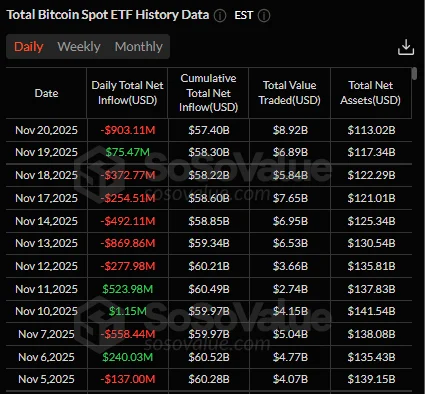
In November, IBIT alone was responsible for $2.47 billion in withdrawals, accounting for 63% of the month’s total $3.79 billion in withdrawals—surpassing February’s previous outflow record of $3.56 billion.
The exit wave marked a sharp break from the steady inflows that had defined much of the year. What started as a promising chapter for institutional Bitcoin adoption quickly turned into a month dominated by redemptions, hesitation, and a retreat that caught many investors off guard.
Key Takeaways
- BlackRock’s IBIT alone drove $2.47 billion in November withdrawals, making it the largest contributor to the month’s record Bitcoin ETF outflows.
- Total U.S. spot Bitcoin ETF outflows hit $3.79 billion, surpassing February’s previous record.
- A single-day $903 million redemption underscored how quickly institutional sentiment shifted during the month.
- Bitcoin’s price dropped to a seven-month low as ETF outflows intensified and market caution increased.
A Reversal That Hit Fast
Just weeks earlier, Bitcoin ETFs appeared steady after a long stretch of inflows and institutional enthusiasm. But November disrupted that narrative.
After briefly breaking a five-day outflow streak with $75.4 million in inflows on Wednesday, U.S. spot Bitcoin ETFs faced $903 million in redemptions on Thursday, marking the biggest single outflow day of the month and one of the largest since ETF trading began in January 2024.
IBIT was the main driver. The fund’s $1.02 billion in withdrawals this week alone marked what CryptoQuant CEO Ki Young Ju called IBIT’s “largest weekly outflow ever.”
Fidelity’s Wise Origin Bitcoin Fund (FBTC) followed with a still-substantial $1.09 billion in outflows this month. Together, IBIT and FBTC made up a staggering 91% of all U.S. spot Bitcoin ETF redemptions in November.
Market Sentiment Shifts Despite Bitcoin’s Stability
What makes the month’s performance surprising is that it occurred despite Bitcoin’s relatively stable price action early in November. ETFs had largely been treated as a reliable access point for institutions, offering an easier gateway into Bitcoin than direct token purchases.
Yet the sudden change in flows shows how quickly sentiment can turn. Analysts suggest institutional investors may have reduced risk or rebalanced portfolios ahead of year-end positioning. ETF vehicles, used heavily for tactical exposure, often reflect these short-term shifts.
November’s severe outflow doesn’t necessarily indicate long-term pessimism. Instead, it highlights how ETF demand can fluctuate sharply even when broader market optimism remains intact. But the scale of the withdrawals shows just how influential a single large issuer like BlackRock can be when the tide turns.
Price Reaction and Market Warnings
Following Thursday’s near $1 billion ETF exodus, Bitcoin fell to $83,461, its lowest level since April—a seven-month low, according to CoinGecko. The drop renewed warnings from several industry voices that the current downturn may not be finished.
Alliance DAO co-founder QwQiao reiterated a caution he first shared in September, arguing that a large portion of new ETF-driven capital is “dumb money,” adding:
“There’s a large cohort of dumb money who know nothing about crypto buying DATs and ETFs. This never ends well.”
He suggested markets may need to endure another 50% correction before forming a more durable bottom.
What Comes Next for Bitcoin ETFs?
While November’s record-setting outflows look severe, many analysts are urging caution before drawing conclusions about long-term sentiment. Institutional investors often reduce exposure late in the year as part of routine rebalancing, and ETFs—especially recently launched ones—are sensitive to tactical shifts.
Still, the month is a wake-up call. It underscores that Bitcoin ETFs, despite their regulated structure, remain tied closely to the volatility and emotional swings of the broader crypto ecosystem. If outflows continue into December, concerns about sustained risk-off positioning will likely grow louder.
For now, all eyes remain on whether U.S. spot Bitcoin ETFs—led by giants like BlackRock and Fidelity—can regain stability after a historic month that erased billions and rattled market confidence.