Although not many people think Web3 will become the driving force behind a whole new career economy, it already is.
As blockchain technology extends beyond cryptocurrency trading into real-world applications, such as finance, supply chain management, and digital identity, employers are actively seeking professionals who understand how this technology works and how to enhance it.
Now, from blockchain developers to project managers, UX designers, and legal consultants, the range of job types in blockchain continues to expand as organizations explore decentralized solutions. Each role requires a combination of technical expertise, creative problem-solving, and strategic thinking.
In this guide, you’ll discover the most in-demand blockchain career paths and the essential skills to get started.
Key Takeaways
- Blockchain technology continues to create high-demand career opportunities across various industries, including finance, healthcare, gaming, supply chain management, and government.
- Core blockchain roles, such as developers, solution architects, and project managers, require technical skills in coding, smart contract design, and system integration.
- Supporting positions in writing, marketing, finance, and data science are essential for driving adoption and innovation within blockchain ecosystems.
- Building a blockchain career involves learning cryptography, mastering coding languages like Solidity and Python, and contributing to open-source projects.
- Networking with blockchain communities, attending events, and showcasing a strong project-based portfolio can significantly boost job opportunities in the blockchain space.
What is Blockchain?
Blockchain is a digital ledger technology that securely records transactions across multiple computers in a way that makes the data almost impossible to alter or delete.
Instead of relying on a central authority, such as a bank or government, blockchain operates on a decentralized network, meaning every participant (or “node”) in the system has access to the same verified information.
Each transaction is stored in a “block,” and once a block is filled, it’s linked to the previous one, forming a continuous chain of records. This process ensures transparency, security, and traceability.
Originally built to power cryptocurrencies like Bitcoin, blockchain has evolved far beyond digital money. Today, it’s used in industries such as healthcare, logistics, real estate, and finance to increase trust, efficiency, and accountability in data-driven operations.
Key Features of Blockchain
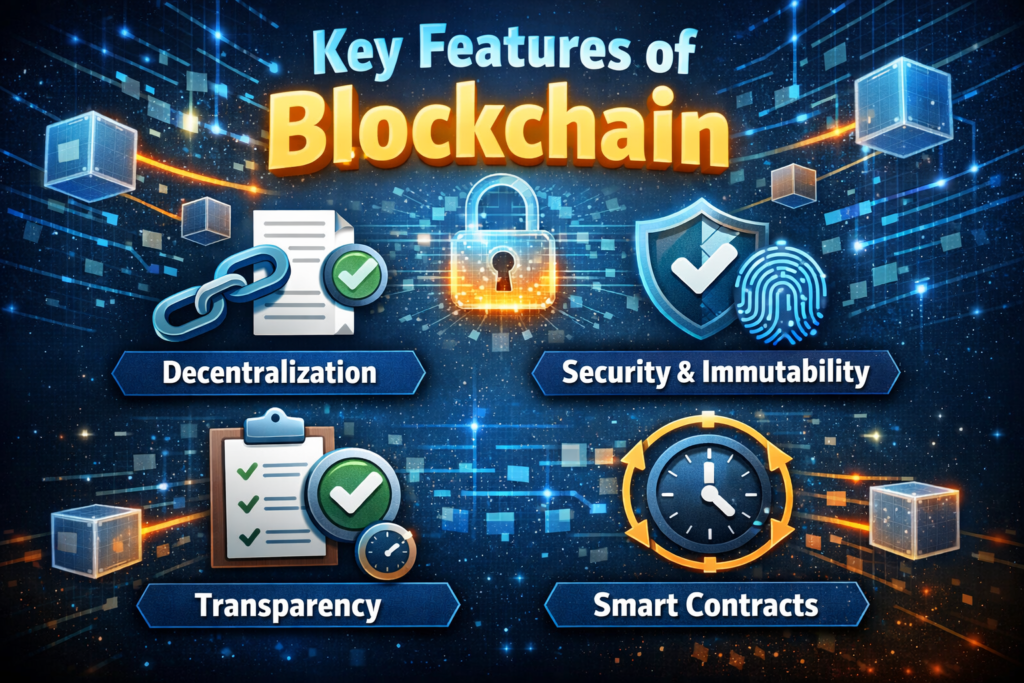
Blockchain technology stands out because of its core features, which include:
Decentralization
In a blockchain network, data isn’t stored on a single central server. Instead, it’s distributed across multiple computers, known as nodes.
This structure eliminates the need for intermediaries, such as banks or data authorities, allowing participants to interact directly. Decentralization reduces single points of failure and ensures that no single entity controls the entire network.
Transparency
All participants in a blockchain network can view transactions recorded on the ledger. This openness fosters trust, as anyone can verify the authenticity of data without needing third-party validation. Transparency is a key reason why blockchain is utilized in sectors such as supply chain management and finance.
Immutability
Once data is added to the blockchain, it cannot be changed or deleted. Each block is linked cryptographically to the one before it, creating a permanent record of transactions.
This immutability protects against fraud, tampering, and unauthorized alterations, ensuring long-term data integrity.
Security
Blockchain uses advanced cryptographic algorithms to safeguard data. Every transaction is verified and encrypted before being added to the chain. The decentralized structure also makes it extremely difficult for hackers to compromise the system, since altering one record would require controlling most of the network simultaneously.
Read Also: What is a Modular Blockchain Design? A Comprehensive Guide
Core Blockchain Job Roles
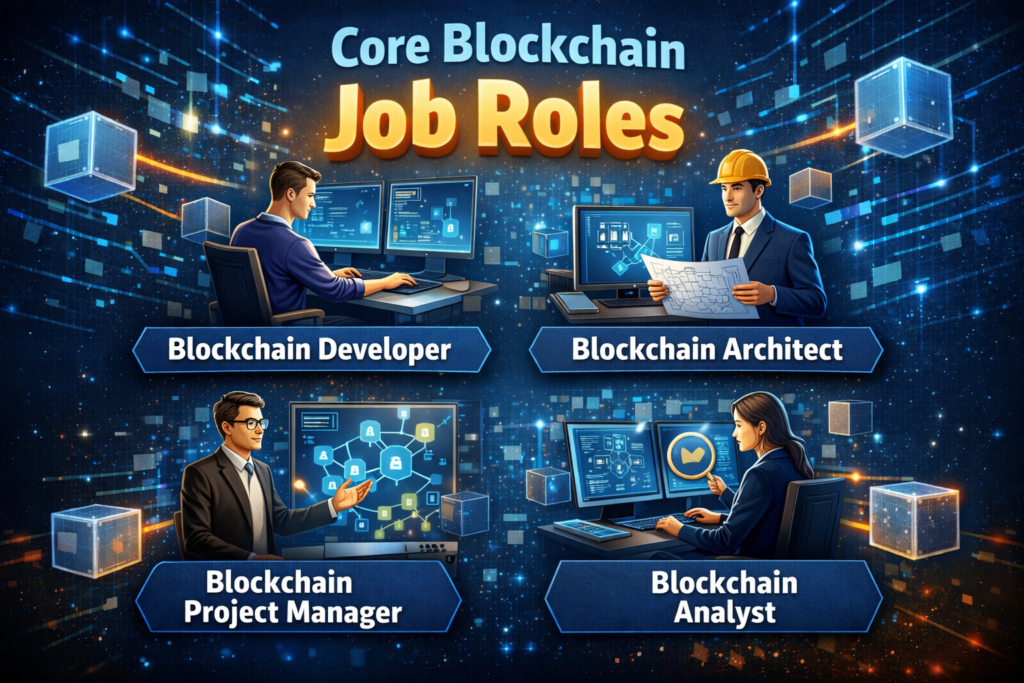
Here are the core Blockchain jobs:
Blockchain Developer
A Blockchain Developer is one of the most in-demand professionals in the blockchain ecosystem.
These experts design, build, and maintain decentralized applications (DApps), smart contracts, and blockchain systems that power industries from finance and healthcare to gaming and supply chain management. Their work ensures that blockchain-based platforms run smoothly, securely, and efficiently.
Responsibilities
Blockchain developers are responsible for turning blockchain concepts into practical solutions. Their core duties include:
- Designing and developing blockchain architecture: Creating the structural foundation of blockchain systems, including nodes, consensus mechanisms, and transaction logic.
- Building and deploying smart contracts: Writing self-executing programs that automate transactions without intermediaries, often using languages like Solidity.
- Developing decentralized applications (DApps): Integrating blockchain functionality into user-friendly applications for finance, NFTs, gaming, and more.
- Maintaining blockchain networks: Monitoring performance, troubleshooting issues, and ensuring nodes remain synchronized and secure.
- Collaborating with cross-functional teams: Working alongside project managers, UI/UX designers, and security experts to deliver complete blockchain solutions.
- Conducting security audits: Testing and debugging smart contracts to eliminate vulnerabilities and protect user assets.
Skills Required
Becoming a successful blockchain developer requires a mix of programming expertise, analytical thinking, and understanding of decentralized systems.
Key skills include:
- Proficiency in programming languages: Experience in Solidity (for Ethereum), JavaScript, Python, Go, C++, or Rust.
- Understanding blockchain architecture: Knowledge of consensus algorithms, distributed ledger technology (DLT), and peer-to-peer networking.
- Smart contract development: Ability to write, test, and deploy secure smart contracts on platforms like Ethereum or Binance Smart Chain.
- Cryptography fundamentals: Understanding hash functions, digital signatures, and encryption methods to protect blockchain data.
- Data structures and algorithms: Essential for managing distributed data and optimizing blockchain performance.
- Problem-solving and debugging: The ability to identify bugs and design efficient, secure solutions.
- API and integration skills: Experience integrating blockchain functionality with existing systems through APIs and SDKs.
Popular Tools and Technologies
Blockchain developers rely on a wide range of tools to build and maintain decentralized solutions.
Some of the most widely used include:
- Solidity: The primary programming language for developing smart contracts on the Ethereum network.
- Web3.js: A JavaScript library that allows interaction between web applications and Ethereum-based blockchains.
- Truffle Suite: A development framework for testing and deploying smart contracts.
- Hardhat: A development environment for compiling, debugging, and deploying Ethereum-based smart contracts.
- Ganache: A local blockchain used for testing and simulating Ethereum networks.
- Remix IDE: A browser-based IDE for writing, testing, and deploying Solidity contracts.
- Metamask: A browser extension that connects decentralized applications to blockchain networks.
- IPFS (InterPlanetary File System): A decentralized storage solution often used to manage off-chain data.
Blockchain Solution Architect
A Blockchain Solution Architect plays a pivotal role in translating complex business requirements into scalable and secure blockchain solutions.
Acting as the bridge between technical development teams and business stakeholders, this professional ensures that blockchain implementations align with organizational goals, regulatory standards, and industry best practices. Essentially, they are the master planners of blockchain systems, combining deep technical expertise with strategic thinking.
Responsibilities
The responsibilities of a blockchain solution architect extend across every stage of blockchain adoption, from conceptualization to deployment and beyond.
Some key duties include:
- Designing blockchain architecture: Defining the overall structure of blockchain systems, including node setup, consensus mechanisms, and data flow.
- Selecting the appropriate blockchain platform: Evaluating and recommending the most suitable frameworks, such as Ethereum, Hyperledger Fabric, Solana, or Polygon, based on the project’s needs.
- Integrating blockchain with existing systems: Ensuring seamless interoperability between blockchain networks and traditional IT infrastructures.
- Developing technical roadmaps: Creating detailed documentation that guides developers, testers, and engineers through each phase of blockchain implementation.
- Collaborating with cross-functional teams: Working closely with developers, project managers, UX designers, and legal teams to ensure that blockchain solutions meet both technical and business requirements.
- Ensuring scalability and performance: Optimizing the blockchain network to handle large volumes of transactions without compromising speed or security.
- Managing security and compliance: Establishing protocols to protect data integrity, privacy, and ensure compliance with regulations like GDPR or KYC/AML standards.
- Overseeing deployment and maintenance: Supervising testing, deployment, and updates to keep blockchain applications secure and efficient over time.
Skills Required
To excel as a blockchain solution architect, one must possess a combination of technical mastery, business understanding, and leadership skills.
Core competencies include:
- Strong programming knowledge: Proficiency in languages such as Solidity, Java, Python, C++, or Go.
- Deep understanding of blockchain principles: Knowledge of distributed ledgers, consensus mechanisms (PoW, PoS, PBFT), cryptography, and tokenomics.
- System design and architecture expertise: Ability to create scalable, secure, and modular blockchain frameworks tailored to business goals.
- Smart contract development and auditing: Familiarity with designing and evaluating smart contracts for accuracy and security.
- API and integration knowledge: Experience in connecting blockchain solutions with external data sources through APIs and SDKs.
- Analytical and problem-solving skills: The ability to analyze complex challenges and propose effective blockchain-based solutions.
- Business acumen: Understanding of organizational objectives and the ability to align blockchain strategies with them.
- Leadership and communication: The capacity to coordinate technical teams, explain blockchain concepts clearly to non-technical stakeholders, and make informed architectural decisions.
Common Tools and Frameworks Used
Blockchain solution architects rely on a range of platforms and tools to design and implement efficient systems:
- Ethereum / Hyperledger Fabric / Corda: Popular blockchain frameworks used for building enterprise-grade solutions.
- Solidity / Vyper: Languages for writing smart contracts on Ethereum-based platforms.
- Truffle Suite / Hardhat: Environments for testing, compiling, and deploying blockchain applications.
- Ganache: A local testing environment to simulate blockchain behavior during development.
- Infura / Alchemy: Platforms that provide scalable API access to blockchain networks without hosting full nodes.
- IPFS (InterPlanetary File System): Used for decentralized storage of off-chain data.
- Docker / Kubernetes: Tools for containerization and deployment of blockchain infrastructure.
- AWS Blockchain Templates / Azure Blockchain Service: Cloud tools that assist in building and deploying blockchain networks.
Blockchain Project Manager
A Blockchain Project Manager plays a critical role in turning blockchain ideas into fully functional projects. They act as the central link between developers, business leaders, and clients, ensuring that blockchain solutions are delivered on time, within budget, and aligned with organizational goals.
Unlike traditional project managers, blockchain project managers must understand both project management principles and the technical complexities of distributed ledger systems.
Responsibilities
The role of a blockchain project manager goes beyond scheduling tasks and managing teams. They oversee every stage of blockchain implementation, from concept to deployment.
Their key responsibilities include:
- Planning and strategy development: Creating detailed project plans, defining timelines, milestones, and deliverables for blockchain initiatives.
- Coordinating cross-functional teams: Working closely with blockchain developers, architects, UX designers, and legal experts to ensure smooth collaboration.
- Managing resources and budgets: Allocating technical and financial resources efficiently to avoid project delays and overspending.
- Ensuring regulatory compliance: Staying up to date with blockchain laws, smart contract regulations, and data protection standards like GDPR or AML/KYC requirements.
- Monitoring progress and performance: Tracking development stages, identifying risks early, and implementing corrective actions to maintain project flow.
- Stakeholder communication: Translating technical updates into clear reports for business leaders, investors, and clients.
- Quality assurance and testing: Overseeing system testing, smart contract audits, and blockchain performance checks before launch.
- Deployment and maintenance: Coordinating go-live activities and ensuring post-deployment support and optimization.
Skills Required
To manage blockchain projects successfully, a project manager needs a mix of leadership, technical insight, and organizational skills.
Essential skills include:
- Project management expertise: Proficiency in methodologies like Agile, Scrum, and Waterfall to handle iterative blockchain development cycles.
- Technical understanding of blockchain: Knowledge of blockchain fundamentals, consensus mechanisms, smart contracts, and decentralized applications (DApps).
- Strong communication and leadership: Ability to manage diverse teams, resolve conflicts, and ensure everyone aligns with the project vision.
- Risk management: Identifying potential pitfalls in blockchain implementation, such as scalability or security issues.
- Analytical and problem-solving skills: Evaluating technical and business challenges to make informed decisions.
- Budgeting and financial management: Handling costs related to blockchain infrastructure, testing, and deployment.
- Adaptability: Keeping up with evolving blockchain technologies and frameworks.
Useful Tools and Platforms
A blockchain project manager typically uses a combination of project management and blockchain-specific tools to keep projects organized and efficient:
- Jira / Trello / Asana: For task tracking, sprint planning, and team collaboration.
- Slack / Discord: For team communication across global blockchain communities.
- GitHub / GitLab: To monitor code updates and track developer contributions.
- Confluence / Notion: For documentation and project reporting.
- Smart contract management tools: Such as Remix, Truffle, and Hardhat for testing and deployment.
- Blockchain platforms: Ethereum, Hyperledger, or Polygon, depending on the project scope.
Blockchain UX/UI Designer
A Blockchain UX/UI Designer plays a vital role in making blockchain technology accessible and user-friendly. While blockchain is known for its complexity, it’s the designer’s job to simplify that complexity through intuitive interfaces and seamless user experiences.
These professionals bridge the gap between highly technical blockchain systems and end users, ensuring that decentralized applications (DApps), wallets, exchanges, and NFT platforms are not only functional but also visually appealing and easy to navigate.
Responsibilities
Blockchain UX/UI designers focus on both the visual appearance and user experience of blockchain products, as well as how users interact with them.
Their primary responsibilities include:
- Designing user interfaces for decentralized applications (DApps): Creating intuitive dashboards, wallets, and transaction views that guide users through blockchain interactions.
- Conducting user research: Understanding how users engage with blockchain products to identify pain points and usability challenges.
- Simplifying complex blockchain processes: Turning technical actions such as wallet setup, gas fee estimation, and token swaps into clear, simple user flows.
- Collaborating with developers and product managers: Working closely with blockchain engineers to ensure design feasibility and consistency across products.
- Creating design systems: Building reusable components, icons, and typography that align with a brand’s blockchain identity.
- Prototyping and testing: Using tools to build interactive mockups and gather feedback before implementation.
- Ensuring accessibility and responsiveness: Making blockchain interfaces inclusive, mobile-friendly, and optimized for multiple devices.
Skills Required
To succeed as a blockchain UX/UI designer, professionals must blend creativity, user empathy, and technical expertise.
Key skills include:
- Strong UI/UX design principles: Mastery of layout, color theory, typography, and interaction design.
- Understanding blockchain workflows: Familiarity with concepts like wallets, tokens, transactions, smart contracts, and decentralized identities.
- Proficiency in design tools: Expertise in Figma, Adobe XD, Sketch, and InVision for wireframing and prototyping.
- User research and testing: Ability to conduct usability studies and interpret data to improve user experiences.
- Front-end familiarity: Basic understanding of HTML, CSS, and JavaScript to collaborate effectively with developers.
- Problem-solving and communication: Translating technical requirements into visually coherent and intuitive designs.
- Attention to security-focused design: Ensuring that the UI communicates trust, safety, and transparency — crucial elements in blockchain platforms.
Common Tools and Technologies
Blockchain UX/UI designers rely on both traditional design software and blockchain-specific tools to bring their ideas to life:
- Design Platforms: Figma, Adobe XD, Sketch, InVision, and Zeplin for design and collaboration.
- Prototyping Tools: Axure RP, Marvel, and Framer for interactive mockups.
- User Testing Tools: Maze, Lookback, and UsabilityHub for gathering user feedback.
- Blockchain Tools: MetaMask, Web3.js, and WalletConnect, to understand how users interact with blockchain systems.
- Analytics Tools: Hotjar and Google Analytics for measuring user behavior and engagement.
Blockchain Quality Engineer
A Blockchain Quality Engineer plays a crucial role in ensuring that blockchain-based systems are reliable, secure, and function exactly as intended.
In an environment where transactions are irreversible and smart contracts operate automatically, even a minor bug can lead to major financial or operational losses.
That’s why blockchain quality engineers are responsible for testing, auditing, and validating every component of a blockchain solution, from smart contracts to decentralized applications (DApps) and network performance.
Responsibilities
Blockchain quality engineers oversee the entire quality assurance (QA) process within blockchain projects.
Their main responsibilities include:
- Testing blockchain architecture and protocols: Verifying that the underlying blockchain infrastructure (nodes, consensus mechanisms, data storage) operates efficiently and securely.
- Smart contract auditing: Reviewing smart contract code for logic errors, vulnerabilities, and gas inefficiencies before deployment.
- Automated and manual testing: Running both automated scripts and manual tests to ensure that blockchain applications meet performance and security standards.
- Integration testing: Ensuring blockchain components integrate seamlessly with APIs, web interfaces, and external systems.
- Performance monitoring: Evaluating network speed, scalability, and throughput to detect latency or transaction issues.
- Security validation: Identifying potential threats such as replay attacks, double-spending, or data tampering.
- Documentation and reporting: Creating detailed reports on bugs, vulnerabilities, and quality metrics for developers and stakeholders.
- Collaboration with development teams: Working closely with blockchain developers, solution architects, and project managers to ensure high-quality product delivery.
Skills Required
Blockchain quality engineers require a combination of technical expertise, analytical thinking, and a profound understanding of decentralized systems.
Core skills include:
- Proficiency in programming languages: Experience with Solidity, JavaScript, Python, Go, or Rust to analyze and test blockchain code.
- Knowledge of blockchain frameworks: Understanding popular networks such as Ethereum, Hyperledger Fabric, Solana, and Polygon.
- Testing and automation tools: Experience using frameworks like Selenium, Mocha, Jest, or Cypress for automated QA processes.
- Smart contract auditing: Ability to detect vulnerabilities and optimize code for efficiency.
- Security and cryptography fundamentals: Understanding hashing, encryption, and key management techniques.
- API and integration testing: Familiarity with tools like Postman for verifying blockchain API endpoints.
- Analytical and problem-solving skills: The ability to identify, diagnose, and resolve complex bugs in distributed systems.
- Attention to detail: Ensuring accuracy and consistency across every layer of the blockchain network.
Common Tools and Frameworks Used
Blockchain quality engineers use specialized tools to perform rigorous testing and validation, including:
- Truffle Suite / Hardhat: For testing and deploying smart contracts on Ethereum-based blockchains.
- Ganache: A local blockchain for simulating network behavior during development and testing.
- Remix IDE: Used for smart contract testing and debugging.
- MythX / Slither / Oyente: Security analysis tools for detecting vulnerabilities in smart contracts.
- Selenium / Cypress: For front-end testing of decentralized applications (DApps).
- Jenkins / GitLab CI/CD: For continuous integration and automated testing pipelines.
- Postman / Insomnia: For API endpoint validation and integration testing.
Blockchain Legal Consultant
A Blockchain Legal Consultant specializes in guiding individuals, startups, and enterprises through the complex legal and regulatory environment surrounding blockchain technology.
As blockchain disrupts traditional systems of finance, contracts, and data management, it introduces new legal challenges that require expertise at the intersection of law, technology, and digital innovation.
Blockchain legal consultants ensure that organizations build and deploy blockchain solutions that comply with relevant laws, protect users, and minimize legal risks.
Responsibilities
Blockchain legal consultants play a crucial advisory and compliance role in blockchain projects. Their primary responsibilities include:
- Regulatory compliance: Ensuring blockchain projects adhere to national and international laws such as AML (Anti-Money Laundering), KYC (Know Your Customer), GDPR (data privacy), and securities regulations.
- Smart contract legality: Reviewing and drafting smart contracts to ensure they are enforceable and aligned with existing legal frameworks.
- Intellectual property protection: Advising on the ownership and licensing of blockchain innovations, including software, tokens, and digital assets.
- Token classification and issuance: Determining whether a digital token qualifies as a utility, security, or governance token and advising clients on compliant token launches (ICOs, IDOs, or STOs).
- Cross-border legal considerations: Helping organizations navigate jurisdictional challenges in decentralized ecosystems that operate globally.
- Data protection and privacy: Ensuring blockchain applications handle user data responsibly and meet regional data protection requirements.
- Dispute resolution and litigation: Assisting in resolving disputes arising from smart contracts, token sales, or blockchain transactions.
- Corporate and contractual advisory: Drafting legal documents such as partnership agreements, licensing contracts, and service terms tailored to blockchain projects.
Skills Required
To be effective, a blockchain legal consultant must combine legal expertise with a thorough understanding of blockchain technology and its implications.
Essential skills include:
- Strong legal background: A law degree and professional experience in corporate, financial, or technology law.
- In-depth understanding of blockchain technology: Familiarity with how blockchains, smart contracts, and decentralized applications function.
- Knowledge of regulatory frameworks: Expertise in AML, KYC, securities, privacy, and taxation laws relevant to digital assets.
- Analytical and critical thinking: Ability to interpret emerging regulations and assess their impact on blockchain operations.
- Communication and advisory skills: The ability to explain complex legal issues to developers, investors, and business leaders in clear, actionable terms.
- Research proficiency: Staying updated on evolving blockchain regulations, case law, and international compliance standards.
- Negotiation and drafting: Strong contract-drafting and negotiation skills, especially for agreements involving digital assets and decentralized systems.
Common Tools and Resources Used
Blockchain legal consultants use various digital and legal research tools to perform their duties effectively:
- Legal research platforms: LexisNexis, Westlaw, and Bloomberg Law for tracking blockchain-related legislation and case law.
- Blockchain analytics tools: Chainalysis, Elliptic, and TRM Labs for tracing transactions and ensuring AML compliance.
- Smart contract analysis tools: MythX, Slither, and OpenZeppelin for auditing smart contract security.
- Regulatory databases: FATF and SEC repositories for reviewing compliance requirements.
- Document management tools: Clio, DocuSign, and ContractWorks for managing legal documents and agreements securely.
Blockchain Web Designer
A Blockchain Web Designer combines creativity, technical skill, and blockchain literacy to create engaging, user-friendly websites and interfaces for decentralized platforms.
These designers play a vital role in connecting users to complex blockchain ecosystems, such as crypto exchanges, NFT marketplaces, and decentralized finance (DeFi) platforms, through intuitive visual design and seamless user experiences.
Their work ensures that blockchain products are not only functional and secure but also visually appealing and easy to navigate.
Responsibilities
Blockchain web designers handle both the visual and interactive elements of blockchain-based platforms.
Their main responsibilities include:
- Designing blockchain-driven websites: Creating layouts for DApps, token dashboards, crypto wallets, NFT galleries, and blockchain startup sites.
- Implementing responsive design: Ensuring websites are mobile-friendly and deliver consistent performance across different devices.
- Collaborating with blockchain developers: Working closely with front-end engineers and smart contract developers to integrate blockchain functionality with web interfaces.
- Designing for Web3 interactivity: Incorporating wallet integrations (e.g., MetaMask, WalletConnect) and blockchain-based login systems.
- Optimizing UI/UX for clarity: Simplifying complex blockchain actions like transactions, staking, or token swaps into intuitive visual steps.
- Maintaining design consistency: Building reusable design components that align with brand identity and blockchain project aesthetics.
- Testing and improving usability: Running user experience tests to identify friction points and enhance accessibility.
- Staying updated with blockchain trends: Monitoring design innovations in Web3, NFTs, and decentralized apps to keep products modern and competitive.
Skills Required
To succeed as a blockchain web designer, one must blend traditional design skills with a solid understanding of blockchain functionality and front-end development principles.
Essential skills include:
- Proficiency in web design tools: Expertise in Figma, Adobe XD, Sketch, and Photoshop for layout design and prototyping.
- Front-end development knowledge: Understanding of HTML, CSS, JavaScript, and frameworks like React or Vue.js.
- Familiarity with Web3 libraries: Knowledge of Web3.js, Ethers.js, or Wagmi to design around blockchain interactions.
- Understanding blockchain concepts: Awareness of smart contracts, tokens, wallets, NFTs, and transaction processes.
- UI/UX design principles: Ability to create clear, intuitive, and visually cohesive interfaces for decentralized systems.
- Responsive and adaptive design: Skills in optimizing user experiences across different devices and screen sizes.
- Problem-solving and teamwork: Collaborating effectively with developers, project managers, and marketing teams.
- Creative thinking: Translating abstract blockchain ideas into user-centered, visual storytelling.
Common Tools and Technologies Used
Blockchain web designers use a mix of design software and blockchain-related technologies to bring their concepts to life:
- Design Platforms: Figma, Adobe XD, Sketch, and InVision for design and collaboration.
- Front-End Frameworks: React.js, Next.js, or Vue.js for developing interactive blockchain web interfaces.
- Web3 Libraries: Web3.js, Ethers.js, and Wagmi for integrating blockchain transactions and wallet connections.
- Testing Tools: Lighthouse and BrowserStack for performance and cross-device testing.
- Version Control: GitHub and GitLab for managing design-integrated code projects.
- Blockchain Platforms: Ethereum, Solana, and Polygon for understanding on-chain data flows relevant to interface design.
Supporting and Related Roles in Blockchain
Beyond the core technical positions, the blockchain ecosystem depends on several supporting and related roles that help drive innovation, adoption, and market growth.
These professionals bring expertise in business strategy, communication, finance, data analytics, and trading, ensuring that blockchain projects thrive both technically and commercially.
Below are some of the most essential supporting roles in the blockchain industry.
Business Development Representative
A Business Development Representative (BDR) in blockchain focuses on expanding partnerships, generating new leads, and promoting the adoption of blockchain technology. They identify collaboration opportunities with startups, investors, and enterprises, helping blockchain companies scale their operations.
Key responsibilities include:
- Identifying and engaging potential clients or partners in industries like fintech, logistics, or gaming.
- Pitching blockchain solutions tailored to business needs.
- Collaborating with product and marketing teams to refine offerings.
- Building long-term relationships that drive ecosystem growth.
Skills required are:
- Strong communication, negotiation, and analytical skills
- Basic understanding of blockchain technologies, token economies, and decentralized platforms.
Technical Writer
A technical writer plays an essential role in simplifying complex blockchain concepts for both technical and non-technical audiences. They create whitepapers, API documentation, tutorials, and user guides that help developers and investors understand how a blockchain product works.
Key responsibilities include:
- Writing and editing technical documents, FAQs, and project documentation.
- Translating technical processes into clear, concise language.
- Collaborating with developers, architects, and marketing teams to ensure accuracy and consistency.
Skills required are:
- Excellent writing skills, attention to detail, and a solid grasp of blockchain fundamentals.
- Familiarity with GitHub, Markdown, and documentation tools like Docusaurus or Notion is often valuable.
Marketing Manager
A blockchain marketing manager promotes blockchain projects and drives community engagement. They combine digital marketing strategies with an understanding of decentralized ecosystems to increase visibility and trust.
Key responsibilities include:
- Developing and executing marketing campaigns for products, token launches, and community initiatives.
- Managing social media, content marketing, and influencer partnerships.
- Overseeing brand communication to ensure transparency and credibility.
Skills required are:
- Digital marketing expertise
- Strategic thinking, data analysis, and a working knowledge of blockchain audiences, particularly within DeFi, NFTs, or crypto trading spaces.
Financial Analyst
A blockchain financial analyst evaluates the economic performance of blockchain projects, cryptocurrencies, and digital assets. They analyze tokenomics, investment trends, and market risks to guide decision-making for investors or organizations.
Key responsibilities include:
- Performing market analysis and tracking blockchain investment trends.
- Assessing project financials, token performance, and ROI.
- Preparing financial reports and forecasts for stakeholders.
Skills required include:
- Strong quantitative and analytical skills
- Understanding of blockchain economics
- Proficiency in tools like Excel, Power BI, or crypto analytics platforms (CoinGecko, Glassnode, Messari).
Data Scientist / Machine Learning Engineer
Data Scientists and Machine Learning Engineers play a key role in extracting insights from blockchain data. They build predictive models, optimize network performance, and detect fraudulent activities through advanced analytics.
Key responsibilities include:
- Analyzing blockchain transaction data for patterns and trends.
- Building machine learning algorithms to predict token movements or optimize smart contracts.
- Enhancing blockchain scalability and security through AI-driven models.
Skills required are:
- Proficiency in Python, R, SQL, TensorFlow, and blockchain data APIs.
- A deep understanding of distributed systems and statistical analysis is also essential.
Cryptocurrency Trader or Analyst
A cryptocurrency trader or analyst focuses on market trends, price movements, and investment opportunities within the crypto space. They analyze on-chain data, global news, and technical indicators to make informed trading decisions.
Key responsibilities include:
- Conducting technical and fundamental analysis of digital assets.
- Managing trading portfolios and executing buy/sell orders across exchanges.
- Evaluating token performance and market volatility.
Skills required include:
- Analytical thinking
- Understanding of blockchain technology
- Familiarity with trading tools (TradingView, Binance, CoinMarketCap)
- Risk management strategies.
Who’s Hiring in the Blockchain Space?
Now that you know how blockchain functions and the types of roles available, the next big question is — who’s actually hiring? The good news is that blockchain is no longer confined to cryptocurrency projects alone.
It has spread across multiple industries, creating an expanding job market for skilled professionals. From global financial institutions to emerging startups, organizations worldwide are exploring how blockchain can transform operations, enhance transparency, and foster trust.
Industries Adopting Blockchain
Blockchain adoption spans a wide range of industries, each leveraging the technology to solve unique challenges.
Finance and Banking
The financial industry remains the biggest adopter of blockchain. Banks and fintech companies use it for cross-border payments, digital identity verification, and fraud prevention. Firms like JPMorgan Chase, Mastercard, and Visa have launched blockchain-based payment solutions.
Healthcare
Hospitals and research institutions are employing blockchain to secure patient data, enhance interoperability, and ensure transparency in drug supply chains. Companies like Change Healthcare and BurstIQ are leading the way.
Supply Chain and Logistics
Blockchain enables the tracking of goods from origin to delivery with real-time visibility and tamper-proof data. IBM and Maersk’s TradeLens project is an excellent example of blockchain improving logistics efficiency.
Gaming and Entertainment
Web3 gaming companies are integrating blockchain for NFTs, in-game assets, and player ownership. Platforms like Axie Infinity and Immutable X are creating new play-to-earn economies.
Government and Public Sector
Governments are exploring blockchain for secure record keeping, land registration, and voting systems. Estonia is a notable pioneer in public blockchain applications.
These sectors continue to offer consistent demand for developers, project managers, designers, and blockchain analysts.
Major Companies and Startups Offering Blockchain Career Opportunities
The hiring landscape in blockchain includes a mix of established tech giants and ambitious startups driving innovation.
Global corporations like IBM, Microsoft, Amazon, and Oracle have dedicated blockchain divisions that recruit developers, engineers, and researchers.
Financial firms such as Goldman Sachs, PayPal, and Deloitte are also expanding their blockchain teams to explore digital assets and decentralized finance (DeFi) applications.
On the startup front, companies such as Chainlink Labs, ConsenSys, Polygon, Coinbase, and Binance continue to offer abundant blockchain job opportunities. These firms often hire across remote-first positions, allowing professionals from all over the world to collaborate in building decentralized ecosystems.
Additionally, blockchain-focused venture studios, DAOs (Decentralized Autonomous Organizations), and NFT projects are consistently recruiting talent in development, community management, and marketing roles.
Remote and Global Hiring Trends in the Blockchain Ecosystem
One of blockchain’s most exciting features is its borderless nature, and that extends to hiring. Many blockchain organizations are remote-first, giving professionals the freedom to work from anywhere while contributing to global projects.
Countries such as the United States, Singapore, Switzerland, Nigeria, and the United Arab Emirates are emerging as key hubs for blockchain jobs; however, opportunities are now available worldwide due to the decentralized nature of Web3.
Platforms like CryptoJobs, Indeed, Upwork, AngelList, and RemoteOK frequently list blockchain-related openings from both startups and major enterprises.
Moreover, as more organizations adopt decentralized operations, roles in blockchain development, smart contract auditing, and community management are increasingly offered on flexible, contract-based, or freelance terms, giving workers control over their schedules and income sources.
How to Start a Career in Blockchain
Starting a career in blockchain can seem overwhelming at first, but with the right approach, it becomes an exciting and rewarding journey. The blockchain industry is constantly growing, and employers are looking for people who combine technical ability with curiosity, creativity, and a willingness to learn.
Here’s a step-by-step guide to help you build a strong foundation and position yourself for success in this evolving field.
Learn Blockchain Fundamentals and Cryptography
Every blockchain professional begins with understanding the basics — how blockchain works, why it’s secure, and what makes it different from traditional systems. Study topics like decentralization, consensus mechanisms (Proof of Work, Proof of Stake), smart contracts, and tokenomics.
Equally important is learning cryptography, the science that ensures security and trust in blockchain networks. Understanding concepts such as hashing, digital signatures, and public-private keys will help you grasp how transactions and identities are secured across decentralized systems.
You can start with free online courses from Coursera, Udemy, or Binance Academy and gradually move into specialized certifications in blockchain development or cryptography.
Develop Coding Skills
Technical skills are the backbone of a successful blockchain career. If you want to work as a developer, engineer, or architect, mastering programming languages used in blockchain is essential.
- Solidity is the most widely used language for writing smart contracts on Ethereum and similar networks.
- Python is excellent for blockchain automation, analytics, and AI integrations.
- JavaScript (with libraries like Web3.js and Ethers.js) helps build interactive blockchain-based web apps.
- Rust is popular for networks like Solana and Polkadot, known for its speed and performance.
Even if you don’t plan to become a developer, learning basic coding will help you understand how blockchain applications are built and how different parts of the system interact.
Get Familiar with Popular Blockchains
To thrive in the blockchain industry, it’s essential to understand how various blockchain ecosystems operate. Each has its unique architecture, consensus mechanism, and use cases.
- Ethereum is the pioneer of smart contracts and decentralized applications (DApps).
- Solana offers high-speed transactions, making it well-suited for DeFi and gaming projects.
- Polkadot focuses on interoperability, allowing different blockchains to communicate seamlessly.
Explore each network’s whitepapers, developer documentation, and community forums to gain an understanding of their structure and development environment. This familiarity helps you choose where to specialize or contribute as you grow in your career.
Read Also: 8 Best Privacy Preserving Blockchains 2026
Build and Contribute to Open-Source Blockchain Projects
Hands-on experience is invaluable in blockchain. The most effective way to learn and gain recognition is by contributing to open-source projects. Platforms like GitHub, Gitcoin, and DAO communities are full of projects seeking developers, testers, writers, and designers.
Start small by fixing a bug, suggesting documentation improvements, or designing a UI component for a DApp. Each contribution helps you build practical experience, network with professionals, and gain credibility in the community. Many employers prefer candidates who’ve worked on real blockchain codebases or collaborative projects.
Network with Blockchain Communities and Attend Events
Networking remains one of the fastest ways to grow in the blockchain industry. Join online communities on platforms like Discord, Reddit, and Telegram, where blockchain professionals share insights, opportunities, and resources.
You can also attend hackathons, conferences, and meetups, both virtual and in-person, such as ETHGlobal, Web3 Summit, and Blockchain Expo. These events provide valuable learning experiences and opportunities to meet mentors, collaborators, and potential employers.
Engaging with communities not only helps you stay updated on trends but also increases your visibility in the industry.
Create a Strong Blockchain Portfolio and Resume
Finally, showcase your skills and experience with a professional blockchain portfolio. Include projects you’ve built or contributed to, smart contracts you’ve deployed, articles you’ve written, or analytics you’ve performed.
Clearly highlight your technical skills, certifications, and relevant achievements on your resume. Utilize platforms like GitHub, LinkedIn, or your personal website to showcase your expertise and attract recruiters.
Your portfolio should tell your story — how you’ve applied your skills, solved problems, and grown within the blockchain ecosystem. With persistence and consistent learning, you’ll find that opportunities in blockchain are not just abundant, but global and future-proof.
Final Thoughts
Blockchain technology continues to open powerful career paths across multiple industries, creating opportunities for developers, designers, analysts, marketers, and innovators worldwide.
As adoption increases in finance, healthcare, gaming, and government, the demand for blockchain expertise continues to grow stronger each year.
Building a successful career begins with understanding its core principles, learning essential tools, and engaging with active communities. By developing relevant skills and contributing to real projects, you can position yourself at the forefront of digital transformation.
Blockchain jobs reward curiosity, collaboration, and creativity — qualities that define the professionals driving the next generation of decentralized solutions.
Frequently Asked Questions
What Kind of Jobs Are There in Blockchain?
Jobs in blockchain range from technical roles like blockchain developers, solution architects, and quality engineers to non-technical positions such as project managers, legal consultants, marketers, financial analysts, and data scientists, all supporting the growth of decentralized systems and digital assets.
What Are the 4 Types of Blockchain?
The four types of blockchain are public, private, hybrid, and consortium blockchains. Public blockchains (like Bitcoin and Ethereum) are open to everyone, private blockchains are restricted to specific members, hybrid blockchains combine both public and private features, and consortium blockchains are governed by a group of organizations rather than a single entity.
Is Blockchain a Good Career?
Yes, blockchain is a good career because it offers high demand, competitive salaries, and global opportunities across technology, finance, gaming, and emerging Web3 industries.
Is Blockchain in Demand in 2026?
Yes, blockchain is highly in demand in 2026, with growing adoption across finance, healthcare, supply chain, and Web3 industries — creating strong career opportunities for skilled professionals worldwide.
What Degree Do You Need for Blockchain?
You don’t need a specific degree to work in blockchain, but a background in computer science, information technology, finance, or engineering can be helpful. What matters most are practical skills — like understanding blockchain fundamentals, coding (Solidity, Python, JavaScript), and hands-on experience with decentralized systems.