




Indiana is moving closer to opening the door for cryptocurrency exposure within its public retirement system.
The Indiana Senate Insurance and Financial Institutions Committee has advanced House Bill 1042 (HB1042), a proposal that reshapes how digital assets could be introduced into state-managed retirement plans. While earlier drafts signaled broader access, the amended version narrows the scope, drawing a clear distinction between defined benefit pensions and defined contribution plans.
Under the latest language, defined benefit pension funds would not be permitted to invest in cryptocurrency exchange-traded funds (ETFs). Instead, any crypto exposure would be limited to member-directed options within defined contribution arrangements, if the state ultimately chooses to offer them.
Key Takeaways
- The amended HB1042 bars defined benefit pension funds from investing in cryptocurrency ETFs.
- Crypto exposure, if introduced, would be limited to defined contribution plans through self-directed brokerage windows.
- Any access would be restricted to exchange-listed cryptocurrency ETFs rather than direct digital asset holdings.
- Lawmakers structured the bill to expand investment choice while maintaining fiduciary safeguards and limiting systemic risk.
A Narrower Path to Crypto Exposure
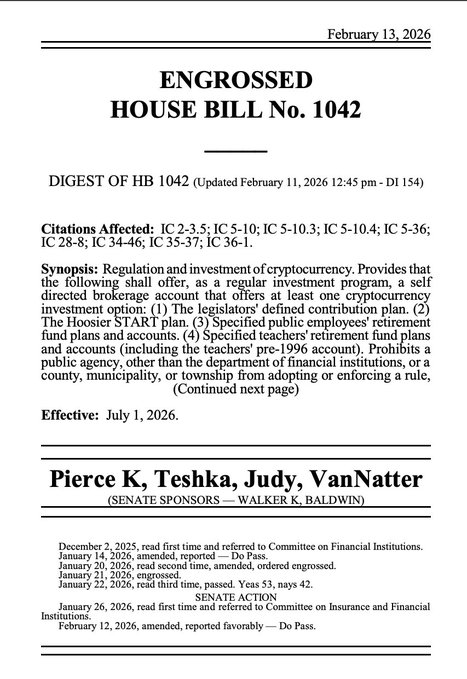
The revised bill removes authority for traditional pension portfolios—those that guarantee fixed retirement benefits—to allocate funds to crypto ETFs. That decision reflects concerns about volatility and fiduciary risk tied to public pension management.
However, the legislation preserves a potential pathway for participants in defined contribution plans. In these plans, individual members control their investment selections, and retirement outcomes depend on performance rather than a guaranteed payout.
If implemented, cryptocurrency exposure would likely be offered through self-directed brokerage windows. These platforms allow participants to access a broader range of exchange-listed investment products beyond the core plan menu. In this case, access would be limited to cryptocurrency ETFs rather than direct ownership of digital tokens such as Bitcoin or Ethereum.
This approach avoids the operational and custody challenges associated with holding crypto assets directly. By restricting exposure to exchange-traded products, the structure keeps plan-level assets insulated while placing investment decisions squarely in the hands of individual participants.
How INPRS Could Structure Access
The Indiana Public Retirement System (INPRS) would be responsible for determining how, and whether, crypto exposure becomes available.
One likely model involves integrating crypto ETFs into a self-directed brokerage account option. That structure would separate higher-risk investments from standard retirement fund offerings. Fiduciaries could maintain oversight through disclosure requirements, trading rules, and vendor supervision without assuming responsibility for managing digital wallets or private keys.
INPRS has taken a measured stance as the bill progressed. According to investment counsel Tom Perkins, the agency has worked closely with lawmakers to refine the proposal.
“We’ve worked with the House to get it to the current form and (we’re) more or less happy with it.”
That comment signals institutional comfort with the current guardrails embedded in the legislation.
Lawmakers Emphasize Choice and Safeguards
Supporters of HB1042 argue that the bill is about expanding investment options rather than mandating crypto exposure.
Representative Kyle Pierce, the bill’s sponsor, has framed the proposal as a way to provide additional “investment choices” while maintaining “guardrails.” He has also linked the measure to broader discussions about how blockchain technology and digital assets could support state initiatives in the future.
By limiting access to defined contribution plans and excluding defined benefit pensions, lawmakers appear to be balancing innovation with risk management.
What This Means for Retirement Members
For members enrolled in defined benefit pension plans, the immediate impact is straightforward: no crypto exposure under the current bill.
For those in defined contribution plans, the possibility exists—but it would not be automatic. Access would depend on INPRS implementation decisions and would likely come with volatility disclosures and oversight mechanisms.
Importantly, investments would be confined to regulated, exchange-listed ETFs. Participants would not be purchasing digital assets directly or interacting with crypto exchanges. This significantly reduces administrative complexity while maintaining exposure to the asset class.
The bill’s advancement marks another example of state-level policymakers grappling with how digital assets fit within public financial systems.
As institutional interest in cryptocurrency ETFs grows nationally, Indiana’s approach reflects a cautious but deliberate step toward integrating digital assets into retirement planning—without placing guaranteed pension obligations at risk.
HB1042 now moves forward in the legislative process, where further debate and potential refinements could shape the final framework for crypto access within Indiana’s retirement system.