


If you have typed “best cryptos to buy” into a search engine recently, you will know the results are overwhelming. Every article gives you a different list and tells you this coin or that coin is about to explode. Most of that content is noise. This article is not trying to be a price prediction. It is a practical guide for beginners who want to understand which cryptocurrencies have real reasons behind them, not just hype.
As of May 2026, the global cryptocurrency market sits at roughly $2.8 trillion in total value, according to CoinGecko data cited by Coincub. Bitcoin alone accounts for over 54% of that. The market has matured significantly since earlier cycles. Institutional money, regulated ETFs, and clearer government frameworks in the UK, EU, and US have all changed what it means to invest in crypto. The coins that survive long term are the ones with genuine utility, real adoption, and strong communities. That is the lens this article uses.
Before anything else: no list of coins is financial advice. Crypto is volatile. Prices can drop sharply, and no coin is guaranteed to rise. Only invest money you can genuinely afford to lose. UPay supports you in accessing and spending crypto globally, but the decision of what to buy is always yours.
What Makes a Cryptocurrency Worth Buying?
Before picking any coin, you need a framework. Here are the things that actually matter:
- Real use case: Does the coin or its network actually do something useful? Coins built around genuine utility tend to have more staying power than those built purely on hype.
- Market capitalisation: This is the total value of all coins in circulation. Higher market cap generally means more stability and more liquidity. You can find live market cap data on CoinMarketCap.
- Institutional adoption: When large asset managers, banks, or corporations hold a coin, it signals confidence in the long-term thesis. It also adds liquidity.
- Regulatory clarity: Coins operating in legally clear environments carry less risk of being suddenly shut out of major markets.
- Team and development activity: Active development on a project means it is evolving and responding to real problems. A project with no updates for months is often a warning sign.
Choosing the right cryptocurrency in 2026 requires more than chasing headlines. The market is larger and more complex than in earlier cycles, and only a fraction of the thousands of tokens will survive. Over 70% of altcoins historically fail, making diversification essential.
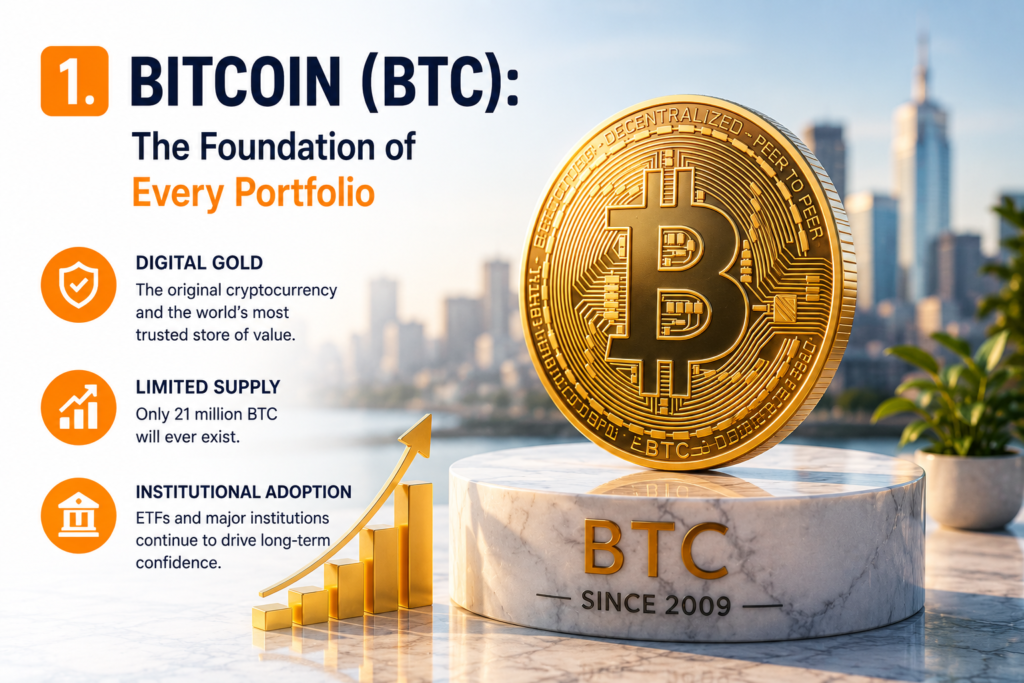
1. Bitcoin (BTC): The Foundation of Every Portfolio
Bitcoin is the original cryptocurrency. It was created in 2009 by someone using the name Satoshi Nakamoto, and it remains the most widely recognised and most valuable digital asset in the world. If you are new to crypto and you want to start somewhere that makes sense, Bitcoin is that place.
Bitcoin has a fixed supply of 21 million coins. That cap will never change. As of May 2026, Bitcoin is trading in the region of $80,000, and analysts at institutions including BlackRock have raised year-end targets as high as $150,000. The most important development for Bitcoin in recent years is the launch of spot Bitcoin ETFs in the United States, which gave traditional investors a way to hold BTC exposure without managing a crypto wallet.
According to KuCoin, Bitcoin spot ETFs attracted $622.75 million in net inflows in a single week in May 2026. That is not retail speculation. That is institutional capital flowing in on a regular basis. BlackRock’s Bitcoin ETF alone holds over 1.3 million BTC, which is more than 6% of all Bitcoin in circulation.
Bitcoin is not a fast-moving technology platform. It is more like digital gold. It is slow, secure, and deliberately limited. Those qualities are exactly why large investors treat it as a store of value and a hedge against economic instability.
Why it makes sense for beginners: Bitcoin is the most liquid, most researched, and most widely held cryptocurrency on the planet. It is the safest starting point in a market that is full of risk.
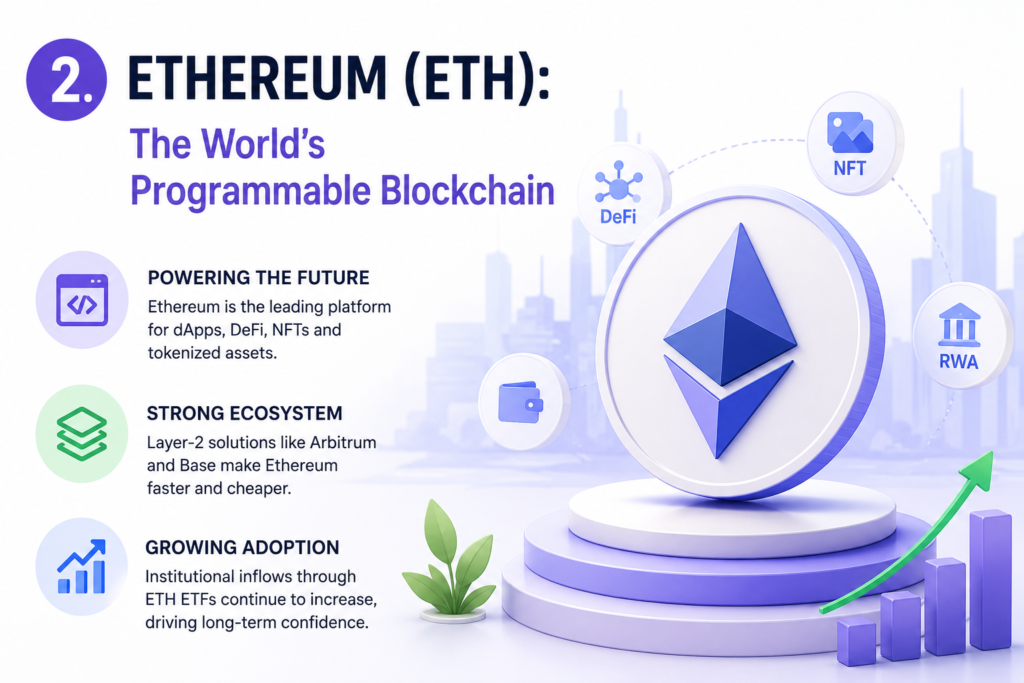
2. Ethereum (ETH): The World’s Programmable Blockchain
If Bitcoin is digital gold, Ethereum is digital infrastructure. It is a programmable blockchain that allows developers to build applications on top of it. Everything from decentralised finance (DeFi) lending platforms to NFT marketplaces to tokenised real-world assets runs on Ethereum or is connected to it in some way.
According to Coincub, Ethereum holds roughly 75% of the total value locked in DeFi. That is an extraordinary amount of dominance. No other smart contract blockchain comes close to matching its ecosystem depth. Layer-2 networks like Arbitrum and Base are built on top of Ethereum and dramatically reduce transaction costs, which was one of Ethereum’s historical limitations.
In April 2026, Ethereum spot ETFs attracted over $70 million in weekly inflows, according to KuCoin data. Institutional money is expanding its crypto exposure beyond Bitcoin, and Ethereum is the most natural next step.
Why it makes sense for beginners: Ethereum is the second largest cryptocurrency by market cap, and it underpins the largest ecosystem in crypto. If any sector of Web3 grows over the next few years, Ethereum is likely to benefit from it.
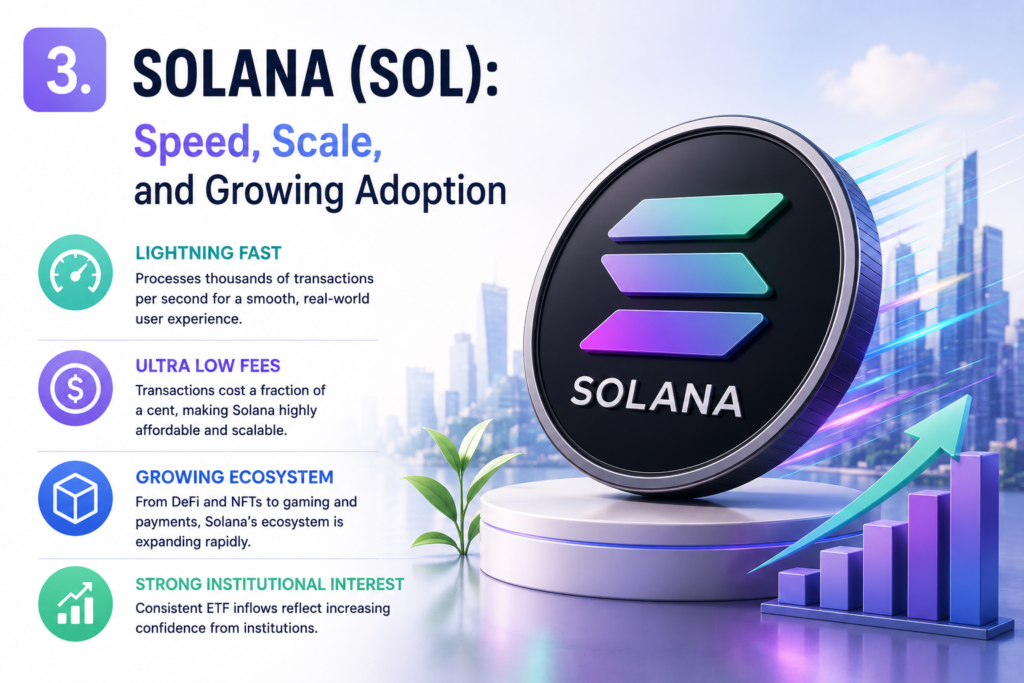
3. Solana (SOL): Speed, Scale, and Growing Adoption
Solana is a blockchain platform built for speed. Where Ethereum can process roughly 15 to 30 transactions per second under normal conditions, Solana is capable of tens of thousands. That speed, combined with very low transaction fees, has made Solana the preferred platform for consumer applications, gaming, and high-frequency trading.
Think of it this way. Imagine you are trying to send a payment or use a decentralised app during a busy period on Ethereum. You might face slow confirmation times and expensive fees. On Solana, the same transaction completes in under a second and costs a fraction of a penny. That practical difference matters to real users.
Solana ETFs recorded $39.23 million in inflows during the week of 11 May 2026, according to KuCoin. That came after a seven-month positive streak in ETF inflows, suggesting sustained institutional interest rather than a short-term spike.
Analysts at Coincub forecast a price range of $200 to $500 for SOL in 2026.
Why it makes sense for beginners: Solana offers a combination of genuine technical strength, a growing ecosystem, and real user activity. It is not just speculation. The network is being used.
4. XRP: Cross-Border Payments at Institutional Scale
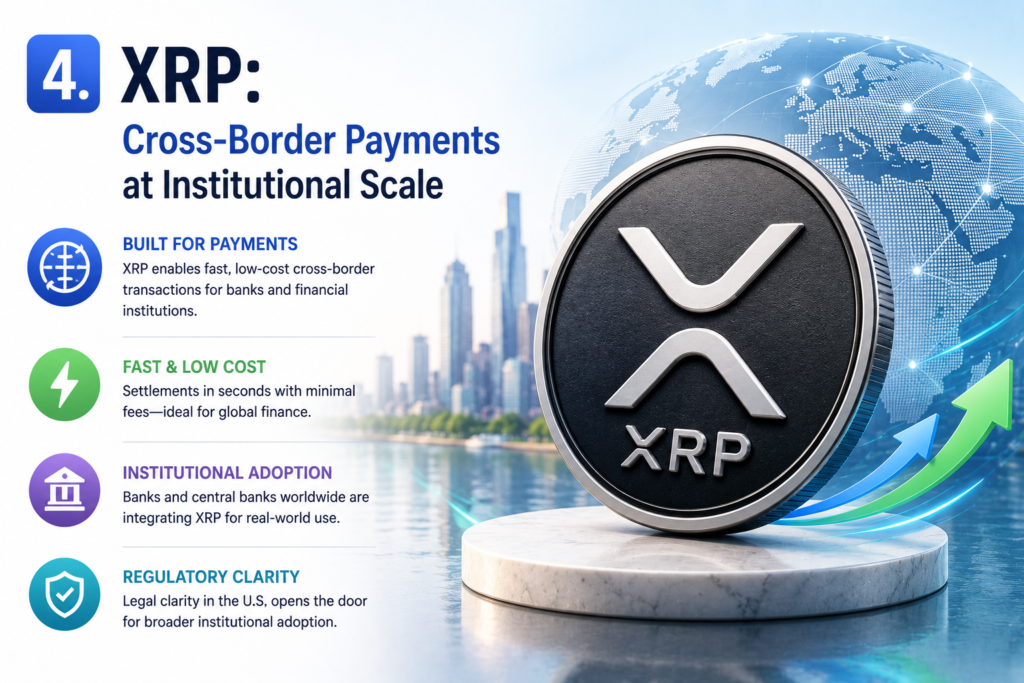
XRP is the token associated with Ripple, a company that has spent over a decade building payment infrastructure for banks and financial institutions. XRP is not trying to replace Bitcoin or compete with Ethereum. It is designed to do one thing exceptionally well: move value across borders instantly and cheaply.
Ripple has spent years in a legal battle with the US Securities and Exchange Commission (SEC) over whether XRP is a security. That dispute has now largely been resolved in Ripple’s favour following the SEC’s dropped appeal. The outcome opened the door to broader adoption among US financial institutions, and it removed a significant source of uncertainty that had weighed on XRP’s price for years.
Singapore’s central bank has been testing financial settlements on the XRP Ledger, according to CoinDCX. New XRP ETF approvals in global markets are also expanding the investment access point for XRP. Analysts at Coincub forecast a price range of $5 to $13 for XRP in 2026.
Why it makes sense for beginners: XRP has a specific, real-world use case in international payments and is backed by years of institutional development. It is not speculative in the same way that newer altcoins are.
5. BNB: The Backbone of the Binance Ecosystem
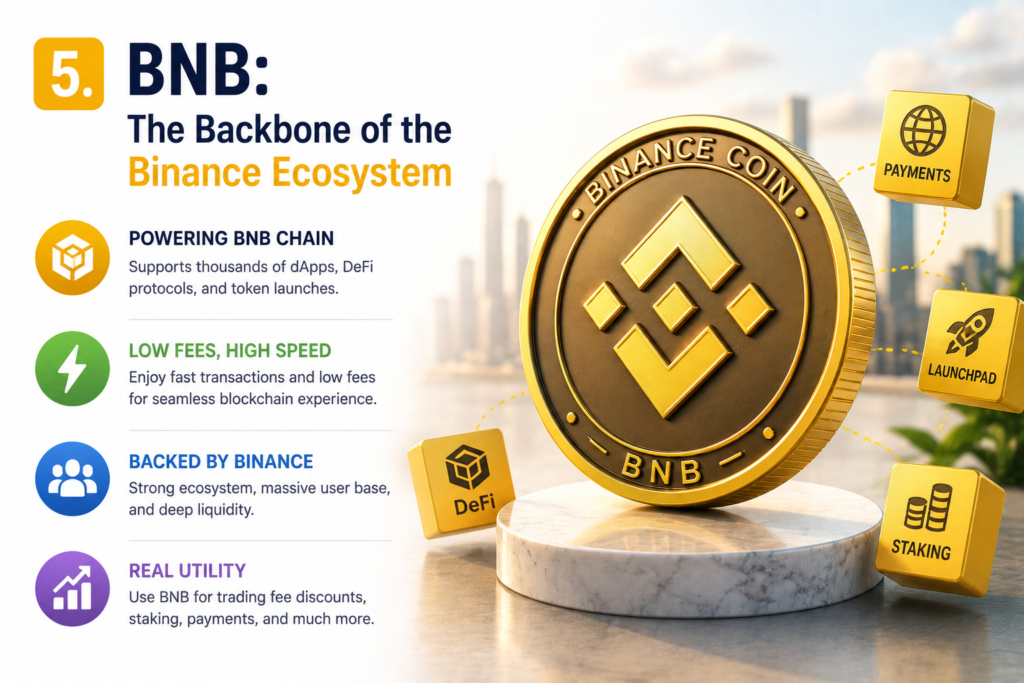
BNB started as the native token of Binance, the world’s largest cryptocurrency exchange. It was originally used to pay trading fees at a discount. Over time, it evolved into the fuel for an entire blockchain ecosystem: the BNB Chain, which supports thousands of decentralised applications, token launches, and DeFi protocols.
BNB Chain is known for its low fees and high transaction throughput. It sits in a similar space to Ethereum and Solana but with a specific advantage: the massive user base of Binance itself. Any developer building on BNB Chain immediately has access to that existing audience.
While the user base and utility are strong, the main concern with BNB is centralisation. Unlike Bitcoin or Ethereum, BNB is closely tied to a single company, Binance. If Binance faces regulatory action in key markets, that has a direct knock-on effect on BNB’s value. This is a known risk that any investor needs to weigh up before buying.
Why it makes sense for beginners: BNB has an established ecosystem, consistent trading volume, and a very active development community. The Binance link is both its strength and its risk.
6. Chainlink (LINK): The Connector Between Blockchains and the Real World
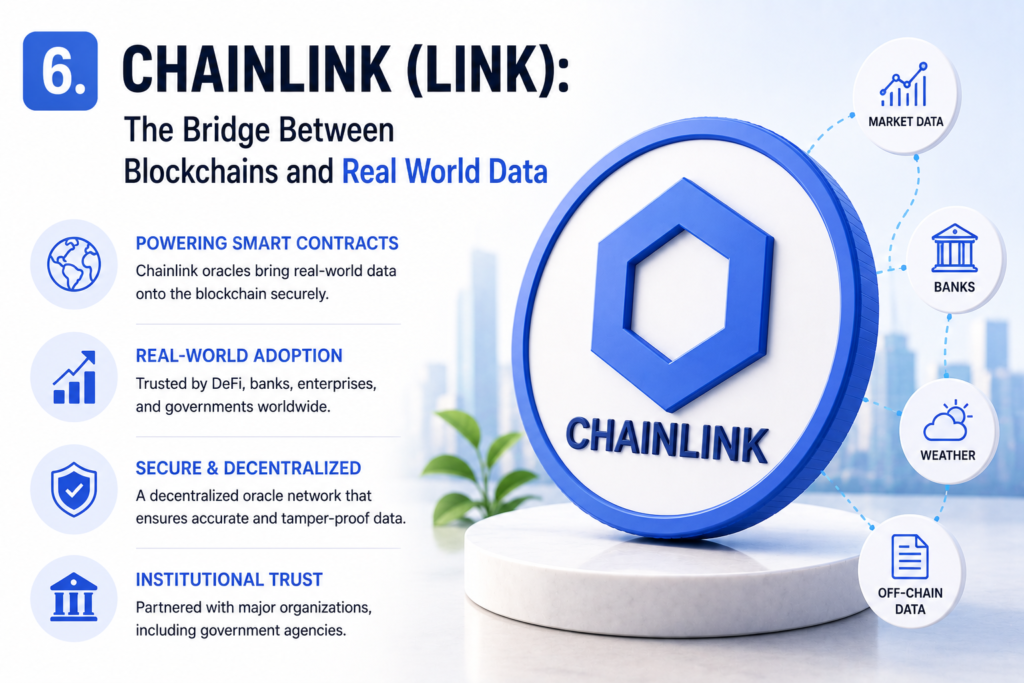
Chainlink solves a problem that most people never think about: blockchains cannot access external data on their own. A smart contract on Ethereum does not know what the price of gold is, or what the weather is in Lagos, or what a government statistics database says. Chainlink is the infrastructure that brings that external data onto blockchains in a secure, verifiable way. This is called an oracle network.
The reason Chainlink matters in 2026 is that real-world asset tokenisation is growing rapidly. Banks, asset managers, and governments are beginning to put financial instruments, property titles, and official data on blockchains. Every single one of those use cases requires an oracle to bring off-chain data on-chain. Chainlink is the dominant player in that space.
According to The Motley Fool, Chainlink scored a notable win in August 2025 when it began working with the US Department of Commerce to bring government economic data onto public blockchains. That kind of institutional partnership is a meaningful signal for a project with genuine infrastructure value.
Why it makes sense for beginners: Chainlink is not a bet on price speculation. It is a bet on the infrastructure that makes the rest of the crypto industry function. That kind of foundational utility tends to have long-term staying power.
How to Build a Sensible Crypto Portfolio as a Beginner
The coins above are not equally risky. Here is how to think about weighting your exposure:
- Foundation (50 to 60%): Bitcoin and Ethereum. These are the most established, most liquid, and most institutionally supported assets in the market. They are still volatile by traditional standards, but they carry significantly less risk than smaller coins.
- Major altcoins (20 to 30%): Solana and XRP sit in this category. They have real use cases, growing adoption, and strong fundamentals, but they are more sensitive to market conditions than Bitcoin.
- Infrastructure tokens (10 to 20%): BNB, Chainlink, and similar tokens serve specific roles in the crypto ecosystem. They carry more risk than the top two but have genuine reasons behind their valuations.
A strategy used by many investors is called dollar-cost averaging (DCA). Instead of putting all your money in at once, you invest a fixed amount at regular intervals regardless of the price. This removes the pressure of trying to time the market perfectly, which nobody can do reliably.
What to Avoid as a Beginner
This section matters as much as the list above.
- Anonymous team tokens: If nobody is willing to put their name behind a project, there is no accountability if things go wrong.
- Coins that promise guaranteed returns: Nothing in crypto is guaranteed. Any project claiming otherwise is misleading you.
- Meme coins with no utility: Some meme coins have produced extraordinary short-term returns. Most have produced total losses. They are not investments. They are speculative with very unfavourable odds for most participants.
- New tokens from anonymous developers with no audit: CoinGecko research found that more than 50% of cryptocurrencies have stopped trading, according to The Motley Fool. Many of those were tokens with no real product behind them.
- Putting all your money in one coin: Even Bitcoin can drop 50% or more in a bear market. Spreading your exposure across a few established coins reduces the damage any single price move can do to your portfolio.
How to Actually Buy Crypto in 2026
Once you have decided which coins to buy, the practical steps are straightforward. First, choose a reputable platform or exchange. In the UK, look for platforms registered with the Financial Conduct Authority (FCA). Create an account, complete identity verification (KYC), and fund your account with pounds or another fiat currency.
After buying, consider how you will store your crypto. Leaving it on an exchange is convenient but carries custodial risk. A self-custody wallet, where you hold your own private keys, gives you full control. For long-term holdings, a hardware wallet adds another layer of security.
Take your time, invest wisely, and always continue learning about this evolving market.
Summary: The Best Cryptos to Buy in 2026
To bring it together plainly:
- Bitcoin (BTC): The most trusted, most liquid, most institutionally supported crypto asset. The starting point for any portfolio.
- Ethereum (ETH): The backbone of decentralised finance and Web3. Deep ecosystem, strong adoption, and growing institutional interest.
- Solana (SOL): Speed and scale for consumer applications. Active ecosystem and consistent ETF inflows suggest real demand.
- XRP: Cross-border payments at institutional scale. Legal clarity in the US and growing adoption among banks and central banks.
- BNB: The Binance ecosystem token. Strong utility, but monitor regulatory developments closely.
- Chainlink (LINK): The infrastructure layer connecting blockchains to real-world data. Quietly essential to the entire crypto industry.
None of this is a guarantee that any of these coins will rise in value. The crypto market is volatile by nature. But if you are going to invest in crypto as a beginner, these are the coins with real arguments behind them rather than just noise.
For further reading, check CoinMarketCap for live market data, CoinCodex for regularly updated rankings, and the UPay blog for ongoing crypto education and payment guidance.