




Bitcoin mining in 2026 is very different from what it was a few years ago. Mining is no longer something you can do with a normal computer or laptop. Today, it requires specialised machines built only for mining Bitcoin.
These machines are called ASIC miners.
As the Bitcoin network grows, mining difficulty increases, and electricity costs continue to rise. This means choosing the right mining machine is more important than ever. The wrong machine can lead to high power bills and little or no profit, while the right one can help you mine more efficiently and reduce running costs.
In this guide, we will look at the best Bitcoin mining machines in 2026, focusing on performance, energy efficiency, and real-world usability.
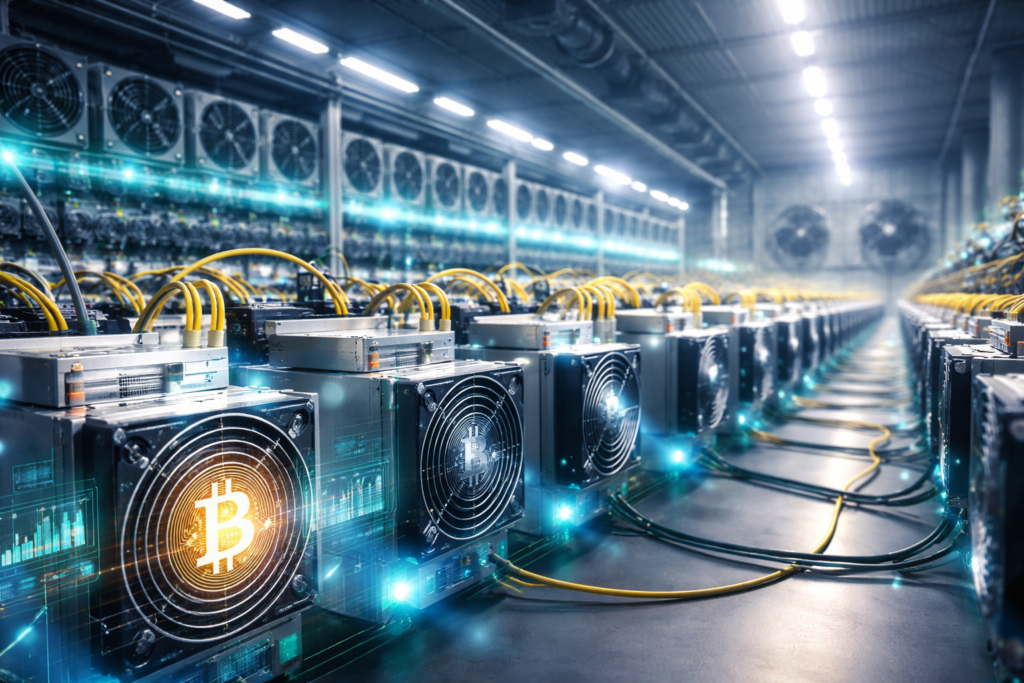
What Is a Bitcoin Mining Machine?
A Bitcoin mining machine is a special computer built only for mining Bitcoin. Unlike normal computers, these machines are designed to solve Bitcoin’s mathematical problems as fast and efficiently as possible.
These machines are called ASIC miners, which means Application-Specific Integrated Circuit. In simple terms, an ASIC miner does one job only (Bitcoin mining), and it does it very well.
In the early days of Bitcoin, people could mine using laptops or desktop computers. Later, graphics cards (GPUs) were used. Today, that is no longer practical. Bitcoin mining has become very competitive, and ASIC miners are now the only realistic option for mining Bitcoin.
A typical Bitcoin mining machine:
- Has a very high hash rate (mining power)
- Uses a lot of electricity
- Produces heat and noise
- Runs continuously, 24/7
Because of this, choosing the right machine is not just about power. You must also consider electricity usage, cooling needs, durability, and long-term profitability. This is why newer machines focus on being more energy-efficient, not just more powerful.
How Bitcoin Mining Machines Work
Bitcoin mining machines verify transactions and secure the Bitcoin network. They do this by solving complex mathematical problems, a process known as hashing.
Here is a simple way to understand it.
Every time people send Bitcoin, those transactions are grouped into a block. Miners compete to be the first to confirm that block by finding the correct hash. The first miner to succeed:
- Confirms the transactions
- Adds the block to the blockchain
- Earns a Bitcoin reward and transaction fees
ASIC miners are built to perform this hashing process extremely fast. They try billions or trillions of calculations per second, which is why the hash rate is so important.
Key Terms
- Hash Rate: This shows how powerful a mining machine is. A higher hash rate means the machine can try more calculations every second, increasing its chances of earning rewards.
- Power Consumption: The amount of electricity the machine uses. Mining machines run all day and night, so power usage directly affects your electricity bill.
- Efficiency: The ratio of power used to each unit of hash rate. In 2026, efficient machines are more important than ever, given high electricity costs.
If a machine has a high hash rate but uses too much electricity, it may not be profitable. This is why modern Bitcoin mining focuses on balancing power and efficiency rather than raw speed.
Key Factors to Consider Before Buying a Bitcoin Mining Machine in 2026
Before buying a Bitcoin mining machine in 2026, it is important to look beyond just the price and the machine’s power. Mining has become more competitive, and small details can make a big difference in whether you turn a profit.
Below are the key factors you should consider.
Hash Rate (Mining Power)
Hash rate shows how powerful a mining machine is. It is usually measured in terahashes per second (TH/s). A higher hash rate means the machine can mine faster and has a better chance of earning Bitcoin rewards.
However, a higher hash rate usually comes with higher power consumption, so it should never be considered in isolation.
Power Consumption
Power consumption is the amount of electricity the machine uses, measured in watts (W). Since mining machines run 24/7, electricity costs are one of the biggest expenses in Bitcoin mining.
In 2026, miners are paying closer attention to machines that use less power to produce more output, especially in regions where electricity is expensive.
Energy Efficiency
Energy efficiency tells you how much power is used for each unit of hash rate. This is often shown as joules per terahash (J/TH).
Lower numbers are better.
An efficient machine can stay profitable longer, even when Bitcoin prices drop or mining difficulty increases.
Cost of the Machine
Bitcoin mining machines can be expensive. Some cost as much as a small car. You should always compare the machine’s price with:
- Expected earnings
- Electricity costs
- Maintenance costs
A cheaper machine is not always better if it uses too much electricity.
Noise and Heat
ASIC miners are very loud and produce a lot of heat. This makes them unsuitable for many homes without proper ventilation or sound control.
If you plan to mine at home, noise level and cooling requirements are very important.
Longevity and Support
Mining machines do not last forever. Over time, newer and more efficient models are released.
Before buying, consider:
- How long is the machine expected to stay profitable
- Availability of spare parts
- Manufacturer support and warranty
Best Bitcoin Mining Machines in 2026 (Top ASIC Miners)
In 2026, Bitcoin mining is dominated by high-efficiency ASIC miners designed to deliver strong performance while keeping electricity costs as low as possible. Below are some of the best Bitcoin mining machines to consider, based on real-world usage, efficiency, and long-term value.
Full Comparison: Top 13 Bitcoin Mining Machines 2026
The table below summarizes specifications for every machine covered in this guide. All profitability figures assume BTC at $110,000 and electricity at $0.07/kWh unless otherwise noted. Prices reflect market rates as of March 2026.
| Miner | Hash Rate | Power | Efficiency | Noise | Price (USD) | Best For |
|---|---|---|---|---|---|---|
| Antminer S21 XP Hyd | 500 TH/s | 5,500W | 11 J/TH | ~50 dB | $12,700–$16,000 | Industrial |
| Antminer S21e XP Hyd 3U | 860 TH/s | 11,180W | 13 J/TH | ~50 dB | $17,000+ | Mega-scale |
| Antminer S19 XP Hydro | 255 TH/s | 5,304W | 20.8 J/TH | ~55 dB | $6,000–$8,500 | Mid-scale |
| Whatsminer M60S++ | 220 TH/s | 3,410W | 15.5 J/TH | ~75 dB | $3,900–$4,600 | Mid-size ops |
| Whatsminer M63 Hydro | 334–368 TH/s | 6,280–6,890W | 18.5 J/TH | ~52 dB | $6,799–$8,700 | Industrial |
| Antminer S19j Pro+ | 122 TH/s | 3,355W | 27.5 J/TH | ~75 dB | $1,800–$2,400 | Budget miners |
| Avalon Made A1466 | 150 TH/s | 3,420W | 22.8 J/TH | ~72 dB | $2,800–$3,500 | Beginners |
| Auradine Teraflux AH3880 | 600 TH/s | 8,700W | 14.5 J/TH | 35 dB | TBD | New deployments |
| Bitdeer Sealminer A2 | 226 TH/s | 3,729W | 16.5 J/TH | ~70 dB | Limited | Bitdeer partners |
| Avalon Q | 30–90 TH/s | 800–1,600W | 26.7 J/TH | ~45 dB | $1,400–$1,800 | Home miners |
| Whatsminer M50S++ | 154–162 TH/s | 3,234W | 21 J/TH | ~75 dB | ~$1,840 | Value mid-tier |
| Antminer T21 | 190 TH/s | 3,610W | 19 J/TH | ~75 dB | $2,800–$3,500 | Budget new-gen |
| Bitaxe Gamma | 1.2 TH/s | 17W | 14 J/TH | ~30 dB | $200–$300 | Hobbyists |
Tier 1: Industrial Flagships
1. Bitmain Antminer S21 XP Hyd (500 TH/s); Best Overall
Hash Rate: 500 TH/s Power: 5,500W Efficiency: 11 J/TH Price: $12,700–$16,000
The Antminer S21 XP Hyd is the gold standard for Bitcoin mining in 2026. Built around 5nm ASIC chip technology and a closed-loop hydro cooling system, it achieves 11 J/TH, the best efficiency in the 500+ TH/s class. At $0.07/kWh electricity, the machine generates approximately $16.80 in daily revenue against $9.24 in electricity costs, yielding a monthly profit of around $504. ROI sits in the 592–951-day range depending on purchase price and market conditions.
The hydro cooling architecture not only extends chip lifespan through consistent thermal management but also reduces noise to approximately 50 dB; roughly 25 dB quieter than equivalent air-cooled units. Operators running large fleets see an additional benefit: heat removal via liquid rather than air significantly reduces HVAC expenditures in the facility. Bitmain has confirmed that LuxOS and Braiins OS compatibility updates are forthcoming, enabling further performance tuning for advanced operators.
The primary drawbacks are its price point and infrastructure requirements. A dedicated hydro cooling setup; heat exchangers, coolant supply, and circulation pumps, adds $2,000–$5,000 in setup costs beyond the machine itself, and professional installation is strongly recommended. This machine is built for operators running ten or more units with access to sub-$0.10/kWh electricity; it is not a practical option for home or small-scale miners.
2. Bitmain Antminer S21e XP Hyd 3U (860 TH/s); Highest Raw Hashrate
Hash Rate: 860 TH/s Power: 11,180W Efficiency: 13 J/TH Price: $17,000+
The Antminer S21e XP Hyd 3U holds the title of the most powerful Bitcoin miner ever manufactured. Packaged in a 3U rack-mount form factor designed for data center integration, it delivers 860 TH/s with 13 J/TH efficiency; not as lean as the S21 XP Hyd on efficiency but unmatched in absolute hashrate density per rack unit. Monthly profits range from $810 to $960 under base-case conditions, with an estimated ROI of 17–21 months at current BTC prices.
This machine is practically exclusive to large public mining companies and mega-scale industrial operations. Its 11,180W power draw requires enterprise-grade electrical infrastructure, and its hydro cooling demands match those of the S21 XP Hyd at a significantly larger scale. For any operation already running data center-grade power and cooling, the S21e XP’s hashrate density makes it an attractive choice for maximizing output per square foot of facility space.
3. Bitmain Antminer S19 XP Hydro (255 TH/s); Proven Workhorse
Hash Rate: 255 TH/s Power: 5,304W Efficiency: 20.8 J/TH Price: $6,000–$8,500
Released in March 2022, the Antminer S19 XP Hydro has accumulated over three years of real-world operational data, making it one of the best-tested machines in the industry. While its 20.8 J/TH efficiency has been surpassed by newer models, its reliability track record, mature firmware ecosystem, abundant replacement parts, and lower price on secondary markets keep it relevant in 2026. Daily profits at $0.07/kWh run between $5 and $8, with annual earnings in the $1,800–$2,880 range. For operators with electricity below $0.06/kWh, this machine remains a solid performer, with a proven lifespan and excellent secondary-market liquidity.
4. MicroBT Whatsminer M60S++ (220 TH/s); Best Air-Cooled Value
Hash Rate: 220 TH/s Power: 3,410W Efficiency: 15.5 J/TH Price: $3,900–$4,600
MicroBT’s flagship air-cooled machine offers 15.5 J/TH efficiency, strong by non-hydro standards, at a price point substantially below Bitmain’s hydro machines. The M60S++ integrates its power supply (PSU included in retail price), features a modular hashboard design for field-level repairs, and supports 220–240V operation globally. At $0.07/kWh, it generates approximately $5.72 per day and $171.60 per month in profit, with an ROI in the 710–755-day range.
The M60S++ is particularly well-suited for mid-sized operators running 10–100 units who want competitive efficiency without the capital expenditure and infrastructure complexity of hydro cooling. MicroBT’s growing global service network has improved considerably since 2023, reducing downtime concerns that historically favored Bitmain. The 75 dB noise level remains a constraint for deployment locations near occupied spaces.
5. MicroBT Whatsminer M63 Hydro (334–368 TH/s); Best Bitmain Alternative
Hash Rate: 334–368 TH/s Power: 6,280–6,890W Efficiency: 18.5 J/TH Price: $6,799–$8,700
The M63 Hydro is MicroBT’s direct competitor to Bitmain’s S21 series, offering respectable hashrates of 334–368 TH/s with liquid cooling. It’s 18.5 J/TH efficiency trails Bitmain’s S21 XP Hyd, but the M63 Hydro provides supply chain diversification for operators wary of concentrating purchasing with a single manufacturer. Pricing per terahash is competitive, and MicroBT’s hydro machines have demonstrated improvements in build quality and reliability across successive iterations.
Tier 2: Mid-Range and Budget Machines
6. Bitmain Antminer S19j Pro+ (122 TH/s); Best Budget Entry
Hash Rate: 122 TH/s Power: 3,355W Efficiency: 27.5 J/TH Price: $1,800–$2,400
The S19j Pro+ is the most widely deployed Bitcoin miner in history by unit count, and its secondary market availability remains extraordinarily deep in 2026. Its 27.5 J/TH efficiency is firmly in old-generation territory, meaning it is only consistently profitable for operators with electricity costs below $0.06/kWh. At $0.07–0.08/kWh, margins become very thin, and above $0.08/kWh the machine typically operates at a loss. Its value proposition lies in its sub-$2,400 acquisition cost, mature third-party firmware optimizations, and a repair ecosystem so developed that experienced operators can maintain fleets at very low downtime rates. Miners with access to cheap renewable energy, solar, hydroelectric, or stranded gas, can still extract meaningful returns from the S19j Pro+.
7. Canaan Avalon Made A1466 (150 TH/s); Best for Beginners
Hash Rate: 150 TH/s Power: 3,420W Efficiency: 22.8 J/TH Price: $2,800–$3,500
Canaan’s A1466 occupies a useful middle ground: it is not the most efficient machine in its price tier, but Canaan is consistently cited for the most intuitive web interface in the ASIC market, conservative and stable operation, and genuinely responsive customer support. For commercial operations just beginning to scale, operators running their first 5–20 machines, the A1466 lowers the learning curve considerably. Its 22.8 J/TH efficiency means it requires electricity below $0.08/kWh for reliable profitability. Canaan’s machines historically exhibit lower fan and hashboard failure rates than comparable Bitmain units, a meaningful operational advantage as operations grow.
8. Auradine Teraflux AH3880 (600 TH/s); Most Exciting New Entrant
Hash Rate: 600 TH/s Power: 8,700W Efficiency: 14.5 J/TH Price: TBD (March 2026 release)
Auradine’s Teraflux AH3880 has generated more pre-release industry discussion than any other miner in recent memory, primarily because of one remarkable specification: 35 dB noise output at 600 TH/s. For context, 35 dB is quieter than a typical refrigerator and dramatically below the 70–80 dB baseline of conventional air-cooled ASICs. This could realistically unlock deployment locations: office buildings, light industrial facilities, mixed-use properties, where traditional ASICs have always been impractical. Auradine’s AI-optimized cooling system reportedly achieves this through a combination of advanced liquid cooling and low-RPM airflow management. The company is US-based, which addresses growing concerns about supply chain diversification.
The significant unknowns are pricing (not yet confirmed at the time of writing), real-world performance verification from independent testers, and Auradine’s after-sales service network, which is unproven at scale. Early adopters should approach with measured optimism and closely monitor the first independent benchmark results before committing large capital.
9. Bitdeer Sealminer A2 (226 TH/s); The Vertical Integration Play
Hash Rate: 226 TH/s Power: 3,729W Efficiency: 16.5 J/TH Price: Limited external availability
Public mining company Bitdeer’s decision to design and manufacture its own ASIC hardware reflects a broader trend in the industry: the largest operators are increasingly seeking to capture hardware margin and tailor machine performance to their specific infrastructure. The Sealminer A2 offers 16.5 J/TH efficiency, competitive with MicroBT’s mid-tier offerings, but external sales are limited. It is primarily relevant as a signal of where the industry is heading: vertical integration will likely characterize the next phase of mining company evolution, with implications for the used-hardware market and third-party ASIC pricing.
10. Canaan Avalon Q (30–90 TH/s); Best Home Miner
Hash Rate: 30–90 TH/s (adjustable) Power: 800–1,600W Noise: ~45 dB Price: $1,400–$1,800
The Avalon Q is Canaan’s answer to the question that residential miners have been asking for years: can Bitcoin mining be done at home without destroying your relationships with neighbors, housemates, or family members? The answer with the Avalon Q is a credible yes. Three adjustable operating modes: 30 TH/s at 800W for quiet operation, 60 TH/s at 1,200W for balanced operation, and 90 TH/s at 1,600W for maximum output, allowing the owner to tune the machine’s footprint to their environment and electricity rate. At 45 dB in quiet mode, the device is less intrusive than a dishwasher.
Profitability is modest: at 30 TH/s in 30 TH/s mode and $0.10/kWh (a realistic US residential electricity rate), expect $2–$4 per day, with an ROI of 12–24 months, depending on market conditions. In cold climates, the approximately 2,700 BTU/hour of heat output offsets heating costs during winter, improving the effective economics. The Avalon Q is not a machine for those seeking maximum dollar returns; it is purpose-built for people who want hands-on Bitcoin network participation, practical education in mining operations, or the hedge that comes with holding a small self-operated position in the network.
Additional Machines Worth Knowing
11. MicroBT Whatsminer M50S++ (154–162 TH/s)
The M50S++ fills the gap between the older S19-era machines and newer-generation hardware. At approximately $1,840 with 21 J/TH efficiency, it offers a newer chip architecture over the S19j Pro+ at a comparable price point. It is an air-cooled machine suitable for mid-tier operations looking to upgrade older fleets without the capital commitment of a full hydro transition. Profitability is sensitive to electricity pricing and requires rates below $0.07/kWh for consistent positive margins.
12. Bitmain Antminer T21 (190 TH/s)
Bitmain positions the T21 as its cost-efficient new-generation offering: newer ASIC architecture with respectable 19 J/TH efficiency at a $2,800–$3,500 price point. It is air-cooled and targets operators who want post-S19-era performance without the infrastructure investment required for hydro cooling. For mining farms looking to replace aging S17 or early S19 units on a budget, the T21 offers a meaningful efficiency step-up within a familiar Bitmain ecosystem.
13. Bitaxe Gamma (1.2 TH/s); Open-Source Hobbyist Device
The Bitaxe Gamma sits at the opposite end of the ASIC spectrum: it draws just 17W, delivers 1.2 TH/s, and costs $200–$300. It is not profitable by conventional metrics; at 1.2 TH/s, it will take years of solo mining to probabilistically find a block, but it serves a genuine and growing segment of the market. The Bitaxe is an open-source hardware project maintained by a community of Bitcoin enthusiasts who value self-sovereign network participation and educational access to real mining hardware. For developers, educators, students of Bitcoin’s protocol, and hobbyists who want a device that runs silently on a desk and contributes meaningfully to their understanding of the network, the Bitaxe Gamma is uniquely well-suited.
Which One Is Best for You?
The best Bitcoin mining machine depends on:
- Your electricity cost
- Your budget
- Where and how you plan to mine (home vs mining facility)
A powerful machine is not always the most profitable. In many cases, a slightly weaker but more energy-efficient miner performs better over time.
Bitcoin Mining Profitability in 2026: What to Expect
Bitcoin mining profitability in 2026 depends on more than just owning a powerful machine. Many miners discover too late that a high hash rate alone does not guarantee profit. What matters is how all the factors work together.
Below are the key things that affect profitability.
Electricity Cost
Electricity is the largest ongoing expense in Bitcoin mining. Even the best mining machine can become unprofitable if electricity costs are too high.
Miners with access to:
- Cheap grid power
- Solar or alternative energy
- Industrial power rates
…are more likely to stay profitable in the long run.
Bitcoin Price
The price of Bitcoin directly affects mining income. When prices are high, miners earn more value per unit of work. When prices drop, profit margins become tighter. This is why many miners focus on long-term mining, rather than short-term gains.
Mining Difficulty
Mining difficulty adjusts automatically as more miners join the network. As difficulty increases:
- It becomes harder to earn rewards
- Older or inefficient machines earn less
Machine Efficiency Matters Most
Profitability today is less about raw power and more about how much electricity is used per hash. A machine with lower power consumption can remain profitable even in tough conditions.
Realistic Expectations
Bitcoin mining in 2026 is not a quick-profit activity. ghIt works best for people who:
- Plan carefully
- Track costs closely
- Are comfortable with steady, long-term returns
FAQ
What is the most profitable Bitcoin miner in 2026?
The Bitmain Antminer S21 XP Hyd at 500 TH/s and 11 J/TH is the most profitable machine for operators with access to sub-$0.10/kWh electricity, delivering approximately $504/month net profit at $0.07/kWh and BTC $110,000. The S21e XP Hyd 3U delivers higher absolute returns thanks to its 860 TH/s output, but requires a proportionally greater capital investment and infrastructure.
Is Bitcoin mining still profitable in 2026?
Yes, for operators with efficient hardware and competitive electricity rates. Modern machines generating 11–16 J/TH are profitable at electricity rates up to $0.10–$0.14/kWh with Bitcoin at $110,000. Operations running older hardware (27+ J/TH) need electricity at $0.06/kWh or lower to remain viable. The post-halving environment has narrowed margins but has not made mining structurally unprofitable for well-positioned operators.
How long does it take to mine 1 Bitcoin?
Mining does not work on a per-Bitcoin basis; miners earn a share of the block reward proportional to their hashrate. With a single Antminer S21 XP Hyd (500 TH/s) in a pool, you would expect to earn roughly $16.80 in daily revenue, meaning accumulating 1 BTC worth of earnings (at $110,000) would take approximately 6,500 days in gross revenue terms. In practice, earnings are converted to Bitcoin at prevailing prices; the timeline to accumulate 1 BTC depends entirely on Bitcoin price and operational costs.
Can I mine Bitcoin at home?
Home mining is practical with purpose-built devices like the Canaan Avalon Q (45 dB, 800–1,600W) or the Bitaxe Gamma (17W, whisper quiet). Standard commercial ASICs are not suitable for home use without dedicated electrical work, ventilation, and soundproofing. At residential electricity rates of $0.10–$0.12/kWh, the Avalon Q generates $2–$4/day in profit, yielding an ROI of 12–24 months depending on BTC price.
What electricity rate do I need to mine Bitcoin profitably?
As a general rule, new-generation machines (S21 XP Hyd, M60S++) are profitable at $0.10–$0.14/kWh at current Bitcoin prices. Mid-generation machines (M63 Hydro, T21) require below $0.08/kWh for comfortable margins. Older machines (S19j Pro+) need below $0.06/kWh. These thresholds shift directly with Bitcoin’s price; a sustained rally above $150,000 would meaningfully extend breakeven rates.
What is hashrate, and why does it matter?
Hashrate is a measure of how many SHA-256 calculations a mining machine performs per second, expressed in terahashes per second (TH/s) for modern ASICs. Higher hashrate means a proportionally larger share of total block rewards. Network hashrate, the sum of all miners globally, determines how difficult it is to find a block; a higher global hashrate means more competition and lower earnings per individual terahash.
Should I buy new or used mining hardware?
New hardware offers warranty coverage, the latest efficiency, and firmware support, but commands a premium price. Used hardware, particularly previous-generation machines like the S19 XP Hydro, can offer attractive cost-per-terahash ratios but carries operational risk (no warranty, unknown maintenance history, higher electricity consumption). For operators with technical expertise and access to cheap electricity, well-maintained used machines represent genuine value. For beginners or operators with higher electricity costs, new hardware’s predictability and warranty coverage justify the price premium.
Final Thoughts
The Bitcoin mining hardware landscape in 2026 is defined by a widening gap between industrial-scale operations running the latest hydro-cooled machines at favorable electricity rates and smaller operators constrained by power costs and capital. The Antminer S21 XP Hyd remains the benchmark against which all other machines are judged, but the emerging field of challengers, Auradine’s ultra-quiet Teraflux, MicroBT’s competitive M60S++, and Canaan’s home-friendly Avalon Q, ensures that the market remains competitive across deployment scales.
For any prospective miner, the exercise begins not with selecting a machine but with calculating your electricity rate, available capital, and operational capacity. Match those inputs against the breakeven thresholds detailed in this guide, model a conservative profitability scenario, and only then evaluate which machine delivers the best return within those constraints. Bitcoin mining, done thoughtfully, remains one of the most direct ways to participate in Bitcoin’s network while generating income, but the margin for error has narrowed considerably since the halving, and operational discipline is no longer optional.