
In just five years, stablecoins have transformed from a niche experiment within the cryptocurrency market into a major component of global finance. In 2020, the total stablecoin market capitalization was roughly $28 billion. By 2026, that figure has climbed past $320 billion, with stablecoins facilitating trillions of dollars in annual transactions across trading platforms, decentralized finance (DeFi), and cross-border payments.
Despite this explosive growth, regulations struggled to keep pace. For years, stablecoins operated largely outside broad federal oversight in many major economies, including the United States.
The urgency for regulation became clear following one of the most dramatic failures in cryptocurrency history. In May 2022, TerraUSD, once the world’s third-largest stablecoin with a market capitalization of approximately $18 billion, collapsed within 72 hours, losing its dollar peg and falling to near zero.
The crash triggered a chain reaction across the digital asset ecosystem, wiping out roughly $300 billion in crypto market value and severely damaging investor confidence. The event exposed fundamental weaknesses in certain stablecoin models, particularly algorithmic systems that relied on market incentives rather than tangible reserves.
The collapse sparked a global regulatory response. Governments and financial authorities began developing frameworks to address the risks posed by stablecoins while preserving their potential benefits. By 2024–2025, several major jurisdictions introduced wide-ranging regulatory regimes. In the United States, lawmakers enacted the GENIUS Act to establish federal oversight for payment stablecoins.
The European Union implemented the Markets in Crypto Assets Regulation, one of the world’s most wide-ranging digital asset regulatory frameworks. Meanwhile, Asian financial hubs such as Hong Kong introduced their own stablecoin licensing regimes to maintain competitiveness in the digital finance sector.
Key takeaway
- Stablecoins are now a major financial tool, growing from a $28B market in 2020 to over $320B and powering trillions in global digital transactions.
- Major failures like the collapse of TerraUSD exposed serious risks, including unstable algorithms, lack of reserves, and weak investor protection.
- Governments worldwide are introducing stablecoin regulations through frameworks such as the Markets in Crypto-Assets Regulation and U.S. laws such as the GENIUS Act.
- Regulation aims to increase trust and safety by enforcing reserve backing, transparency, licensing requirements, and consumer protection measures.
What is Stablecoin and Stablecoin Regulation?
Stablecoins are cryptocurrencies designed to maintain a stable value relative to a reference asset, usually a fiat currency such as the U.S. dollar or euro. Unlike most cryptocurrencies whose prices fluctuate significantly, stablecoins attempt to keep a consistent value commonly $1 per coin.
Stablecoin regulation refers to the legal and regulatory frameworks that govern the issuance, reserve management, transparency, and use of stablecoins within the financial system.
These rules are designed to ensure stablecoins remain properly backed, protect users, prevent financial crimes, and reduce risks to the broader economy while allowing innovation in digital payments and blockchain-based financial services.
May 2022: TerraUSD (UST) Collapse
The collapse of TerraUSD (UST) in May 2022 marked one of the most significant crises in the history of the cryptocurrency market and became a defining moment in the push for stablecoin regulation worldwide.
TerraUSD was an algorithmic stablecoin designed to maintain a $1 peg through a supply-balancing mechanism involving its sister token, Terra (LUNA). Instead of being backed by traditional reserves such as cash or government securities, UST relied on an arbitrage system where users could mint or burn LUNA to stabilize the price of UST.
In theory, this mechanism would maintain the peg through market incentives. However, in early May 2022, the system began to break down under intense market pressure. Large withdrawals and selling activity caused TerraUSD to lose its peg to the U.S. dollar.
Within days, the stablecoin plummeted from $1 to just a few cents, eventually falling as low as around $0.03. As confidence disappeared, the stabilization mechanism failed completely. The crisis quickly spread to the broader Terra ecosystem. To defend the peg, massive quantities of LUNA were minted, which caused extreme hyperinflation of the token’s supply.
As a result, the price of LUNA collapsed by more than 99.9%, effectively wiping out its value. In total, the collapse destroyed over $40 billion in market value across TerraUSD, LUNA, and related assets. The event triggered panic across the cryptocurrency market, contributing to a broader market downturn and substantial investor losses.
The TerraUSD collapse exposed the structural weaknesses of algorithmic stablecoins, particularly those without sufficient collateral backing. It also demonstrated how quickly a loss of confidence could destabilize digital financial systems operating at a global scale.
Also Read: Which Crypto Tax App is Better in 2026? We Tested 8 Platforms
Why Regulation is Necessary
As stablecoins continue to grow in adoption and market value, regulators around the world are increasingly focused on creating rules that address potential risks while preserving the benefits of blockchain innovation. Several key factors explain why regulation has become a major priority.
Consumer Protection
One of the primary reasons for regulating stablecoins is to protect users from potential losses. Many people hold stablecoins because they believe each token is fully backed by reserves and can be redeemed at any time.
However, without proper oversight, issuers may not maintain adequate reserves or may provide misleading information about the assets backing their tokens.
A clear example of this risk occurred during the collapse of TerraUSD in 2022. TerraUSD was an algorithmic stablecoin that relied on a complex mechanism involving its sister token, Terra, to maintain its price peg. When confidence in the system collapsed, the stablecoin rapidly lost its value, wiping out tens of billions of dollars in investor funds.
Financial Stability
Stablecoins have grown into a massive segment of the digital asset market, with a combined market capitalization that has exceeded hundreds of billions of dollars. As adoption expands, regulators worry that large stablecoins could become systemically important financial instruments.
If a widely used stablecoin were to lose its price peg or face a sudden wave of redemptions, it could trigger significant disruptions across cryptocurrency markets. Because stablecoins are heavily used for trading, lending, and liquidity in decentralized finance platforms, a major failure could create a chain reaction affecting exchanges, DeFi protocols, and other digital assets.
Regulation helps reduce these risks by enforcing requirements such as high quality reserve assets, liquidity management, and redemption guarantees.
AML and CFT Concerns
Another major regulatory concern involves financial crime prevention. Stablecoins facilitate fast, low cost transfers across borders and can move through decentralized networks with minimal friction.
While this efficiency benefits legitimate users, it can also make stablecoins attractive for illicit activities if proper safeguards are not in place.
Global financial regulators therefore require stablecoin issuers and service providers to comply with anti-money laundering (AML) and counter terrorism financing (CFT) regulations. These measures typically include identity verification procedures, transaction monitoring, and compliance with international financial standards.
Monetary Policy and Currency Sovereignty
Stablecoins also raise important questions about monetary policy and the role of national currencies. If privately issued stablecoins become widely used for payments or savings, they could reduce the influence of central banks over the money supply.
For example, a dollar-pegged stablecoin used globally could potentially compete with local currencies in some economies. This may weaken the ability of governments to control inflation, manage interest rates, or stabilize their financial systems.
As a result, central banks are studying how stablecoins interact with national monetary systems and exploring alternatives such as central bank digital currencies (CBDCs).
Market Integrity
Finally, stablecoin regulation is essential for maintaining market integrity in the broader cryptocurrency ecosystem. Without oversight, issuers might falsely claim that their tokens are fully backed or manipulate supply to influence market prices.
Regulatory frameworks aim to address these risks by requiring transparent reserve disclosures, independent audits, and clear operational standards for issuers. These measures help ensure stablecoins operate in a trustworthy and predictable manner, strengthening confidence among investors, institutions, and regulators.
Major Global Stablecoin Regulatory Frameworks
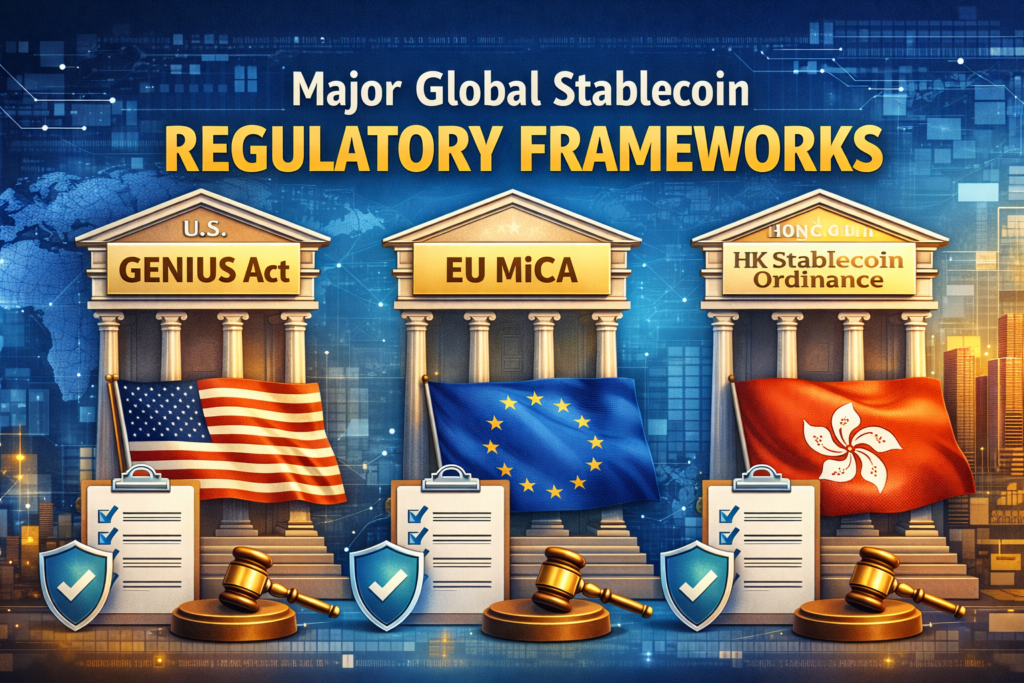
As stablecoins grow in global adoption, governments and financial regulators are working to create clear legal frameworks that govern how these digital assets operate. The goal is to encourage innovation while minimizing risks related to financial stability, consumer protection, and financial crime.
United States Stablecoin Regulation
The United States has taken a multi agency approach to stablecoin regulation. Instead of relying on a single regulatory authority, several federal agencies oversee different aspects of the market.
In recent years, lawmakers have also introduced legislative proposals aimed at establishing a unified national framework for stablecoin issuers.
The GENIUS Act and Its Impact
The Guiding and Establishing National Innovation for U.S. Stablecoins (GENIUS) Act is one of the major legislative efforts aimed at creating a clear regulatory structure for stablecoins in the United States.
The law establishes federal oversight for stablecoin issuers and allows regulated entities such as banks and licensed financial institutions to issue dollar backed stablecoins. Key provisions of the
GENIUS Act include:
- Full Title: Guiding and Establishing National Innovation for U.S. Stablecoins Act of 2025
- Bill Number: S. 1582
- Signed: July 18, 2025 by President Donald Trump
- Purpose: Establish the first dedicated federal regulatory framework for payment stablecoins; protect consumers; strengthen U.S. dollar reserve currency status; combat illicit finance
- Mandatory 1:1 reserve backing for stablecoins
- Reserves held in high-quality liquid assets, such as cash or short-term Treasury securities
- Federal licensing and supervision for issuers
- Strict disclosure and reporting requirements
European Union Stablecoin Regulation (MiCA)
The European Union has introduced one of the world’s most wide-ranging regulatory frameworks for digital assets through the Markets in Crypto Assets Regulation (MiCA). MiCA provides legal clarity for stablecoin issuers, crypto service providers, and investors across the entire EU single market. Markets in Crypto Assets Regulation (MiCA):
- Enacted: June 2023
- Stablecoin Provisions Active: June 30, 2024
- Full Implementation: December 30, 2024
- Scope: All 27 EU member states
- First wide-ranging crypto regulation globally to go fully into effect
Markets in Crypto‑Assets Regulation establishes a unified regulatory framework for cryptocurrencies and stablecoins across all EU member states. Its primary goals and objectives included:
- Harmonize crypto regulation across EU (end national patchwork)
- Protect consumers and investors
- Preserve financial stability and monetary sovereignty
- Support innovation within safe boundaries
- Prevent money laundering and market abuse
MiCA’s is grouped into two Stablecoin Categories which include:
- Electronic Money Tokens (EMTs): Electronic Money Tokens (EMTs) are a category of crypto assets defined under the Markets in Crypto-Assets Regulation. These tokens are designed to maintain a stable value by referencing the value of a single official currency such as the U.S. dollar, euro, or British pound.
- Asset Referenced Tokens (ARTs): Unlike Electronic Money Tokens, which are tied to one fiat currency, ARTs derive their stability from a broader set of underlying assets. These may include another type of financial value or right, a pool or basket of assets, or a combination of crypto assets, commodities, or other financial instruments.
Also Read: Best Cryptos to Buy in 2026: A Beginner’s Honest Guide to the Top Coins
United Kingdom Stablecoin Regulation
The United Kingdom is gradually developing a structured regulatory framework for stablecoins as part of its broader digital asset strategy.
While the country does not yet have a full stablecoin law in force, regulators have made significant progress toward establishing a clear legal structure that supports innovation while protecting the financial system.
Emerging Framework (Draft Regulations 2025)
In April 2025, the UK government published a draft Statutory Instrument outlining proposed regulations for stablecoins and other crypto related financial services. This proposal represents a key step toward integrating stablecoins into the UK’s existing financial regulatory framework.
The initiative is part of a broader strategy led by HM Treasury to bring crypto assets within regulated financial markets while maintaining the United Kingdom’s competitiveness as a global fintech hub.
At present, the UK does not have a fully enacted stablecoin law. However, regulators are actively developing detailed policy proposals that address issuance, custody, reserve management, and operational standards for stablecoin providers.
As part of this process, the Financial Conduct Authority has released consultation papers seeking industry feedback on how stablecoins should be regulated. Two of the most important consultation documents include:
- CP25/14, which focuses on requirements for stablecoin issuance and custody services.
- CP25/15, which outlines prudential standards such as capital adequacy and liquidity requirements for firms operating in the stablecoin sector.
- These consultations allow regulators to evaluate the practical implications of proposed rules before final legislation is introduced.
Singapore Stablecoin Regulation
Singapore has developed one of the clearest and most structured regulatory frameworks for stablecoins in Asia. The framework was introduced by the Monetary Authority of Singapore and officially took effect in August 2023.
It aims to support responsible innovation while ensuring stablecoins remain reliable payment instruments within the financial system. The regulations focus on Single-Currency Stablecoins (SCS).
These are stablecoins designed to maintain their value relative to a single fiat currency. The framework primarily covers stablecoins pegged to major fiat currencies such as Singapore Dollar (SGD), U.S. Dollar (USD) and Euro (EUR)
MAS Regulatory Philosophy
Singapore’s regulatory strategy is built around a risk proportionate approach. Rather than imposing blanket restrictions, MAS calibrates requirements based on the specific risks posed by each digital asset activity. This philosophy reflects two major goals:
- Encouraging financial innovation and the development of blockchain technology
- Managing potential vulnerabilities that could affect consumers or financial stability
Consumer protection remains a central priority. By enforcing strict reserve backing, operational safeguards, and transparency standards, Singapore aims to create a stable environment where digital assets can grow responsibly while maintaining strong trust in the financial system.
Hong Kong Stablecoin Regulation
Hong Kong is building a clear legal framework for stablecoins as part of its effort to become a major digital asset hub in Asia. In May 2025, the government passed a new law known as the Stablecoin Ordinance, which sets out rules for companies that issue fiat-backed stablecoins.
The law was approved by the Legislative Council and officially published (gazetted) in May 2025. Regulators expect the framework to come into force around August 2025. Once the law takes effect, companies issuing stablecoins will need to follow strict financial and operational standards.
Regulatory Guidance and Industry Consultation
Before finalizing the rules, the HKMA released a document called the Draft Guideline on Supervision of Licensed Stablecoin Issuers in May 2025. This guideline explains how licensed issuers should operate under the new law.
The regulator opened a public consultation period, which ended in June 2025, allowing industry participants to provide feedback. Based on these discussions, the HKMA is now finalizing the operational details of the framework.
Overall, Hong Kong’s stablecoin regulation aims to create a safe and transparent environment for digital assets while encouraging innovation in the region’s financial sector.
United Arab Emirates Stablecoin Regulation
The United Arab Emirates operates a dual regulatory system for stablecoins and other virtual assets. Regulation is divided between federal authorities overseeing the mainland and specialized regulators supervising crypto activities in Dubai.
On the mainland, stablecoins are primarily governed by the Central Bank of the United Arab Emirates through the Payment Token Services Regulation (PTSR). The regulation became effective in August 2024 and introduced rules for stablecoin issuance and related payment services across the UAE mainland.
Regulatory Approach
The UAE particularly Dubai has positioned itself as a crypto friendly jurisdiction with clear regulatory pathways for blockchain companies. Authorities aim to attract global stablecoin issuers and digital asset firms while maintaining strong safeguards for financial stability.
This strategy places the UAE in direct competition with leading crypto hubs such as Singapore and Hong Kong as it seeks to become a major center for digital asset innovation in the region.
Japan Stablecoin Regulation
Japan is taking a progressive approach to stablecoins and decentralized finance. The Web3 White Paper 2024 recommends reassessing the classification of tokenized membership interests under the Financial Instruments and Exchange Act and supports innovation in DAOs and stablecoin development.
The government aims to balance innovation with consumer protection, ensuring that stablecoins operate safely within Japan’s financial system. Detailed stablecoin regulations are expected in the second half of 2025, likely emphasizing transparency, full reserve backing, and AML/CFT compliance.
Japan may also develop a unique regulatory framework that builds on its advanced digital payment infrastructure, combining innovation friendly policies with strong financial safeguards.
South Korea Stablecoin Regulation
South Korea regulates stablecoins under the Virtual Assets Act, a key law that establishes a legal framework for crypto-assets, including stablecoins. Implementation of the act is ongoing, providing licensing, compliance, and operational standards for issuers and service providers.
In parallel, bank-led pilots for won-denominated stablecoins are underway, supported by the government to test practical use cases for digital payments. The proposed Digital Asset Innovation Growth Act (DAIGA) aims to clarify institutional responsibilities and enhance the Bank of Korea’s supervisory role over stablecoins.
Together, these measures are expected to create a complete regulatory framework, with full stablecoin regulations anticipated in late 2025, combining innovation support with strong oversight and consumer protection.
Brazil Stablecoin Regulation
Brazil regulates stablecoins under Law No. 14,478/2022 (Virtual Assets Law), which became effective in June 2023. This law establishes a general legal framework for virtual assets, including stablecoins, covering issuance, custody, and market operations.
To develop detailed rules, Brazilian regulators launched public consultations (ECPs 109 & 110/2024) in November 2024, gathering industry feedback on licensing, reserve requirements, and compliance measures. The consultation period concluded in February 2025.
Based on these inputs, detailed stablecoin regulations are expected in the second half of 2025, aiming to ensure that stablecoin issuance in Brazil operates transparently, with proper reserve backing, regulatory oversight, and safeguards for consumers and financial stability.
Stablecoin Types & Regulatory Treatment
Stablecoins, designed to maintain a stable value relative to a reference asset, can be broadly divided into three main types: fiat backed, crypto backed, and algorithmic stablecoins.
Each type has distinct mechanisms, market adoption, and regulatory treatment across jurisdictions. Understanding these differences is critical for investors, developers, and regulators navigating the digital asset space.
Fiat Backed Stablecoins
Fiat backed stablecoins dominate the market, representing about 97% of the total stablecoin market capitalization, which amounts to over $310 billion out of a roughly $320 billion total. This overwhelming market share underscores their importance in digital finance and payments, as well as why regulators prioritize oversight in this category.
Mechanism
Fiat backed stablecoins are fully collateralized by fiat currency or highly liquid assets. Typically, each token is backed by a 1:1 ratio with a fiat currency, most commonly the U.S. dollar.
Issuers hold reserves in bank accounts or invest in high-quality liquid assets such as Treasury bills and cash equivalents to ensure liquidity and stability.
Redemption mechanisms allow users to exchange their stablecoins for fiat at the pegged value. This feature is central to their role as a reliable medium of exchange in both crypto markets and cross border payments.
Examples
- Tether (USDT) – With a market cap of around $187 billion, Tether maintains reserves in U.S. Treasuries, cash, and repurchase agreements. The project has faced criticism over transparency and the lack of fully independent audits historically.
- USD Coin (USDC) – Issued by Circle, USDC has a market cap of around $78 billion. It is known for high transparency, monthly attestations, and compliance with MiCA regulations in the EU.
- Euro Coin (EURC) – Euro-backed stablecoin also issued by Circle and fully compliant with MiCA.
- PayPal USD (PYUSD) – Issued by Paxos for PayPal, facilitating mainstream adoption in payments.
- First Digital USD (FDUSD) – A Hong Kong-regulated USD-backed stablecoin targeting institutional and retail users.
Regulatory Status
Fiat backed stablecoins are the most regulated and generally considered the safest model. In the U.S., they fall under federal oversight via the GENIUS Act, while in the EU, they are classified as Electronic Money Tokens (EMTs) under MiCA.
Singapore, Hong Kong, and other jurisdictions also impose strict licensing, reserve backing, and transparency requirements. Regulators emphasize proof of 1:1 backing, reserve audits, and ongoing disclosures to maintain confidence.
Crypto Backed Stablecoins
Crypto backed stablecoins make up a small portion of the market, under 2% or roughly $6 billion in total market capitalization. They are primarily used within decentralized finance (DeFi) ecosystems rather than as mainstream payment tools.
Mechanism
These stablecoins are backed by other cryptocurrencies, such as Ether or Bitcoin, instead of fiat currency. To account for the volatility of crypto assets, they are typically over-collateralized. For instance, $150 worth of ETH might be held to back $100 of stablecoins. Smart contracts manage collateral automatically, triggering liquidation if the collateral value drops below required thresholds.
Examples
- DAI – Decentralized stablecoin issued by MakerDAO, backed by crypto collateral, with a market cap of $4.7 billion (declining).
- sUSD (Synthetix USD) – Backed by the SNX token within the Synthetix network.
- LUSD (Liquity USD) – ETH-backed stablecoin for lending and borrowing within the Liquity protocol.
Regulatory Status
Crypto backed stablecoins exist in a regulatory gray area. They are not explicitly covered by the GENIUS Act’s definition of payment stablecoins in the U.S., and depending on the structure, the EU may classify them as Asset Referenced Tokens (ARTs).
Their decentralized nature makes them less regulated, allowing flexibility for innovation but limiting institutional adoption. Regulatory focus is generally lower, but risks include potential security breaches, smart contract failures, and collateral mismanagement.
Algorithmic Stablecoins
Algorithmic stablecoins now make up less than 1% of the market following the collapse of TerraUSD in May 2022. Prior to that event, they represented around 3–5% of the total market.
Mechanism
These stablecoins operate without collateral or with minimal collateral. Algorithms and smart contracts adjust the supply dynamically to maintain the peg. If the token price exceeds $1, the system mints new tokens to increase supply and lower the price.
Conversely, if the price falls below $1, tokens are burned or incentives are used to reduce circulation, raising the price. The peg relies entirely on market incentives and arbitrage.
Examples
- TerraUSD (UST) – Collapsed in May 2022, causing $40 billion+ in losses.
- Ampleforth (AMPL) – Uses rebasing mechanisms to adjust supply daily.
- Frax (FRAX) – Hybrid stablecoin with partial algorithmic mechanisms.
Regulatory Status
Algorithmic stablecoins are highly scrutinized due to past collapses. The GENIUS Act in the U.S. excludes algorithmic stablecoins from the “payment stablecoin” definition, while in the EU, some may qualify as EMTs
if they reference a single official currency. Globally, regulators are considering stricter rules, potential restrictions, or outright bans. Algorithmic stablecoins are not recommended for mainstream payments due to inherent instability.
Key Requirements for Stablecoin Issuers
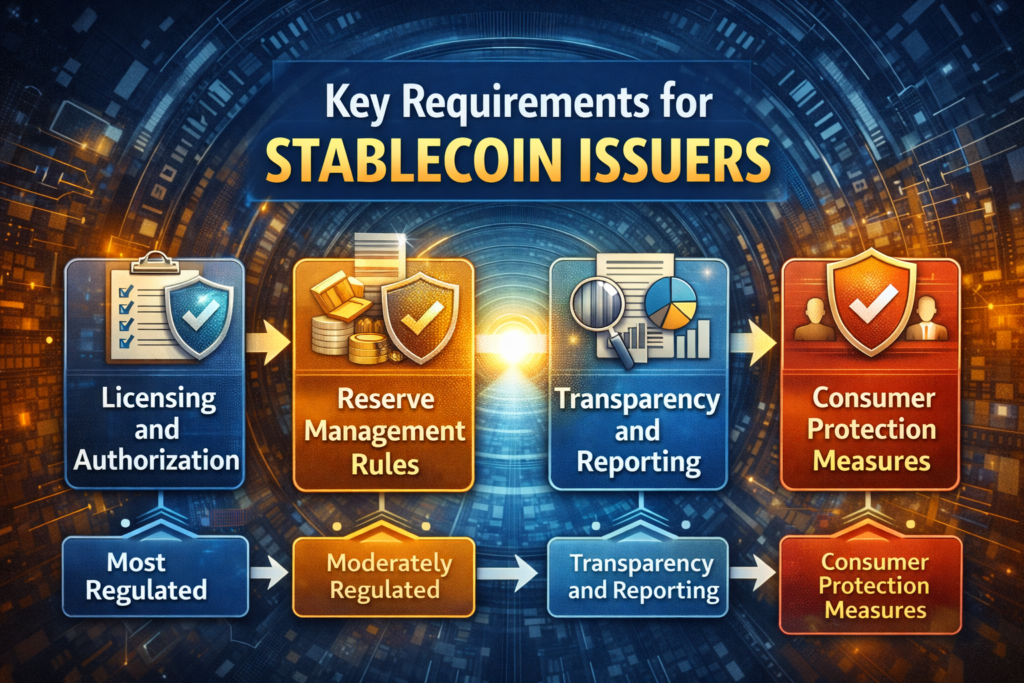
Stablecoin issuers operate at the intersection of traditional finance and blockchain technology. Because stablecoins are often used for payments, trading, and storing value, regulators around the world impose strict requirements on companies that issue them.
These rules are designed to ensure that stablecoins remain reliable, transparent, and safe for users while preventing financial instability or fraud.
Licensing and Authorization
Stablecoin issuers are generally required to obtain regulatory approval before operating. Depending on the jurisdiction, companies may need to be licensed as a financial institution, such as a bank, especially if the stablecoin functions like digital money or a payment instrument.
In some regions, issuers must operate as Electronic Money Institutions (EMIs), which allows them to issue digital money backed by fiat currency. For example, under the EU’s Markets in Crypto-Assets Regulation, issuers of certain stablecoins must meet electronic money regulations.
Many regulators also require registration as a Crypto Asset Service Provider (CASP) or similar digital asset entity. This allows authorities to supervise crypto businesses and ensure compliance with financial crime regulations.
Reserve Management Rules
Maintaining strong reserves is essential for stablecoin stability. Regulators typically require 1:1 reserve backing, meaning every token issued must be supported by assets of equal value.
These reserves must consist of high quality and liquid assets, such as cash, bank deposits, or short-term government securities. The goal is to ensure that users can redeem their stablecoins at any time.
Another key rule is the segregation of funds. Stablecoin reserves must be kept separate from the issuer’s corporate funds so that user assets remain protected even if the company faces financial problems.
Transparency and Reporting
Transparency is a core requirement in most stablecoin regulations. Issuers must regularly disclose the composition and value of their reserves so users and regulators can verify that the stablecoin is properly backed.
Independent third party audits or attestations are often required to confirm that reserves match the number of tokens in circulation. Some jurisdictions are also exploring real-time reserve reporting, allowing regulators to monitor reserve levels more frequently.
Consumer Protection Measures
Consumer protection rules ensure that stablecoin users have reliable access to their funds. One key requirement is redemption rights, meaning users must be able to exchange their stablecoins for the underlying fiat currency at the promised value.
Issuers must also provide clear risk disclosures explaining how the stablecoin works and what risks users may face. In some jurisdictions, regulators may also introduce investor protection or compensation mechanisms to safeguard users if an issuer fails.
Benefits of Stablecoin Regulation
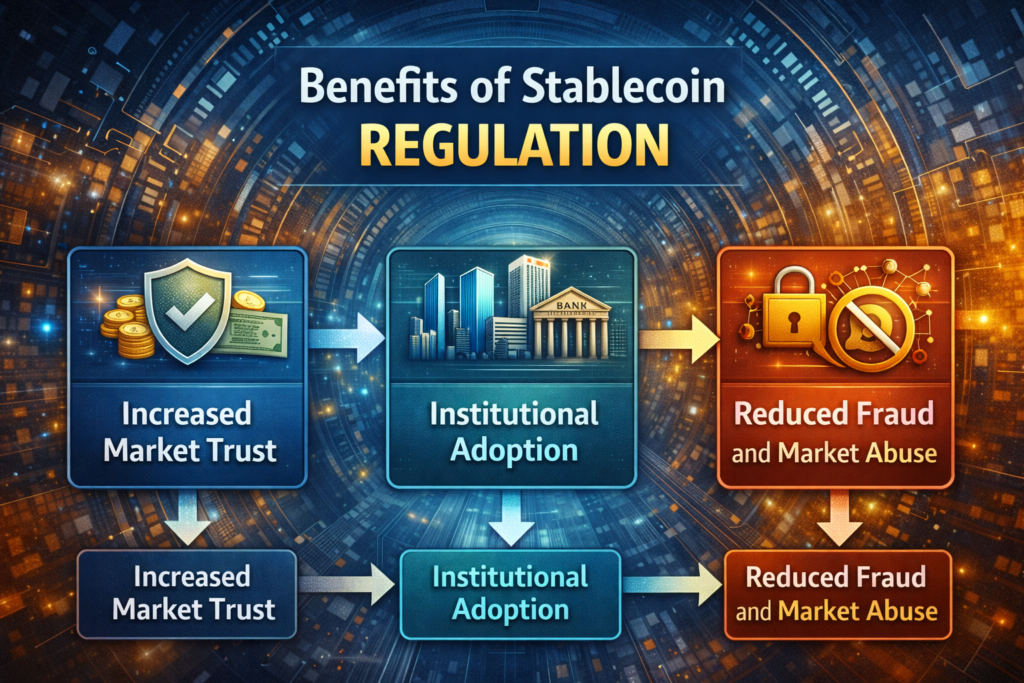
Stablecoin regulation plays a critical role in shaping a safe, transparent, and sustainable digital asset ecosystem. Because stablecoins function as digital representations of fiat currency and are widely used for payments, trading, and decentralized finance, regulators view them as potentially significant components of the global financial system.
Increased Market Trust
Regulation significantly improves trust in the stablecoin ecosystem. One of the major concerns surrounding stablecoins has historically been uncertainty about whether issuers truly hold the reserves that back their tokens. Regulatory frameworks address this issue by requiring verified reserves, periodic disclosures, and independent audits.
When regulators enforce transparency standards, users can confirm that stablecoins are actually backed by the assets they claim to hold. This reduces fears of insolvency, hidden liabilities, or reserve manipulation. Greater trust encourages wider adoption among consumers, merchants, and financial institutions.
Institutional Adoption
Stablecoin regulation plays a critical role in enabling institutional participation in the digital asset economy. Banks, payment companies, hedge funds, and multinational corporations typically require legal clarity before adopting new financial technologies. Regulatory frameworks provide that clarity by defining:
- Who can issue stablecoins
- What assets must back them
- How reserves must be managed
- What consumer protections must be implemented
This regulatory certainty allows traditional financial institutions to integrate stablecoins into their services with reduced legal risk.
Reduced Fraud and Market Abuse
Regulation helps reduce criminal activities and market manipulation within the stablecoin ecosystem. Without oversight, stablecoins could potentially be used for money laundering, fraud, or illicit financial flows.
To address these risks, regulators typically require stablecoin issuers to implement Anti-Money Laundering (AML) and Know Your Customer (KYC) procedures. These compliance programs help identify suspicious transactions and prevent illegal activities.
Challenges and Criticisms of Stablecoin Regulation
While stablecoin regulation aims to improve financial stability and consumer protection, it has also generated significant debate within the cryptocurrency industry. Regulators must balance the need for oversight with the desire to maintain innovation in the digital asset ecosystem.
Innovation vs Regulation Debate
One of the most debated issues surrounding stablecoin regulation is the balance between innovation and regulatory oversight. Supporters of regulation argue that clear rules are necessary to protect consumers and maintain financial stability.
However, critics warn that strict regulations may slow down innovation in blockchain technology. Startups and developers often move quickly to experiment with new financial models, and excessive regulatory barriers could limit this experimentation.
Over Regulation Risks
Another concern is the possibility of over-regulation, where regulatory requirements become so strict that they hinder the growth of the stablecoin industry.
For example, requiring stablecoin issuers to obtain full banking licenses or maintain extremely conservative reserve structures may significantly increase operational costs. These requirements could discourage new entrants and concentrate the market among a few large companies.
Regulatory Fragmentation Across Countries
Stablecoin regulation varies significantly across jurisdictions. Different countries are developing their own frameworks, creating a fragmented global regulatory environment.
For example, the European Union has implemented wide-ranging rules under Markets in Crypto-Assets Regulation, while the United States enacted its own framework through the GENIUS Act in 2025.
Conclusion
Stablecoin regulation has become a key aspect of the digital finance ecosystem. In just a few years, stablecoins have grown from niche crypto tools into a major component of global financial infrastructure, enabling fast and low cost digital payments while handling trillions of dollars in transactions.
However, this growth has also highlighted risks, including reserve mismanagement, algorithmic failures, and consumer protection gaps. Governments worldwide are responding with regulatory frameworks designed to balance safety and innovation.
Licensing requirements, reserve backing, transparency mandates, consumer protection measures, and anti-money laundering compliance form the foundation of these rules. By enforcing these standards, regulators aim to ensure that stablecoin issuers are accountable and that users can trust the stability of these digital assets.
FAQs
What is stablecoin regulation?
Stablecoin regulation refers to the legal rules and oversight frameworks established by governments and financial authorities to govern the issuance, management, and use of stablecoins. These regulations typically focus on reserve backing, transparency, consumer protection, and financial stability.
Why do governments regulate stablecoins?
Governments regulate stablecoins to protect consumers, prevent financial fraud, and reduce systemic risks to the financial system. Regulation also ensures that stablecoins maintain proper reserves and are not used for illegal activities such as money laundering.
Which stablecoins are most regulated?
Fiat-backed stablecoins are generally the most regulated because they directly represent traditional currencies. Examples include USD Coin and PayPal USD, which operate under regulatory frameworks that require transparency and reserve disclosures.
What are the main requirements for stablecoin issuers?
Stablecoin issuers are typically required to obtain licenses, maintain 1:1 reserve backing, provide regular financial disclosures, conduct independent audits, and implement anti-money laundering (AML) and know-your-customer (KYC) procedures.
Are algorithmic stablecoins regulated?
Algorithmic stablecoins face heavier scrutiny due to past failures such as TerraUSD. Many regulatory frameworks either exclude them from payment stablecoin definitions or subject them to stricter oversight due to their higher risk.
How does regulation benefit the stablecoin market?
Regulation can increase market trust, encourage institutional adoption, improve consumer protection, and reduce fraud. Clear rules also help stablecoins integrate more easily with the traditional financial system.