



Crypto is changing how people pay online. You’ve probably seen a “Pay with Bitcoin” option at checkout and wondered how it works, who handles the transaction behind the scenes, and whether it’s actually secure.
For online business owners, these questions matter even more. Many merchants struggle with high payment processing fees that cut into profits, while others lose customers because buyers in other countries cannot use their preferred payment method.
A BTC payment gateway helps with these problems. It lets you accept crypto payments, lowers processing costs, and makes it easier to get paid by customers anywhere in the world.
This guide breaks down exactly what a BTC payment gateway is, how it works, what it costs, and which providers are worth your time.
Key Takeaways
- A BTC payment gateway processes Bitcoin payments between customers and businesses, much like PayPal or Stripe processes card payments.
- Top providers include UPay, BitPay, BTCPay Server, and NOWPayments, each suited to different business needs.
- Fees range from 0% for self-hosted setups to roughly 1% for most managed gateways, well below typical credit card processing rates.
What Is a BTC Payment Gateway?
A BTC payment gateway is software that allows your business to accept Bitcoin as payment. Think of it as a translator sitting between your customer’s crypto wallet and your business wallet or bank account, depending on your settlement preference.
Just as traditional financial systems rely on banking payment gateways to process fiat currencies, crypto transactions depend on dedicated Bitcoin payment gateways to handle digital asset transfers efficiently.
Businesses across e-commerce, SaaS, travel, and retail are now using it as a real payment method.
In addition to facilitating payments, Bitcoin payment gateways also support the deposit and withdrawal of Bitcoin funds, along with the settlement of online Bitcoin transactions between parties.
These gateways make it simple to add crypto payments to a website without handling the technical side, and they keep transactions fast and secure.
How a BTC Payment Gateway Works: Step by Step
A BTC payment gateway works similarly to a traditional payment gateway, like Stripe processes a credit card. The difference is that instead of connecting to a bank network, it connects to the Bitcoin blockchain. Here’s what happens in a typical Bitcoin payment transaction:
Step 1: The customer chooses Bitcoin at checkout
At checkout, the customer selects Bitcoin instead of a card or bank transfer.
Step 2: The payment gateway creates an invoice
The payment gateway immediately generates an invoice containing all the payment details. This includes the exact amount of Bitcoin required, a unique wallet address for the transaction, and a QR code that mobile users can quickly scan.
Step 3: The customer completes the payment
Using their crypto wallet, the customer scans the QR code or copies the wallet address, then sends the required amount of Bitcoin.
Step 4: The blockchain verifies the transaction
After the payment is sent, the Bitcoin network processes and validates it. The network usually needs three to six confirmations before the payment counts as final, which takes about 30 to 60 minutes.
Step 5: The funds are settled
Once the blockchain confirms the payment, the gateway notifies the merchant that it is complete. The funds then settle based on the merchant’s setup: either sent straight to their crypto wallet as Bitcoin, or converted automatically to local currency and deposited into their bank account.
The whole process is automated. You don’t need to understand blockchain mechanics to accept Bitcoin payments. The gateway handles everything behind the scenes.
Why Businesses Are Using a BTC Payment Gateway
Lower Fees
Traditional credit card processors charge between 1.5% and 3.5% per transaction. BTC payment gateways typically charge 0.5% to 1%, and some self-hosted options like BTCPay Server charge nothing at all.
For a business doing $100,000 in monthly sales, that difference could mean $2,000 to $3,000 saved every single month.
No Chargebacks
Card payments expose merchants to chargebacks, where a customer disputes a charge and the money is pulled back, sometimes months later. Crypto removes this risk because blockchain transactions are final once confirmed and cannot be reversed. The blockchain also checks that the buyer has enough funds before processing, which cuts down on failed payments.
As a result, businesses receive instant and final settlement of funds, improving payment security and reducing financial uncertainty.
Borderless Payments
Bitcoin works the same way everywhere. Whether your customer is in Lagos, São Paulo, Manila, or New York, they can pay you in minutes.
You avoid costly international wire fees, eliminate the hassle of currency conversions, and bypass the banking restrictions that often delay or block global transactions.
Types of BTC Payment Gateways
Not every BTC payment gateway is the same. Here’s how they break down:
Custodial Gateways
Custodial gateways manage the payment process on your behalf by temporarily holding your cryptocurrency, converting it into fiat currency, and then transferring the funds directly to your bank account. These platforms are beginner-friendly because you do not need to manage or secure a personal crypto wallet yourself. Two well-known examples are UPay and BitPay.
Non-Custodial Gateways
Non-custodial gateways send payments directly to your personal crypto wallet without controlling your funds at any point in the transaction process. This model gives you greater ownership and independence, but it also means you are fully responsible for protecting your wallet and private keys. Platforms such as BTCPay Server operate using this approach.
Self-Hosted Gateways
Self-hosted gateways allow you to run the payment infrastructure on your own server rather than relying on a third-party provider. This setup gives you complete control over your transactions, enhances privacy, and eliminates processing fees. BTCPay Server is one of the most popular solutions in this category.
However, setting up and maintaining a self-hosted gateway usually requires technical knowledge and server management skills.
Hybrid Gateways
Hybrid gateways combine the benefits of crypto and fiat payment systems by allowing you to divide incoming payments between different destinations. For example, a platform may automatically convert 50% of a payment into fiat currency for your bank account while sending the remaining 50% to your Bitcoin wallet.
This approach helps businesses maintain stable cash flow while still keeping exposure to crypto holdings.
Top BTC Payment Gateway Providers
Here’s a quick list of the top BTC payment gateway options available today:
UPBusiness: Best for crypto-to-fiat conversion

Source: UPay.best
UPBusiness is a BTC payment gateway that lets businesses accept Bitcoin and over 50 other cryptocurrencies while settling in traditional currencies like USD. Merchants can add it through APIs, payment buttons, or e-commerce plugins.
It supports instant crypto-to-fiat conversion, which helps limit exposure to price swings, and it issues physical and virtual Visa crypto cards so balances can be spent directly.
BitPay: Best for enterprise merchants
Source: bitpay.com
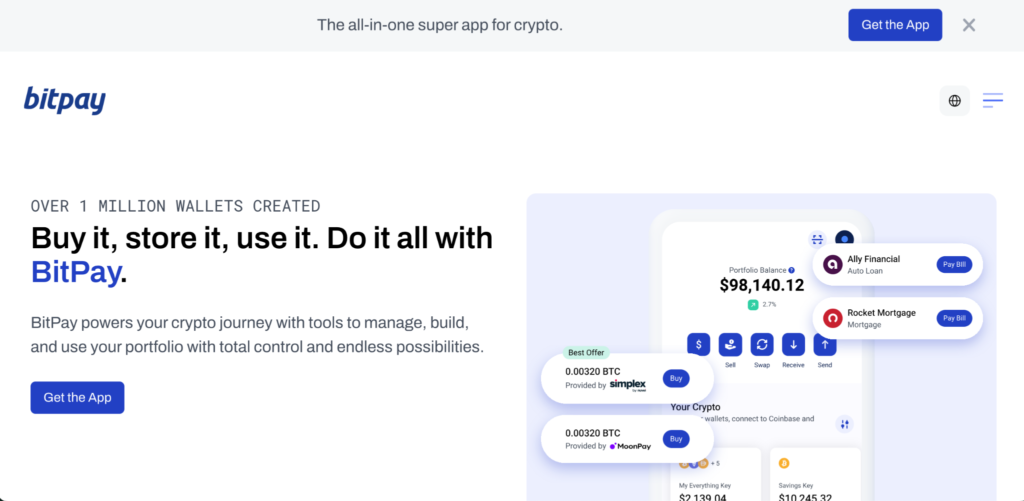
BitPay has established itself as one of the most reliable BTC payment gateways for enterprises and large-scale merchants. Global brands such as Microsoft and AMC Theatres use the platform to accept and process cryptocurrency payments, reinforcing BitPay’s reputation as a trusted industry leader.
The platform enables businesses to accept a wide range of digital assets, including Bitcoin, Ethereum, and several major stablecoins. Merchants can also benefit from daily fiat settlements in currencies such as USD, EUR, and GBP, helping reduce exposure to crypto market volatility.
BitPay integrates with leading e-commerce platforms like Shopify, WooCommerce, and Magento, which makes adoption relatively straightforward for online businesses.
The company charges 1% to 2% plus about 25 cents per transaction, with merchants under roughly $500k a month paying closer to 2%. It operates as a regulated payment service provider and follows Know Your Customer (KYC) and Anti-Money Laundering (AML) rules in the regions it serves.
BTCPay Server: Best for privacy and control
Source: btcpayserver.org
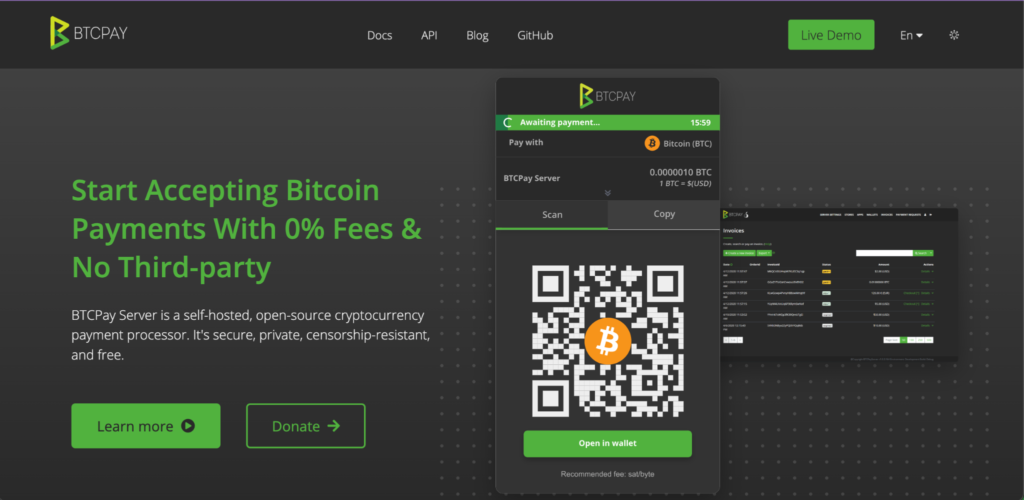
BTCPay Server provides developers and privacy-conscious businesses with a fully open-source, self-hosted crypto payment platform that gives merchants complete control over their transactions and customer data.
It supports both on-chain Bitcoin payments and the Lightning Network, so merchants can process payments quickly even when the main network is busy.
Because it is self-hosted, BTCPay Server does not charge processing fees, helping businesses avoid the extra costs commonly associated with traditional payment gateways.
Its flexible setup also lets developers customize integrations, automate invoicing, and connect it to e-commerce stores and other business tools.
NOWPayments: Best for wide crypto support

Source: nowpayments.io
NOWPayments has established itself as one of the most versatile crypto payment gateways in the market. The platform supports more than 300 cryptocurrencies, giving businesses and merchants the flexibility to accept payments from a broad range of digital asset users.
Service fees start at 0.5% for same-coin payments, with an extra fee when a conversion is needed, so a typical crypto-to-fiat payment lands closer to 1%. It also integrates with leading e-commerce platforms such as Shopify, WooCommerce, and Magento.
In addition, its 99.99% API uptime guarantee ensures reliable payment processing for businesses that depend on uninterrupted transactions.
How to Choose the Right BTC Payment Gateway
Before choosing a BTC payment gateway, consider these four key questions to find the provider that best matches your business needs.
1. Fiat Settlement or Bitcoin Payouts?
Start by deciding how you want to receive payments. If you prefer automatic conversion to fiat currency, providers like BitPay or UPay are strong options. However, if you’re comfortable receiving and holding Bitcoin directly, platforms such as BTCPay Server and NOWPayments offer greater control, increased flexibility, and lower transaction fees.
2. How Technical Is Your Team?
Your team’s technical experience should also influence your decision. Businesses looking for a simple, no-code setup will likely find UPay or BitPay easier to implement and manage.
On the other hand, developers and technically skilled teams that want complete customization and ownership often prefer BTCPay Server because of its open-source infrastructure and advanced control options.
3. Is the Gateway Compatible With Your Store Platform?
Before committing to a provider, confirm that it integrates smoothly with your e-commerce platform. Most leading BTC payment gateways support popular systems such as Shopify and WooCommerce through plugins or native integrations.
Choosing a gateway with built-in compatibility can significantly reduce setup time and technical issues.
4. Monthly Transaction Volume
Transaction volume plays a major role in determining long-term costs. For businesses processing lower payment volumes, fee differences between providers may not have a noticeable impact.
As transaction volume increases, however, even small fee reductions can lead to substantial savings.
Risks and Limitations to Know
BTC payment gateways are not perfect. Here’s what to watch for:
Bitcoin price volatility
If you keep Bitcoin after accepting it as payment, its value may decline before you convert it into fiat currency. To reduce this risk, many payment gateways provide instant conversion services that automatically exchange Bitcoin at the time of the transaction.
Transaction confirmation times
Bitcoin payments require multiple blockchain confirmations before they are finalized, which can take several minutes. This delay may slow down the checkout process for physical retail businesses.
However, the Lightning Network addresses this issue by enabling near-instant, low-cost transactions for smaller payments. Payment providers such as BitPay and BTCPay Server already support Lightning payments.
Regulatory compliance
Most leading crypto payment gateways require users to complete identity verification procedures (KYC). Regulations are also evolving rapidly across different regions.
In Europe, the MiCA framework (Markets in Crypto-Assets Regulation) is reshaping how crypto payment providers operate, while in the United States, the SEC’s Crypto Task Force continues to influence enforcement and compliance standards. Businesses should always review local regulations before integrating Bitcoin payment systems.
Irreversible transactions
Bitcoin transactions cannot be reversed or charged back once completed. While this feature protects merchants from fraudulent chargebacks, it also means businesses must handle legitimate customer refunds manually.
Frequently Asked Questions (FAQs)
What is a BTC payment gateway?
A BTC payment gateway is a service that allows businesses to accept Bitcoin as payment. It processes transactions between a customer’s crypto wallet and the merchant and can settle funds as Bitcoin or convert them to fiat currency.
How long does a Bitcoin payment take to confirm?
Bitcoin transactions typically require 3 to 6 blockchain confirmations, which takes around 30 to 60 minutes, depending on network congestion. Using the Lightning Network can reduce the time to seconds.
Is a BTC payment gateway safe?
Yes. Bitcoin transactions are secured by blockchain cryptography and are irreversible once confirmed. There is no risk of chargebacks or payment fraud from the customer side.
Can small businesses use a BTC payment gateway?
Yes. Providers like UPay and NOWPayments are designed for easy setup with no technical expertise required. Many offer free accounts with no monthly fees.