


Imagine waking up one morning and realizing that your cryptocurrency didn’t just sit idle in your wallet; it actually earned money for you while you slept. No trading, no guessing the market, no constantly checking charts. Just a quiet, steady growth in your holdings.
This is the power of crypto staking, a deceptively simple concept that is reshaping how people interact with blockchain networks.
Staking isn’t just about passive income. It’s about being part of the network itself, locking up tokens to help validate transactions, secure the blockchain, and ensure the system runs smoothly.
Every staker becomes a small but essential guardian of the network, contributing to its resilience while being rewarded for their participation. In some blockchains, staking even gives you a voice in governance, allowing you to vote on upgrades, proposals, and decisions that shape the future of the project.
Key Takeaway
- Staking generates passive income by earning rewards on your crypto holdings, making it attractive for long-term investors.
- Staked tokens help secure networks, with more participation increasing blockchain safety and reducing the risk of attacks.
- Governance participation allows stakers to vote on upgrades and proposals, giving them a direct influence on the network.
- Staking carries risks, including market volatility, slashing penalties, node performance issues, and potential exchange counterparty risks.
- Tax rules vary by region, so keeping records and consulting professionals is important to ensure compliance and optimize returns.
What is Crypto Staking?
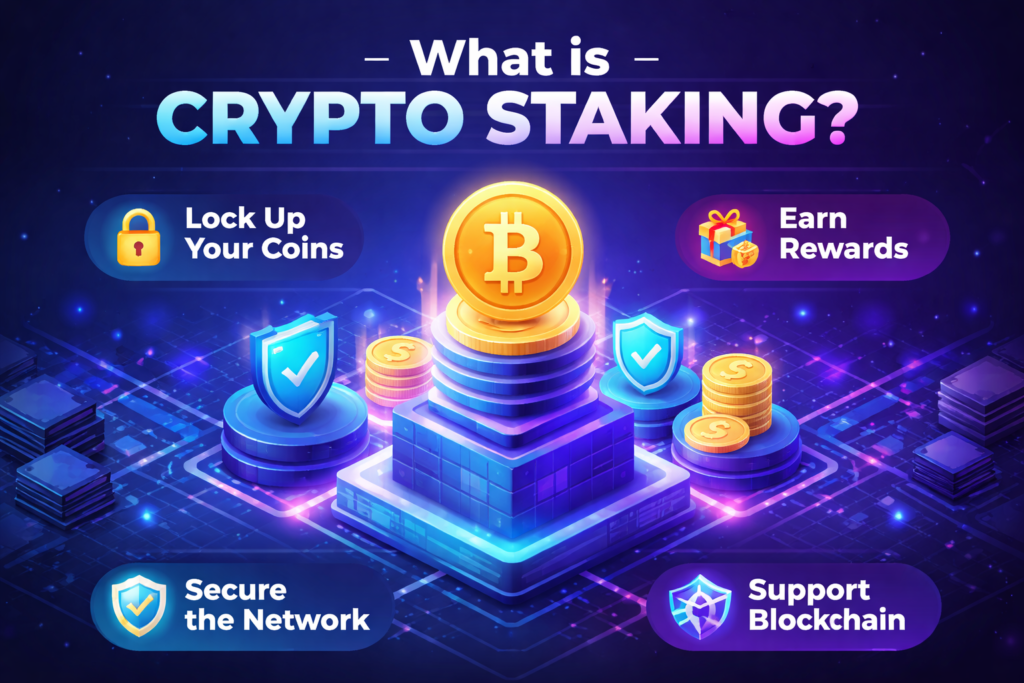
Crypto staking is a way to earn passive income by locking up your cryptocurrency to help operate and secure a blockchain network. Instead of using powerful computers for crypto mining, staking relies on users committing their coins to support the network.
In return for this support, the network rewards participants with additional crypto. This system is commonly used by blockchains that run on Proof of Stake (PoS) or similar consensus models.
Proof of Stake vs Proof of Work
Blockchains rely on consensus mechanisms to verify transactions. The two most common are Proof of Work (PoW) and Proof of Stake (PoS).
Proof of Work (PoW) requires miners to:
- Solve complex mathematical problems
- Compete using high-powered hardware
- Consume large amounts of electricity
Proof of Stake (PoS) works differently. Instead of mining:
- Validators are chosen based on how much crypto they stake
- Energy consumption is significantly lower
- The network becomes more scalable and cost-efficient
Why Stake Crypto?
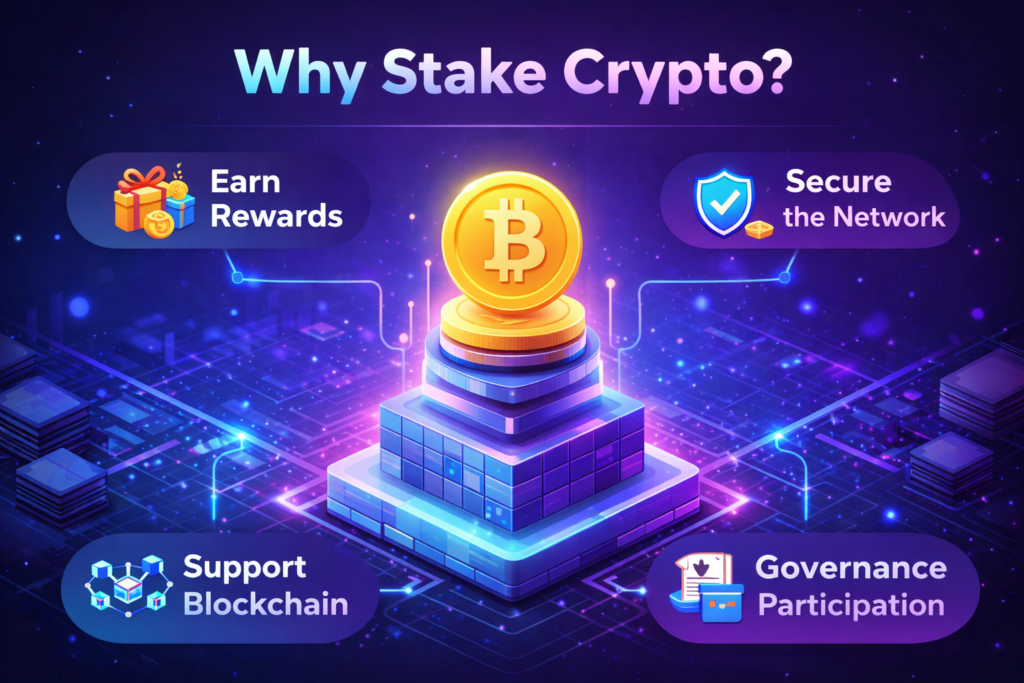
Staking cryptocurrency is more than a way to earn rewards; it’s a key part of how Proof-of-Stake networks function. Understanding why people stake can help you make smarter decisions about your crypto holdings.
Yield and Passive Income
Staking allows users to earn rewards on their holdings, often expressed as an APY. While rates vary by blockchain and validator, staking provides passive income without needing to trade, making it attractive for long-term holders.
Supporting Network Security
Staked tokens help secure the blockchain by enabling validators to confirm transactions and maintain consensus. The more tokens staked, the more resistant the network is to attacks, giving stakers a direct role in protecting the ecosystem.
Governance Participation
Many PoS networks let stakers vote on upgrades and proposals, influencing the future of the blockchain. Participating in governance aligns stakers’ interests with network health and growth.
Also Read: What Is A Stablecoin Payment Processor And How Does It Work?
Top Cryptocurrencies to Stake in 2026
| Chain | Est. APY | Inflation | Real Yield | Slashing Risk | Lock-up | Minimum Stake | Risk Level | Best For |
| Ethereum | 3.5%–5% | ~0.5% | 3%–4.5% | Low | None (exit queue) | 32 ETH | Low | Conservative long-term holders |
| Solana | 6%–8% | ~5% | 1%–3% | Medium | 2–3 days | None (delegated) | Medium | Active DeFi users |
| Polkadot | 12%–15% | ~10% | 2%–5% | Medium | 28 days | ~120 DOT | Medium–High | Yield-focused investors |
| Avalanche | 7%–9% | ~7% | 0%–2% | Low | 14 days | 25 AVAX | Medium | Balanced risk seekers |
| Cosmos | 14%–18% | ~12% | 2%–6% | Medium | 21 days | None (delegated) | Medium–High | High-yield seekers |
| Cardano | 3%–5% | ~2% | 1%–3% | Very Low | None | None | Low | Passive stakers |
| Tezos (XTZ) | 5%–7% | ~4%–5% | 1%–3% | Low | None (flexible) | None (delegated) | Low–Medium | Steady passive delegators |
| Algorand (ALGO) | 6%–8% | ~6% | 0%–2% | Very Low | None | None | Medium | Governance participants |
| NEAR Protocol (NEAR) | 8%–11% | ~5% | 3%–6% | Low | 2–3 days | None (delegated) | Medium | Growth-oriented stakers |
| TRON (TRX) | 4%–6% | ~3%–4% | 1%–3% | Very Low | ~3 days | None | Low–Medium | Lower-volatility income seekers |
| Ethena (ENA) | 8%–15% | Variable | Variable | Medium | Flexible | None | High | DeFi yield strategists |
Staking cryptocurrency is one of the easiest ways to earn passive income while supporting blockchain networks.
With the rapid growth of PoS and hybrid blockchains, 2026 offers a wide range of options for both beginners and experienced investors.
Ethereum (ETH)
Ethereum is the largest Proof-of-Stake network, offering stable, low-risk staking with strong liquidity and deep DeFi integration. It’s widely used by institutions and long-term holders.
Staking & Returns:
- APY: Averages 2.8–4.5%, depending on platform and staking method
- Inflation: Low at approximately 0.5% annually, supporting positive real yields
- Risk: Minimal slashing risk, making ETH one of the safer staking options
- Minimum Stake: 32 ETH for solo validators or as low as 0.01 ETH via pools/exchanges
- Liquidity: Withdrawals typically take 1–3 days after unstaking
Best Options & Use Case:
Stake via Coinbase, Binance, or Kraken, or use liquid staking like Lido (stETH) and Rocket Pool (rETH). Best suited for conservative stakers seeking security, liquidity, and long-term value.
Solana (SOL)
Solana is a high-performance Proof-of-Stake blockchain known for fast transactions, low fees, and a strong DeFi ecosystem.
Staking & Returns
- APY: Averages 6–9%, depending on validator and staking method
- Inflation: Around 5.5% annually, decreasing gradually over time
- Liquidity: Epoch-based unstaking (2–3 days), with instant exit available via liquid staking
Best Options & Use Case:
Stake via Phantom or Solflare wallets, Marinade or Jito for liquid staking, or exchanges like Binance and Kraken. Best suited for active DeFi users and higher-risk yield seekers.
Cardano (ADA)
Cardano is a research-driven Proof-of-Stake blockchain built for security, decentralization, and long-term sustainability, making it one of the most beginner-friendly staking networks.
Staking & Returns:
- APY: 3–5% depending on stake pool
- Minimum Stake: No minimum (just 2 ADA transaction fee + 0.17 ADA deposit)
- Lock-up Period: None; can unstake anytime
- Rewards: Distributed every 5 days (epoch)
- Inflation: Moderate (~3.5–4% annually)
- Slashing Risk: None staking is safe for beginners
Best Options & Use Case:
Stake via Daedalus, Yoroi, or Eternl wallets, or exchanges like Binance and Kraken. Best for beginners, risk-averse stakers, and long-term ADA holders.
Unique Features:
- No slashing mechanism for safer staking
- Native token staking (no wrapping required)
- 3,000+ community-run stake pools supporting decentralization
Also Read: 10 Signs an Airdrop Is a Scam and How To Avoid Them
Polkadot (DOT)
Polkadot is a Nominated Proof-of-Stake (NPoS) blockchain focused on multi-chain interoperability via parachains. Its staking system encourages active participation and governance involvement, making it ideal for long-term holders and DeFi participants.
Staking & Returns:
- APY: 12–16%, depending on validator and nomination strategy
- Minimum Stake: 120 DOT for nominators
- Lock-up Period: 28-day unbonding period
- Inflation: ~10% annually (dynamic based on staking rate)
- Slashing Risk: Medium nominators share risk; validators can lose up to 100% for misbehavior
Best Options & Use Case:
Stake via Polkadot.js, Fearless Wallet, or exchanges like Binance, Kraken, and OKX. Use liquid staking through Acala for more flexibility. Best for long-term holders, governance participants, and multi-chain believers.
Unique Features:
- Multi-chain interoperability via parachains
- Nomination system allows diversification across multiple validators
- Governance participation and on-chain treasury development
Avalanche (AVAX)
Avalanche is a high-performance Proof-of-Stake blockchain featuring sub-second finality, EVM compatibility, and customizable subnets. Its staking system is beginner-friendly with no slashing risk, making it ideal for DeFi users and developers.
Staking & Returns:
- APY: 6–9%, depending on platform and validator
- Minimum Stake: 2,000 AVAX for validators; 25 AVAX for delegators (~$675–875)
- Lock-up Period: 2 weeks to 1 year (user-selected)
- Inflation: ~3.5% annually, capped at 720M AVAX
- Slashing Risk: Non-malicious validators simply forfeit rewards
Best Options & Use Case:
Stake via Avalanche Core Wallet, exchanges like Binance, Coinbase, Kraken, or platforms like Ankr and BlueStake. Best for DeFi users, EVM-compatible developers, and subnet creators.
Unique Features:
- Sub-second finality (< 2 seconds)
- Three interoperable blockchains (X, P, C chains)
- No slashing for validators, reducing staking risk
Cosmos (ATOM)
Cosmos is the “Internet of Blockchains,” using the Tendermint BFT protocol and Inter-Blockchain Communication (IBC) to connect 50+ chains. It’s ideal for users looking to participate in a highly interoperable multi-chain ecosystem.
Staking & Returns:
- APY: 15–21% (varies by validator and platform)
- Minimum Stake: No strict minimum; typically 1 ATOM for delegation
- Lock-up Period: 21-day unbonding
- Inflation: 7–20% annually (dynamic based on staking ratio)
- Slashing Risk: Medium 0.01% for downtime, up to 5% for double-signing
Best Options & Use Case:
Stake via Keplr Wallet, or exchanges like Binance and Kraken. Best for multi-chain enthusiasts and users seeking high APY with moderate risk.
Unique Features:
- “Internet of Blockchains” vision connecting multiple networks
- Inter-Blockchain Communication (IBC) protocol for interoperability
- 50+ connected chains enabling diverse staking opportunities
Tezos (XTZ)
Tezos is a Liquid Proof-of-Stake blockchain with on-chain governance and a self-amending protocol. It’s used in NFTs and has institutional adoption from companies like Ubisoft and Red Bull.
Staking & Returns:
- APY: 5–7% depending on the platform or baker
- Minimum Stake: No minimum for delegation; 6,000 XTZ to run a baker
- Lock-up Period: None for delegators; bakers face ~15 days delay (5 cycles)
- Inflation: ~5.5% annually
- Slashing Risk: Low, minimal penalties for misbehavior
Best Options & Use Case:
Stake via Temple Wallet, or exchanges like Binance and Coinbase. Best for risk-averse stakers seeking moderate returns with governance participation.
Unique Features:
- On-chain governance and self-amending protocol
- Active NFT ecosystem
- Institutional adoption supporting credibility and stability
Algorand (ALGO)
Algorand is a Pure Proof-of-Stake blockchain emphasizing security, speed, and environmental sustainability. Governance participation is required to earn rewards, making it ideal for users interested in decision-making and long-term commitment.
Staking & Returns:
- APY: 4–5% via governance participation
- Minimum Stake: No minimum; 1 ALGO required for governance
- Lock-up Period: 3-month governance commitment periods
- Inflation: ~6% annually, decreasing over time
- Slashing Risk: None staking is safe
Best Options & Use Case:
Stake via the Algorand Wallet for governance rewards, or Binance for simpler staking. Best for users seeking low-risk, environmentally-friendly staking.
Unique Features:
- Governance participation is required for rewards
- Carbon-negative blockchain
- Institutional partnerships (FIFA, El Salvador)
NEAR Protocol (NEAR)
NEAR Protocol is a Nightshade sharding Proof-of-Stake blockchain designed for scalability and developer-friendliness, supporting JavaScript smart contracts and a rapidly growing ecosystem.
Staking & Returns:
- APY: 8–10%, depending on validator and platform
- Minimum Stake: No minimum for delegation; high threshold for validators
- Lock-up Period: 52–65 hours unbonding (2–3 epochs)
- Inflation: ~5% annually
- Slashing Risk: Medium; validators can be penalized for misbehavior
Best Options & Use Case:
Stake via NEAR Wallet, or exchanges like Binance and Coinbase. Best for medium-risk stakers interested in scalable, developer-friendly ecosystems.
Unique Features:
- JavaScript smart contracts for easy development
- Sharding for scalability
- Rapidly growing ecosystem with strong adoption
TRON (TRX)
TRON is a Delegated Proof-of-Stake (DPoS) blockchain known for high staking yields and a strong presence in entertainment and DeFi, but it has centralization concerns due to a small number of validators controlling the network.
Staking & Returns:
- APY: 4–7% depending on validator and platform
- Minimum Stake: No strict minimum for delegation
- Lock-up Period: Flexible (depends on validator or platform)
- Inflation: ~7% annually
- Slashing Risk: Low, but validator misbehavior could affect rewards
Best Options & Use Case:
Stake via TronLink Wallet or major exchanges supporting TRX. Best for high-risk, high-yield seekers willing to tolerate centralization risk.
Unique Features:
- Competitive nominal APY
- Strong entertainment and DeFi ecosystem
- Centralization risk due to the limited validator set
ETHENA (ENA)
ETHENA is a newer staking project launched in 2024 with a distinctive yield model aimed at maximizing returns for early adopters in a decentralized ecosystem.
Staking & Returns:
- APY: 10–15% depending on platform and staking method
- Minimum Stake: Platform-dependent (usually low for early users)
- Lock-up Period: Varies by platform
- Inflation: Managed by tokenomics; designed to support sustainable yield
- Slashing Risk: Medium early-stage network, validator misbehavior possible
Best Options & Use Case:
Stake via the official ETHENA platform or supported exchanges. Best for early adopters seeking high returns and willing to accept higher risk.
Unique Features:
- Distinctive staking/yield model
- Newly launched (2024), early-stage ecosystem
- High potential APY compared to established networks
Risks and Downsides of Staking
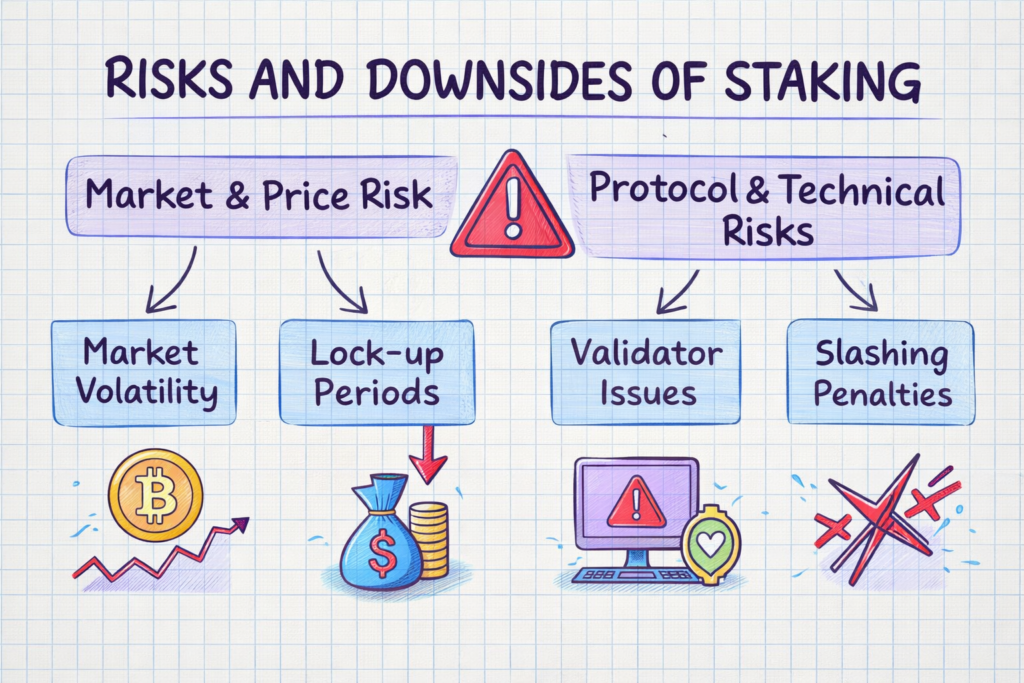
While staking cryptocurrency can provide attractive yields, it is not risk-free. Understanding potential pitfalls is essential before committing funds.
Market & Price Risk
Volatility Impact on Yield
Even if staking generates a healthy APY, the value of the underlying crypto can fluctuate sharply. High volatility may erode gains, turning nominal profits into real losses if the token price drops.
For example, staking 1 ETH might earn 4% APY, but if ETH falls 20% in USD value, the net effect is a loss. Long-term holders may benefit from staking, but short-term volatility can significantly impact returns.
Impermanent Loss on Derivatives
Some staking methods involve derivative tokens, such as stETH or rETH, which are traded on DeFi platforms. The price of these derivatives can diverge from the underlying asset, leading to impermanent loss if the derivative is sold before it converges back with the underlying asset.
Users should consider whether they plan to hold long-term or use derivatives for trading.
Protocol & Technical Risks
Slashing & Penalties
Most Proof-of-Stake networks implement slashing to punish misbehaving validators. Validators can lose a portion or all of their staked funds for downtime, double-signing, or other protocol violations, and delegators sharing a validator may also be penalized indirectly.
Risk levels vary by chain; for example, Cardano has no slashing, while Polkadot and Ethereum carry low-to-medium slashing risk.
Node Uptime / Performance Requirements
Running your own validator or delegating to an underperforming one requires understanding uptime. Downtime or misconfigured nodes can reduce rewards or trigger penalties.
Delegators should choose reliable validators with proven track records. Some chains, like Solana, have historically suffered outages, which may temporarily halt rewards.
Network Forks & Upgrades
Blockchain networks occasionally undergo hard forks or upgrades, which can impact staking. Validators may need to update software promptly to avoid penalties.
Upgrades can temporarily disrupt reward distribution or network functionality. Stakers should stay informed about network announcements and maintain node readiness if self-staking.
Security Best Practices
Protecting staked assets requires a combination of hardware, software, and operational security. Using hardware wallets for non-custodial staking is recommended.
Private keys or seed phrases should never be shared, and software for wallets, nodes, or validator setups should always be kept up to date. Monitoring staking platforms for announcements or security alerts is also essential.
Conclusion
Crypto staking offers a unique opportunity to earn passive income, participate in network governance, and contribute to the security and stability of blockchain networks.
By staking your tokens, you can transform idle assets into a source of consistent rewards while actively supporting the projects you believe in. However, staking is not without risks. Market volatility, slashing penalties, validator performance, network upgrades, and custodial considerations all play a role in determining your net returns.
Understanding these risks and choosing the right networks, validators, and staking strategies is essential to maximizing rewards while minimizing potential losses. By carefully selecting projects, keeping track of rewards, and staying informed about protocol updates and tax implications, you can confidently integrate staking into your investment strategy.
FAQs
What is crypto staking?
Crypto staking is the process of locking up your tokens in a blockchain network to help secure it, validate transactions, and maintain consensus. In return, stakers earn rewards, often expressed as an annual percentage yield (APY).
How much can I earn from staking?
Staking rewards vary depending on the blockchain, validator, and staking method. APYs can range from 2–4% on established networks like Ethereum to 10–20% on newer or specialized projects like Cosmos or ETHENA. Keep in mind that market volatility can affect the value of your rewards.
Is staking safe?
Staking is generally considered safer than trading, but it carries risks. These include market volatility, slashing penalties for misbehaving validators, downtime of nodes, network upgrades, and counterparty risk if using exchanges. Choosing reputable validators and platforms helps reduce risk.
Do I need a lot of crypto to start staking?
It depends on the blockchain. Some networks, like Ethereum, require a minimum of 32 ETH to run a solo validator, while others, like Cardano, Solana, and Polkadot, allow staking with very small amounts via delegation or pools. Many exchanges also allow staking with fractional amounts.
Can I unstake my crypto anytime?
Lock-up periods vary by network. Some chains, like Cardano and Tezos, allow almost immediate unstaking, while others, like Polkadot, have unbonding periods (e.g., 28 days). Always check the staking rules of your chosen network before committing funds.
Are staking rewards taxable?
Yes, in most countries, staking rewards are considered taxable income, even if you don’t sell the tokens. Rules vary by jurisdiction, so keeping detailed records and consulting a tax professional is important for compliance and accurate reporting.