



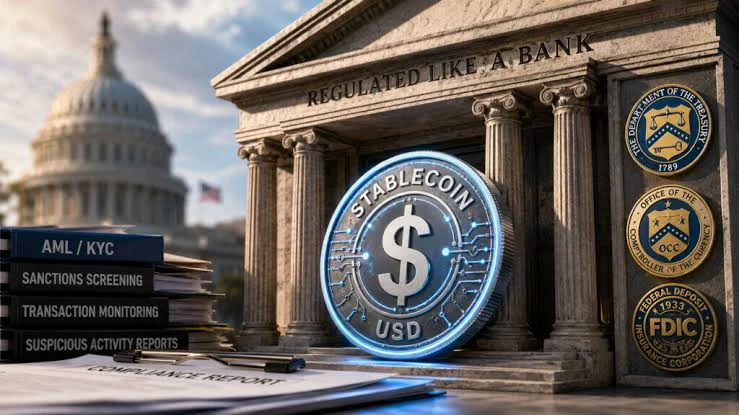
The United States has taken its first major regulatory step toward bringing stablecoin issuers under banking style customer verification rules, signaling a new phase of oversight for one of the fastest growing segments of the digital asset industry.
On June 22, federal regulators published a proposed rule that would require permitted payment stablecoin issuers to establish formal Customer Identification Programs as part of their anti money laundering compliance obligations. The proposal follows requirements contained in the GENIUS Act, the first federal law governing payment stablecoins.
If adopted, issuers would be required to verify the identity of customers who establish direct relationships with them, much like traditional banks verify customers before opening an account.
However, the proposal stops short of extending those requirements to decentralized finance platforms, wallet to wallet transfers, or most activity occurring in the secondary market.
Key Takeaways
- U.S. regulators have proposed requiring permitted stablecoin issuers to verify customer identities before offering direct services such as minting and redemption.
- The proposal was jointly issued by FinCEN, the Federal Reserve, the OCC, the FDIC, and the NCUA, with public comments open until August 21, 2026.
- The draft rule applies only to customers who have a direct relationship with a stablecoin issuer and does not extend identity verification requirements to DeFi protocols, wallet to wallet transfers, or most secondary market transactions.
- Regulators estimate that roughly 99% of stablecoin transaction activity occurs in the secondary market, leaving much of today’s stablecoin ecosystem outside the proposal’s immediate scope.
- The rule implements provisions of the GENIUS Act and marks the first major compliance framework for federally regulated payment stablecoin issuers.
Regulators Target the Issuer, Not Every Stablecoin User
The proposal was jointly released by the Financial Crimes Enforcement Network (FinCEN), the Federal Reserve, the Office of the Comptroller of the Currency, the Federal Deposit Insurance Corporation, and the National Credit Union Administration.
Rather than applying broadly across every stablecoin transaction, the draft focuses specifically on customers interacting directly with approved stablecoin issuers.
That includes activities such as minting new stablecoins, redeeming tokens for U.S. dollars, opening issuer managed accounts, or using custody services provided directly by an issuer. Under the proposal, issuers would need to establish written Customer Identification Programs designed to verify the identity of each customer before providing those services.
For individuals, verification would likely require information already familiar from traditional banking, including legal name, residential address, date of birth, and government issued identification. Businesses would be subject to comparable verification procedures.
Most Stablecoin Activity Remains Outside the Proposal
One of the report’s most notable observations is that regulators estimate approximately 99% of payment stablecoin transaction activity occurs in the secondary market.
That includes trading on centralized exchanges, transfers between self custody wallets, decentralized exchange transactions, liquidity pools, and smart contract interactions. Because those transactions generally do not involve a direct customer relationship with the issuer, they are not covered by the proposed Customer Identification Program requirements.
The agencies acknowledged that collecting customer information after stablecoins leave the issuer would be significantly more difficult, given the permissionless nature of blockchain networks. As currently written, the proposal creates two distinct compliance environments.
The first applies to issuer facing services where stablecoins enter or exit circulation. The second covers the much larger secondary market, where tokens continue moving across exchanges, wallets, decentralized finance protocols, and payment applications under existing legal frameworks.
GENIUS Act Moves Stablecoin Issuers Closer to Banks
The proposal represents one of the first major rulemakings implementing the GENIUS Act, which established a federal framework for payment stablecoins.
Under that law, approved issuers must fully back every payment stablecoin with high quality liquid reserves such as cash or short term U.S. Treasury securities while providing redemption rights to holders. The legislation also classifies permitted payment stablecoin issuers as financial institutions under the Bank Secrecy Act.
According to the proposal, Customer Identification Programs are intended to help issuers develop “a reasonable belief” that they know the true identity of every direct customer.
The Bigger Has Debate Only Started
Although the proposal focuses on issuer relationships, regulators openly acknowledge that most stablecoin activity occurs elsewhere.
That raises broader questions about whether future regulations could eventually extend identity verification requirements beyond issuers to exchanges, hosted wallets, payment providers, analytics firms, or decentralized finance interfaces. The current proposal does not assign those responsibilities.
Instead, regulators describe issuer verification as the most practical place to begin because issuers maintain ongoing customer relationships and already possess the operational infrastructure necessary to collect and verify identity information. For now, decentralized finance protocols and peer to peer transfers remain outside the proposal’s immediate scope.
Public Consultation Now Underway
The proposal has entered its formal consultation stage following publication in the Federal Register.
Interested parties, including stablecoin issuers, cryptocurrency exchanges, banks, wallet providers, compliance firms, developers, and consumer groups, have until August 21, 2026, to submit comments.
Those responses are expected to shape how the final rule defines customer relationships, issuer responsibilities, and the boundary between regulated issuer services and broader blockchain activity.
Industry participants will likely pay particular attention to whether regulators preserve the current distinction between issuer interactions and secondary market transactions or attempt to expand compliance obligations further.
Conclusion
The proposed Customer Identification Program rule marks the beginning of a significant shift in how federally regulated stablecoin issuers will operate in the United States. By requiring identity verification for customers who directly mint, redeem, or maintain accounts with issuers, regulators are moving payment stablecoins closer to the compliance standards already applied across the banking sector.
At the same time, the proposal leaves decentralized finance, peer to peer transfers, and most secondary market activity outside its immediate reach. With regulators acknowledging that nearly all stablecoin transactions occur beyond direct issuer relationships, the debate over where identity requirements should ultimately apply is far from settled. The public consultation period now provides the industry with its first opportunity to influence how that next stage of stablecoin regulation develops.