


Most people who hold crypto do one of two things with it: they trade it, or they ignore it. Both approaches miss something. If your crypto is sitting in a wallet doing nothing, it is not working for you. If you are trading constantly, you are taking on risk without a clear strategy.
A crypto savings account with card access sits between those two options. Your crypto earns interest while it sits, and a physical or virtual card lets you spend from that balance in everyday life. You do not have to sell. You do not have to wait. Your money earns and remains accessible at the same time.
This article explains the concept from scratch, shows exactly how the interest is generated, walks through how the card side works in practice, and points out the risks you need to understand before putting money in. UPay is used as the reference throughout, because UPay is built precisely for this combination of savings and spending.
What Is a Crypto Savings Account?
A crypto savings account is an account where you deposit cryptocurrency and earn a return on it over time. The mechanics mirror a traditional bank savings account: you put money in, the platform uses those funds productively in the background, and you receive interest. The key differences are the asset (crypto instead of pounds or dollars), the rate (significantly higher in most cases), and the protection (no government deposit insurance, unlike a bank).
According to CoinPaper, in 2026 crypto savings accounts “work similarly to traditional savings tools: you deposit your crypto into a platform and earn interest over time, sometimes at rates well above typical bank savings accounts.” That last part is the practical draw. A UK high-street savings account might offer 4% to 5% on cash right now. A crypto savings account on stablecoins can offer 3% to 15% depending on the product, removing underlying crypto asset volatility if you use dollar-backed stables like Tether (USDT) or USD Coin (USDC).
Stablecoins Are the Starting Point for Most Beginners
If you are new to crypto savings, stablecoins are the most sensible starting point. USDT (Tether) and USDC (USD Coin) are both pegged to the US dollar. One USDT is always worth approximately one dollar.
This means you can earn interest without worrying that the value of your principal has dropped overnight. If you deposit £1,000 worth of USDT, you still have the equivalent of £1,000 worth when you withdraw, plus the interest earned. Compare that to depositing Bitcoin and watching its value fluctuate 20% in either direction.
Where Does the Interest Come From?
This is the question that separates informed savers from uninformed ones. Interest on a crypto savings account does not appear from nowhere. It comes from one of three sources:
1. Lending Your Crypto to Borrowers
The platform lends your deposited crypto to other users or institutions who want to borrow it, typically to fund trades or cover short positions. Those borrowers pay interest. The platform keeps a margin and passes the rest to you. This is the same model traditional banks use: your savings fund someone else’s loan, and the bank shares the proceeds with you.
2. Staking on Proof-of-Stake Blockchains
For coins like ETH, SOL, and ADA, the platform stakes your crypto on your behalf to help validate blockchain transactions. The network rewards validators with new coins. Those rewards flow back to depositors as interest. According to the UPay blog on cryptocurrency earnings, Ethereum staking returned around 3.3% APY as of January 2026. As of May 2026, more than 39 million ETH tokens are staked on the Ethereum network, showing the scale of institutional confidence in this model.
3. Providing Liquidity to DeFi Protocols
Some platforms place your funds into decentralised finance protocols like Aave or Curve, which pay liquidity providers a share of trading fees. This can generate higher yields, but it also carries smart contract risk. Reputable platforms only use audited protocols and clearly disclose which method they use. Always ask before depositing.
Types of Crypto Savings Products
Here are the types of crypto savings products you should know:
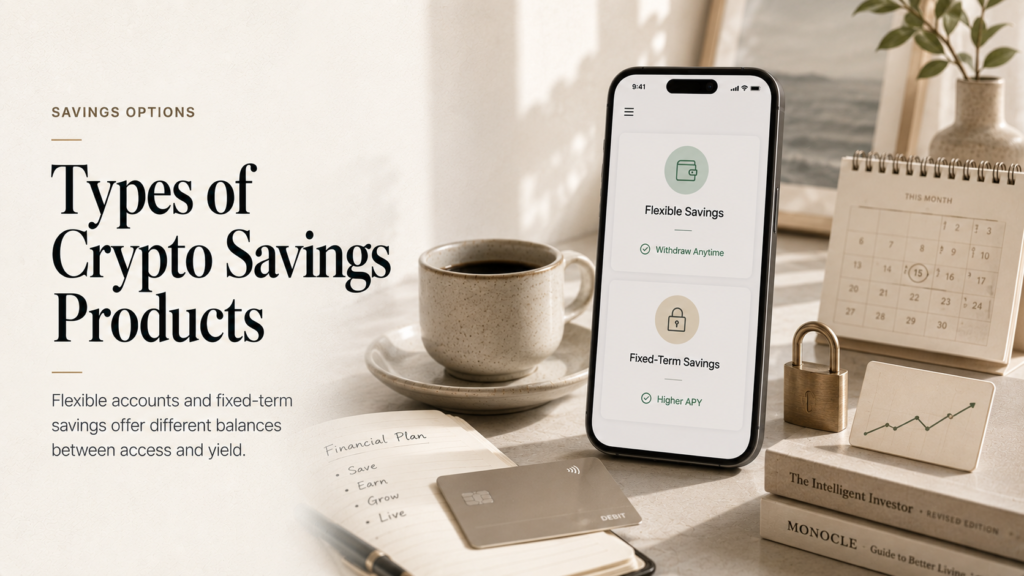
Flexible Savings
Flexible savings accounts have no lock-up period. You deposit, you earn interest daily or weekly, and you withdraw whenever you choose. The rate is lower than fixed-term products because the platform cannot count on your funds being available long enough to deploy them productively.
Nexo, for example, offers flexible options with daily compounding interest. Rates on flexible stablecoin accounts typically sit between 3% and 8%.
Fixed-Term Savings
Fixed-term accounts ask you to commit funds for a set period, anywhere from 7 days to 90 days or longer. In exchange, the rate is higher and locked in for the full term. Binance Earn and Bitget offer locked products reaching up to 15% on stablecoins for fixed periods. The trade-off is access: if you need those funds before the term ends, you may face penalties or be unable to withdraw at all.
How UPay Combines Both
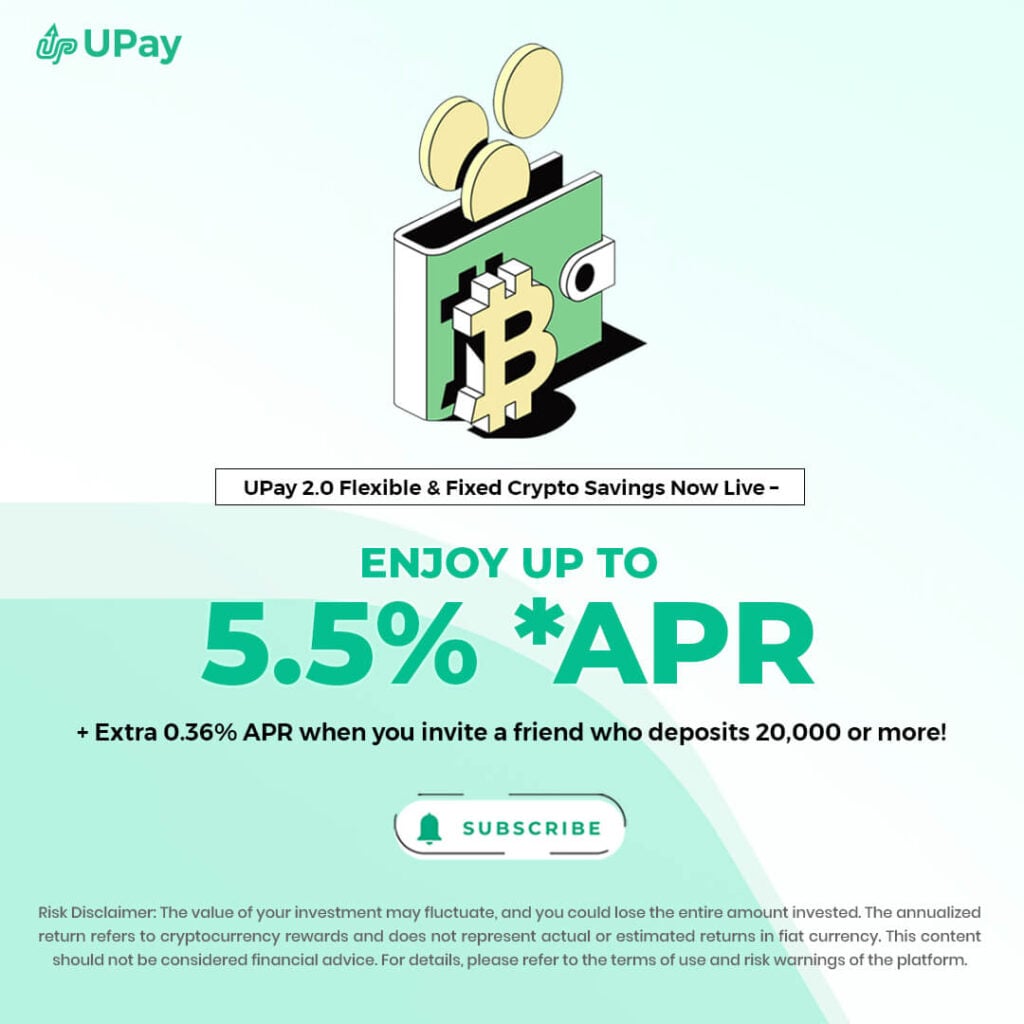
UPay’s model is designed to give you the best of both. According to the UPay blog on crypto card fees, the UPay Card lets you lock idle crypto including BTC, ETH, USDT, and USDC for short periods ranging from 3 to 30 days to earn daily interest. The portion you lock earns interest every day. The portion you do not lock stays on your card and is ready to spend. You choose the balance between savings and spending based on what you actually need.
This avoids a common problem with other savings platforms: having to choose between earning and spending. With UPay, you split your balance. Lock what you do not need this month. Spend freely from what you do.
What Interest Rates Look Like in 2026
The chart above shows the realistic range of returns by asset. A few things to note. First, variable rates can change quickly. A platform advertising 12% on USDT today may reduce that to 4% next month if lending demand drops. Second, the highest advertised rates are usually for fixed-term products. Flexible accounts consistently offer lower rates. Third, stablecoins earn higher rates than major coins like Bitcoin because stablecoins are in higher demand for lending purposes.
If you want rate certainty, use a fixed-term product where the rate is locked at the point of deposit. If you want full access to your funds at any time, accept the lower variable rate of a flexible account.
What Card Access Actually Means
A crypto card removes the biggest practical barrier to using crypto savings in everyday life. Without a card, accessing your savings means initiating a withdrawal, waiting for it to clear, converting the crypto to fiat, and transferring it to a bank account. That process can take hours and often costs fees at multiple steps.
With a card, none of that is necessary. You tap the card at a shop or enter the details online. The platform converts the required amount of crypto to fiat at the point of sale and settles the transaction. From the merchant’s point of view, it is a standard card payment. From your point of view, you just spent crypto without selling it in advance or touching a bank.
According to CryptoNews, Coinbase has done this particularly well by integrating its USDC savings account directly with a Visa debit card. Users earn around 4.1% APY on USDC while holding it, and the card provides access whenever needed. UPay operates on the same principle but adds the short-term locking feature to boost the yield on funds that are not immediately needed.
Many crypto cards allow you to earn cashback rewards into cryptocurrencies of your choice for everyday spending. After earning stablecoin rewards, this balance can be used for earning yield through DeFi, or for sending money abroad without paying unnecessary fees, or simply converted back into fiat currency.
A Real Example: Kemi’s Monthly Budget
Kemi is a freelance designer based in London. She gets paid in USDT by international clients because it is faster and cheaper than bank transfers. At the start of each month, she receives the equivalent of £2,400 in USDT.
She knows she will need roughly £800 for living expenses over the month. The other £1,600 she will not need until the following month at the earliest. Here is what she does:
- She keeps £800 in USDT on her UPay card, ready to spend.
- She locks £1,600 in a 30-day fixed-term savings position at 10% APY.
- Over 30 days, her locked USDT earns approximately £13.33 in interest (£1,600 at 10% APY divided by 12 months).
- She uses her UPay card for everyday purchases throughout the month. Each transaction converts USDT to pounds automatically.
- At the end of the month, her locked funds are released with interest. She repeats the process.
In a year, Kemi earns roughly £160 in interest on the £1,600 she locks each month. That is money she would have left on the table if she had just held USDT in a plain wallet. The card access means she never had to plan around lock-up periods for her spending money.
How to Get Started: Step by Step
- Create your UPay account. Visit upay.best and sign up. Have your government-issued ID ready for identity verification (KYC). The process takes minutes.
- Fund your account. Transfer USDT, BTC, ETH, or another supported coin from your existing wallet. UPay supports over 30 coins. You can also buy crypto directly through the app.
- Decide on your split. Work out how much you need for day-to-day spending this month. That amount stays on your card. The rest goes into a savings lock.
- Lock your savings. Choose your lock period (3 to 30 days on UPay) and confirm. Interest starts accruing daily from the moment you lock.
- Apply for your card. Apply for the UPay card through the app. The card links directly to your account balance. Use it anywhere Visa is accepted.
- Spend and monitor. Use the card normally. Check your interest earnings in the app. When your lock period ends, review your situation and decide whether to lock again or leave the funds flexible.
The Risks You Must Understand
This section is not optional reading. A crypto savings account is not a risk-free product.
No Government Protection
Traditional UK savings accounts are protected up to £85,000 by the Financial Services Compensation Scheme (FSCS). Crypto savings accounts have no equivalent. If the platform fails, there is no government guarantee. According to The College Investor, “unlike bank accounts, crypto funds are not covered by deposit insurance, and yields can vary based on market conditions and platform mechanics.” Celsius, one of the largest crypto lending platforms, collapsed in 2022 and users lost access to their funds for an extended period. Choose well-established platforms.
Variable Rates Can Drop
A variable interest rate can fall significantly without much warning. A platform showing 12% today may reduce that to 4% next month if lending demand drops. If you need rate certainty, use a fixed-term product. If you use a flexible account, check the rate regularly.
Tax on Interest
In the UK, interest earned on crypto savings accounts is treated as income by HMRC. You need to declare it. Keep records of every interest payment including the pound-equivalent value at the time of receipt. Speak to a tax professional who has experience with digital assets if you are unsure how this applies to your situation.
Platform Risk
The platform itself is a risk. Hacks, regulatory action, and insolvency have all affected crypto platforms in recent years. To reduce this risk: use platforms that publish regular proof-of-reserves audits, are registered with relevant financial authorities in your country, and have a track record of reliability.
What to Look for When Choosing a Platform
- Proof of reserves: The platform should publish regular independent audits proving it holds the assets it claims. Ledn publishes monthly Open Book Reports and biannual proof-of-reserves attestations from a third-party accountant.
- Clear explanation of how yield is generated: Lending, staking, or DeFi liquidity provision are all legitimate. But the platform must say clearly which it uses. If they do not explain it, do not deposit.
- Regulatory registration: Check whether the platform is registered with or regulated by a financial authority in your country. In the UK, look for FCA registration, and in the EU, look for MiCA compliance. Note that these frameworks monitor business compliance and still do not provide bank-style deposit guarantees.
- Card integration: Confirm the card is genuinely linked to your savings balance, not a separate account requiring manual transfers. A good platform lets you move between the card and savings without manual transfers.
- Security: Two-factor authentication (2FA), cold storage for the majority of assets, and encrypted communications are the baseline. These are not optional features.
- Flexible withdrawal: For flexible accounts, you should be able to withdraw without a lengthy waiting period. Know the terms before you lock anything.
A variety of payment methods is essential when choosing a crypto savings account platform. Look for platforms that support multiple options such as bank transfers, credit cards, and other cryptocurrencies. Security is paramount when choosing a crypto savings account platform, as these platforms typically hold your assets for extended periods. Ensure that the platform uses advanced security measures, such as two-factor authentication, cold storage, and strong encryption.
FAQ
How often is the interest paid out?
It depends on the platform and the product type. On flexible accounts with platforms like UPay or Nexo, interest compounds daily, meaning your earnings are added to your balance every single day and start earning on themselves straight away. On fixed locked products, where you commit funds for a set period of 7, 30, or 90 days, the interest is usually distributed at the end of the term in one payment. If you are comparing platforms, always check whether the rate quoted is paid daily, weekly, or at maturity, because the same 10% APY paid daily compounds into more than 10% over a year, while end-of-term payment gives you exactly the stated rate and nothing more.
Can I lose my principal if I only hold stablecoins like USDT or USDC?
Yes, you can, and this is one of the most important things to understand before depositing anything. Stablecoins do not carry the usual crypto price risk because they are pegged to the US dollar, so your balance will not drop because the market crashed. But they carry two other risks that are often overlooked.
The first is Platform Risk. If the company holding your funds goes insolvent, gets hacked, or collapses, your deposits are at risk. This is exactly what happened to Celsius users in 2022. There is no government compensation scheme like the UK’s FSCS covering crypto savings accounts.
The second is De-pegging Risk. A stablecoin’s dollar peg depends on its collateral and banking relationships. If those break down, the coin can lose its $1 value. USDC briefly de-pegged in March 2023 when its reserve bank, Silicon Valley Bank, collapsed. It recovered, but for a period users holding USDC saw its value drop. Understanding both risks is essential before committing funds to any savings product.
If I live in the UK and save in USD stablecoins, is it completely risk-free?
No, and there is one specific risk that UK-based savers often miss: Foreign Exchange (FX) Risk. When you hold USDT or USDC, your savings are denominated in US dollars. If the British pound strengthens against the dollar while your money is sitting in that account, the pound value of your savings will fall even if your dollar balance has grown. For example, if you earn 10% interest in USDT over a year but the pound strengthens by 8% against the dollar during that same period, your real purchasing power in UK shops has only increased by around 2%. When your UPay card converts your stablecoin balance to pounds at the checkout, it uses the live exchange rate at that moment. A stronger pound means fewer pounds per dollar, and that affects every transaction you make.
Do I have to pay taxes on my crypto interest?
Yes. HMRC treats interest earned from crypto savings accounts as Miscellaneous Income, not as a capital gain. This means it is taxed at your marginal income tax rate in the year you receive it, the same way bank interest is taxed. The key obligation is that you must record the pound sterling value of each interest payment at the exact moment it hits your account, not at the end of the year and not at withdrawal. If you receive 50 USDT in interest on a Tuesday morning, you record what 50 USDT was worth in pounds at that precise time. Tools like Koinly and Cointracker can automate this tracking if you connect your account. If your total crypto income and gains exceed your annual allowances, you are required to file a self-assessment tax return. When in doubt, speak to a tax professional who has experience with digital assets.
What is the difference between saving on a platform like UPay versus a protocol like Aave?
This is the difference between CeFi and DeFi, and it matters practically, not just technically.
UPay is a CeFi platform, which stands for Centralised Finance. The company holds your funds in custody, manages the yield generation on your behalf, provides customer support, and presents everything through a clean app interface. You do not need a crypto wallet, you do not need to understand how blockchain transactions work, and there is a team you can contact if something goes wrong. The trade-off is that you are trusting the company with your assets, the same way you trust a bank.
Aave is a DeFi protocol, which stands for Decentralised Finance. There is no company in the middle. Your funds are held by smart contracts on the Ethereum blockchain, governed by code. You connect your own self-custodial wallet like MetaMask, interact directly with the protocol, and earn yield without any intermediary taking a cut of your returns. If something goes wrong with the code, there is no customer support line to call and no deposit protection. It requires a higher level of technical understanding and personal responsibility.
For a beginner, CeFi platforms like UPay are the sensible starting point. For users who are comfortable managing their own wallets and understand smart contract risk, DeFi protocols like Aave offer more transparency and potentially higher returns. The right choice depends entirely on your level of experience and how much control you want over your own funds.
Putting It Together
A crypto savings account with card access solves a real problem. It takes assets that most people leave sitting idle and puts them to work. The card access solves the other half of the problem: your savings are not just accumulating in an account you cannot reach. You can spend from your balance in any shop, online platform, or payment terminal that accepts Visa.
The concept is simple. The execution requires choosing the right platform. Use established providers, understand how your interest is generated, keep track of the tax implications, and only lock funds you genuinely do not need during the lock period.
UPay combines the savings and card features into one product.
To get started, visit upay.best.
For further reading on staking stablecoins, the UPay blog has a detailed guide at blog.upay.best/how-to-stake-stablecoins.
For a comparison of crypto card fees and features, see blog.upay.best/crypto-card-fees.