



Bitcoin and Ethereum sit at the top of the cryptocurrency market, and between them they account for more than half of the entire crypto market cap. Most people have heard of both. Far fewer people actually understand what makes them different, why both exist, and which one fits which purpose.
The confusion is understandable. Both are decentralized, both use blockchain technology, and both are bought and sold on the same exchanges. But under the surface, Bitcoin and Ethereum are built for different things, operate differently, and represent fundamentally different visions for what blockchain technology should do.
Bitcoin is digital money. It is designed to be a store of value and a medium of exchange that no government or bank controls. Ethereum is a programmable blockchain. It is a platform for building decentralized applications, running smart contracts, and powering an entire ecosystem of financial and non-financial services.
These are not competing versions of the same product. They are different tools that happen to share some underlying technology. Understanding that distinction is the starting point for understanding everything else in this comparison.
This article covers where each one came from, how each one works, how they compare on every major dimension from security to fees to use cases, and what the data actually shows about each network in 2026.
Key Takeaways
- Bitcoin and Ethereum are not competing versions of the same product. They are built for different purposes and solve different problems.
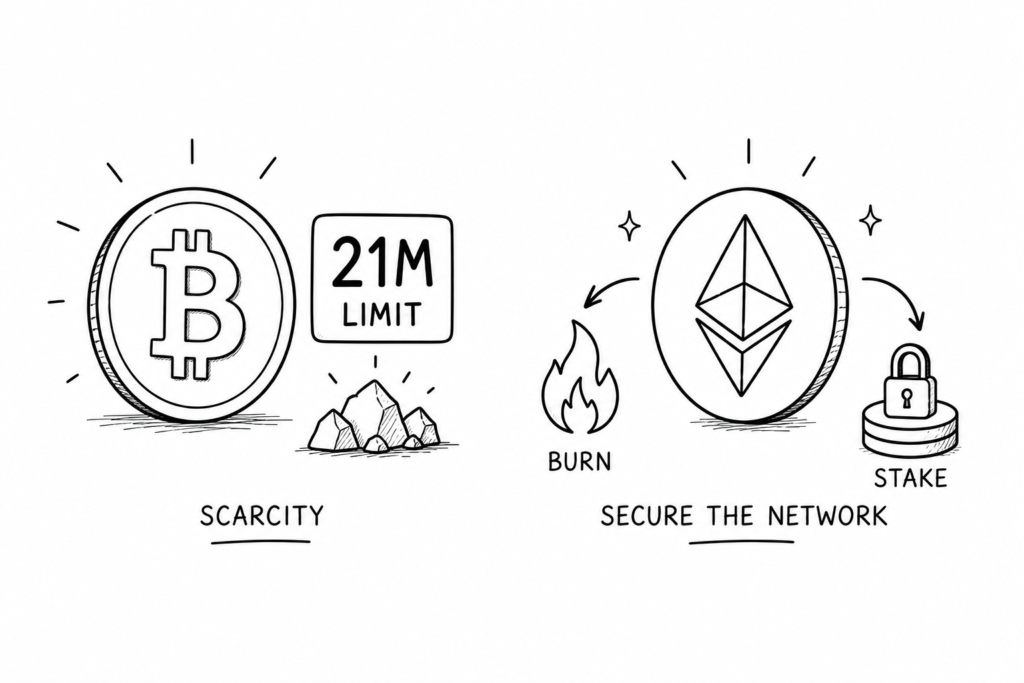
- Bitcoin has a fixed supply of 21 million coins. Ethereum has no hard cap but can become deflationary when network activity is high enough to burn more ETH than is issued.
- Ethereum switched from proof of work to proof of stake in September 2022, cutting its energy consumption by approximately 99.95%. Bitcoin still uses proof of work and consumes an estimated 170 to 210 terawatt-hours of electricity annually.
- Bitcoin has the stronger regulatory clarity and institutional backing in 2025. Ethereum has the largest developer community and powers the majority of DeFi, stablecoin, and NFT activity across the crypto market.
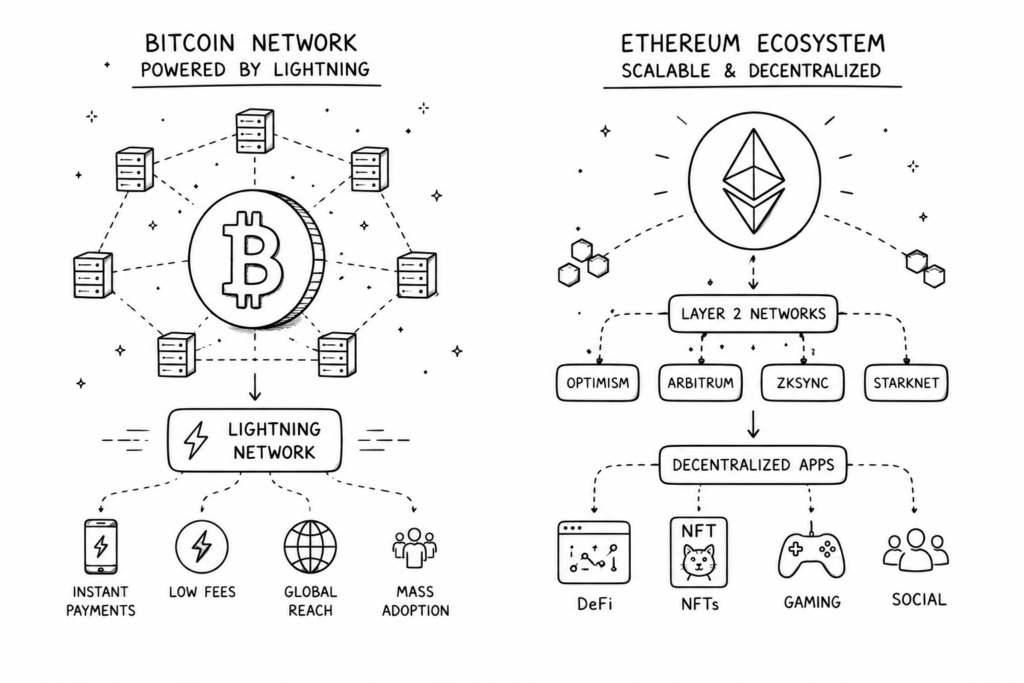
- Both networks rely on Layer 2 solutions to scale. Bitcoin uses the Lightning Network for fast, cheap payments. Ethereum uses rollups like Arbitrum and Optimism to handle high transaction volumes at low cost.
Bitcoin vs Ethereum: Head-to-Head Comparison
Below is a direct summary of how Bitcoin and Ethereum compare on every major dimension.
| Feature | Bitcoin (BTC) | Ethereum (ETH) |
| Purpose | Digital money and a store of value | Programmable blockchain platform |
| Launch Year | 2009 | 2015 |
| Creator | Satoshi Nakamoto (anonymous) | Vitalik Buterin and co-founders |
| Consensus Mechanism | Proof of Work (PoW) | Proof of Stake (PoS) since September 2022 |
| Supply Cap | Hard cap of 21 million coins | No hard cap, but includes deflationary mechanisms |
| Current Supply | Approximately 19.9 million BTC in circulation | Approximately 120 million ETH in circulation |
| Block Time | Approximately 10 minutes | Approximately 12 seconds |
| Base Layer TPS | Around 7 transactions per second | Around 15–30 transactions per second |
| Smart Contracts | Very limited scripting capabilities | Full Turing-complete smart contract support |
| Programming Language | Bitcoin Script | Solidity (primarily) |
| Energy Use | Approximately 170–210 TWh annually | Less than 0.01 TWh annually |
| Use Case | Store of value, payments, and cross-border transfers | DeFi, NFTs, stablecoins, and decentralized applications |
| Scaling Approach | Lightning Network | Layer 2 rollups |
| Regulatory Status | Generally recognized as a commodity in the United States | Regulatory classification remains somewhat contested |
| Developer Activity | Smaller, more conservative development community | Largest developer community in crypto |
| Institutional Products | Spot ETFs available in the US and other markets | Spot ETFs available in the US and other markets |
Origins and History

Bitcoin: The First Blockchain
Bitcoin arrives in October 2008 in the form of a nine-page white paper published under the name Satoshi Nakamoto. The title is “Bitcoin: A Peer-to-Peer Electronic Cash System.” The timing matters. The paper comes out weeks after Lehman Brothers collapses and the global financial system enters crisis.
The embedded message in Bitcoin’s first block, mined in January 2009, reads: “The Times 03/Jan/2009 Chancellor on brink of second bailout for banks.” That is not an accident. Bitcoin is built as a direct response to the failure of centralized financial institutions.
Satoshi Nakamoto’s identity remains unknown to this day. Whether Satoshi is one person or a group, they step away from active development around 2010 and hand control of the codebase to the open-source community.
No single person or organization controls Bitcoin development. The Bitcoin Core development team maintains the reference software, but any proposed change requires community consensus to be adopted.
Bitcoin’s early years are experimental. It is used on forums, traded between enthusiasts for almost nothing, and famously used to buy two pizzas for 10,000 BTC in 2010. It takes years for mainstream awareness to build.
By 2017, Bitcoin reached $20,000 for the first time during a speculative boom. By 2021, it peaked above $68,000. In 2025, Bitcoin climbed beyond $120,000 as spot ETFs, institutional investors, and public companies accelerated adoption.
Currently in 2026, despite market volatility, Bitcoin remained a major global asset, with banks, corporations, and investment funds increasingly treating it as a long term reserve and strategic financial instrument.
Ethereum: Programmable Blockchain
Ethereum starts with a 19-year-old programmer named Vitalik Buterin. Buterin is a Bitcoin enthusiast who becomes frustrated with Bitcoin’s limited scripting capabilities. He wants a blockchain that can run arbitrary programs, not just transfer value. He publishes the Ethereum white paper in late 2013 and the network launches in July 2015.
The core idea is simple but powerful: take blockchain technology and add a Turing-complete programming language.
This allows anyone to write a program (called a smart contract) that lives on the blockchain, executes automatically when conditions are met, and cannot be changed or censored once deployed.
The first major test of Ethereum’s capabilities and its governance comes in 2016. A project called The DAO raises $150 million in Ether through a crowdfunding mechanism on Ethereum. A hacker exploits a vulnerability in The DAO’s smart contract code and drains approximately $60 million worth of Ether.
The Ethereum community faces an impossible choice: let the hack stand and accept the loss, or roll back the blockchain to recover the funds.
The community votes to roll back, creating a fork in the chain. The main chain that rolls back the hack becomes Ethereum. The chain that refuses to roll back continues as Ethereum Classic (ETC).
This event shapes Ethereum’s reputation and highlights a core tension in blockchain philosophy: immutability versus pragmatism.
Ethereum undergoes its biggest technical change in September 2022. “The Merge” transitions Ethereum from proof-of-work mining to proof-of-stake validation.
This is a fundamental change to how the network operates, and it has significant implications for energy consumption, security, and tokenomics that the comparison sections cover in detail.
Core Purpose and Philosophy
What Bitcoin Is Actually For
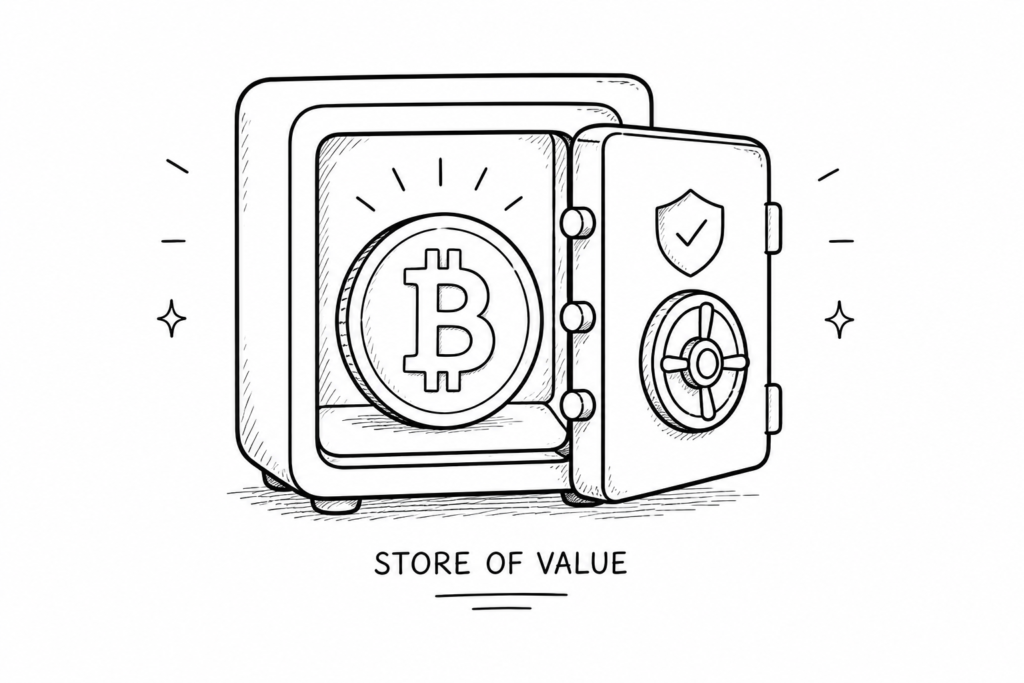
Bitcoin is designed to do one thing well: transfer value between people without requiring a trusted third party. The entire design philosophy centers on simplicity, security, and predictability. Every technical decision in Bitcoin is made with those priorities in mind.
Bitcoin believers often call it “digital gold.” This comparison captures the intended use case well. Gold is valuable because it is scarce, durable, portable, and not controlled by any single government. Bitcoin has those same properties in digital form.
The total supply is capped at 21 million. New Bitcoin enters circulation through a fixed, predictable schedule. The rate of new issuance cuts in half approximately every four years in an event called the halving. The most recent halving occurred in April 2024, reducing the block reward from 6.25 BTC to 3.125 BTC.
Bitcoin’s value proposition rests on scarcity and decentralization. Nobody can print more Bitcoin. Nobody can freeze your Bitcoin wallet. Nobody can reverse a Bitcoin transaction.
These properties make Bitcoin attractive as a hedge against inflation, a way to store wealth outside the traditional financial system, and a way to move large amounts of value across borders without intermediaries.
Bitcoin deliberately resists adding complexity. Proposals to expand Bitcoin’s functionality have consistently been rejected by the community in favor of keeping the base layer simple and stable. The argument is that complexity introduces risk, and the base layer needs to be as secure and predictable as possible.
What Ethereum Is Actually For
Ethereum is designed to be a world computer. The goal is not just to transfer value but to run programs on a decentralized network that no single party controls. Ethereum’s programmability is what separates it from Bitcoin at a fundamental level.
Smart contracts are the mechanism that makes this work. A smart contract is a program stored on the Ethereum blockchain.
It runs automatically when the conditions in the code are met. No one needs to trust the other party because the code executes exactly as written, on a network distributed across thousands of computers worldwide.
This capability opens up an enormous range of applications. Decentralized exchanges let users trade tokens without a central authority holding their funds. Lending protocols let users borrow against crypto collateral without a bank or credit check.
NFT marketplaces allow creators to sell digital items with provable ownership. DAOs (Decentralized Autonomous Organizations) let communities govern shared treasuries and protocols through token-based voting.
Ethereum’s philosophy is that decentralized, programmable infrastructure should be available for building any application that benefits from being trustless and transparent. The trade-off is complexity. Ethereum is harder to understand, harder to develop for, and carries more surface area for potential bugs than Bitcoin.
Technical Architecture
Bitcoin’s Technical Design
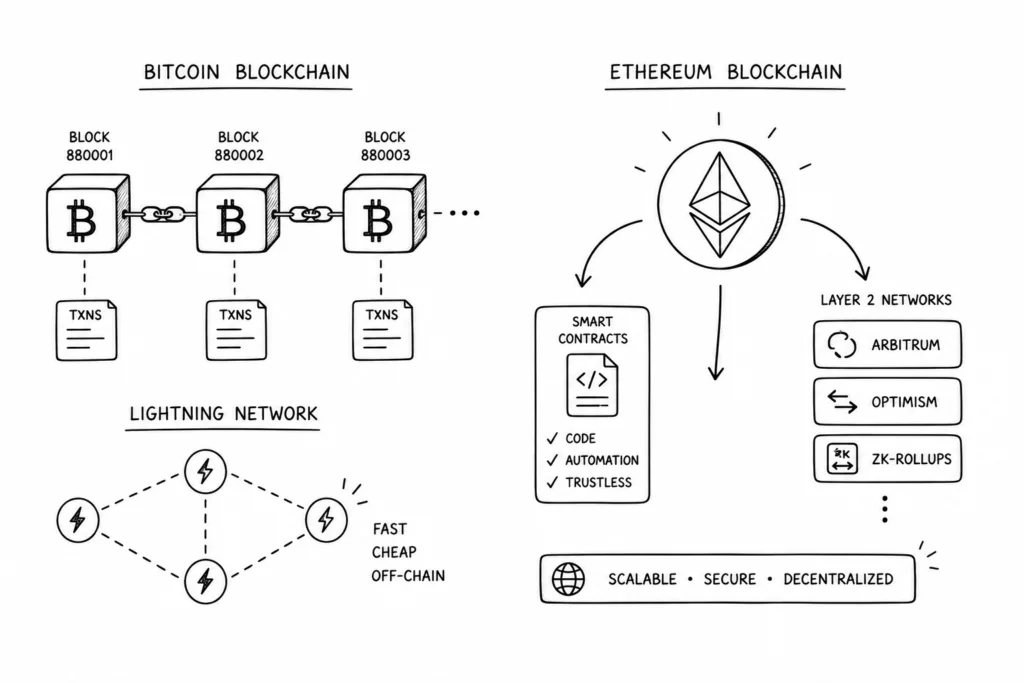
Bitcoin operates on a blockchain where blocks of transactions are added approximately every 10 minutes. Each block contains a batch of transactions, a reference to the previous block, and a proof of work that demonstrates the computational effort spent to create it.
The block size is limited to approximately 4 megabytes (with SegWit accounting), which restricts the number of transactions that fit in each block. This limitation is intentional.
A smaller block size keeps the blockchain manageable for individuals to download and verify, supporting decentralization. The trade-off is throughput: Bitcoin processes around 7 transactions per second on its base layer.
Bitcoin uses the SHA-256 hashing algorithm for its proof-of-work system. Miners compete to find a number (called a nonce) that makes the block’s hash meet a difficulty target. This process requires enormous computational effort but is trivial to verify, which is the key property that makes proof-of-work secure.
The Lightning Network is Bitcoin’s primary scaling solution. It operates as a Layer 2 network built on top of Bitcoin. Users open payment channels between each other by locking Bitcoin in a multisignature address.
Transactions within that channel happen instantly and cheaply, without touching the main blockchain. Only the opening and closing of channels are recorded on-chain. The Lightning Network enables Bitcoin to handle millions of transactions per second in theory, with fees measured in fractions of a cent.
Bitcoin Script, the programming language built into Bitcoin, is intentionally limited. It can handle basic conditions like time locks and multisignature requirements but is not Turing-complete. This means Bitcoin cannot run arbitrary programs on its base layer, which is by design.
Ethereum’s Technical Design
Ethereum’s architecture is significantly more complex. The Ethereum Virtual Machine (EVM) is the environment in which all smart contracts execute.
Every node on the Ethereum network runs the EVM and executes every smart contract transaction, arriving at the same result independently. This is how consensus is maintained: not just on the transfer of value but on the execution of code.
Ethereum uses the concept of gas to measure the computational work required by each transaction. Every operation in the EVM costs a certain amount of gas. Users pay for gas in Ether (ETH). More complex smart contract interactions cost more gas. This mechanism prevents infinite loops and spam by making every computation have a cost.
Gas fees on Ethereum have historically been unpredictable and sometimes very high during periods of network congestion. The EIP-1559 upgrade in 2021 introduced a base fee that adjusts automatically based on network demand, plus a tip that users can add to prioritize their transactions. The base fee is burned (destroyed) rather than paid to validators, which has deflationary implications for ETH supply.
Ethereum’s base layer currently processes around 15 to 30 transactions per second. The network relies on Layer 2 solutions for higher throughput. Rollups are the primary Layer 2 technology on Ethereum.
Optimistic rollups (used by Optimism and Arbitrum) execute transactions off-chain and post compressed data back to Ethereum, relying on a challenge period to catch fraud.
ZK-rollups (used by zkSync, StarkNet, and others) use zero-knowledge proofs to verify batches of transactions cryptographically. Both approaches increase throughput dramatically while inheriting Ethereum’s security.
Ethereum’s development roadmap, often called “The Surge” and related phases following The Merge, focuses on making rollups cheaper and faster through data availability improvements, particularly through a feature called EIP-4844 (Proto-Danksharding), which launched in March 2024 and significantly reduced Layer 2 transaction costs.
Consensus Mechanism: Proof of Work vs Proof of Stake
Bitcoin’s Proof of Work
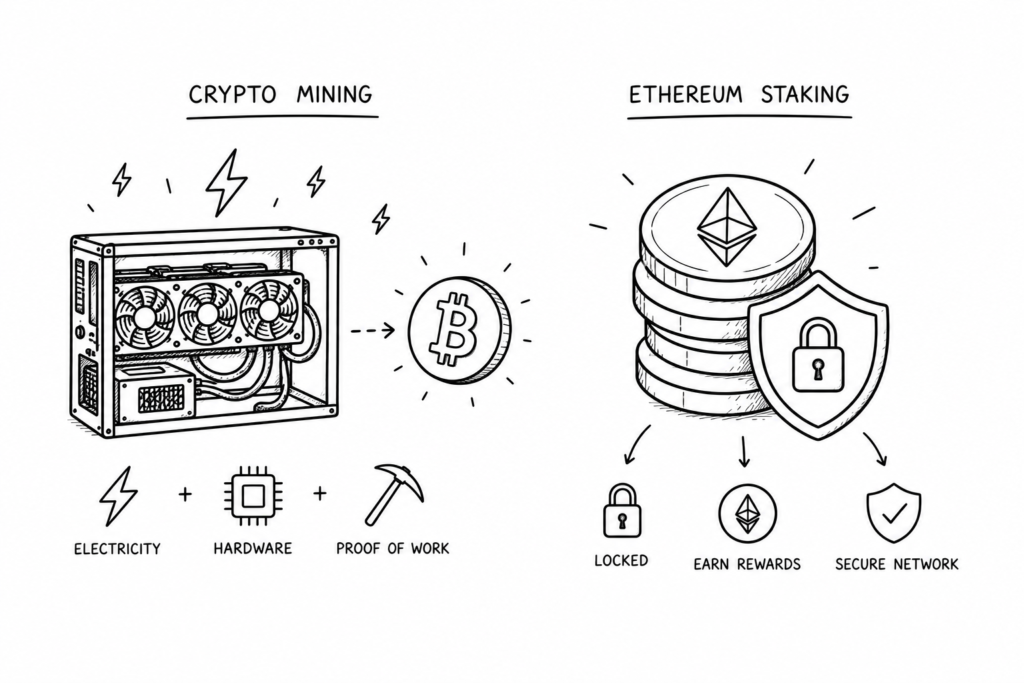
Bitcoin uses proof of work as its consensus mechanism. Miners around the world compete to solve a computationally difficult puzzle. The first miner to solve it gets to add the next block to the blockchain and receives the block reward (currently 3.125 BTC) plus the transaction fees included in that block.
Proof of work has a 15-year track record on Bitcoin. The network has never been successfully attacked through its consensus mechanism.
The computational cost of attacking Bitcoin (which would require controlling more than 50% of the network’s total hash rate) is estimated to be in the billions of dollars and is growing as more mining hardware comes online.
The Bitcoin network’s hash rate reached new all-time highs in 2025, reflecting massive investment in mining infrastructure. This growing hash rate continuously increases the cost of any potential attack, making the network more secure over time as adoption and investment grow.
The criticism of proof of work is its energy consumption. Bitcoin mining consumes an estimated 170 to 210 terawatt-hours of electricity per year, comparable to the annual energy consumption of a country like Poland or Argentina.
Proponents argue that a significant and growing portion of this energy comes from renewable sources (estimates range from 40% to 75% depending on the source and methodology), and that the energy expenditure is the price of a trustless, decentralized monetary system. Critics argue the environmental cost is too high for what Bitcoin provides.
Proof of work is also decentralized in a specific way. Anyone with hardware and electricity can participate. No token holding is required. However, in practice, mining has concentrated into large industrial operations that can access cheap electricity and bulk hardware discounts, which reduces the effective decentralization of Bitcoin mining.
Ethereum’s Proof of Stake
Ethereum’s transition to proof of stake in September 2022 fundamentally changed how the network reaches consensus.
Instead of miners competing through computation, validators stake ETH as collateral and are selected to propose and attest to blocks. Validators earn rewards for honest behavior and face slashing (losing a portion of their stake) for dishonest or negligent behavior.
To become a validator on Ethereum, you stake 32 ETH. As of November 2025, over 30 million ETH (more than 25% of the total supply) is staked in the network, representing tens of billions of dollars in security collateral. This massive economic commitment is what secures the network under proof of stake.
Proof of stake reduces Ethereum’s energy consumption by approximately 99.95% compared to proof of work. Ethereum’s annual energy consumption dropped from around 80 terawatt-hours to less than 0.01 terawatt-hours after The Merge. This change has significant environmental implications and removes one of the primary criticisms directed at Ethereum.
The trade-off is that proof of stake introduces different security assumptions. Attacking Ethereum requires acquiring a large portion of the staked ETH, which is expensive in capital terms but different from the hardware and energy investment required to attack Bitcoin.
Proof-of-stake security is tied to the value of the staked asset, creating a dependency on ETH price. Critics, including Bitcoin advocates, argue that proof of stake is inherently more centralized because wealthy validators have more influence than smaller ones, and that the slashing mechanism introduces complexity and new attack vectors.
Liquid staking protocols have added another layer to Ethereum’s staking ecosystem. Services like Lido allow users to stake ETH without the 32 ETH minimum and receive a liquid token (stETH) representing their staked position. Lido controls over 30% of all staked ETH as of 2025, raising questions about concentration risk within Ethereum’s validator set.
Supply and Monetary Policy
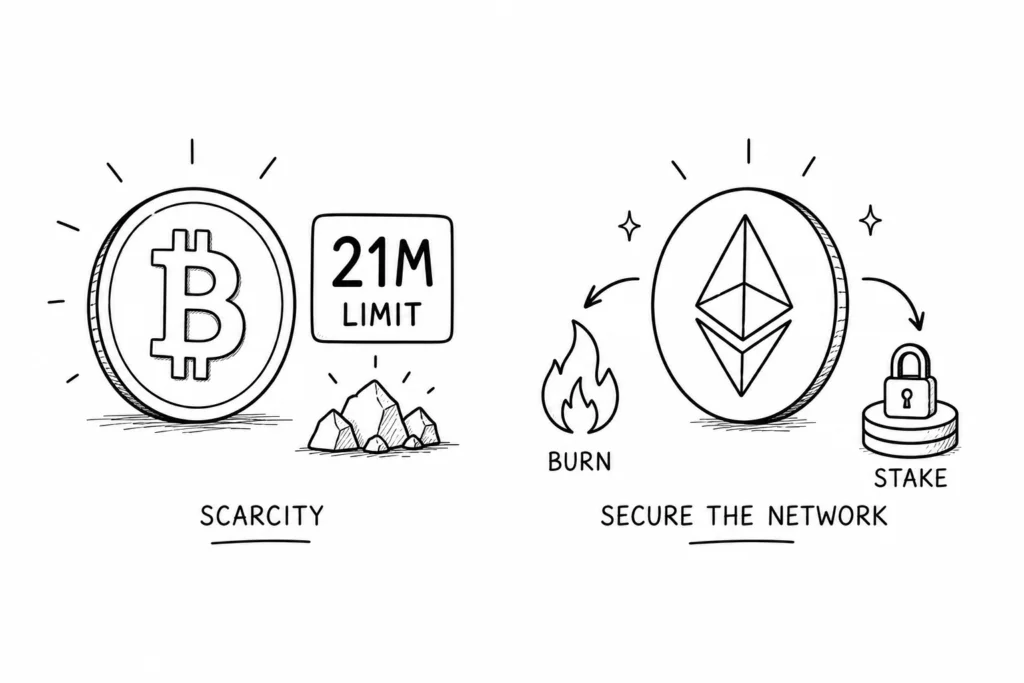
Bitcoin’s Fixed Supply
Bitcoin has a hard cap of 21 million coins. This is coded into the protocol and can only be changed through consensus of the network, which has historically been near-impossible to achieve for fundamental rules.
As of November 2025, approximately 19.8 million Bitcoin are in circulation. The remaining roughly 1.2 million will be mined over the next century, with the last Bitcoin expected to be mined around 2140.
The halving mechanism cuts the block reward in half every 210,000 blocks (approximately every four years). The halving schedule creates a predictable, disinflationary issuance curve.
Each halving reduces the rate at which new Bitcoin enters circulation, historically creating supply-side pressure that has preceded price increases, though correlation with the halving is debated among analysts.
After all 21 million Bitcoin are mined, no new Bitcoin enters circulation. Miners will rely entirely on transaction fees for compensation. Whether transaction fees alone can sustain adequate miner incentives to secure the network long-term is an open question in Bitcoin research.
Bitcoin’s fixed supply is its most frequently cited advantage as a store of value. Unlike fiat currencies, which central banks can expand through monetary policy, Bitcoin’s total supply is mathematically certain and cannot be inflated away. This property is central to the “digital gold” narrative.
Ethereum’s Variable Supply
Ethereum has no hard supply cap. The current total supply is approximately 120 million ETH. However, Ethereum’s post-Merge monetary policy means that ETH can be both inflationary and deflationary depending on network activity.
New ETH enters circulation as staking rewards paid to validators. The current issuance rate is approximately 0.5 to 1% annually, far lower than pre-Merge issuance which ran around 4.5% annually.
EIP-1559, introduced in 2021, burns the base fee from every transaction. When the network is busy enough, the amount of ETH burned exceeds the amount issued to validators, making ETH net deflationary.
During periods of high DeFi, NFT, or other on-chain activity, significant amounts of ETH are destroyed permanently. The Ethereum community coined the term “ultrasound money” to describe this dynamic, arguing that ETH can be deflationary where Bitcoin is merely disinflationary.
Since The Merge, periods of high activity have seen ETH supply shrink rather than grow. However, during lower-activity periods, issuance exceeds burns and supply grows modestly. The net effect over the long term depends on sustained demand for Ethereum block space.
Transaction Speed and Fees
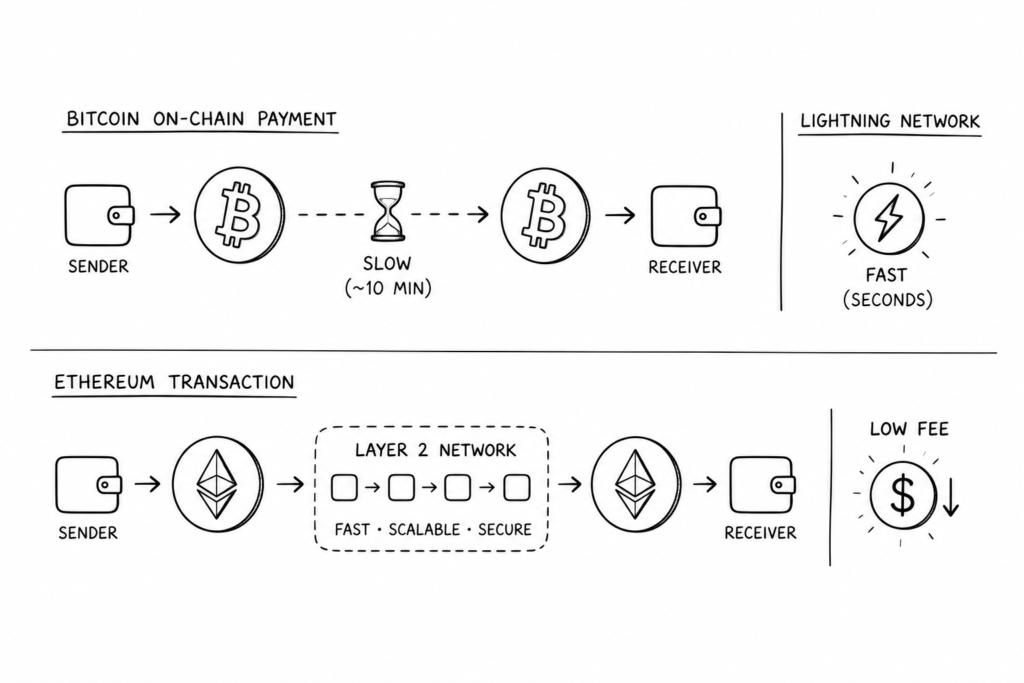
Bitcoin: Deliberate and Predictable
Bitcoin transactions on the base layer typically confirm in 10 to 60 minutes, depending on the fee paid and current network congestion. Users who pay higher fees get their transactions prioritized by miners.
During periods of high demand, fees can rise significantly. In May 2023, during an Ordinals inscription boom, Bitcoin transaction fees averaged over $30. During quieter periods, fees are a few dollars or less.
The Lightning Network dramatically changes this picture for smaller transactions. Lightning payments are instant and cost fractions of a cent. Lightning is well-suited for everyday purchases, micropayments, and high-frequency transfers where waiting for on-chain confirmation is impractical.
The Lightning Network has grown substantially in capacity, infrastructure, and adoption over the past three years. Its expansion has been driven by increased integration with exchanges, payment processors, wallets, and merchant solutions, making Bitcoin payments faster and cheaper for users worldwide.
Bitcoin is not well-suited for on-chain micropayments or high-frequency small transactions. The base layer fee structure makes small transactions economically irrational unless routed through Lightning.
For large value transfers, particularly cross-border ones where wire transfer fees and settlement times are the alternative, Bitcoin’s base layer works well even with elevated fees.
Ethereum: Faster but Variable
Ethereum processes transactions in blocks approximately every 12 seconds after The Merge, significantly faster than Bitcoin’s 10-minute average. A transaction on Ethereum is typically considered final after a few minutes, though certain high-security applications wait for more confirmations.
The challenge with Ethereum has historically been fees. Gas costs on Ethereum’s base layer have at times exceeded $50 to $200 for a simple swap during peak DeFi activity. This made Ethereum impractical for small transactions during congested periods.
The introduction of Layer 2 rollups has substantially changed this. Transactions on Optimism, Arbitrum, Base, and other rollups cost fractions of a cent to a few cents even for complex DeFi interactions.
EIP-4844 in March 2024 reduced Layer 2 costs by another 80 to 90% by creating a dedicated data lane (blobs) for rollup data. As of 2025, most Ethereum activity migrates to rollups, and the base layer is increasingly used for settling rollup batches rather than individual transactions.
The trade-off is that the multi-layer architecture adds complexity. Users need to bridge assets between layers, understand which network they are on, and sometimes wait for withdrawal periods when moving assets from optimistic rollups back to the main chain.
Bitcoin and Ethereum Security
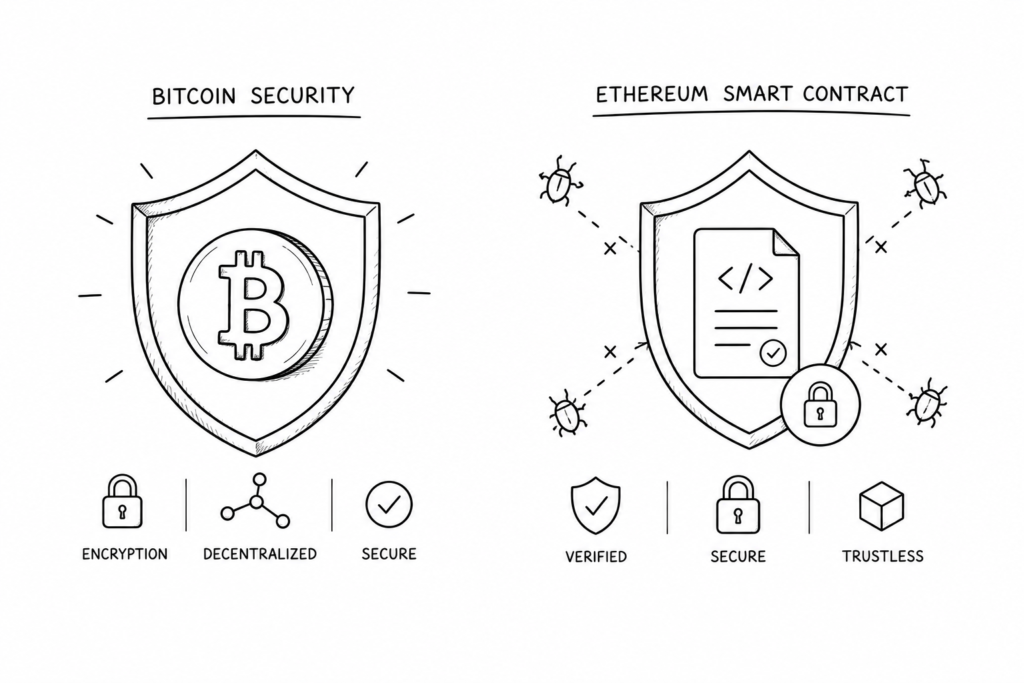
Bitcoin’s Security Track Record
Bitcoin’s base layer has never been successfully hacked in 17 years of continuous operation. The network has processed hundreds of millions of transactions without a consensus-level failure.
Bitcoin’s security comes from its hash rate: the total computational power dedicated to mining.
Any attacker would need to control more than 50% of that hash rate to attempt a double-spend attack, and the cost of acquiring that hardware while simultaneously operating it would be astronomical.
Bitcoin’s simplicity is also a security advantage. The limited scripting capabilities mean there is less surface area for bugs or exploits. The consensus rules have changed very rarely and very carefully.
Bitcoin does face security risks at layers above the base protocol. Exchange hacks, wallet software vulnerabilities, and user error account for the majority of Bitcoin losses. The protocol itself is secure; the ecosystem around it is not uniformly so.
Ethereum’s Security Model
Ethereum’s security after The Merge relies on economic incentives. Validators stake ETH as collateral and face financial penalties for misbehavior. The enormous amount of ETH staked (tens of billions of dollars worth) creates a very high economic barrier to attack.
However, Ethereum’s complexity introduces security considerations that Bitcoin does not face. Smart contract bugs have resulted in billions of dollars in losses over Ethereum’s history.
The DAO hack in 2016, the Parity multisig bug in 2017, and numerous DeFi protocol exploits have demonstrated that smart contract security is genuinely difficult. Each new protocol deployed on Ethereum introduces new potential vulnerabilities that are not present at the base layer.
Ethereum’s security audit ecosystem has matured significantly. Major protocols undergo multiple professional audits, and formal verification methods are increasingly used for critical code.
Bug bounty programs incentivize researchers to find and report vulnerabilities before they are exploited. Despite these improvements, smart contract exploits remain a recurring feature of the Ethereum ecosystem.
The rollup-centric future also introduces bridge security as a concern. Bridges moving assets between Ethereum and Layer 2 networks have been targets for some of the largest hacks in crypto history. Ronin Bridge, Wormhole, and Nomad are among the protocols that suffered nine-figure losses
Use Cases of Bitcoin and Ethereum
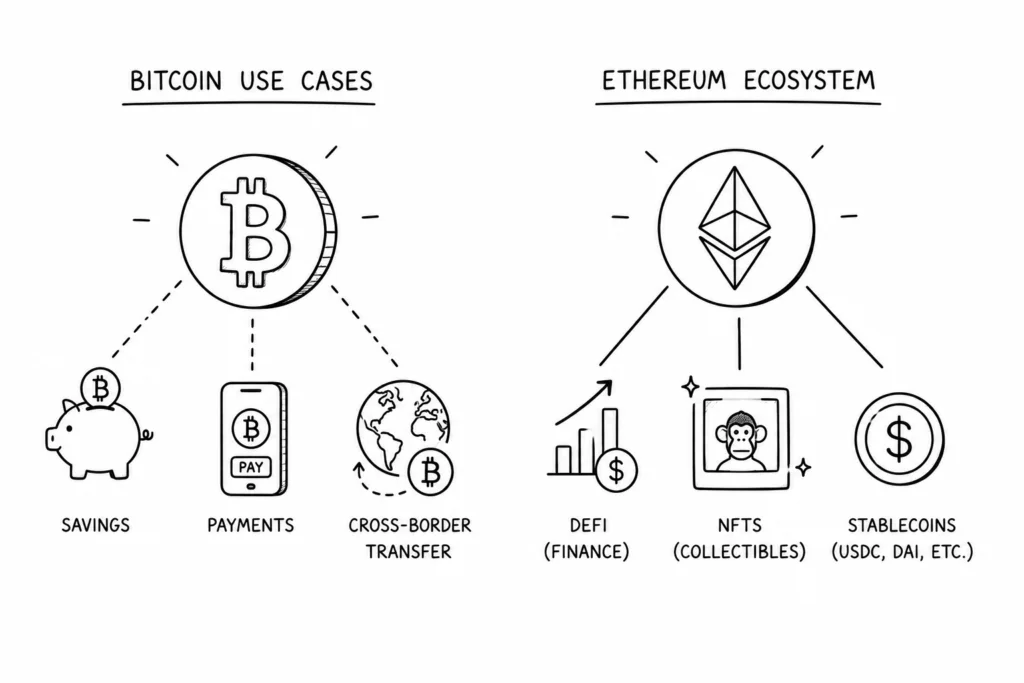
What People Actually Use Bitcoin For
1. Store of Value: The most common use of Bitcoin is simply holding it as a long-term asset. Individuals, family offices, and public companies hold Bitcoin on their balance sheets as a hedge against currency debasement and inflation.
MicroStrategy, now known as Strategy Inc., holds over 840,000 BTC as of May 2026, making it the largest corporate holder of Bitcoin. Several sovereign wealth funds and pension funds have begun allocating to Bitcoin through regulated ETFs.
2. Cross-Border Transfers: Sending large amounts of money internationally using Bitcoin is faster and cheaper than traditional wire transfers for many use cases. Settlement is final in under an hour regardless of the destination, with fees that do not scale with the amount sent.
3. Payments: Bitcoin functions as a medium of exchange in certain markets, particularly through the Lightning Network. El Salvador’s Chivo wallet enables everyday Bitcoin payments.
Strike and other Lightning-based apps enable fee-free international remittances. In countries with unstable currencies, Bitcoin serves as a practical payment tool for merchants and consumers who need an alternative to their local currency.
4. Institutional Financial Products: The approval of spot Bitcoin ETFs in the United States in January 2024 opened Bitcoin to a new class of investor.
These ETFs have accumulated tens of billions of dollars in assets under management, providing regulated exposure to Bitcoin through traditional brokerage accounts.
What People Actually Use Ethereum For
1. Decentralized Finance (DeFi): Ethereum is the foundation of DeFi. Decentralized exchanges like Uniswap enable users to trade tokens without intermediaries.
Lending protocols like Aave and Compound allow users to borrow against crypto collateral. As of 2025, billions of dollars in assets sit in DeFi protocols on Ethereum and its Layer 2 networks.
The total value locked (TVL) in Ethereum DeFi fluctuates with market conditions but consistently represents the majority of all DeFi activity across all blockchains.
2. NFTs: The NFT market is built primarily on Ethereum. ERC-721 and ERC-1155 token standards define how NFTs are created and transferred.
The peak NFT boom in 2021 to 2022 ran almost entirely on Ethereum, with marketplaces like OpenSea processing billions in volume. NFT activity has shifted toward more sustainable use cases including gaming, digital identity, event ticketing, and creator monetization.
3. Stablecoins: The majority of stablecoin transactions settle on Ethereum or its Layer 2 networks. USDT (Tether) and USDC (Circle) both have massive Ethereum-based supplies.
Stablecoins are the primary use case driving Ethereum transaction volume and fee revenue, as they provide dollar-denominated value in a format compatible with DeFi protocols.
4. DAOs and Governance: Decentralized autonomous organizations use Ethereum smart contracts to manage treasuries, govern protocols, and coordinate communities. Major protocols like Uniswap, Aave, and Compound are governed by their token holders through on-chain voting mechanisms.
5. Token Issuance: Ethereum’s ERC-20 token standard is the dominant standard for launching new crypto assets. Most altcoins, governance tokens, and project tokens launch on Ethereum before potentially moving to other chains. The network effects around Ethereum as the primary platform for new token launches are significant.
6. Enterprise and Institutional Use: Ethereum’s programmability makes it attractive for institutional applications including tokenized securities, settlement systems, and supply chain management. Several major financial institutions including JPMorgan, Goldman Sachs, and BlackRock have built or invested in Ethereum-based systems.
The Ethereum Ecosystem vs Bitcoin’s Ecosystem
Ethereum’s Ecosystem Breadth
The Ethereum ecosystem is the largest and most diverse in crypto by a significant margin. It includes hundreds of DeFi protocols, dozens of active Layer 2 networks, thousands of NFT collections, hundreds of gaming and metaverse projects, and the infrastructure providers (wallets, node services, analytics tools, auditing firms) that support all of them.
The developer community around Ethereum is the largest of any blockchain. More developers work on Ethereum and EVM-compatible chains than on any other blockchain platform.
The EVM (Ethereum Virtual Machine) has become the de facto standard for smart contract development, with competing blockchains like BNB Chain, Avalanche, Polygon, and Fantom all adopting EVM compatibility to access Ethereum’s developer tools and talent pool.
This network effect compounds over time. A developer who learns Solidity (Ethereum’s primary smart contract language) can deploy to Ethereum, Polygon, Arbitrum, Optimism, Avalanche, and dozens of other EVM-compatible chains with minimal modification.
This creates a self-reinforcing ecosystem where Ethereum benefits from the growth of its compatible chains while the compatible chains benefit from access to Ethereum’s security, liquidity, and user base.
Bitcoin’s Ecosystem
Bitcoin’s ecosystem is narrower but increasingly active. The primary focus is on financial applications: custody, exchanges, payment processing, and yield generation.
The Taproot upgrade in 2021 and the subsequent Ordinals protocol in 2023 expanded what is possible on Bitcoin’s base layer. Ordinals allow data (including images) to be inscribed directly onto satoshis (the smallest unit of Bitcoin), effectively enabling NFTs on Bitcoin.
The Ordinals ecosystem generated enormous controversy within the Bitcoin community and significant fee revenue for miners, demonstrating that demand for Bitcoin block space extends beyond simple value transfer.
Bitcoin Layer 2 networks are an area of growing development. The Lightning Network is the most mature. But projects like Stacks, Rootstock, and Merlin Chain are building smart contract capabilities on top of Bitcoin, aiming to bring DeFi functionality to Bitcoin without changing the base layer. These are much earlier in development than Ethereum’s Layer 2 ecosystem.
The Lightning Network itself has evolved significantly. Protocols like Taproot Assets allow stablecoins and other assets to be issued and transferred over Lightning channels, expanding Bitcoin’s utility beyond pure BTC transfers.
Price Performance and Volatility
Historical Performance
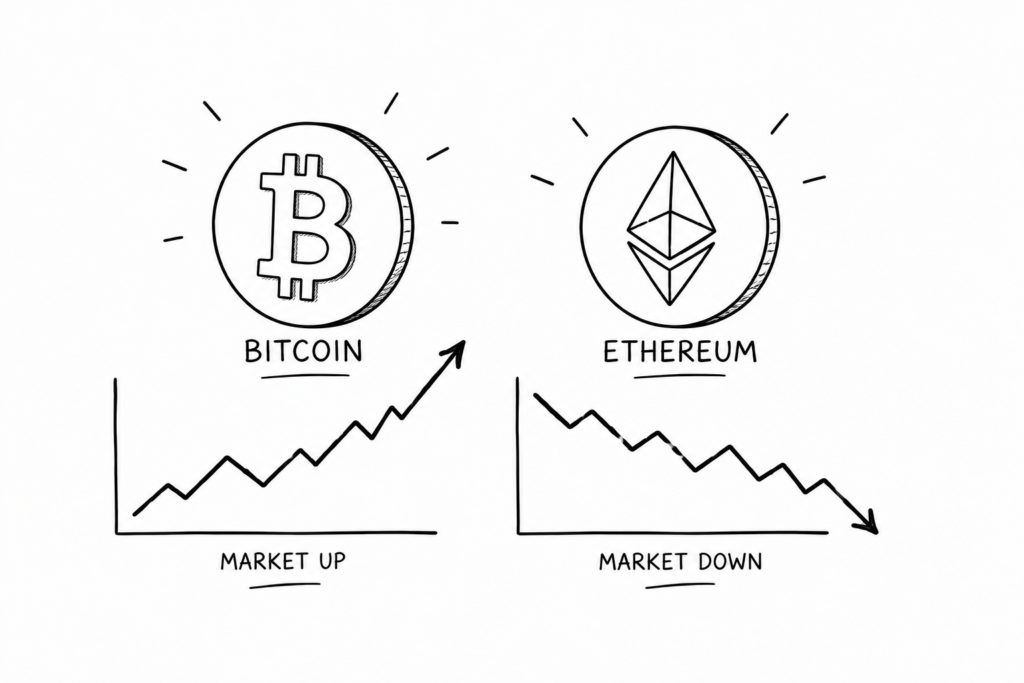
Both Bitcoin and Ethereum have delivered extraordinary returns relative to virtually any other asset class over the past decade, while experiencing volatility that would be unacceptable in most traditional portfolios.
Bitcoin launched at effectively zero value in 2009. It first crossed $1 in 2011, $1,000 in 2013, $10,000 in 2017, and $60,000 in 2021. Each major cycle has produced higher peaks and higher lows than the previous one, though the cycles have also shown signs of maturing as the market grows larger.
Ethereum launched at around $0.30 in 2015. It first crossed $1,000 in January 2018, pulled back to under $100 later that year, and peaked at over $4,800 in November 2021 during the NFT and DeFi boom. As of November 2025, Ethereum trades in a range reflecting both progress on its roadmap and competitive pressure from alternative blockchains.
The ETH/BTC ratio (sometimes called the flippening ratio) measures Ethereum’s market cap relative to Bitcoin’s. At Ethereum’s peak relative strength in 2021 to 2022, the ratio approached 0.08, with Ethereum’s market cap reaching close to half of Bitcoin’s at that point. The ratio has generally declined since then as Bitcoin’s institutional adoption and ETF-driven inflows have accelerated.
Volatility and Correlation
Both assets are highly volatile relative to traditional financial assets. Bitcoin’s annualized volatility has historically ranged between 50% and 100%, though it has trended downward as the market matures. Ethereum is typically more volatile than Bitcoin, with larger percentage swings in both directions.
The correlation between Bitcoin and Ethereum is high, typically ranging from 0.7 to 0.9 during normal market conditions.
This means they tend to move in the same direction in response to broader market sentiment. During risk-on periods, both assets rise. During risk-off events, both fall. Holding both provides less diversification than many investors assume.
There are periods where the two diverge. Ethereum often outperforms Bitcoin during periods of strong DeFi or NFT activity, as demand for block space drives ETH valuations. Bitcoin often outperforms during periods of institutional buying or macro-driven safe-haven flows. The drivers for each asset are partially distinct.
Bitcoin and Ethereum Regulation and Legal Status
Bitcoin’s Regulatory Clarity
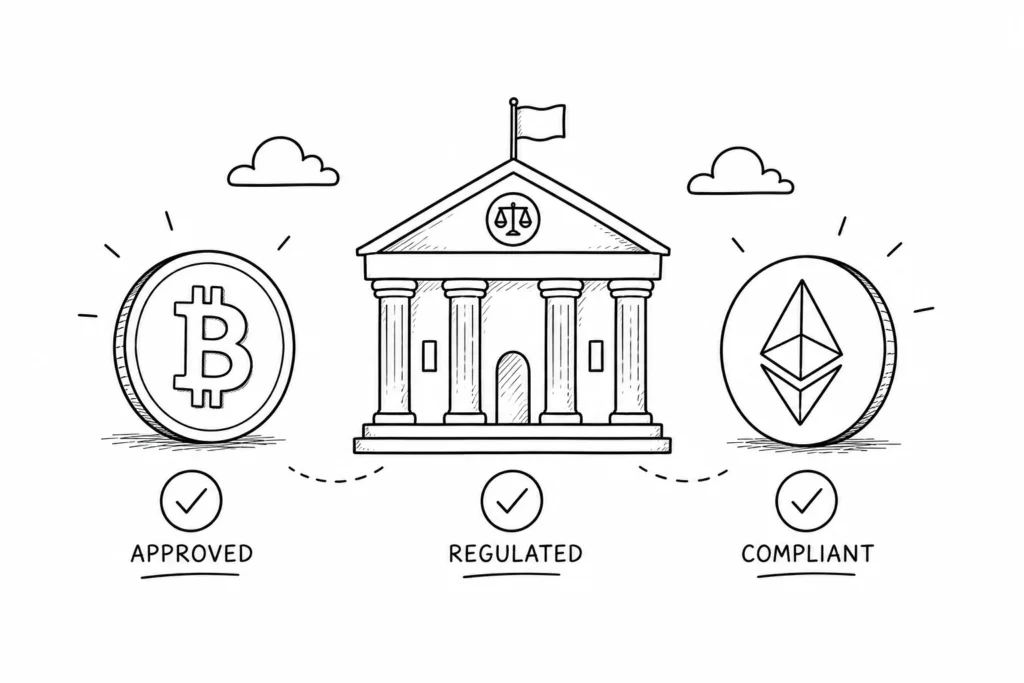
Bitcoin is the most legally clear cryptocurrency in most major jurisdictions. The United States Securities and Exchange Commission has publicly stated that it does not consider Bitcoin a security, giving it a relatively clean legal status that other crypto assets lack.
The approval of spot Bitcoin ETFs in the US in January 2024 put Bitcoin in the same product category as gold ETFs, further legitimizing it within the traditional financial system.
In the EU, MiCA (Markets in Crypto-Assets regulation) treats Bitcoin as a crypto-asset, with specific frameworks for how exchanges and service providers can offer Bitcoin-related products. The UK FCA permits Bitcoin investments through regulated products.
El Salvador made Bitcoin legal tender in September 2021, and the Central African Republic followed in 2022. Both have since reversed course: El Salvador removed Bitcoin’s legal-tender status in 2025 under an IMF loan agreement, and the Central African Republic repealed its law in 2023.
Countries that have moved to restrict or ban Bitcoin include China (which banned crypto mining and exchanges in 2021), though peer-to-peer trading continues. Most developed economies permit Bitcoin with varying degrees of regulatory clarity around taxation and service provider licensing.
Ethereum’s Regulatory Position
Ethereum’s regulatory status is more complex. The SEC has historically implied that proof-of-work cryptocurrencies like Bitcoin are commodities rather than securities.
After Ethereum’s transition to proof of stake, SEC Chair Gary Gensler suggested that proof-of-stake tokens may more closely resemble securities because stakers receive rewards (similar to how shareholders receive dividends). This created regulatory uncertainty for Ethereum specifically.
The approval of spot Ethereum ETFs in the United States in May 2024 provided some regulatory clarity, implying that regulators are comfortable with Ethereum being offered as an investment product through regulated channels.
However, the SEC’s position on whether ETH itself is a security versus a commodity has not been definitively resolved.
The regulatory question matters practically because it affects how exchanges can list Ethereum, whether certain Ethereum-based products need to register as securities, and how institutional investors can engage with the Ethereum ecosystem.
The ERC-20 token standard creates additional regulatory complexity for Ethereum because most tokens launched on Ethereum are subject to their own securities analysis.
Many DeFi protocols face regulatory scrutiny in the US over whether they constitute unregistered securities exchanges or broker-dealers.
Environmental Impact
Bitcoin’s Energy Debate
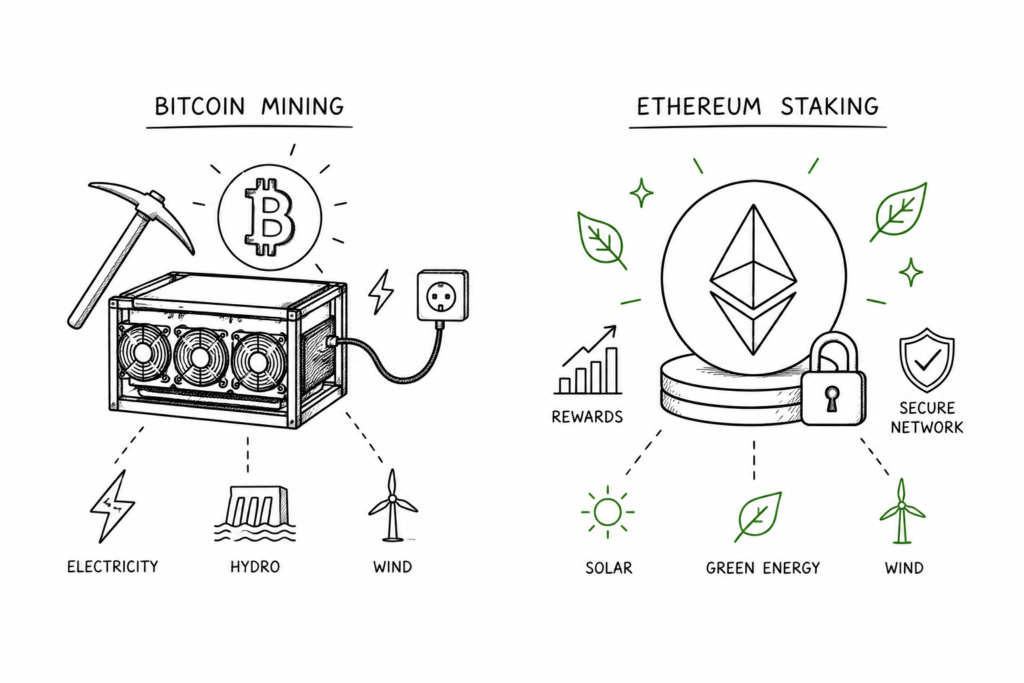
Bitcoin mining is energy-intensive by design. The proof-of-work mechanism requires vast computational effort, which translates directly into electricity consumption. The estimated annual energy use of the Bitcoin network ranges from 170 to 210 terawatt-hours, depending on the methodology used.
The environmental debate around Bitcoin is genuine and ongoing. Critics point to the carbon footprint of mining operations that use fossil fuels. Proponents point to the growing share of renewable energy in Bitcoin mining, the use of stranded or wasted energy that would otherwise go unused (such as flare gas from oil wells), and the argument that Bitcoin provides sufficient value to justify its energy use.
The Bitcoin Mining Council, a voluntary industry group, reports that member miners use approximately 60% sustainable energy.
Independent estimates vary, but the trend toward renewable energy in Bitcoin mining is real, driven by economics (renewable energy is often cheapest at scale) rather than purely by environmental concern.
The environmental argument against Bitcoin has lost some momentum in the institutional space. Major pension funds and sovereign wealth funds that have begun investing in Bitcoin ETFs have apparently concluded that the environmental trade-off is acceptable at their scale.
Ethereum’s Post-Merge Energy Profile
Ethereum’s energy consumption after The Merge is negligible compared to Bitcoin. Proof-of-stake validation requires only the electricity needed to run server hardware, not the massive computational effort of proof-of-work mining. Ethereum’s annual energy consumption is now roughly comparable to that of a few thousand households.
This shift eliminates the primary environmental criticism of Ethereum. It is now one of the few major financial networks that operates at a scale of billions of dollars in daily transaction volume with minimal environmental impact.
Which Should You Choose?
Bitcoin Makes More Sense If…
You want a simple, long-term store of value that behaves like digital gold. You want maximum security, predictability, and a 15-year track record of reliability.
You want to hold a single asset without needing to understand smart contracts, gas fees, DeFi protocols, or Layer 2 networks.
You are investing in crypto through a retirement account or traditional brokerage through an ETF. You want exposure to an asset with the strongest institutional backing and regulatory clarity.
Bitcoin does not require you to understand the technology deeply to benefit from its core value proposition. Buy and hold is a complete strategy with Bitcoin in a way it is not with Ethereum.
Ethereum Makes More Sense If…
You want to participate in DeFi, earn staking rewards, or interact with decentralized applications. You are a developer who wants to build on a programmable blockchain.
You see the value in a platform that powers hundreds of financial and non-financial applications. You are willing to engage with a more complex ecosystem and understand the trade-offs involved. You want exposure to the growth of decentralized finance and the broader Ethereum application ecosystem.
Ethereum requires more ongoing engagement to use fully. Gas fees, Layer 2 bridges, wallet security for DeFi interactions, and understanding smart contract risks are all relevant if you want to do more than simply hold ETH.
The Both Answer
For many investors and users, the honest answer is that Bitcoin and Ethereum serve different roles and holding both makes sense.
Bitcoin provides the store-of-value anchor. Ethereum provides exposure to the growth of decentralized applications and DeFi. The two assets have different risk profiles, different drivers, and different use cases within a crypto portfolio.
The assets are not really in competition with each other at a fundamental level.
Bitcoin is not trying to be Ethereum, and Ethereum is not trying to be Bitcoin. They are different things, which is why both exist and both have maintained dominant positions despite years of competition from hundreds of other blockchains.
The Road Ahead For Bitcoin and Ethereum
Bitcoin’s Development Trajectory
Bitcoin’s development moves deliberately and conservatively. Proposed improvements go through years of discussion, testing, and community consensus before being implemented.
The next major upgrade expected is related to enhanced scripting capabilities through proposals like OP_CAT, which could enable more complex covenant conditions on Bitcoin transactions.
The development of BitVM, a framework for running complex computations on Bitcoin verified by the blockchain, is expanding what is possible on Bitcoin without changing the base protocol.
Lightning Network adoption and development continues. New wallet software, enterprise Lightning infrastructure, and stablecoin protocols on Lightning all represent areas of active development.
The question of whether transaction fees can sustain miner security once block rewards become negligible (in the 2040s and beyond) is a long-term research question that Bitcoin’s ecosystem is beginning to address more seriously.
Ethereum’s Development Roadmap
Ethereum has a detailed published roadmap with phases called The Surge, The Scourge, The Verge, The Purge, and The Splurge. Each phase addresses different aspects of scaling, security, and simplification.
The Surge focuses on making rollups the default execution layer for Ethereum, increasing data availability for rollup batches, and reaching a long-term goal of very high transaction throughput at very low cost.
Proto-Danksharding, implemented in March 2024, is the first step. Full Danksharding, which would dramatically increase blob capacity, is a major target for coming years.
The Verge focuses on making it easier to verify the Ethereum blockchain without downloading all historical data, through a technology called Verkle Trees.
The Purge focuses on eliminating historical data requirements to reduce node storage costs. The Splurge covers miscellaneous improvements.
Ethereum’s roadmap is ambitious and technically complex. Each upgrade carries execution risk, and the timeline for major improvements has historically extended beyond initial estimates. But the direction is clear and the developer talent working on it is substantial.
Conclusion
Bitcoin and Ethereum are both foundational to the modern crypto ecosystem, and both have earned their positions through years of real-world use, technical development, and market adoption.
Bitcoin does what it was designed to do extremely well. It is a decentralized, scarce, censorship-resistant form of digital money with a 15-year track record of security and reliability.
For people who want a simple, long-term store of value or a way to move large amounts of money across borders without intermediaries, Bitcoin delivers.
Ethereum does something entirely different equally well. It is a programmable platform that supports a vast and growing ecosystem of financial and non-financial applications.
For people who want to participate in DeFi, build decentralized applications, or gain exposure to the growth of on-chain finance, Ethereum is the platform where most of that activity happens.
The comparison between them is ultimately not about which is better. It is about understanding what each one is actually for.
Confusing them leads to comparing the wrong things: criticizing Bitcoin for not supporting DeFi (it was not designed to) or criticizing Ethereum for having a more complex monetary policy (complexity was the trade-off for programmability).
Both have significant roles to play as the global financial system increasingly incorporates blockchain technology.
Both have real risks and real limitations. And both reward the people who take the time to understand them on their own terms rather than through the lens of which one wins a competition that neither is actually trying to win.