



Every week, new cryptocurrencies launch with promises of revolutionary technology, passive income, and extraordinary returns. Most of them fail. Some are outright scams. A small number turn into genuinely useful projects that hold or grow in value over time.
The difference between investing in the first and last category often comes down to one thing: how well you researched the project before putting your money in.
Researching a cryptocurrency is not the same as researching a stock. Traditional financial analysis tools like earnings reports, price-to-earnings ratios, and dividend history do not apply directly to crypto projects. You need a different framework, one that combines technical understanding, community analysis, on-chain data, and fundamental project evaluation.
This guide walks you through that framework step by step. It covers how to read a whitepaper, how to evaluate a team, how to understand tokenomics, how to use on-chain tools, how to spot red flags before you lose money, and how to build a consistent research process you can apply to any project, from established networks like Bitcoin and Ethereum to newly launched tokens.
The goal is not to tell you what to buy. The goal is to give you the tools to make that decision yourself with as much reliable information as possible.
Key Takeaways
- Researching a cryptocurrency before investing is the single most effective way to avoid putting money into projects that were never going to work.
- The whitepaper is the most important document a crypto project publishes, and skipping it means you are relying on someone else’s interpretation rather than the original source.
Always check the token distribution and vesting schedule, because a project where insiders hold a large percentage with short unlock periods is structurally set up to disappoint retail holders. - The headline trading fee is rarely the full cost, and the same principle applies to crypto research: the headline narrative is rarely the full picture.
- On-chain data shows you how a network is actually being used, not just how it is being marketed, which makes it one of the most reliable research tools available.
A credible team with a verifiable professional history and active GitHub contributions is one of the strongest indicators that a project is serious about building something real. - Good research is not a one-time activity; monitoring a project after you invest is just as important as the analysis you do before buying in.
Why Researching Cryptocurrencies Is Important
The crypto market has created real wealth for many investors. It has also destroyed wealth on a scale that few other markets match.
The collapse of Terra Luna in 2022 wiped out over $40 billion in market value in a matter of days. The FTX implosion that followed erased billions more and left hundreds of thousands of users unable to access their own funds. The list of failed projects, broken promises, and outright fraud in this industry runs into the thousands.
Most of these disasters share a common thread: the people who lost money either did not research the project properly, trusted social media hype instead of primary sources, or ignored warning signs that were visible to anyone who looked closely enough. In many cases, the problems were obvious in the tokenomics, the team history, or the smart contract code. They simply went unexamined by the people who invested.
Good research does not guarantee that an investment works out. Markets are unpredictable, and even well-researched projects can fail.
But thorough research dramatically reduces the chance of putting money into something that was never going to work in the first place. It separates projects with real substance from those riding on marketing and momentum alone.
Research also helps you understand what you own. Investors who understand the fundamentals of a project tend to hold through temporary volatility rather than panic-selling at the bottom.
They also recognise when something genuinely changes in a project and when it is time to exit. That kind of informed judgement only comes from having done the work.
The most common research mistakes in crypto are: relying on social media for investment decisions without verifying primary sources, skipping the whitepaper and token distribution details, not checking who is actually behind the project, ignoring how the token supply works over time, and treating price momentum and social hype as a substitute for fundamentals.
Understanding What You Are Looking At
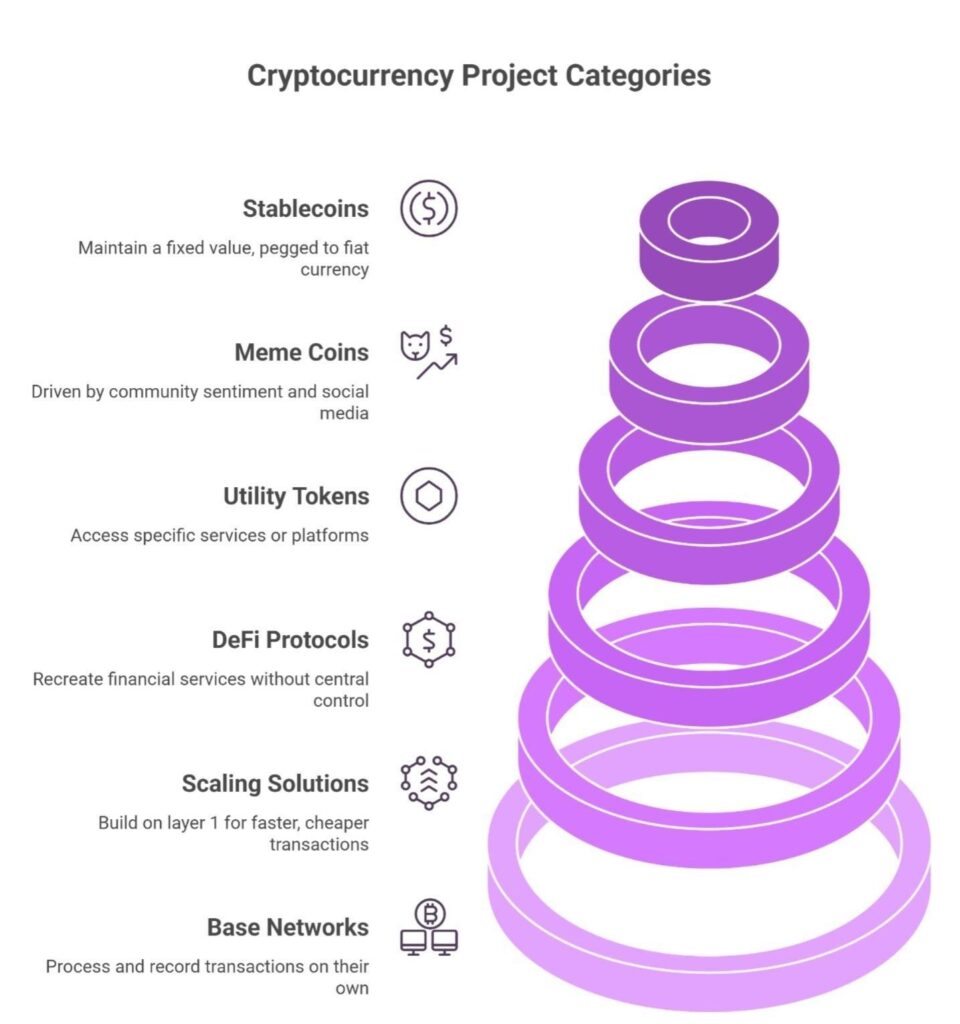
Before you research any specific cryptocurrency, it helps to understand the broad categories of projects that exist. The word “cryptocurrency” covers a wide range of assets with very different purposes, structures, and risk profiles. A layer 1 blockchain and a meme coin require completely different evaluation approaches.
Layer 1 Blockchains
A layer 1 blockchain is a base network that processes and records transactions on its own. Bitcoin and Ethereum are the two most prominent examples, but the category also includes Solana, Avalanche, and Cardano, among many others.
These networks compete on speed, security, decentralisation, developer adoption, and ecosystem size. When you research a layer 1, you are evaluating whether its technology, community, and adoption trajectory can compete in an increasingly crowded market with strong network effects favouring incumbents.
Layer 2 Networks
Layer 2 networks build on top of existing layer 1 blockchains to make transactions faster and cheaper. Arbitrum, Optimism, and Base are layer 2 networks built on Ethereum.
They inherit some of Ethereum’s security while reducing congestion and gas fees. When you research a layer 2, pay attention to how it handles security, whether it is genuinely decentralised or still controlled by a small team, what its long-term fee model looks like, and how its total value locked and transaction volume compare to competitors.
DeFi Protocols
Decentralised finance protocols are applications that recreate financial services like lending, borrowing, trading, and earning interest without a central company running them. Uniswap, Aave, Compound, and MakerDAO are well-known examples.
DeFi protocols often have their own governance tokens that give holders voting rights on protocol decisions. Research for DeFi focuses heavily on smart contract security, total value locked, protocol revenue, and governance structure.
Utility Tokens
Some tokens give access to a specific service or platform. Chainlink (LINK) is used to pay for oracle data services. Filecoin (FIL) compensates providers of decentralised storage.
These tokens have value tied to actual usage of the underlying service. Research for utility tokens focuses on whether real demand for the service exists, whether the token is genuinely necessary to access that service, and whether usage and demand are growing over time.
Meme Coins
Meme coins like Dogecoin and Shiba Inu started as jokes and evolved into assets with significant market caps driven largely by community sentiment and social media activity.
They typically lack strong technical fundamentals or a defined use case. Research for meme coins focuses almost entirely on community size, social momentum, and token distribution, since there is often very little else to analyse.
Stablecoins
Stablecoins are designed to maintain a fixed value, usually pegged to a fiat currency like the US dollar. USDC, Tether (USDT), and DAI are the most widely used examples.
Research for stablecoins focuses on the reserve mechanism that maintains the peg, who audits those reserves, the regulatory status of the issuer, and what happens under stress conditions.
The collapse of TerraUSD in 2022 demonstrated what happens when an algorithmic stablecoin mechanism fails under pressure: $40 billion in value was wiped out in under a week.
How to Read a Cryptocurrency Whitepaper
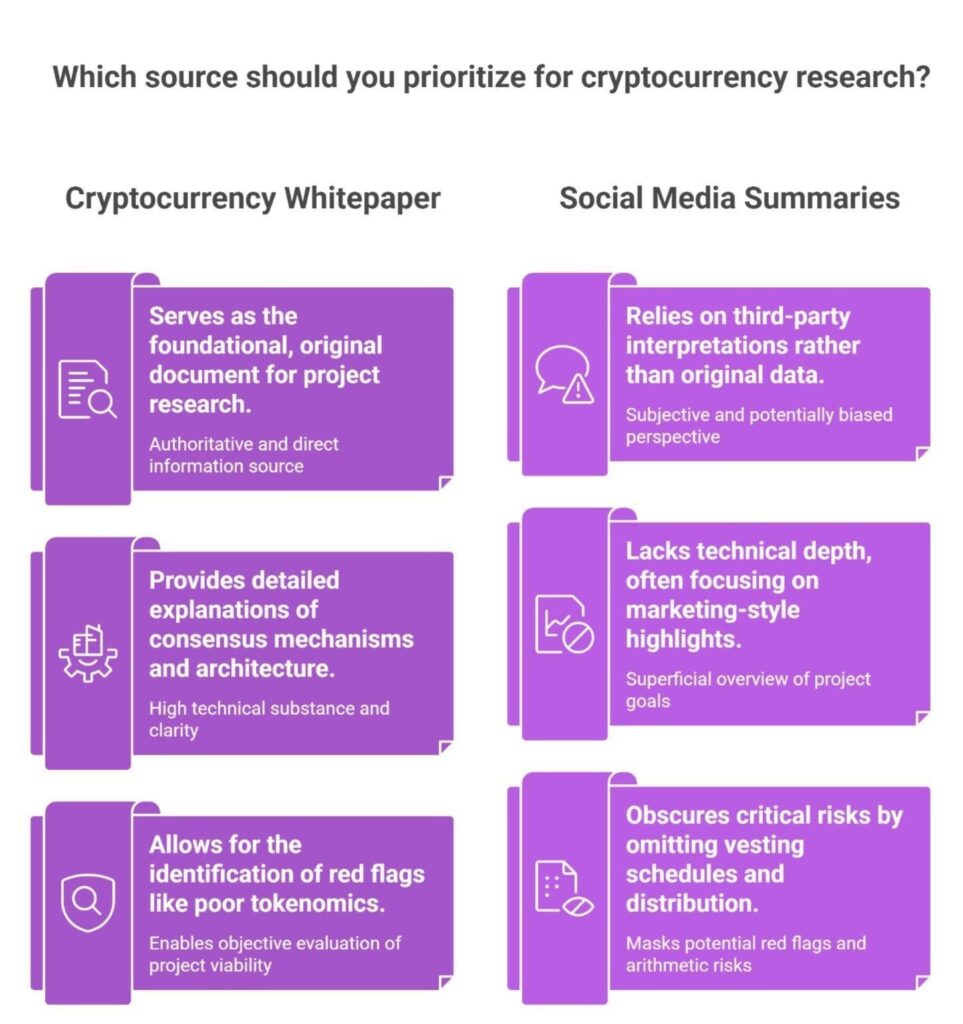
A whitepaper is the foundational document for most crypto projects. It outlines the problem the project aims to solve, the technology it uses, the tokenomics, the roadmap, and in many cases the team.
Bitcoin’s original whitepaper, published by Satoshi Nakamoto in 2008, is nine pages long and is one of the clearest technical documents ever written in this space. Most project whitepapers are longer, and many are not as clear.
Reading the whitepaper is not optional if you are doing serious research. It is the primary source of information about a project and the first place to look for red flags.
Skipping it and relying on summaries from social media or influencer videos means you are getting someone else’s interpretation rather than the original source.
A clearly defined problem
The whitepaper should open by identifying a specific problem or gap that the project addresses. Vague statements like “revolutionising finance” or “disrupting the blockchain space” are not meaningful.
A strong whitepaper describes a concrete problem with evidence that the problem is real and significant. Ethereum’s 2014 whitepaper clearly identified the limitation of Bitcoin’s scripting language and proposed a general-purpose smart contract platform as the solution. The problem was specific, the evidence was there, and the proposed solution was technically coherent.
A credible solution
After identifying the problem, the whitepaper should explain how the project’s technology solves it and why existing solutions fall short. Look for technical depth here. If the solution section reads like marketing copy with no technical substance, that is a concern.
You do not need to understand every technical detail, but the core approach should be explained clearly enough that a patient reader can grasp how it works at a high level.
Token necessity
One of the most important questions a whitepaper should answer is: why does this project need its own token? Many projects issue tokens for fundraising without a compelling reason for the token to exist in the ecosystem beyond that purpose.
A strong whitepaper explains what the token does, who uses it, why they need it, and what happens to demand over time as usage grows. If the honest answer is that the token pays for development and provides no other utility, that matters significantly for understanding long-term value.
Token distribution and vesting schedules
Look for a clear breakdown of how the total token supply is allocated. What percentage goes to the team? What goes to early investors? What is reserved for the public? What is earmarked for ecosystem development or staking rewards? And when do the team and early investor tokens unlock?
Projects where insiders hold a large percentage with short or no vesting periods present a genuine risk of price pressure once those tokens become available to sell. This is not speculative; it is arithmetic.
Technical architecture
A serious blockchain project includes a technical section explaining the consensus mechanism, transaction processing approach, network architecture, and security model.
What you are looking for is whether the technical claims are specific and verifiable, or aspirational and vague. Claims like “our novel consensus mechanism achieves one million transactions per second” without explaining how should raise questions, because that is a claim that contradicts everything the industry knows about the trade-offs involved.
Roadmap and delivery history
The roadmap shows what the project has already built and what it plans to build. If the project has been running for some time, check whether past milestones were met on time.
A project that consistently misses its own targets is signalling something about the team’s ability to execute, regardless of how ambitious the future roadmap looks.
Red flags in whitepapers:
- No whitepaper, or one that consists mostly of images and marketing language with no technical content
- Content copied or plagiarised from other projects (search key sentences to verify)
- No explanation of why the token is necessary for the ecosystem to function
- Token allocations heavily weighted toward the team and early investors with short or no vesting
- Vague or physically impossible technical claims presented without explanation
- No mention of known limitations or design trade-offs
Bitcoin’s whitepaper (bitcoin.org/bitcoin.pdf) and Ethereum’s original whitepaper (ethereum.org/en/whitepaper) are both worth reading even if you never plan to invest in them. They set the standard for what a credible technical document looks like and give you a benchmark for evaluating every whitepaper you read afterward.
Evaluating the Team Behind a Crypto Project
In early-stage ventures, the team is often the most important factor in whether the project succeeds. The same principle applies to crypto projects. An experienced, credible team with a track record of delivering can compensate for early product weaknesses. A team with no relevant experience, anonymous founders, or a history of failed or fraudulent projects is a serious warning sign.
Researching founders and core team members
Start with LinkedIn. Look at each named team member’s professional history and check whether it is consistent with their claimed role. A chief technology officer who has no software engineering background deserves scrutiny. A founder who claims a decade of blockchain experience but whose LinkedIn profile was created recently is worth questioning closely.
Search each team member on Twitter, GitHub, and through a general web search. Developers who are serious about their work typically have a public profile on GitHub where you can see their code contributions. If the lead developer has no public code history, that does not automatically disqualify them, but it is a data point worth noting alongside everything else.
Check whether any team members have been involved in previous projects and what happened to those projects. A founder who has launched two previous crypto projects that both collapsed or disappeared is not someone you want to trust with your money, regardless of how compelling their current pitch sounds.
Anonymous teams
Some projects operate with anonymous or pseudonymous founders. Bitcoin itself was created by the pseudonymous Satoshi Nakamoto. Anonymity is not automatically disqualifying, but it does shift the burden of trust from the team to the code and the community.
For a project with anonymous founders to be credible, the code should be open source and independently audited, the project should have a track record long enough to establish some trust, and an active community should hold the team accountable. A brand-new project with anonymous founders and an unaudited codebase is a very different risk profile from a mature protocol that has operated transparently for years.
Advisers and backers
Many crypto projects list prominent advisers and investors to add credibility. Treat these with scepticism. An adviser listing means very little unless that person is actively contributing to the project. Some people listed as advisers have no idea they appear on the website, or agreed to the listing in exchange for a token allocation they plan to sell at the earliest opportunity.
Backing from credible venture capital firms like Andreessen Horowitz (a16z), Paradigm, or Multicoin Capital does carry more weight, since these firms conduct due diligence before investing. But even institutional backing does not guarantee success, and institutional investors have their own incentives that do not always align with retail holders. When you see a list of prominent backers, look for press releases or public announcements confirming the investment rather than accepting the claim at face value.
GitHub activity
For any project claiming to build technology, check its GitHub repository. Look at the commit history to see whether developers are actively writing and updating code. A high frequency of commits from multiple contributors suggests active development. A repository that has not been updated in months suggests the project may be stalled or that the development described in marketing materials is not actually happening.
You do not need to read the code itself. What you are assessing is the pattern of activity: how often new code is committed, how many developers contribute, whether issues are raised and resolved, and whether the codebase appears to grow and mature over time.
Understanding Tokenomics
Tokenomics refers to the economic design of a cryptocurrency: how many tokens exist, how they are distributed, how new tokens enter circulation, and what creates demand for the token over time. Getting tokenomics wrong is one of the most common ways crypto projects fail even when the underlying technology is sound. A well-designed protocol with a poorly designed token economy will almost always underperform its potential.
Think of tokenomics as the supply and demand mechanics of a specific token. On the supply side: how many tokens exist now, how many will exist in the future, and when are locked tokens released into circulation? On the demand side: what do people actually need this token for, and does that demand grow or shrink as the project scales?
Total supply and circulating supply
Every token has a total supply (the maximum number of tokens that will ever exist) and a circulating supply (the number currently available in the market). These two numbers can be dramatically different, and confusing them leads to poor investment decisions.
Bitcoin has a total supply of 21 million. As of 2026, around 19.9 million are in circulation, with the remainder to be mined over the coming decades. This fixed, predictable supply schedule is a core part of the investment thesis for many Bitcoin holders.
Many altcoins have a large gap between circulating supply and total supply. If a token has 100 million in circulation but a total supply of 10 billion, that means 9.9 billion more tokens will eventually enter the market. As they do, they dilute existing holders unless demand grows fast enough to absorb the additional supply. Always check both figures on CoinGecko or CoinMarketCap before forming a view on whether a token is cheap or expensive based on its price alone.
Fully Diluted Valuation
Fully Diluted Valuation (FDV) is the market cap calculated using the total supply at the current price. It represents what the market cap would be if every token were already in circulation. A large gap between market cap and FDV signals significant future supply that will eventually enter the market. CoinGecko displays both figures for most tokens, and comparing them is a quick but important check.
Token distribution
A healthy token distribution gives no single party outsized control. When a small number of wallets hold a large percentage of the total supply, those holders can move the market significantly if they decide to sell. You can check wallet concentration on blockchain explorers. On Etherscan, search for any ERC-20 token and view the list of top holders. If the top 10 wallets hold 60% or more of all tokens, that concentration is a genuine risk.
Vesting schedules
A vesting schedule determines when locked tokens become available to sell. Team tokens with a one-year cliff (nothing unlocks for the first year) followed by monthly releases over three years is a reasonable structure. It signals that the team is committed to the project’s long-term success rather than looking for a quick exit.
Short vesting periods, or no vesting at all, are a warning sign. If team tokens unlock within six months of launch, insiders can start selling relatively soon. In many historical rug pulls and failed projects, the pattern is consistent: the team sells its allocation shortly after tokens unlock, the price collapses, and retail holders absorb the losses.
Inflation and emission schedules
Some tokens have a fixed supply like Bitcoin. Others have an inflationary model where new tokens are continuously created and distributed as staking rewards or liquidity incentives. High inflation dilutes existing holders. A token offering extremely high APY staking rewards may sound attractive until you realise that the new tokens funding that yield increase the total supply, and the price needs to grow faster than the inflation rate for holders to come out ahead in real terms.
Always find the current annual inflation rate for any token you research. Compare it to the growth in actual usage and demand. A token with 50% annual inflation needs demand to grow by 50% just to maintain its price, before any additional return for holders.
Token utility and value accrual
The most important tokenomics question is: why does this token need to exist, and what makes people want to hold it rather than sell it immediately after receiving it?
Tokens accrue value in different ways. Some are required to use a network (ETH pays Ethereum gas fees). Some give governance rights over a protocol (UNI holders vote on Uniswap decisions). Some receive a share of protocol revenue. Some have no defined utility beyond speculation. Understanding which category a token falls into determines what actually drives its long-term value.
Ethereum introduced a fee-burning mechanism in 2021 through EIP-1559. When network usage is high, more ETH is burned than is created through staking rewards, making the supply deflationary. Understanding this mechanism explains a great deal about the long-term ETH value proposition. Looking for equivalent value accrual mechanisms in other tokens is a useful research habit.
Analysing Market Capitalisation and Trading Volume
Market capitalisation and trading volume are the two most commonly cited numbers in crypto analysis. They are also two of the most commonly misused. Understanding both what they measure and what they do not measure helps you use them correctly.
Market capitalisation
Market cap is the current price of a token multiplied by its circulating supply. A token priced at $1 with 1 billion tokens in circulation has a $1 billion market cap. It gives a rough sense of the total value the market assigns to a project relative to others in the same space, but it has important limitations.
The key one: market cap uses circulating supply, not total supply. A token with 10% of its total supply in circulation today has a much lower market cap than it will once the remaining 90% of tokens unlock. When comparing market caps across projects, always check what fraction of the total supply is currently circulating. Two tokens with the same market cap can have very different future supply trajectories.
Market caps in crypto are generally grouped into large cap (over $10 billion), mid cap ($1 billion to $10 billion), small cap ($100 million to $1 billion), and micro cap (under $100 million). Each category carries different liquidity characteristics and risk profiles. Large caps are more established with higher liquidity and lower volatility relative to the rest of the market. Micro caps can move dramatically on small amounts of volume and are the most vulnerable to manipulation.
Trading volume and liquidity
Trading volume measures the total value of all transactions over a given period, usually 24 hours. High volume relative to market cap suggests genuine activity and liquid markets. Low volume relative to market cap suggests a thinly traded asset where a large buyer or seller can move the price significantly.
A useful ratio is volume divided by market cap. A token with a $100 million market cap and $50 million in daily volume has very active trading. The same market cap with $200,000 in daily volume is thinly traded and potentially easy to manipulate.
Be aware that reported trading volumes on many exchanges are routinely inflated. Exchanges have incentives to show high volume because it attracts traders seeking liquidity. Third-party data providers like Messari and Kaiko attempt to filter out wash trading and fake volume, and their adjusted figures are more reliable than raw exchange-reported numbers for making meaningful comparisons.
Liquidity refers to how easily you can buy or sell a token without significantly moving the price. Check the order book depth on the exchange where you plan to trade. A healthy order book has substantial buy and sell orders within a few percentage points of the current price on both sides. A thin order book with large gaps between price levels means your trade will have significant slippage, especially for larger positions.
Reading On-Chain Data
On-chain data is information recorded directly on the blockchain: every transaction, wallet balance, smart contract interaction, and token transfer. Because blockchains are public, anyone can read this data. It gives you a direct window into how a network is actually being used, not just how it is being marketed. This makes on-chain analysis one of the most powerful and underused research tools available to retail investors.
Active addresses
The number of unique active addresses over a given period measures actual network usage. A growing count of active addresses suggests more people are using the network. A declining count that does not match marketing claims of growing adoption is a signal worth investigating closely.
Use this metric as a trend indicator rather than an absolute user count. One person can control many addresses, and automated smart contract interactions count as activity without representing individual human users. The trend over time matters more than the absolute figure.
Transaction count and value
Transaction count measures how many individual transactions occur on a network per day. Transaction value measures the total dollar amount transferred. Together, they tell you whether a network is being used for real economic activity or mostly sitting idle. A project claiming to be a major DeFi hub but processing a few hundred transactions per day is not matching its pitch.
Total Value Locked
Total Value Locked (TVL) measures the total assets deposited into a DeFi protocol. It is the standard metric for evaluating lending protocols, decentralised exchanges, and yield farming platforms. Growing TVL suggests users are trusting the protocol with more of their assets. Rapidly declining TVL suggests users are withdrawing, often in response to concerns about security, yield sustainability, or competitive alternatives.
TVL should always be evaluated alongside the protocol’s token market cap. The ratio of market cap to TVL gives a rough sense of whether the token is cheap or expensive relative to the economic activity the protocol handles. A token market cap significantly higher than TVL may indicate overvaluation relative to current usage, though expectations of future growth matter too.
Exchange reserves and token flows
The amount of Bitcoin or Ethereum held on exchanges is a widely watched indicator. Declining exchange reserves generally mean holders are moving assets to personal wallets, which suggests long-term holding intent and reduces immediately available supply. Rising exchange reserves mean more assets are available for potential sale and can signal approaching sell pressure.
On Etherscan, you can look up the top holders of any ERC-20 token. Large token transfers from project wallets to exchange deposit addresses can signal that a major holder is preparing to sell. Services like Whale Alert track large transactions across major blockchains and provide early visibility into significant movements.
Key on-chain tools:
Glassnode (glassnode.com) is the leading platform for Bitcoin and Ethereum on-chain metrics, including exchange flows and holder behaviour. The free tier provides daily data. DefiLlama (defillama.com) tracks TVL across all DeFi protocols and chains, protocol revenue, and fee data, entirely for free. Dune Analytics (dune.com) lets anyone run SQL queries against on-chain data and provides thousands of community-built dashboards covering specific protocols. Etherscan (etherscan.io) and Solscan (solscan.io) provide raw blockchain data for Ethereum and Solana, respectively. Token Terminal (tokenterminal.com) tracks protocol revenue and provides P/E equivalents for crypto projects.
Evaluating the Technology
You do not need to be a software developer to evaluate a crypto project’s technology. What you need is a framework for assessing whether the technical claims are credible, how the technology compares to existing solutions, and whether the engineers appear to be building in the open with accountability.
The blockchain trilemma
The blockchain trilemma, a concept popularised by Ethereum founder Vitalik Buterin, holds that blockchain networks face a fundamental trade-off between three properties: decentralisation, security, and scalability. Improving one of these typically comes at the cost of another. Bitcoin maximises security and decentralisation at the cost of throughput. Solana prioritises speed and low fees but achieves this partly by running on fewer, more powerful validators than Ethereum, which reduces decentralisation.
When a project claims to have solved the trilemma, meaning it delivers all three properties simultaneously without trade-offs, treat that claim with serious scepticism. How does it achieve high throughput? Does it use a small, trusted validator set? Does it rely on a centralised component somewhere in the system? What happens to network security if a few large validators go offline or collude? The answers reveal what trade-offs the project has actually made, even if the marketing does not acknowledge them.
Consensus mechanisms
The consensus mechanism is how a blockchain network reaches agreement on which transactions are valid. Proof of Work (PoW) requires miners to spend computational energy to validate transactions. Bitcoin uses PoW. The energy cost makes attacks expensive, but it limits transaction throughput and consumes significant electricity.
Proof of Stake (PoS) requires validators to lock up tokens as collateral. They are selected to validate blocks based on their stake and earn rewards for honest behaviour. If they act dishonestly, their staked tokens can be destroyed (slashed). Ethereum moved to PoS in September 2022. PoS is more energy-efficient than PoW and generally supports higher throughput, but the security model relies on economic penalties rather than physical energy costs, which is a different kind of security guarantee.
When a project introduces a new or modified consensus mechanism, look for independent security analysis of that mechanism before treating the project as technically sound. Novel consensus designs that have not been stress-tested at scale carry higher security risk than established approaches.
Smart contract audits
Smart contracts are self-executing code that runs on a blockchain. They handle billions of dollars in DeFi protocols and token contracts. When smart contracts have vulnerabilities, attackers exploit them to drain funds. The Ronin bridge hack in 2022 cost $625 million. The Poly Network hack in 2021 drained over $600 million before the attacker returned most of the funds.
Any project that holds user funds through a smart contract should have its code independently audited by a reputable security firm. Firms like Trail of Bits, Certik, Quantstamp, and OpenZeppelin Audits are well-known in this space. An audit does not guarantee safety, but it substantially reduces the risk of common vulnerabilities going undetected.
When a project claims to be audited, verify the claim. Find the actual audit report, check who conducted it, read the findings section, and confirm whether the project addressed the identified issues. Some projects reference audits that cover only a portion of their codebase, or were conducted on an earlier version of the code that has since changed significantly.
Open source code
Serious blockchain projects make their code publicly available on GitHub. Open source code allows independent developers and security researchers to review it, identify bugs, and suggest improvements. Projects that keep their code closed cannot benefit from this review process, and users have no way to verify that the technology works as described.
Open source also means the code can be forked by others. This does not undermine the project’s value. The value of a blockchain comes from its network, community, and economic activity, not from code secrecy. Projects that refuse to open source their code while asking for trust are making an unusual request.
Community, Social Signals, and Market Sentiment
Cryptocurrency markets are more influenced by community and sentiment than almost any other asset class. The size, quality, and engagement of a project’s community shapes its adoption, its resilience through downturns, and its ability to attract developers and partners. A technically strong project with a weak community often underperforms. A technically weak project with a passionate community can sustain itself longer than fundamentals would suggest.
Evaluating community quality
Discord and Telegram are where most active crypto communities live. When you join a project’s Discord server, pay attention to what people are actually discussing. Are community members talking about the technology, debating governance proposals, and helping each other understand how the protocol works? Or is the server mostly price predictions, requests for the team to “pump it,” and complaints about when the token will recover?
Healthy communities have channels for development updates, governance discussions, technical support, and general conversation. Community size alone is not meaningful. A server with 500,000 members that is mostly bots and price speculation provides less signal than a server with 5,000 genuinely engaged members who understand the project deeply.
Twitter and social media
Twitter remains the primary social media platform for the crypto industry. Following core developers, security researchers, and credible analysts gives you a real-time feed of technical developments, vulnerability disclosures, and market commentary. When a major security researcher posts a thread about a vulnerability in a protocol you hold, that is actionable information. When an anonymous account with a large following posts about a “hidden gem” token, that is noise requiring verification before you act on it.
Distinguish between signal and noise. Signal comes from developers announcing technical milestones, security researchers disclosing findings with evidence, and analysts sharing on-chain data with clear sourcing. Noise comes from influencers promoting tokens they hold, anonymous accounts making price predictions, and coordinated campaigns to generate excitement around a project before insiders sell.
Paid promotion is widespread in crypto social media. Influencers are regularly paid to promote tokens without adequate disclosure. If you see an account with a large following posting repeatedly and enthusiastically about a specific small-cap token, check whether they disclose a financial relationship. If they do not, treat the content as advertising rather than research.
Reddit and forums
For researching specific projects, the project-specific subreddit can be useful, but be aware that moderators of those communities often have financial interests in the project and may remove critical posts. A more useful tactic is to search Reddit for the project name plus words like “problems,” “criticism,” or “exit scam.” This surfaces concerns that the project’s own channels would never highlight. Communities that defend against all criticism and remove negative posts are telling you something important about the culture of accountability around the project.
Sentiment tools
Santiment (santiment.net) tracks social volume, development activity, and whale behaviour across hundreds of tokens. LunarCrush (lunarcrush.com) aggregates social media activity and scores tokens on community engagement. Neither predicts price, but both help you understand the narrative environment around a project and whether social activity is growing or declining relative to historical patterns.
The Crypto Fear and Greed Index (alternative.me) measures overall market sentiment on a scale from extreme fear to extreme greed. Historically, periods of extreme fear have coincided with market lows, and periods of extreme greed have preceded corrections. It is a blunt instrument but provides useful context for understanding where broad market psychology currently sits.
Analysing the Competition
No crypto project exists in isolation. Every protocol competes with alternatives for users, developers, capital, and attention. Understanding the competition any project faces is essential to evaluating its realistic growth path.
Identifying direct competitors
Start by identifying what category the project belongs to, then list the main competing projects. If you are researching a decentralised exchange, your comparison set includes Uniswap, Curve, and Jupiter. If you are researching a new layer 1 blockchain, your comparison set includes Ethereum, Solana, and Avalanche, each with established ecosystems and significant network effects working in their favour.
For each competitor, compare transaction fees, transaction speed, developer ecosystem size, total value locked or trading volume, community size, and funding. A new layer 1 claiming to be “the Ethereum killer” needs a compelling answer to why developers and users would abandon a platform with thousands of existing applications in favour of one with very few.
Network effects
Network effects are one of the most powerful and underappreciated factors in crypto. A network effect exists when a platform becomes more valuable as more people use it. The more developers build on Ethereum, the more applications exist for users. The more users exist, the more attractive Ethereum is for new developers. This self-reinforcing cycle is why established networks are difficult to displace even when a technically superior competitor exists.
When evaluating a newer project, ask how it plans to overcome the network effect advantage of incumbents. Is it targeting a niche that existing platforms serve poorly? Does it offer better economics for users or developers? Does it interoperate with established networks rather than competing directly? These are questions with real answers that the whitepaper and team should address clearly.
Market cycles
Crypto markets move in broad cycles. Projects that launch near the top of a bull cycle often see rapid initial appreciation followed by severe drawdowns as the market corrects. Projects that survive a full bear market, maintain development activity, and grow their fundamentals during the downturn tend to emerge stronger in the following cycle.
Tracking whether a project has lived through at least one complete market cycle is one way to assess its resilience and the commitment of its team. A project that raised money at the peak of the 2021 bull cycle and continued developing through the 2022-2023 bear market has demonstrated something that a brand-new project simply cannot yet show.
Regulatory and Legal Considerations
Regulation is one of the biggest external risks for crypto projects. A project that is technically sound, well-funded, and growing can face serious disruption if a regulator classifies its token as an unregistered security, restricts its operations in major markets, or takes enforcement action against the team.
The securities question
In the United States, the Securities and Exchange Commission (SEC) applies the Howey Test to determine whether an asset is a security. Under this test, an asset is likely a security if it involves an investment of money in a common enterprise with an expectation of profit primarily from the efforts of others. Many tokens may meet this definition, and the SEC has brought enforcement actions against numerous crypto projects and exchanges in recent years.
Tokens classified as unregistered securities in the US face potential exchange delistings, legal action against the project, and restrictions on who can hold them. When you research a project, check whether it has received any regulatory communications and whether the team has taken steps to ensure legal compliance in major markets. Projects that deliberately avoid the question are taking on legal risk that eventually affects token holders.
Global regulatory environment
The regulatory environment for crypto varies significantly by country. The European Union’s Markets in Crypto Assets (MiCA) regulation came into force in 2024 and provides a relatively clear framework for issuers and exchanges operating in the EU. The UK is developing its own regulatory framework under the Financial Conduct Authority. Singapore has a licensing regime through the Monetary Authority of Singapore (MAS). Various Gulf states have established crypto-friendly regulatory zones that attract projects seeking legal clarity.
Check whether a project has obtained relevant licences in the jurisdictions where it operates and where its users are based. A project that is transparent about its regulatory strategy and actively engaged with regulators carries meaningfully less legal risk than one that avoids the topic entirely.
Smart contract legal risk
DeFi protocols that operate through smart contracts without a clear legal entity behind them exist in a regulatory grey area. Some regulators have started treating the developers of such protocols as liable for compliance obligations even when the protocol itself is technically decentralised. The US government’s sanctions against the Tornado Cash mixer protocol and the subsequent arrest of its developers illustrated the limits of “it is just code” as a legal defence.
For protocols holding significant assets and serving real users, the absence of any legal structure or compliance framework is increasingly a risk factor that sophisticated investors take seriously.
How to Spot Crypto Scams and Red Flags
Crypto scams range from obvious pump-and-dump schemes to sophisticated operations that take months to execute. Knowing the common patterns is your best defence against the most prevalent traps.
Rug pulls
A rug pull occurs when the developers of a project attract buyers, then withdraw the project’s liquidity or sell their own holdings all at once, leaving other investors with worthless tokens. On decentralised exchanges, rug pulls are often executed by adding liquidity to a trading pair to attract buyers as the price rises, then removing all the liquidity at once. The price collapses immediately, and buyers cannot sell because there is no longer any liquidity to sell into.
Warning signs include an anonymous team with no verifiable history, unaudited code, no vesting schedule on team tokens, hyperaggressive marketing with extraordinary return promises, no credible backers, liquidity locked for only a very short period or not locked at all, and any smart contract function that allows the owner to freeze transfers or mint unlimited new tokens.
Pump and dump schemes
In a pump and dump scheme, a coordinated group accumulates a low-market-cap token at low prices, then launches a marketing campaign across social media and messaging platforms to attract retail buyers. When the price has risen enough, the group sells its position, the price collapses, and late buyers absorb the loss.
Signals include: a sudden unexplained price spike in a low-volume token; waves of social media posts from accounts with little history all posting similar messages about the same token; claims of imminent exchange listings or partnerships that cannot be verified; and price charts showing a near-vertical rise followed by an equally sharp collapse.
Honeypot tokens
A honeypot token is a smart contract designed so that buyers can purchase but cannot sell. The contract code includes a restriction preventing any address except the deployer from selling. Buyers watch the price rise, attempt to sell, and find themselves locked in with no recourse.
You can check for honeypot characteristics using Honeypot.is for Ethereum tokens or RugCheck (rugcheck.xyz) for Solana tokens. These tools analyse the contract code and flag restrictions that prevent normal selling. Running this check before buying any unfamiliar token takes less than a minute and costs nothing.
Fake teams and plagiarised documents
Some projects use stock photos or AI-generated images for team profiles, or list real people as team members without their knowledge. Run profile photos through reverse image search on Google Images to check whether they appear elsewhere on the internet. A developer headshot that also appears in a stock photo library is a clear sign the team is fabricated.
Plagiarised whitepapers are also a common pattern. Copy distinctive sentences from the whitepaper into a search engine and check whether they appear verbatim in other documents. A project that cannot write its own technical document is unlikely to be building original technology.
Red flag checklist before investing in any project:
No independent smart contract audit from a reputable firm. Anonymous team with no verifiable professional background. Team holds a large token percentage with no meaningful vesting period. Promises of guaranteed returns. Whitepaper that is vague, plagiarised, or consists mostly of marketing language. Sudden unexplained price spikes accompanied by coordinated social media activity. Smart contract allows the owner to freeze transfers or mint unlimited tokens. No working product despite months or years of development claims. No response to legitimate technical questions from the community. Liquidity that is not locked or expires within a very short period.
Approaching Cryptocurrency Valuation
Valuing cryptocurrencies is genuinely difficult. Traditional models based on earnings, cash flows, or dividends do not map cleanly onto most crypto assets. But that does not mean crypto is impossible to value. It means you need to use different frameworks depending on the type of asset.
Bitcoin: scarcity and store of value
The dominant valuation framework for Bitcoin treats it as a scarce, hard-to-produce asset whose value comes from its properties as a store of value rather than its utility in any specific application. Bitcoin’s value is driven by its fixed supply schedule, its resistance to censorship and confiscation, its security through proof of work, and its growing recognition as a legitimate asset class by institutional investors.
Quantitative models like Stock-to-Flow compare Bitcoin’s existing supply to its annual new supply (production rate) to model scarcity relative to other assets. The Puell Multiple tracks miner revenue relative to historical averages as an indicator of market cycle positioning. These are imperfect models, but they provide useful context for understanding where Bitcoin is in its historical pattern relative to past cycles.
Smart contract platforms: network usage framework
Ethereum and similar smart contract platforms are more complex to value because their utility is broader. One approach treats the native token as the monetary premium required to use the network. As more economic activity flows through Ethereum, demand for ETH to pay transaction fees increases. Combined with the fee-burning mechanism introduced in 2021, higher usage directly reduces supply, creating price support from the demand side.
The Network Value to Transaction (NVT) ratio compares a network’s market cap to the value of transactions it processes. A high NVT suggests the market values the network at a significant premium over current transaction throughput, indicating either overvaluation or strong expectations of future growth. Token Terminal publishes annualised fee and revenue data for major protocols, which provides useful comparison material.
DeFi protocols: revenue-based valuation
DeFi protocols that generate measurable revenue can be valued using an approach similar to traditional price-to-earnings analysis. Divide the fully diluted market cap by annualised protocol revenue to get a P/E equivalent. A protocol with a $500 million market cap generating $50 million in annual fees has a P/E of 10, which is directly comparable to traditional financial company valuations.
Token Terminal tracks protocol revenue and provides these ratios across dozens of DeFi projects. Comparing P/E ratios across competing protocols gives a rough sense of relative valuation, though growth expectations and security track record both influence whether a premium is justified.
A note on reflexivity
Crypto markets are highly reflexive. Rising prices attract new buyers, which drives prices higher, which attracts more buyers. This means a project can trade at an apparent overvaluation for an extended period during a bull market. The same reflexivity works in reverse during downturns.
Use valuation frameworks as a guide to understanding relative value and the risk embedded in current prices, not as a precise tool for timing the market. A token trading at 50 times protocol revenue is telling you that a great deal of future growth is already priced in. That does not guarantee an immediate correction, but it does tell you how much of the bull case needs to come true for the investment to make sense at today’s price.
Research Tools and Resources
Good research depends heavily on the tools you use. Here is a thorough overview of the most useful resources, organised by what they are best for.
Market data and project overview
CoinGecko (coingecko.com) is the most complete free source for token prices, market caps, circulating and total supply, trading volume, exchange listings, and developer activity scores. It tracks over 10,000 tokens across hundreds of exchanges and is one of the first places to look when starting research on any project. CoinMarketCap (coinmarketcap.com) offers similar data and is useful for cross-referencing, especially volume figures and market cap rankings.
Messari (messari.io) provides deeper research than price aggregators, including qualitative project profiles, token unlock schedules, governance data, and research reports. The free tier is genuinely useful. The Pro tier unlocks token unlock calendars that show exactly when locked tokens become available, which is critical for understanding future sell pressure.
On-chain analytics
Glassnode (glassnode.com) is the leading platform for Bitcoin and Ethereum on-chain metrics, including exchange flows, holder behaviour, and market cycle indicators. The free tier provides daily data, and paid plans unlock hourly data and more advanced indicators. DefiLlama (defillama.com) tracks TVL across every major DeFi protocol and blockchain, protocol revenue and fees, and chain-by-chain comparisons, entirely for free. Dune Analytics (dune.com) lets anyone run SQL queries against on-chain data and provides thousands of community-built dashboards covering specific protocols and metrics that are not available elsewhere.
News and analysis
The Block (theblock.co) produces credible journalism and data-driven research on the industry. It is one of the most reliable sources for breaking news on regulatory developments, funding rounds, and protocol updates. CoinDesk (coindesk.com) and Decrypt (decrypt.co) both provide broader news coverage and are worth following for staying current with major developments.
Security and scam detection
Token Sniffer (tokensniffer.com) analyses ERC-20 and BEP-20 token contracts for common scam characteristics in seconds. RugCheck (rugcheck.xyz) performs similar analysis for Solana-based tokens, checking for mint authority, freeze authority, and holder concentration risks. CertiK Skynet (certik.com) provides security scores and audit information for thousands of projects, aggregating findings into a composite score useful as a quick overview.
A good research practice is to cross-reference all key findings across at least two independent sources. If CoinGecko and Messari both show the same token unlock schedule, you can be more confident in that figure than if you found it in only one place.
How to Build Your Own Research Framework
The most effective crypto researchers are not the ones with access to the most data. They are the ones with a consistent, repeatable process they apply to every project they evaluate. A structured framework turns the information in this guide from theory into a practical tool.
A step-by-step research process
Read the whitepaper and official documentation first. Understand the problem, the proposed solution, the technology, and the tokenomics before reading anyone else’s opinion on the project. Forming your own view from primary sources first protects you from being led by someone else’s framing.
Verify the team. Check LinkedIn, GitHub, and previous project history for every named team member. Run profile photos through reverse image search. Search each name alongside the words “scam” and “fraud” to check for concerning history.
Analyse the tokenomics. Check circulating supply versus total supply, the Fully Diluted Valuation, token distribution, vesting schedules, and annual inflation rate. Calculate how much supply dilution existing holders face over the next 12 and 24 months.
Review on-chain data. Check active addresses, transaction volume, TVL if applicable, top holder concentration, and exchange flows using the tools in section 14.
Assess the technology. Verify the code is open source, check whether audits were conducted by reputable firms, and confirm that identified audit findings were addressed in the current codebase.
Map the competition. Identify the main competing projects and compare them on the metrics that matter most for this asset category.
Evaluate the community. Spend time in the Discord and Telegram. Read the project subreddit. Assess the ratio of substantive discussion to price speculation.
Check for red flags. Run the smart contract through Token Sniffer or RugCheck. Search for the project name plus “scam” and “rug” on Google and Reddit. Check whether any team members have histories with failed or fraudulent projects.
Understand the regulatory risk. Check whether the token has faced any regulatory action, and whether the project addresses legal compliance in major markets.
Form a valuation view. Use the appropriate framework for the asset type: scarcity and monetary premium for Bitcoin, network usage and fee economics for smart contract platforms, and revenue-based ratios for DeFi protocols.
Staying current
Research is not a one-time activity. Once you hold a position in a project, monitoring it is as important as the initial analysis. Follow the project’s official blog and developer channels for updates. Track key on-chain metrics monthly to see whether fundamentals are improving or deteriorating. Watch for token unlock events that could introduce selling pressure.
Set up Google Alerts for the project name and the names of key team members. Security incidents, regulatory actions, and team changes often surface in news before they appear in the project’s own communications. Staying informed lets you reassess your position as new information emerges rather than reacting after the market has already moved.
Keeping a research log
Writing down your research findings and the reasoning behind your decisions serves two important purposes. First, it forces you to articulate your thesis clearly, which helps identify gaps in your thinking. Second, it gives you a reference point for reviewing decisions later. Understanding what you knew and what you missed at the time of a decision is more valuable for improving your process than the outcome alone.
A simple research log in a spreadsheet or note-taking app is sufficient. Record the project name, the date of your research, your key findings in each area of the framework, your overall assessment, and the specific conditions under which you would reconsider your position.
Read Also: Investing in Cryptocurrency for Dummies
Conclusion
Good crypto research is not about finding certainty. No amount of analysis tells you with confidence how a token’s price will move or which projects will succeed over the next five years. What research does is improve the quality of your decisions by helping you understand what you own, what risks you are taking, and whether the current price reflects the actual state of a project.
The researchers who make consistently better decisions in this market are not those who find the best tips or follow the right influencers. They are the ones who go back to primary sources, read the actual documents, check real data, and form their own conclusions rather than outsourcing their thinking to social media. That habit is available to anyone, regardless of technical background or investing experience.
The framework in this article gives you a repeatable process for evaluating any cryptocurrency. Start with the whitepaper, verify the team, understand the tokenomics, and use on-chain tools to see what is actually happening on the network.
Check the technology and the audit history. Read what critics are saying, not just the project’s own marketing; compare to competitors and keep monitoring after you invest.
Apply this process consistently, document your reasoning, and review your decisions over time. The research skill you build in this way compounds: each project you analyse teaches you something useful for the next one, and the pattern recognition you develop over time is one of the most durable advantages any investor in this market can have.
Frequently Asked Questions
How long should I spend researching a cryptocurrency before investing?
There is no fixed answer, but for any meaningful investment, several hours of research across multiple sessions is a reasonable minimum. Spreading research over a few days lets you revisit conclusions with fresh eyes and gives time for new information to surface. The time you invest should scale with the amount you plan to invest and the risk profile of the asset.
Is it safe to rely on YouTube and social media influencers for crypto research?
Social media and YouTube can be useful for discovering what projects people are discussing, but they should never be your primary research source. Many influencers are paid to promote specific tokens and have financial incentives that are not aligned with their audience. Use social media to identify topics worth researching, then go back to primary sources.
What is the single most important factor to check for a new token?
If you had to pick one factor, the token distribution and vesting schedule are probably the most important for new projects. A project where insiders hold 40% of the supply with tokens that unlock in six months is structurally set up to disappoint retail holders, regardless of how good the technology is.
What is the difference between fundamental and technical analysis in crypto?
Fundamental analysis evaluates the intrinsic value of a project based on its technology, team, tokenomics, adoption, and competitive position. Technical analysis studies price charts and trading patterns to forecast future price movements. Both have a place in crypto research. Fundamental analysis helps you decide whether a project is worth owning. Technical analysis helps with timing decisions and risk management.
How do I evaluate a DeFi yield opportunity?
For any DeFi yield opportunity, start by asking where the yield comes from. Sustainable yield comes from real economic activity: borrowers paying interest, traders paying swap fees, network participants paying for security. Unsustainable yield comes from token emissions, where the protocol pays you in freshly created tokens that inflate the supply and tend to lose value over time. Always check the smart contract audit status before depositing funds. Start with small amounts until you are comfortable with how the protocol works. Never deposit more into any DeFi protocol than you are prepared to lose entirely.
What is the quickest way to check if a token might be a scam?
The fastest initial check is to run the token contract address through Token Sniffer (for Ethereum tokens) or RugCheck (for Solana tokens). These tools flag common contract-level red flags in under a minute. Then check top token holders on the relevant blockchain explorer: if five or fewer wallets hold more than 50% of the supply, concentration risk is very high. Finally, search the project name plus “scam” on Google and Reddit. Most problematic projects have a trail of complaints that surfaces quickly with a basic search.
What should I do when I find conflicting information about a project?
Go back to primary sources. If the conflict is about fees or tokenomics, check the official documentation and the actual smart contract code. If it involves the team, verify through LinkedIn and GitHub directly rather than relying on secondary accounts. If it is about a factual event like a hack or regulatory action, look for coverage from multiple independent news sources. Conflicting information from secondary sources is common and does not necessarily indicate a problem. Conflicting information when you check primary sources directly is a genuine red flag worth taking seriously.