



The traditional banking system has long plagued B2B payments with delayed transactions, hefty middleman fees, and various charges.
B2B crypto payment infrastructure exists to resolve this issue. It is the technology stack that lets businesses send, receive, and settle payments using digital assets, primarily stablecoins, without relying on slow, expensive traditional banking rails. It is important to distinguish between Merchant Gateways, which primarily handle customer-facing checkouts, and B2B or Treasury Infrastructure, which is designed for asset management, institutional payouts, and back-end financial operations.
In this guide, we’ll explore the top 8 B2B crypto payment infrastructures, why enterprises are adopting them, and how businesses can integrate them securely into existing financial systems.
Key Takeaways
- Stablecoins are the backbone of most B2B crypto transactions today.
- Implementation requires treasury integration, multi-signature approvals, and compliance systems.
- Top providers include Merchant Gateways (B2BinPay, CoinsPaid, CoinGate, and Stripe) and Treasury & Enterprise Infrastructure (Upay, Fireblocks, BVNK, and Ripple).
What Is B2B Crypto Payment Infrastructure?
B2B crypto payment infrastructure is the combination of software, protocols, and services that businesses use to send and receive crypto-based payments from other businesses. It includes wallets, payment APIs, compliance tools, fiat conversion systems, and settlement networks.
Think of it as the plumbing behind the payment. When a company in Singapore pays a vendor in Brazil using USDC, there is an entire layer of technology handling wallet generation, blockchain verification, currency conversion, compliance checks, and final settlement. That layer is the infrastructure.
Unlike retail crypto payments, where a customer buys a product and pays with Bitcoin, B2B transactions tend to be higher in value, more regulated, and deeply integrated into a company’s accounting and treasury systems.
Therefore, the infrastructure must reflect that. It needs audit trails, multi-signature approval workflows, AML checks, and the ability to connect directly with a company’s existing finance stack.
Read Also: Best Payment Gateways in Nigeria for 2026
B2B Crypto Payment Infrastructure Stack
A complete crypto payment solution is built on several core components that work together to deliver secure, compliant, and efficient transactions.
Wallet Infrastructure
The platform provides enterprise-grade wallet systems that securely separate customer and business funds, support multi-signature authorization for enhanced security, and integrate with multiple blockchain networks to facilitate smooth asset management.
Payment Processing Layer
Strong APIs and SDKs enable businesses to process transactions efficiently by routing payments, generating invoices, and verifying on-chain transactions in real time, creating a smooth payment experience for both merchants and customers.
Compliance Tools
Integrated compliance features help businesses meet regulatory requirements through KYC (Know Your Customer) and KYB (Know Your Business) verification, AML (Anti-Money Laundering) monitoring, and transaction screening to detect and prevent suspicious activity.
Settlement and Conversion
The system allows businesses to settle transactions in the format that best suits their needs, whether in stablecoins, cryptocurrencies, or traditional fiat currencies, ensuring flexibility for all parties involved.
Treasury Management
Advanced dashboards and automation tools give businesses greater control over their finances by connecting payment operations with broader cash flow and treasury management processes, helping improve visibility, efficiency, and decision-making.
Why Businesses Are Shifting to Crypto Payment Infrastructure
Here are some of the advantages that crypto B2B payment infrastructure offers:
Lower Transaction Costs
Global businesses spend more than $120 billion annually on cross-border transaction fees, according to a J.P. Morgan report. Every stage of the traditional banking process, from correspondent banking and currency conversion to wire transfer processing, adds additional costs.
In contrast, crypto payments enable direct peer-to-peer transfers, requiring only minimal network fees and significantly reducing expenses. However, note that low fees depend on the company’s preferred network.
Sending USDT/USDC on legacy networks like Ethereum can still be expensive during peak periods. As a result, most platforms specifically use Layer-2 networks (like Arbitrum, Base, or Solana) to offset transaction costs.
Faster Settlement Times
Traditional cross-border payments rely heavily on the SWIFT network, which was established in the 1970s. As a result, settlements can take anywhere from one to five business days.
Data shows that only 35% of retail cross-border payments reach beneficiaries within one hour, well below the G20’s target of 75%. However, blockchain-powered payments settle within minutes or even seconds, operating 24/7, including weekends and public holidays.
Expanded Global Reach
Many suppliers across regions such as West Africa, Southeast Asia, and Latin America still face limited access to reliable banking services. According to World Bank data, 1.4 billion adults remain unbanked.
Stablecoins remove this barrier by allowing transactions to take place without dependence on local banking infrastructure. As long as both parties have access to a digital wallet, they can send and receive payments smoothly.
Growing Adoption Backed by Data
The rapid growth of stablecoin payments highlights the increasing demand for blockchain-based transactions. McKinsey and Artemis Analytics estimate that B2B stablecoin payments account for about $226 billion a year.
Meanwhile, total stablecoin transaction volume climbed to $35 trillion annually, while real-world payment activity is about $90 billion.
Greater Transparency and Easier Reconciliation
Blockchain technology records every transaction on a transparent and immutable ledger that both parties can verify. This visibility streamlines reconciliation processes, eliminates uncertainty around payment status, and reduces the need for lengthy follow-ups between finance teams.
Improved Business Efficiency
Crypto payments fit naturally into modern digital workflows. By using APIs and automation tools, businesses can initiate, monitor, and verify transactions programmatically. This capability simplifies payment operations, reduces manual effort, and enables faster, more efficient financial processes.
Top B2B Crypto Payment Infrastructure Platforms
Below are our picks for the top crypto payment infrastructure platform:
Merchant Gateways
Source: b2binpay.com
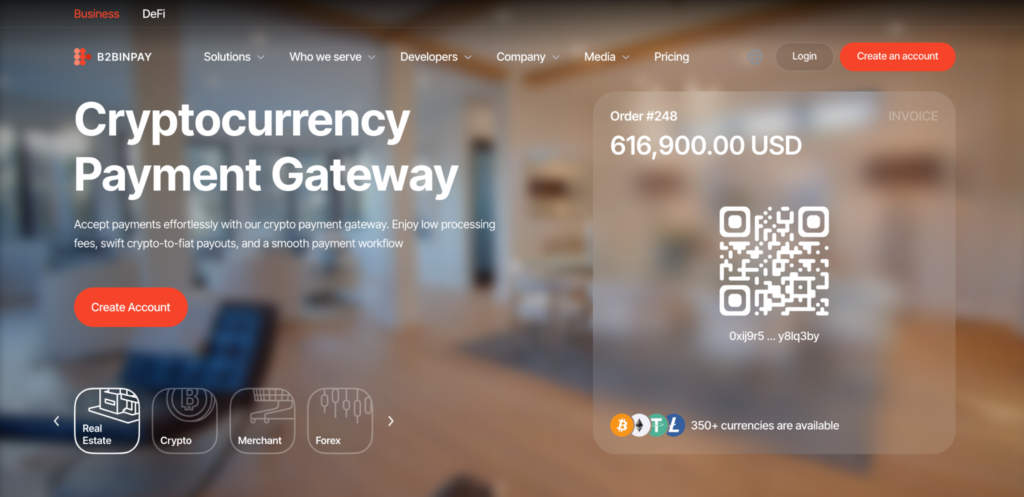
B2BinPay is an all-in-one crypto payment platform designed for merchants, enterprises, and financial institutions that need to accept, convert, and disburse crypto at an institutional scale.
The platform has processed over $5.1 billion in transactions and serves 980+ merchants across Forex, iGaming, and e-commerce sectors. It supports 350+ cryptocurrencies and tokens across 9 blockchains, with automatic conversion of 70+ tokens to USD or EUR to eliminate volatility exposure.
B2BinPay offers real on-chain wallets with auto-sweeping and auto-payouts, a white-label solution for banks and EMIs that want to launch branded crypto payment products, and a DeFi app for non-custodial multisignature processing.
Its off-chain transaction system speeds up transfers and reduces blockchain fees, and it holds licenses in Mauritius and El Salvador.
1. CoinsPaid

Source: coinspaid.com
CoinsPaid is an Estonia-based B2B crypto payment processor founded in 2014, with approximately over €29 billion in transactions processed.
The platform serves millions of merchants with a particular focus on real estate, forex, digital services, and large-scale e-commerce, including white-label checkout for businesses that want a branded payment experience.
It supports multiple assets across 20+ blockchains and over 40 fiat currencies, with instant fiat conversion via an integrated OTC desk for transactions over $1 million. CoinsPaid has no monthly account fees and offers a transparent fee structure.
Furthermore, by complying with EU AML, KYC, and KYB requirements and maintaining its regulated status, Coinspaid establishes itself as a trusted and reliable leader in the crypto payments space.
2. CoinGate
Source: coingate.com
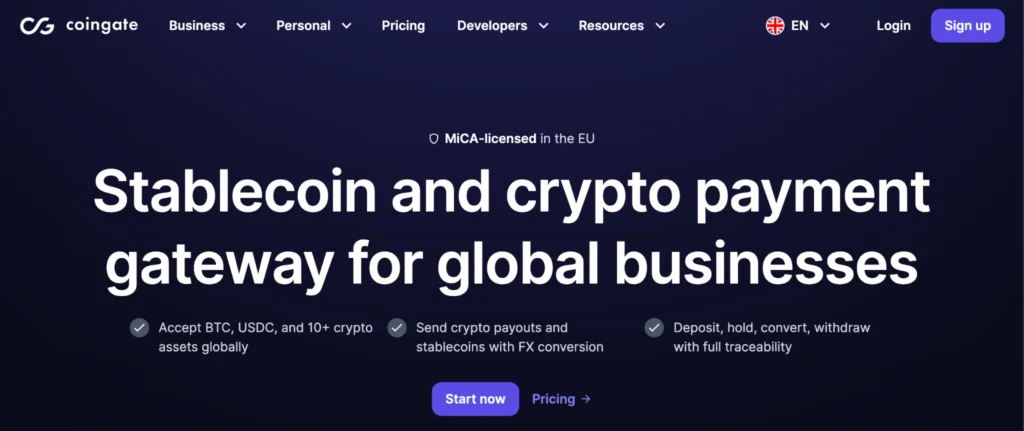
CoinGate is a Lithuania-based crypto payment processor founded in 2014. The platform is fully licensed under MiCA (Markets in Crypto-Asset Regulation) in the European Union, processing 7 million payments in 2025 across 180+ countries.
It offers a flat 1% transaction fee with settlement in EUR, USD, and GBP, and also supports Bitcoin, Ethereum, USDC, and other major assets across Lightning, Polygon, Solana, and Binance Smart Chain.
Teams can integrate with CoinGate through an API, use plugins for WooCommerce and PrestaShop, or get started directly from the dashboard with no code. For European businesses, its MiCA licensing removes significant regulatory uncertainty and makes it one of the safest, most compliant gateways for EU-based merchants.
The platform is not designed for large enterprises needing custom settlement logic, but for mid-market businesses in Europe; it is the most straightforward, compliant entry point.
3. Stripe
Source: stripe.com
Stripe facilitates crypto payments by drawing on its established financial infrastructure to integrate stablecoin support directly into its core processing engine.
Stripe now offers stablecoin payments layered on top of its existing card and ACH infrastructure, allowing businesses to send and receive USDC with the same developer experience and dashboard they use for traditional card payments.
This makes Stripe the lowest-friction entry point for businesses already on its platform that want to add stablecoin settlement without a separate provider integration. Stripe manages on-ramp, off-ramp, and FX in a single API call, and thousands of businesses worldwide already trust its compliance infrastructure.
It is best suited to e-commerce businesses and SaaS platforms already using Stripe that want to extend payments to crypto-native customers or international corridors where card rails underperform.
Treasury & Enterprise Infrastructure
1. Upay

Source: business.upay.best
Upay is a global digital asset platform backed by 2Square, operating under multiple regulatory licenses, including MSB in the US and Canada, VASP in Lithuania and the UAE, and financial services licenses in Hong Kong.
Its B2B arm, UP Business, provides secure and scalable infrastructure for merchants, agents, and API-integrated partners requiring enterprise-level account management and transaction solutions.
Upay enables instant crypto-to-fiat conversion across eight major currencies, including USD, EUR, JPY, GBP, and CNY, and supports 50+ assets, including BTC, ETH, USDT, and USDC.
The platform offers branded crypto card issuance for businesses under its white-label solution, borderless cross-border remittance, and integration with Apple Pay and Google Pay for hybrid spending scenarios.
Upay is particularly suited to businesses operating across multiple jurisdictions that need a regulated, multi-license payment infrastructure with both consumer and B2B product lines running in parallel.
2. Fireblocks
Source: fireblocks.com
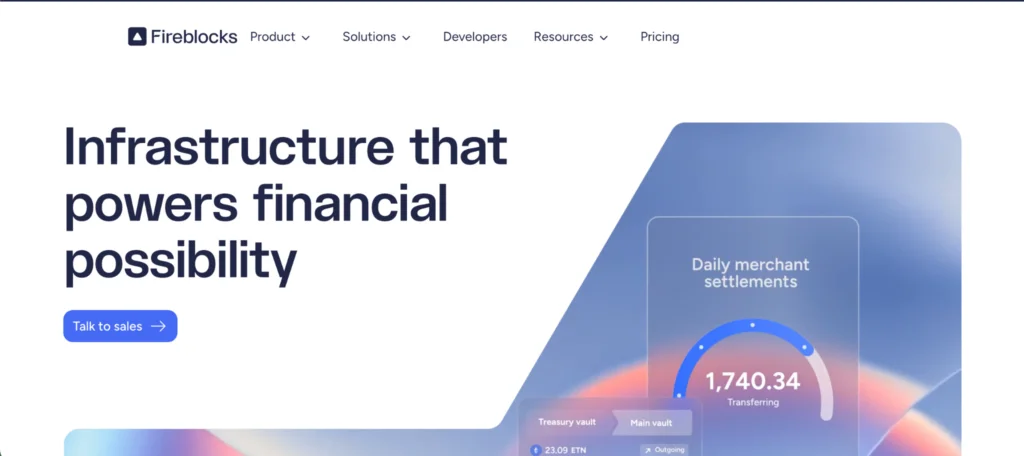
Fireblocks is an institutional-grade infrastructure designed for enterprises that require custody, compliance, and payments in one place. The platform processes over $200 billion in stablecoin transactions every month and serves over 2,400 clients, including Revolut, ABN AMRO, and Bridge.
Its Fireblocks Network for Payments, launched in September 2025, connects participants across 100+ countries and 60+ fiat currencies through a single API. Businesses get MPC wallet custody, multi-chain support, automated AML compliance, and access to all major stablecoins, including USDC, USDT, and PYUSD.
Fireblocks is best for enterprises that need a neutral, multi-rail payments network with full treasury and custody control, and it integrates with Circle’s Arc blockchain for compliance-ready stablecoin settlement.
3. BVNK

Source: bvnk.com
BVNK is a UK-based stablecoin payments infrastructure company that processed over $30 billion in annualized stablecoin payment volume in 2025. The platform serves fintechs and enterprises that need to move money between fiat and stablecoins at scale, with 99.9% uptime and 25+ global licenses covering 130+ countries.
BVNK offers virtual accounts, embedded payment processing, compliance policy enforcement, and audit logging that meet financial audit standards. In 2025, Visa invested in the company, and BVNK launched Layer1, an embedded wallet product unifying fiat and stablecoin flows.
Clients include Deel, Worldpay, and Xapo Bank, making it the closest enterprise stablecoin alternative to Stripe for high-volume B2B settlement.
4. Ripple
Source: ripple.com
Ripple is one of the most established names in cross-border B2B payments. The platform is built on the XRP Ledger, which settles transactions in 3 to 5 seconds at a fraction of the cost of SWIFT transfers.
Ripple’s infrastructure is used by financial institutions and payment providers to execute real-time international settlements, with a focus on high-friction corridors where traditional remittances are slow and expensive.
The platform supports instant payouts, multi-currency liquidity management, and interoperability with banks across more than 90 countries. Its compliance model is built with financial institutions in mind, prioritizing regulatory alignment and banking partnership over crypto-native flexibility.
Ripple is the strongest option for established financial institutions and PSPs that want blockchain-powered cross-border settlement without departing from a bank-friendly compliance framework.
What to Look for When Choosing a B2B Crypto Payment Infrastructure Provider
No two businesses have the same needs. Here are some values that should align with your needs:
Compatible Currencies and Blockchain Networks
While supporting 300+ tokens sounds impressive, most B2B payment volume relies on USDT, USDC, BTC, and ETH. Make sure the platform supports the assets and networks that matter to your business.
Local Bank Account Support
If your finance team operates in USD, EUR, or another fiat currency, you’ll need automatic conversion at settlement. Providers such as Upay, Fireblocks, BVNK, BitPay, and CoinGate streamline this process, while non-custodial solutions leave conversion in your hands.
Compliance and Regulatory Requirements
EU businesses should prioritize MiCA-licensed providers, while US companies should verify MSB registration. Enterprises handling significant transaction volumes also need strong KYC/KYB checks, AML screening, Travel Rule compliance, and audit-ready reporting.
Existing Systems Integration
Even the most advanced payment infrastructure adds little value if it creates manual reconciliation work. Look for native ERP integrations, webhook support, and well-documented APIs that fit smoothly into your workflows.
Read Also: Crypto Payment Gateway API Integration Guide: Everything You Need to Know
Final Thought
The evolution of crypto payment infrastructure increasingly relies on reliable service layers that integrate smoothly with existing financial systems. As adoption accelerates, institutions are seeking providers that deliver compliance-ready scalability, deep liquidity, and operational transparency.
In this environment, the leading B2B crypto payment platforms distinguish themselves not through experimentation, but through their ability to provide strong, enterprise-grade financial infrastructure.
Frequently Asked Questions (FAQs)
What is B2B crypto payment infrastructure?
B2B crypto payment infrastructure is the technology stack, including wallets, APIs, compliance tools, and settlement systems, that enables businesses to send and receive crypto payments, primarily stablecoins, as part of their financial operations.
Why are businesses using stablecoins for B2B payments?
Stablecoins like USDC and USDT are pegged to the US dollar, which means their value doesn’t fluctuate. This makes them predictable for invoicing, accounting, and treasury management in a way that Bitcoin and Ethereum are not.
Is B2B crypto payment infrastructure regulated?
Yes, reputable providers operate under financial licenses such as MSB (US), VASP (EU/UAE), and MiCA (EU). Compliance tools, including KYC, KYB, and AML monitoring, are standard on enterprise-grade platforms.
What is the difference between custodial and non-custodial B2B crypto infrastructure?
Custodial platforms hold your funds on your behalf and convert them at settlement. Non-custodial platforms route payments directly to a wallet you control, with no third-party access to your funds.