


Crypto cardholders spent $759 million in July 2026, roughly two and a half times the $306 million recorded a year earlier, according to Paymentscan data published by a16z crypto. Nearly nine million separate purchases went through those cards in that single month, at an average of $86 each.
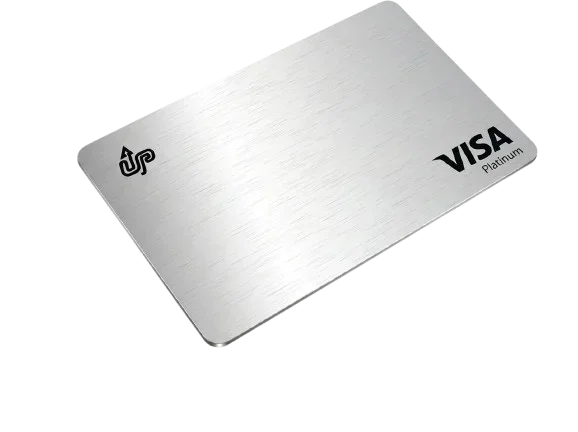
The UPay Platinum Metal Card is aimed at the part of that market that has outgrown a plastic prepaid card. It is a physical metal payment card funded by crypto and stablecoin balances, built for people who move money across borders as a matter of routine.
Introducing the UPay Platinum Metal Card

UPay is launching the Platinum Metal Card that draws on your crypto balance and converts to local currency at the point of sale. It runs on existing card network rails, so it works wherever that network is already accepted and asks nothing new of the merchant at checkout.
Two things separate the Platinum Metal Card from the standard UPay card, the first being the material of the card itself, since the card body is metal rather than plastic and carries the weight that comes with that construction and gives it a sleek design. The second is the tier it belongs to, because a metal card sits at the top of a card programme and carries different limits and different access rules than the entry product.
UPay’s platinum metal card gives you a tier badge that increases your limits, your rewards rate and your level of support unlike the levels you have experienced so far with the regulay UPay crypto card.
Since most metal cards come with a cost of subscription, here’s a comparison of UPay’s platinum metal card compared to other metal card providers.
| Card | What unlocks the metal card | Subscription cost |
|---|---|---|
| MetaMask Metal | Metal tier subscription | $199 a year. |
| Crypto.com | A stake of EUR 450,000 in CRO | The stake stays locked to keep the tier |
| Wirex Elite | 7.5 million WXT tokens locked | EUR 29.99 a month for the top cashback rate |
| RedotPay physical | One-off issuance charge | $100 to issue, about 2.2% on cross-currency spend |
| UPay Platinum Metal | Just apply! | No monthly or annual card fee. |
Where the UPay Platinum Metal Card Works
UPay puts its card coverage at more than 168 countries and its funding options at more than 100 supported coins. Both are company-published figures rather than independently audited ones, which is normal across this category but worth stating plainly to the reader.
The network underneath the card matters as much as the country count does. Artemis research reported in January 2026 that Visa captures more than 90% of on-chain card volume, largely through early partnerships with crypto-native infrastructure providers. By April 2026, Visa reported its stablecoin settlement programme running at a $7 billion annualised rate across nine blockchains, up 50% in a single quarter. Visa also runs more than 130 stablecoin-linked card programmes spread across more than fifty countries.
Coverage is not permanent, and this is the part most comparison charts quietly get wrong. Binance discontinued its Visa debit card across the European Economic Area on 20 December 2023, then withdrew its European licence application and halted EEA crypto services on 1 July 2026. Anyone who chose that card on the strength of a comparison table found the footprint had moved underneath them. Check a provider’s current status in your own country before ordering any physical card, because metal takes weeks to arrive and a licence position can change faster than that.
Funding behaviour has settled into a clear pattern as well. Dollar-backed stablecoins now account for roughly 84% of tracked crypto card spending, with USDC at about 58% and USDT at about 26% as of July 2026. Euro-backed EURe held close to 88% of that volume in early 2024 and has since fallen to around 2%. If you hold digital dollars and spend in several currencies, a card is now the most direct route between the two.
What the Platinum Metal Card Does Not Do
Four limitations are worth reading before you join any waitlist.
The balance is custodial
Your funds sit with UPay rather than in a wallet you control yourself. That is the standard model across this category, but it is not the only available structure. Gnosis Pay and MetaMask both connect their cards to wallets the user holds directly. If self-custody is non-negotiable for you, this is the wrong card to wait for.
A reload fee can outrun a subscription
A card with no annual fee still costs real money if you top it up often enough at 2%. Someone loading $2,000 every month pays $480 a year at that rate, which lands well above the $199 that MetaMask charges for its Metal tier. Run the arithmetic against your own monthly volume rather than against the headline claim.
Physical cards carry physical friction
Shipping windows, replacement timelines and country-level restrictions all apply to a metal card. None of those costs appear anywhere in a standard feature comparison table.
Rewards terms need reading closely
Across this whole category, headline cashback rates often apply only to certain transaction types or stop at a monthly cap. RedotPay Pro is the clearest current example, since its 3% rate covers mobile wallet payments only. Check which transactions qualify on any card before treating the advertised rate as your real return.
Who Is The UPay Platinum Metal Card Built For?
The card fits people whose money already moves internationally. That includes crypto-native professionals, founders and traders paid partly or wholly in stablecoins, alongside globally mobile earners who hold dollars on-chain and spend across several currencies. Frequent travellers form the second group, since traditional banks commonly charge 2% to 3% in foreign transaction fees and add a spread on the exchange rate on top of that.
It fits some people poorly, and saying so plainly is more useful than pretending otherwise. If you are optimising purely for the highest cashback percentage, a staking-based card will beat it on paper every time. If you need to keep custody of your own assets, a wallet-linked card is simply the better structure for you. If your spending is domestic, modest and denominated in one currency, an ordinary local debit card will cost you less than any crypto card on the market.
Frequently Asked Questions
Which countries can order the Platinum Metal Card?
UPay lists card coverage across more than 168 countries in total, including the United States, European regions, and even in Africa. Basically, anywhere crypto is accepted.
What can you fund the card with?
Most crypto cards run on dollar-backed stablecoins, with USDC and USDT which makes it easy to fund the card from your regular bank account by simply sending money into your wallet.
Does it work with Apple Pay and Google Pay?
Yes, UPay Platinum Metal Card works seamlessly with Apple Pay and Google Pay.
How is it different from the standard UPay card?
The metal card gives you a lot more perks and increases your access to more of UPay’s offerings rather than alongside the virtual and plastic options.