Every card reader on the market counts transactions the same way, one tap, one charge. Nobody questioned it. Then someone running a car wash did the math and realized his processing fees were higher than his water bill.
That question led to the CryptoPay card reader: a terminal that waits, batches every swipe from a single visit, and sends one charge. Simple idea, expensive problem solved.
First things first
What Is a Crypto Payment Card Reader?
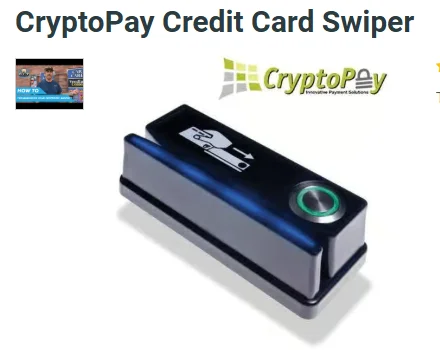
CryptoPay is a credit card acceptance system designed for unattended environments, such as car wash bays, vacuums, and vending machines. It is not intended to process cryptocurrency payments.
Instead, it reads credit or debit cards and uses a backend processor (such as WorldPay) to handle payment settlement.
The system is composed of two main parts:
- The CryptoPay coordinator, which links to the internet and communicates with swipers.
- One or more CryptoPay swipers, each placed at a point of service (bay, vacuum, etc.). Each swiper reads a card, controls the timer logic, and works independently, yet is managed by the coordinator.
Read Also: How to Issue Branded Crypto Cards for Your Business.
Key Features of the CryptoPay Card Reader
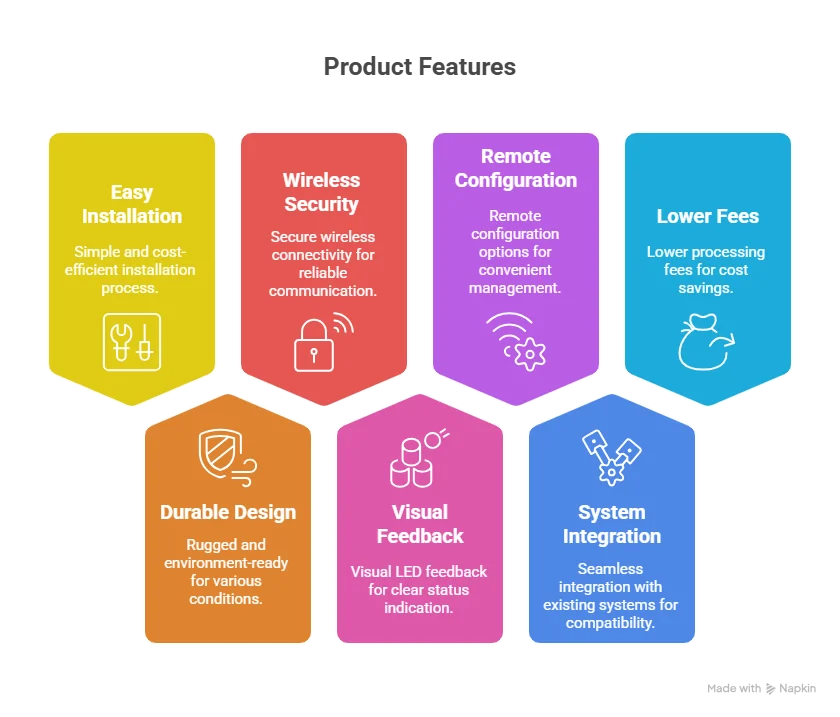
Below are the features that make this device an effective solution for crypto and traditional card-based transactions:
Simple and Cost-Efficient Installation
The CryptoPay system is designed with simplicity in mind. With only two components, the CryptoPay coordinator and one or more
CryptoPay swipers, the setup is streamlined and user-friendly. The reduced hardware complexity translates to lower installation costs, minimal maintenance, and faster deployment.
Rugged and Environment-Ready
Built for durability, the CryptoPay swiper is tough enough to withstand harsh environments like car wash bays, where exposure to water, soap, and varying weather conditions is constant.
This resilience ensures consistent performance without the need for frequent repairs or replacements.
Secure Wireless Connectivity
One of the most essential features of the CryptoPay card reader is its secure, proprietary wireless connection between swipers and the coordinator.
This eliminates the need for Cat5 cabling at every point of sale, allowing full coverage across multiple stations, saving time, effort, and infrastructure costs.
Visual LED Feedback
Each swiper includes a colorful LED light bar that runs along its length.
The flowing “waterfall” display is not only eye-catching at night but also signals to customers that the unit is active and ready for card swipes, creating a high-tech and user-friendly experience.
Remote Configuration Options
Swipers can be configured remotely by Genesys, offering flexible modes of operation:
- Count-Up Mode
- Count-Down Mode
- Auto-Cashier Mode
- Vending Machine Mode
Merchants can also customize pricing and time settings and activate bonus modes as needed.
These flexible options help tailor the reader’s functionality to different business needs without requiring on-site changes.
Smooth Integration with Existing Systems
Connecting the swiper to a coin box timer is as simple as using three wires.
This makes the CryptoPay reader highly adaptable to existing infrastructure, enabling businesses to modernize their payment systems without complete overhauls.
How the Reader Works
When a customer swipes their credit or debit card at a self-service station, such as a wash bay, vacuum unit, vending machine, or laundry terminal, the reader immediately validates the card.
Once authorized, the connected equipment activates, allowing the customer to begin their service without delay.
If the same card is used multiple times within a short period, for instance, to start another cycle or purchase an additional service, the system automatically runs a tab.
Instead of processing each swipe as a separate transaction, CryptoPay groups all activity from that card within a two-hour window and sends the total as a single transaction to the payment processor.
This smart batching approach helps minimize transaction fees and simplifies payment reconciliation for business owners.
Read Also: Top DeFi Protocols by Category.
Benefits of Using a Card-Based POS System for Unattended Businesses
| Benefit | Key Advantage |
| Customer Inclusivity | Expands your reach and reduces checkout friction by offering flexible payment choices. |
| Reduced Fraud & Chargebacks | Minimizes financial risk through encrypted data, instant validation, and verified transactions. |
| Processing Cost Control | Lowers fees by consolidating multiple small payments into single transactions. |
| Easy Retrofit & Scalability | Integrates wirelessly with existing infrastructure for effortless upgrades and expansion. |
| Operational Simplicity | Saves time via centralized remote management, software updates, and troubleshooting. |
Installation and Setup Guide for the CryptoPay Card Reader System
Now here comes the important part. Setting up your CryptoPay credit card system properly ensures smooth operation, secure transactions, and optimal performance.
This complete installation and setup guide walks you through every essential step, from pre-installation checks to online configuration, so your system is ready to accept payments efficiently.
Pre-Installation Checklist
Before installing your CryptoPay system, confirm a few important requirements to avoid delays or technical issues.
These are:
- Internet Connection: Ensure there is a working wired internet connection at your car wash location. This is necessary to activate and configure your CryptoPay equipment, as the system relies on online communication to process payments and manage configurations.
- Merchant Account Activation: Verify you have an activated merchant account with WorldPay. If you haven’t set one up, contact Genesys Sales at 719-277-7400. Activation may take up to two weeks, so plan accordingly. This account is mandatory to program and configure your CryptoPay system.
- MPM Number and Password: Confirm that you have received your MPM number and password from CryptoPay via email. These credentials are essential for programming your devices.
- CPY Number: Write down the CPY number located on the CryptoPay coordinator. You will need this number during the online configuration stage.
- Swiper Serial Numbers and Mount Locations: Record the 16-digit Swiper IDs found on the back of each swiper, along with their intended mounting locations (e.g., Bay 1, Vacuum 1). This information is necessary for swiper configuration later on.
Once you’ve checked off these items, you’re ready to proceed with the physical installation of your CryptoPay equipment.
Step 1: Install the Coordinator
The CryptoPay coordinator serves as the central hub, wirelessly connecting with the swipers and communicating with the internet.
Installation Location
Install the coordinator in a secure, dry location, preferably close to a power outlet and your internet router. Avoid metal walls, large metal objects, or water tanks, as these can block the radio signals between the coordinator and swipers.
If using Wi-Fi, keep the wireless router antenna at least 6 feet away from the coordinator’s antenna to prevent radio interference.
Connecting the Coordinator
- Power Cord: Plug the supplied power cord into the coordinator and a wall outlet.
- Internet Cable: Connect an Ethernet cable from your router box to the coordinator’s internet port.
- Antenna: Attach the supplied antenna securely to the coordinator.
Once powered and connected, the run light on the coordinator will flash, indicating a successful internet connection.
Step 2: Install the Swipers
Swipers are the payment devices installed at each point of sale, such as coin boxes, vacuums, or vending machines.
Mounting
- Mount each swiper vertically, with the button at the bottom.
- Use the three required mounting holes, two for screws and one for power and signal wire routing.
- Ensure there’s enough clearance above and below the swiper to allow a credit card to swipe smoothly without obstruction.
Wiring
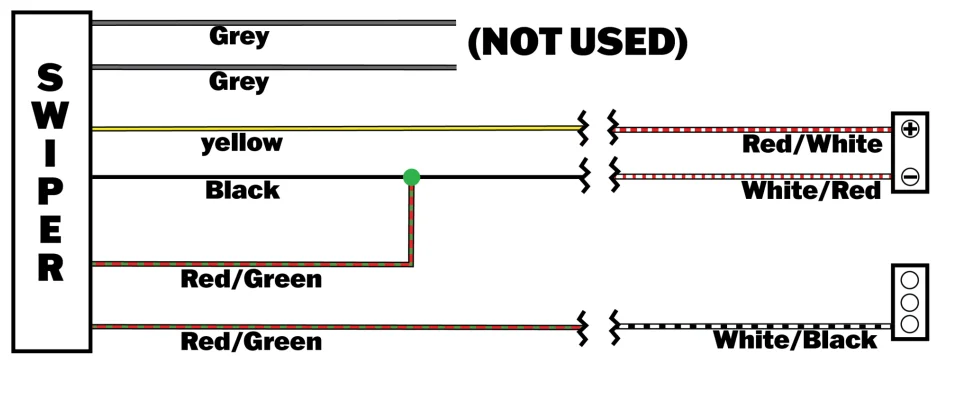
Power Wires: Connect the swiper’s black and yellow wires to a 24VAC power source.
- Black Wire = 24VAC Common
- Yellow Wire = 24VAC Hot
Signal Wires: Connect one signal wire to your timer system.
- Blue Wire = DC Signal Pulse
- Red Wire = AC Signal Pulse
Only one signal wire should be connected per swiper, depending on your timer system.
Initial Swiper Status
After powering the swiper, the LED light bar will illuminate. A blinking yellow LED indicates the swiper is in “Out of service” mode and requires configuration before use.
Step 3: Online Configuration
This step involves programming both the coordinator and swipers through the CryptoPay online portal.
Creating an Account and Logging In
- Visit www.mycryptopay.com/login and click “Create A New Account”.
- Fill in your username, email address, and password.
- After account creation, log in with your new credentials.
Adding Your Site
- Upon logging in, you will be prompted to add a site.
- Enter a site name, select your time zone, and input the CPY number from the coordinator unit.
- Make sure to enter the CPY number exactly as it appears on the label.
- Click Add Site.
Setting Up Merchant Account Information
- Go to the Manage Site page.
- You will see an alert if your merchant account is not set.
- Use the MPM number and password emailed from CryptoPay to enter your merchant account details.
- Select your payment processor and submit.
- Use copy-paste to avoid entry errors since the credentials are case-sensitive and may include special characters.
Configuring Swipers
- In the Manage Site section, confirm the coordinator status shows as Connected and swipers are detected.
- Swipers are initially “Out of service.”
- Click Configure next to each swiper device.
- Assign each swiper a name based on its location (e.g., Bay 1, Vacuum 1).
- Select the appropriate profile matching your timer setup, such as count-up or count-down mode.
- Fill in the required fields under “Basic Options,” “Card Options,” and “Button Options.”
- Confirm changes and apply.
- Repeat this for all swipers installed on-site.
Final Testing and Verification
Once the coordinator and swipers are configured:
- Perform a test swipe with a credit card.
- The swiper’s LED bar should turn blue for a valid swipe or red for an invalid swipe.
- Verify that the timer activates.
- Confirm the transaction appears correctly in your online purchase records at mycryptopay.com/login.
For visual guidance, CryptoPay provides installation videos at: https://www.getcryptopay.com/index.php?page=videos
Always keep your CPY number, MPM credentials, and Swiper IDs recorded safely for reference during configuration or troubleshooting.
Also, ensure your timer configuration matches the swiper settings to avoid operational mismatches.
Following this detailed installation and setup guide will ensure your CryptoPay card reader system is installed correctly, configured securely, and ready to provide smooth, cost-efficient payment processing for your car wash or service location.
Read Also: Quick tips on how to convert crypto to cash.
Pricing and Subscription Plans
The CryptoPay card reader system provides a cost-effective solution for businesses seeking reliable and secure credit card and crypto payment processing, eliminating the high overhead typically associated with point-of-sale hardware.
One-Time Hardware Cost

- Product Name: CryptoPay Credit Card Swiper (Coin Box Version)
- Brand: CryptoPay
- Model Number: SWIPER-COIN-NG
- Part Number: CPS3005
- Current Price: $399.99
Additional components, such as the CryptoPay Coordinator, are also required and typically sold separately, depending on your setup.
No Monthly Subscription Fees
CryptoPay does not require a monthly subscription to operate its system. After purchasing the hardware and setting up your merchant account with a supported processor (such as WorldPay), you can begin accepting payments.
This makes CryptoPay a cost-efficient choice, especially for small to mid-sized businesses looking to minimize recurring costs.
Transaction-Based Processing
CryptoPay partners with WorldPay for payment processing. Standard credit card transaction fees apply through your merchant account.
However, CryptoPay’s system includes a transaction consolidation feature that bundles multiple swipes within a two-hour window into one transaction.
This significantly reduces per-transaction processing fees, especially useful in high-turnover locations like car washes.
Optional Add-Ons
Depending on your business needs, you may need to purchase additional components beyond the base swiper unit. Common add-ons include:
- Additional swipers for businesses with multiple service bays, vacuum stations, or vending points. Each service point requires its own swiper unit.
- CryptoPay Coordinator — one coordinator is required per physical location or site. If you are expanding to a second location, you will need a second coordinator.
- Power and signal cables — required for wiring swipers to your existing timer system. Ensure you have the correct cable length for each installation point before starting.
- Optional installation support from Genesys — if you prefer professional setup, Genesys offers installation assistance.
Read Also: Coin Ticker: The Three Letters That Speak for a Whole Crypto Project.
Is CryptoPay Right for Your Business?
CryptoPay is not a general-purpose card terminal. It was designed to solve a very specific problem — unattended businesses where customers swipe multiple times in a single visit and traditional per-transaction fees eat into already thin margins.
It is a strong fit if you operate:
- A car wash with self-service bays
- A laundromat with coin-operated or card-operated machines
- A vending machine business with high daily transaction volume
- A parking facility or vacuum station
- Any unattended service point where customers cycle through multiple paid sessions per visit.
In these environments, CryptoPay’s two-hour transaction batching feature directly addresses your biggest cost problem. Instead of paying a processing fee on every individual swipe, every card interaction within a two-hour window is grouped into one charge.
For a car wash operator handling dozens of bay sessions daily, this can translate to significant monthly savings on processing costs alone.
It is not the right fit if you operate:
- A staffed retail store or boutique
- A restaurant or café
- A service business where customers make a single payment per visit
- Any business that needs a customer-facing display, receipt printing, or staff interaction at the point of sale.
If your customers typically swipe once and leave, the batching feature provides no benefit, and you would be paying $399.99 per unit for hardware that a standard POS terminal handles equally well at a lower cost.
The question to ask before purchasing is simple: do your customers swipe more than once per visit? If yes, CryptoPay is worth evaluating. If no, a conventional card reader is the more practical and cost-efficient choice.
Conclusion
The CryptoPay card reader doesn’t overcomplicate payments, it simplifies them. One charge per visit, no subscription fees, no rewiring.
For unattended businesses where every swipe and every dollar counts, that simplicity is the product. If your current setup is costing you more than it should, this is the switch worth making.