


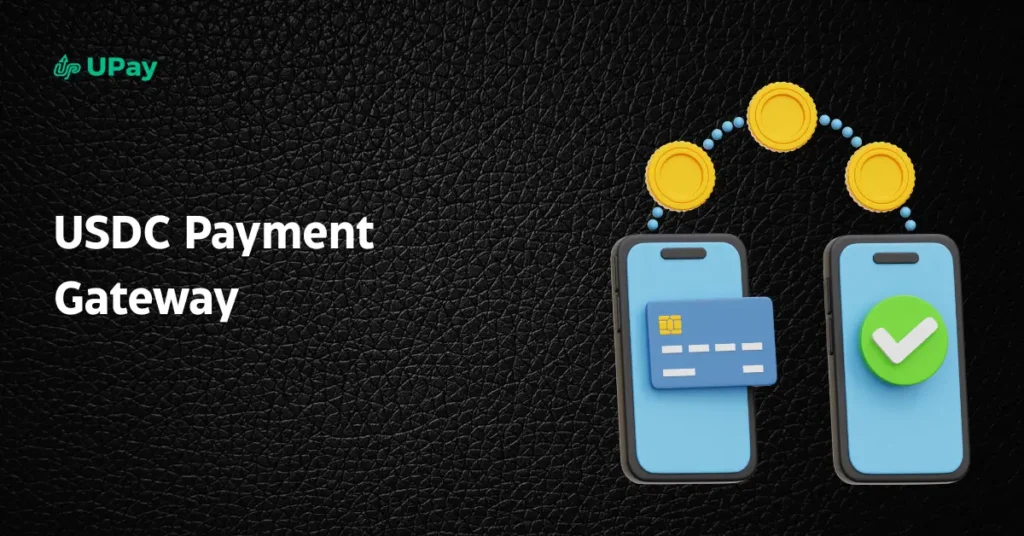
A USDC payment gateway is a service that handles the technical and financial infrastructure required for a business to accept USD Coin as payment.
It generates payment addresses or QR codes for customers to send USDC to, confirms that the transaction has been received on the blockchain, notifies the merchant’s system that payment is complete, and manages the settlement of funds to the merchant’s account either in USDC, another stablecoin, or converted to fiat currency.
The gateway sits between the customer’s wallet and the merchant’s account, performing the same role that Stripe or PayPal performs for card payments.
The difference is that instead of routing a card transaction through a network of banks, card schemes, and processors each taking a cut a USDC transaction moves directly on a blockchain.
The gateway’s job is to make that blockchain transaction as easy to trigger and verify as clicking a pay button.
USDC itself is issued by Circle, a regulated financial institution.
Each USDC token is backed one-to-one by US dollar reserves held in regulated financial institutions and US government treasuries, and Circle publishes monthly attestations from accounting firms confirming the reserve backing.
Read Also: How Many Crypto Wallets Do You Actually Need?
How USDC Payment Gateways Work
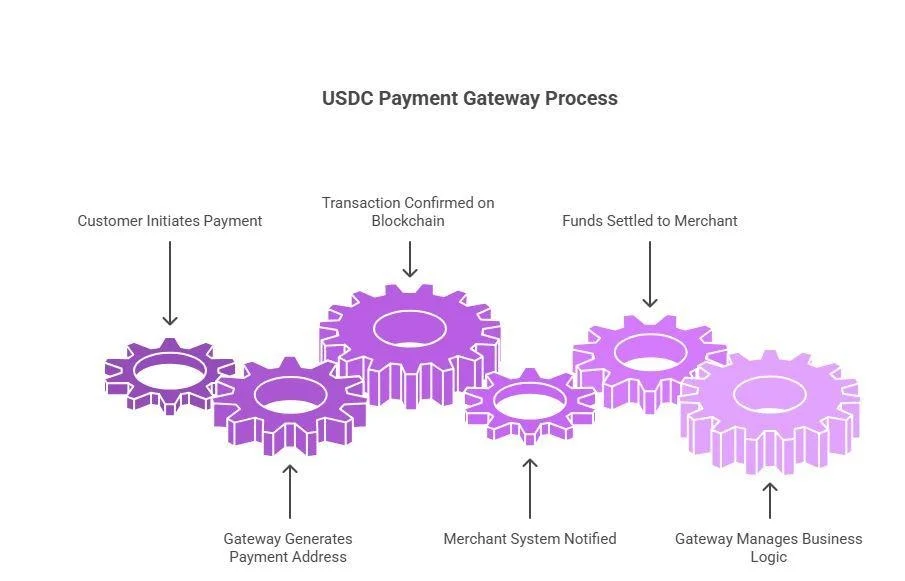
| Step / Aspect | Description | Key Details |
| 1. Payment Initialization | Gateway generates a unique payment address/QR code tied to the order details. | Encodes amount, order ID, and an expiration window. |
| 2. Customer Action & Broadcast | Customer scans QR code or copies address, enters USDC amount, and confirms. | Transaction is broadcast to the selected blockchain network. |
| 3. Blockchain Confirmation | Gateway monitors the network in real time and detects the incoming transaction. | Speeds vary by network (e.g., sub-second on Solana, seconds on L2s). |
| 4. Merchant Processing & Safety | Gateway triggers a webhook to confirm payment; businesses wait for 1–3 block confirmations. | Mitigates unconfirmed transaction risks and handles compatibility (EOAs vs. smart wallets). |
| 5. Settlement & Comparison | Funds arrive instantly on-chain, bypassing traditional banking clearing cycles. | Eliminates chargeback risk; separate fiat conversion follows traditional banking hours. |
| 6. Edge Case Management | Gateway automatically resolves payment discrepancies via configured rules. | Handles underpayments (tolerance thresholds) and overpayments (refunds or balance credits). |
Why Businesses Choose USDC Over Other Payment Methods
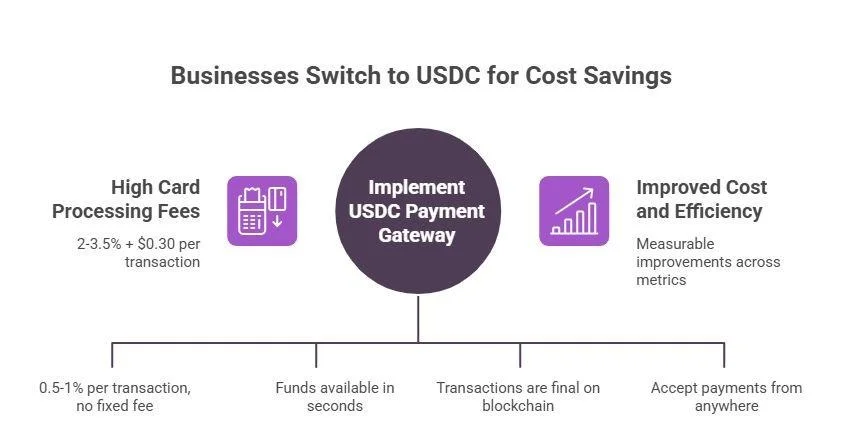
| Economic Advantage | Traditional Card Processing | USDC Payment Gateway | Key Impact |
| Processing Fees | 2% to 3.5% + fixed fee (e.g., $0.30), exceeding 5% on small orders. | 0.5% to 1% with no fixed per-transaction fee. | Drastically lowers costs across all transaction sizes. |
| Settlement Speed | 1 to 5 business days for funds to clear to bank accounts. | Instant on-chain settlement (seconds), independent of location. | Frees up cash flow immediately (plus 1–3 days for fiat off-ramps). |
| Chargeback Risk | Vulnerable to friendly fraud and post-purchase bank disputes + fees. | Zero protocol-level chargebacks (final upon confirmation). | Eliminates automated reversals, protecting high-risk verticals. |
| Global Reach | Blocked international cards, currency conversion fees, and bank hurdles. | Frictionless global payments at identical speeds and costs. | Equalizes transactions for customers worldwide regardless of location. |
Read Also: CryptoPay Card Reader Review: Features, Pricing, Installation, and Setup Guide.
Top USDC Payment Gateway Providers
| Gateway Provider | Key Features | Fee Structure | Best For |
| Upay | APIs, KYC/AML compliance, white-label card program for payouts. | Custom / Tiered | Merchants, fintechs, and SaaS seeking compliance and payout tools. |
| Circle Payments API | Direct infrastructure, multi-chain support, programmable balances, fiat on/off-ramps. | Low direct network/processing costs | Developers and enterprises needing direct, custom crypto integration. |
| Stripe | Unified dashboard for cards and crypto, auto-fiat conversion (Ethereum/Polygon). | ~1.5% for crypto transactions | Existing Stripe merchants wanting seamless setup without new dashboards. |
| Coinbase Commerce | E-commerce plugins (Shopify, WooCommerce), hosted checkout page. | 0% platform fee (gas fees apply) | Businesses comfortable holding USDC for operations or supplier payouts. |
| NOWPayments | 300+ cryptocurrencies, auto-fiat conversion, multi-chain routing. | 0.5% processing fee | Merchants needing multi-asset support and flexible payout destinations. |
| CoinGate | Mobile POS app, EU regulatory licensing, automatic fiat settlement (EUR/USD). | 1% processing fee | European businesses and physical retail stores needing regulatory clarity. |
| BitPay | Long-standing track record (since 2011), business debit card, multi-chain support. | 1% processing fee | Risk-averse merchants wanting a proven, battle-tested processor. |
| Transak | Global coverage (160+ countries), handles both on-ramps and off-ramps. | 1% to 3.5% | Web3 apps, NFT marketplaces, and platforms needing two-way fiat/crypto flows. |
Integration: How to Add a USDC Payment Gateway to Your Business
| Integration Model | Description | Requirements & Best For |
| 1. E-Commerce Plugins | Installs directly onto platforms like Shopify, WooCommerce, or Magento. | No-code; connects via API key in minutes. Best for standard online stores. |
| 2. Hosted Checkout Pages | Redirects customers to a gateway-managed URL to complete payment and return. | Minimal dev work (redirect + webhook). Best for custom sites without native plugins. |
| 3. Direct API Integration | Custom-built UI where the gateway handles backend monitoring and settlement. | Development team required. Best for full control over the checkout experience. |
| Core Technical Setup | Requires a webhook endpoint to receive real-time, authenticated payment confirmations. | Mandatory for all models to automatically update order statuses on your server. |
| Testing & Security | Use gateway testnet environments to simulate payments, edge cases, and webhooks. | Secure API keys via environment variables and validate webhook signatures to prevent spoofing. |
Real-World Use Cases and Examples
The abstract benefits of USDC payment gateways become concrete when examined through specific business scenarios.
A digital goods business selling software licences, design assets, or online courses accepts USDC through Coinbase Commerce integrated with its Shopify store.
A customer in Germany pays €90 worth of USDC for a licence, which arrives in the merchant’s Coinbase Commerce wallet within seconds.
The merchant pays no processing fee. The customer paid exactly the quoted price with no currency conversion surcharge.
The licence is delivered automatically by Shopify fulfilment system as soon as the payment confirms. Total processing cost to the merchant: zero gateway fee plus blockchain network fees of a few cents.
A cross-border B2B supplier in Asia invoices European customers in USDC through a Circle Payments API integration. Settlement happens in hours instead of the three to five business days a SWIFT wire transfer would take.
The supplier eliminates the $25–$45 wire transfer fee per invoice and the 1% to 2% currency conversion loss that international bank transfers carry.
On 50 invoices per month averaging $5,000, this saves the supplier over $3,000 per month in transaction costs alone.
An NFT marketplace in Southeast Asia uses Transak for its fiat on-ramp, allowing users to purchase USDC with their local currency through local payment apps and bank transfers, then spend it on the platform.
The same users withdraw earnings in USDC and convert back to local fiat through Transak’s off-ramp. The entire payment flow from local currency in to local currency out is handled by a single integration, and the marketplace never touches fiat directly.
A SaaS company in Europe adds USDC as a payment option for annual subscriptions alongside credit card and bank transfer. Within three months, 12% of new annual subscriptions are paid in USDC, predominantly from customers in regions where card authorisation rates for international merchants are low.
The USDC subscriptions have a zero chargeback rate compared to a 1.8% chargeback rate on card subscriptions. The effective saving on chargeback costs and dispute fees covers the gateway integration cost within the first quarter.
Read Also: Top DeFi Protocols by Category:
Advantages and Limitations
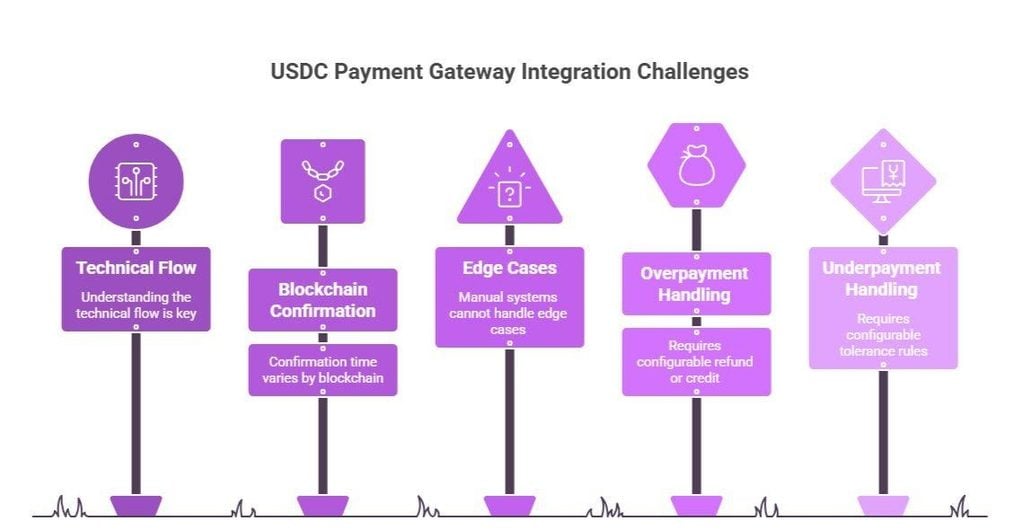
| Advantages | Limitations |
| Lower Fees: 0.5% to 1% without fixed per-transaction costs. | Low Customer Adoption: Minority of Western consumers hold crypto. |
| Instant Settlement: Real-time on-chain funds access. | UX Barriers: Requires a wallet and basic technical know-how. |
| Zero Chargebacks: Eliminates fraudulent chargebacks and reversals. | Accounting Complexity: Requires specialized tools or manual reconciliation. |
| Global Reach: Seamless cross-border payments without FX friction. | Regulatory Uncertainty: Varying legal frameworks across jurisdictions. |
Conclusion
USDC payment gateways have moved from a niche technical experiment to a practical business infrastructure option.
The economics are straightforward: lower fees than card processing, instant settlement, no chargebacks, and global reach without the friction of international banking.
For businesses with international customers, high transaction values, or customers in markets with high stablecoin adoption, the case for adding USDC as a payment option is grounded in real cost savings rather than ideology.