



Stablecoins have become the digital backbone of cryptocurrency transactions, promising stability in a market known for its constant volatility.
But how do you really know that a stablecoin like USDC or USDT is fully backed by real assets? That’s where stablecoin attestation reports come in. These reports serve as the transparency bridge between issuers and users, showing if the coins in circulation truly match the reserves held.
Now, many people often wonder, ‘Does this report actually prove the stablecoin is safe?’ The answer lies in understanding what the attestation covers, who conducts it, and how to interpret the details. It’s not just accounting jargon, it’s your window into financial accountability.
Learning how to read a stablecoin attestation report helps you distinguish between trusted digital assets and risky ones, ensuring your confidence is well-founded. This guide will walk you through everything you need to know about the stablecoin attestation report and its significance.
Key Takeaways
- Stablecoin attestation reports provide independent verification that every issued token, such as USDC or USDT, is fully backed by real, measurable assets.
- These reports enhance transparency and investor confidence by confirming reserve adequacy through third-party accounting firms that follow AICPA standards.
- Understanding key sections of an attestation report, including total supply, reserve composition, and auditor details, helps users assess the true stability of a stablecoin.
- While attestations offer valuable insights, they represent a point-in-time review and not continuous, real-time verification of reserves.
- Full audits and on-chain proof-of-reserve systems remain essential for ensuring long-term trust, compliance, and accountability in the stablecoin ecosystem.
What Is a Stablecoin Attestation Report?
A stablecoin attestation report is an independently reviewed statement confirming that a stablecoin issuer holds sufficient reserves to support every token it has issued.
In essence, it’s a detailed financial confirmation that shows each unit of digital currency, such as USDC, USDT, or PYUSD, is backed by tangible assets, including cash, U.S. Treasury bills, or other short-term, low-risk instruments.
These attestations are not casual updates; they’re formal evaluations conducted by certified public accounting or assurance firms. Such firms follow established professional frameworks, most notably those outlined by the AICPA (American Institute of Certified Public Accountants).
The result is a transparent snapshot of a stablecoin’s financial health, allowing users, investors, and regulators to verify that its value truly matches what’s claimed.
Difference Between Attestation and Audit
| Criteria | Stablecoin Attestation | Audit |
| Purpose and Scope | Verifies whether a stablecoin issuer holds enough reserves to back all tokens in circulation. Focuses on specific financial claims. | Provides a full examination of a company’s financial statements, operations, and internal controls. Broader in scope. |
| Level of Assurance | Offers limited or moderate assurance based on data provided by the issuer. | Delivers reasonable (high) assurance after in-depth verification and testing. |
| Frequency and Detail | Conducted monthly or quarterly to give ongoing transparency into reserves. | Performed annually and involves a deeper review. |
| Timeframe | Represents a snapshot of reserves at a specific date. | Covers financial activities over a longer period, usually a full fiscal year. |
| Conducted By | Carried out by independent certified public accounting or assurance firms using attestation standards (e.g., AICPA). | Performed by licensed audit firms with broader financial and compliance expertise. |
| Outcome | Produces a concise report confirming reserve adequacy and accuracy as of the attestation date. | Results in a detailed audit opinion assessing the fairness and accuracy of full financial statements. |
Understanding the difference between an attestation and an audit is important when evaluating the transparency of a stablecoin. While both provide financial verification, their purposes, depths, and levels of assurance differ significantly.
Purpose and Scope
An attestation focuses on confirming specific claims made by a stablecoin issuer, primarily verifying whether the reserves match the tokens in circulation. An audit, however, is a broader review of a company’s entire financial records, operations, and internal controls.
Level of Assurance
Attestations provide limited or moderate assurance, verifying that the reported data appears accurate based on provided evidence. Audits deliver high (reasonable) assurance, offering deeper validation of a company’s financial integrity.
Frequency and Detail
Stablecoin issuers typically release attestation reports on a monthly or quarterly basis, providing regular updates on their reserve status. Audits occur annually and involve far more detailed testing and verification processes.
Timeframe
An attestation represents a snapshot of reserves at a specific date. In contrast, an audit examines financial activities over an extended period, typically covering a full fiscal year.
Conducted By
Independent certified accounting firms perform both, but audit teams typically include specialists in financial systems and compliance. Attestation engagements are often handled by assurance teams focusing on targeted validations.
Outcome
An attestation results in a brief report confirming reserve adequacy as of a specific date. An audit produces a complete opinion, detailing the fairness and accuracy of the company’s entire financial statements.
How To Read a Stablecoin Attestation Report
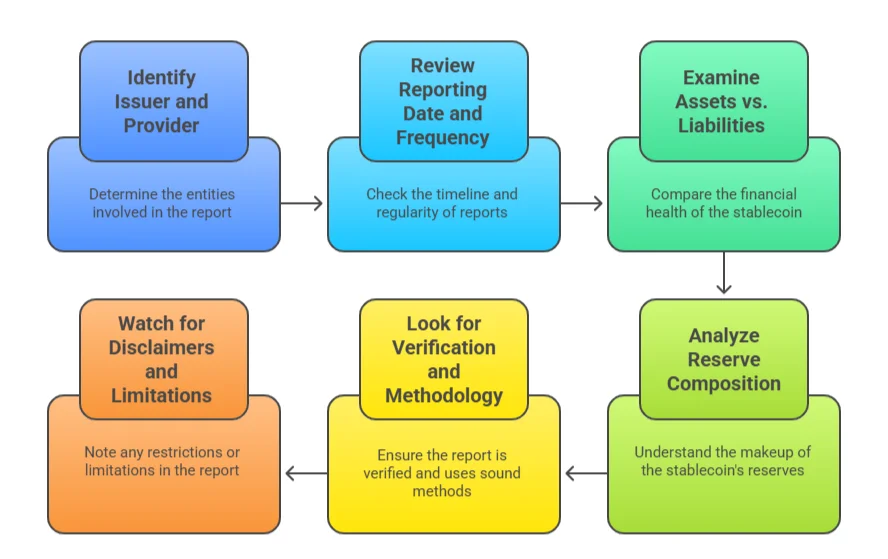
Reading a stablecoin attestation report can seem technical at first glance, but once you understand what to look for, it becomes a straightforward process. Each section provides insight into the trustworthiness, transparency, and financial health of the stablecoin issuer.
Here’s a step-by-step guide to help you evaluate one with confidence.
Step 1: Identify the Issuer and Attestation Provider
Start by confirming who issued the stablecoin (e.g., Circle for USDC, Tether for USDT, or PayPal for PYUSD) and who conducted the attestation.
The issuer’s credibility matters just as much as the verifier’s independence. A reputable third-party accounting or assurance firm adds confidence that the report was prepared under recognized standards. Be cautious if the issuer self-reports or uses an unknown verifier, as that can weaken transparency.
Step 2: Review the Reporting Date and Frequency
Next, check the report’s date and the frequency of attestations. Some issuers provide monthly attestations (like USDC), while others may report quarterly or irregularly.
The reporting date indicates the precise point in time when the reserves were examined. Remember, attestations are snapshots, not continuous monitoring. The more frequent the reporting, the better it reflects ongoing accountability and reserve stability.
Step 3: Examine Total Assets vs. Total Liabilities
This is the heart of the report. Compare the total assets (reserves held) with the total liabilities (tokens in circulation). The assets should be equal to or greater than the liabilities, confirming full collateralization.
If the reserves fall short, it indicates under-collateralization, a major red flag. Pay attention to how the totals are presented and if they’re broken down by type and value, as this gives a clearer picture of the issuer’s solvency.
Step 4: Analyze Reserve Composition
The composition of reserves reveals how the backing is structured, and this is where most of the acceptable print lies.
Look for details on what assets make up the reserves, such as:
- Cash and bank deposits: provide immediate liquidity.
- U.S. Treasury bills: low-risk, short-term government debt.
- Commercial paper or corporate bonds: higher yield but riskier.
- Repurchase agreements (repos): short-term loans secured by government securities.
Ideally, a substantial reserve portfolio leans heavily on cash and short-term Treasuries, ensuring liquidity and minimal exposure to credit risk.
When Tether (USDT) faced scrutiny in 2021, it was partly due to holding a large portion of its reserves in commercial paper, which introduced higher risk. Since then, Tether claims to have shifted toward safer assets like Treasuries and reverse repos.
Step 5: Look for Third-Party Verification and Methodology
Reliable attestation reports should include details about how the verification was performed. Check whether the report references AICPA standards (like the SSAE 21 standard for attestation engagements) or other recognized frameworks.
The methodology should clearly explain what data was reviewed, how balances were confirmed, and any limitations in the testing process. Third-party verification ensures that the numbers weren’t just reported; they were independently verified.
Read Also: Stablecoin Market Cap 2026: The New Global Reserve?
Step 6: Watch for Disclaimers, Limitations, and Scope of Review
Every attestation includes disclaimers, and these can reveal what’s not covered. Look for phrases like “This report does not constitute an audit” or “Our examination was limited to data provided as of [specific date].”
These statements matter because attestations are point-in-time reviews, not continuous monitoring. They confirm that reserves existed on the date specified, but don’t guarantee that the backing remains intact afterwards.
Also, note any limitations in scope, such as the exclusion of certain subsidiaries, jurisdictions, or reserve categories. A narrow scope could mean parts of the reserves weren’t fully verified.
Why Stablecoin Attestations Matter
Stablecoins now underpin a massive slice of the crypto market, currently estimated at over $310 billion, which is dominated by dollar-pegged tokens.
That scale means any gaps in reserve transparency can ripple through trading venues, DeFi protocols, and broader financial markets.
Central banks and international bodies have warned that weak disclosure or poor reserve practices could undermine trust and financial stability.
Role in Transparency and User Confidence
Attestations are a concise, third-party verification that the coins in circulation are actually supported by real assets.
For users and platforms, an attestation reduces informational asymmetry: traders can see whether reserves consist mainly of cash and short-term Treasuries, or riskier instruments that could lose value quickly.
Regular, clear attestations build confidence, and when reports are thorough and frequent, they can prevent panic during stressed market events. Circle’s public monthly reserve disclosures and formal attestations are an example of how routine transparency can reassure markets.
Connection to Regulation and Risk Management
Regulators are increasingly treating attestations as a minimum transparency requirement as they design formal rules. Attestations help firms demonstrate compliance with emerging standards (for example, AICPA guidance) and allow risk teams to measure counterparty exposure.
When a stablecoin issuer shows a diversified portfolio of high-quality, liquid assets, risk managers can model tail events more reliably. Conversely, incomplete or infrequent disclosures force regulators and custodians to assume higher risk buffers, increasing operational costs for exchanges and custodial services.
Tether, Circle, and Market Reactions
Tether (USDT) has long been scrutinized for the makeup and frequency of its reserve disclosures; regulatory pressures and criticism have pushed it toward more detailed quarterly reporting and third-party attestations in recent years.
Tether’s more recent public reserve reports claim growing allocations to U.S. Treasuries and other liquid assets, signalling an attempt to address past concerns.
Circle’s USDC illustrates another dynamic. In March 2023, public disclosure that significant USDC reserves were held at Silicon Valley Bank precipitated a short-lived de-peg and market stress, showing how reserve concentration and transparency timing can directly affect price stability.
Since then, Circle has emphasized weekly reserve breakdowns and monthly independent attestations. In 2025, the company reported strong reserve-linked revenues and large circulation growth, underscoring how transparent practices can restore or strengthen market trust.
Impact on Investors, Traders, and Institutions
For retail investors, attestations are a quick credibility check before holding or transacting with a stablecoin. For traders and market makers, reliable attestations reduce counterparty risk and enable tighter spreads.
Institutional players, such as custodians, asset managers, and exchanges, often require evidence of high-quality, liquid backing before integrating a stablecoin into custody or settlement workflows.
When attestations are clear and frequent, institutions can commit capital with lower operational overhead; when they are absent or opaque, institutions may either exclude the coin or apply costly risk premiums.
Who Performs Stablecoin Attestations
Stablecoin attestations are carried out by independent third-party accounting or assurance firms whose primary responsibility is to verify that the issuer holds enough real-world assets to back every token in circulation.
These firms provide a neutral, evidence-based opinion that strengthens market confidence and ensures users can trust that a stablecoin’s value isn’t built on empty claims.
Third-Party Accounting and Assurance Firms
Not every accounting firm is qualified to conduct a stablecoin attestation. The process requires adherence to established professional frameworks, typically those set by the AICPA (American Institute of Certified Public Accountants) under standards such as AT-C Section 205.
Prominent firms that have provided attestation services for stablecoins include:
- Grant Thornton LLP: known for auditing Circle’s USDC.
- BDO Italia and BDO Cayman: associated with Tether’s (USDT) quarterly attestations.
- Moore Cayman: previously conducted reviews for Tether before BDO took over.
These firms examine the issuer’s financial data, bank statements, and custodial records to verify that reserves exist and align with the reported supply.
Role of Independent Verifiers in Confirming Stablecoin Reserves
Independent verifiers act as a trust bridge between the stablecoin issuer and the public. Their role is not to manage the funds but to validate them.
They confirm:
- The total value of reserves held by the issuer.
- The types of assets included in those reserves (cash, Treasury bills, repos, etc.).
- That the reserves meet or exceed the number of stablecoins in circulation.
Their confirmation doesn’t just assure users, it also helps regulators, exchanges, and institutional investors assess whether the stablecoin meets basic standards of solvency and liquidity.
Why Independence and Credibility of the Auditor Matter
Independence is the cornerstone of any credible attestation. If the auditor or assurance firm has a financial relationship or conflict of interest with the issuer, the reliability of the report is called into question.
A reputable, independent auditor:
- Ensures objectivity, with no bias toward the issuer’s internal narrative.
- Adheres to strict professional ethics and global accounting standards.
- Enhances market credibility, signaling to investors and regulators that the stablecoin operates transparently.
The credibility of the auditing firm also determines how seriously the report is taken. A report signed by a globally recognized firm like Grant Thornton carries more weight than one from an unverified or lesser-known auditor.
The AICPA 2025 Criteria: Setting a Standard for Stablecoin Verification
In March 2025, the American Institute of CPAs (AICPA) released a landmark framework called 2025 Criteria for Stablecoin Reporting: Specific to Asset-Backed Fiat-Pegged Tokens, the first standardized guidance for stablecoin issuers and assurance practitioners to drive consistency, transparency, and comparability across the industry.
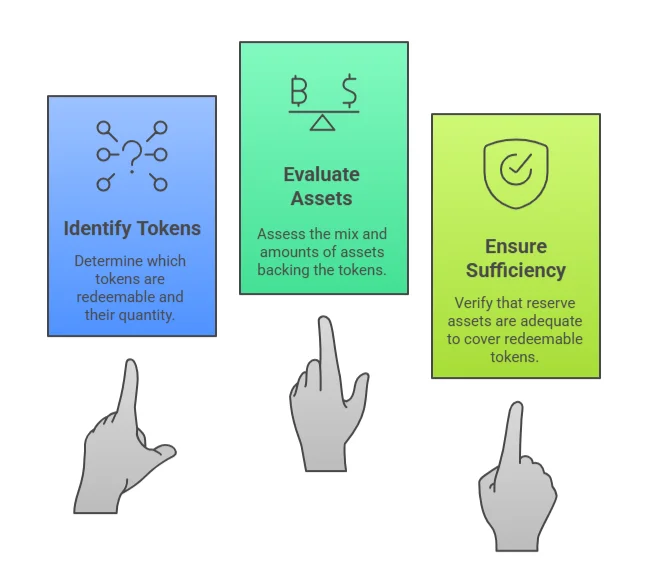
These criteria define how issuers should present and disclose key elements of their operations, including:
- Outstanding redeemable tokens (i.e., which tokens are in scope and how many are subject to redemption)
- Redemption assets (the mix and amounts of assets backing those tokens)
- Sufficiency of assets (that reserve assets are enough to cover the outstanding redeemable tokens)
By requiring standardized disclosure formats and line-item clarity, the AICPA aims to reduce ambiguity in how issuers report backing, redemption claims, and exclusions.
The 2025 criteria represent a turning point: before this framework, issuers used disparate methods and terminologies in their reserve disclosures, making comparisons difficult and trust harder to build.
By establishing a baseline for transparency, the AICPA aims to eliminate ambiguity and facilitate consistent interpretation of stablecoin disclosures by investors, auditors, regulators, and the public.
Additionally, many expect that stablecoin regulations at the federal or state level will increasingly reference or align with these criteria, making them practically important for issuers seeking compliance and market legitimacy.
Inside a Real Report: The February 2025 USDC Example
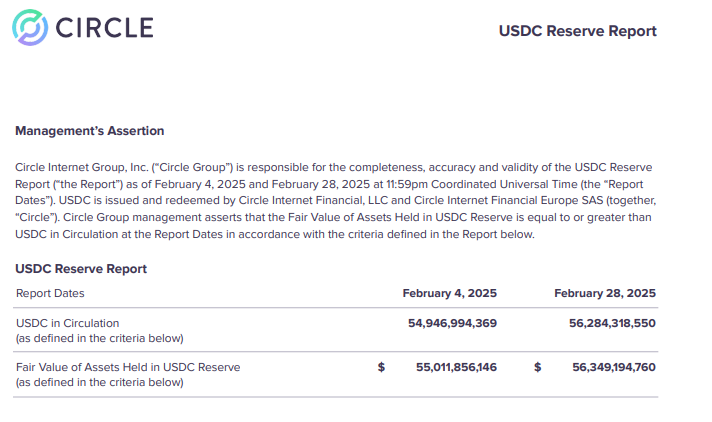
Let’s look at Circle’s February 2025 attestation for USDC, one of the more transparent reports available publicly.
Snapshot of Supply vs. Reserves
Circle’s report covers two “report dates”: February 4, 2025, and February 28, 2025.
- On February 4, the USDC in circulation was $54,946,994,369, and the fair value of reserve assets was $55,011,856,146, resulting in a slight excess.
- On February 28, circulation had grown to $56,284,318,550, and reserves totaled $56,349,194,760.
These figures show that reserve assets exceeded liabilities on both dates, meeting the issuer’s assertion.
Structure & Criteria of the Report
Circle defines “USDC In Circulation” by excluding “Tokens Allowed But Not Issued” and “Access Denied Tokens”, ensuring only active, redeemable tokens are counted.
The attestation was examined under AICPA standards, and the independent reviewer (in this case, Deloitte) expressed an unqualified opinion: the reserve assertion was “fairly stated, in all material respects.”
Reserve Composition & Backing Assets
While the report does not always list every line item asset publicly in the summary, in Circle’s overall transparency disclosures, USDC reserves are held through the Circle Reserve Fund, a regulated money market fund composed of:
- Cash at banks/deposits
- Short-dated U.S. Treasury securities
- Treasury repurchase agreements (repos)
Circle keeps these assets segregated from its corporate funds, and they are custodized separately, reducing the risk of commingling.
Key Observations & Risks
- The surplus between reserves and circulating supply is relatively thin in some cases, i.e., the buffer is not huge. That margin may shrink if market conditions stress liquidity.
- Because the review is point-in-time (Feb 4 and Feb 28), it doesn’t guarantee that reserves remain above liabilities on every intervening day.
- The report’s definitions and token exclusions (access-denied tokens and tokens allowed but not issued) matter, as they can materially affect how “in circulation” is measured.
- The reputation of Deloitte as a Big Four firm helps bolster confidence, but the attestation is still not a full audit covering all periods.
How Stablecoin Reserves Are Verified
Stablecoin reserve verification is the backbone of digital dollar credibility. It’s the process that ensures the stablecoin you hold, whether USDC, USDT, or PYUSD, is genuinely backed by equivalent real-world assets.
This verification is conducted by independent accounting or assurance firms using standardized financial procedures, and it plays a central role in maintaining market confidence.
Methods Used by Accounting Firms to Confirm Holdings
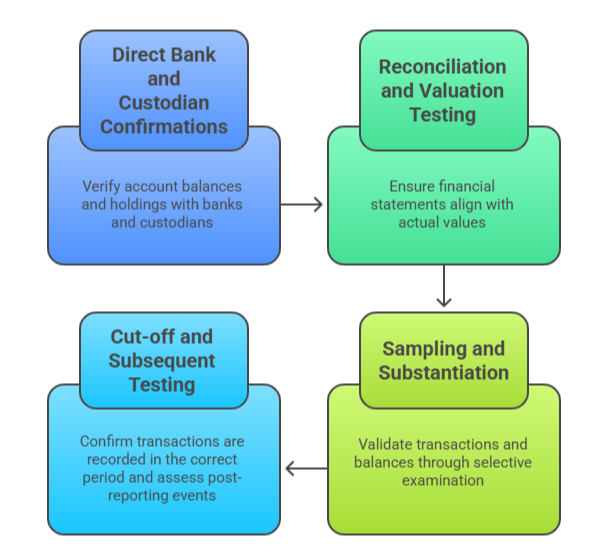
Accounting and assurance firms rely on multiple verification methods to confirm that a stablecoin issuer’s reported reserves exist and are fairly stated. These methods typically include:
Direct Bank and Custodian Confirmations
Auditors obtain official balance confirmations directly from banks, custodians, or trust companies holding the reserves. This ensures that the reported cash and assets truly exist and are not self-declared by the issuer.
Reconciliation and Valuation Testing
The firm reconciles the issuer’s internal ledgers against third-party statements. For securities such as U.S. Treasury bills or repurchase agreements, the auditors check market valuations, maturities, and liquidity status to confirm fair value.
Sampling and Substantiation
When reserves are diversified across several banks or instruments, auditors may use sampling techniques, reviewing a representative portion of accounts or transactions to validate the broader reserve pool.
Cut-off and Subsequent Testing
To confirm accuracy around the reporting date, firms examine transactions shortly before and after the attestation period. This prevents issuers from temporarily moving funds to “window dress” reserves.
These procedures are performed in accordance with AICPA attestation standards, such as AT-C Section 205, ensuring professional consistency across issuers.
Frequency and Limitations of Verification
Stablecoin attestations are usually conducted monthly or quarterly, providing regular but not continuous transparency. Each attestation reflects a point-in-time snapshot, meaning it verifies reserves as of a specific date, not their status on a daily basis between reports.
For instance, Circle (USDC) publishes monthly attestations verified by Deloitte, while Tether (USDT) issues quarterly attestations reviewed by BDO Italia. These periodic checks enhance confidence but still leave short intervals during which reserve compositions could change.
Limitations also arise from the scope of review:
- Auditors rely on data provided by the issuer and custodians, not real-time blockchain monitoring.
- Some asset types (like reverse repos or foreign holdings) may have valuation complexities.
- The attestation cannot detect fraud or hidden liabilities unless explicitly uncovered during testing.
Therefore, while attestations offer moderate assurance, they are not complete audits and users must interpret them accordingly.
On-Chain vs. Off-Chain Transparency Measures
Verification doesn’t end with accounting reports. Modern stablecoin issuers are increasingly combining off-chain attestations with on-chain transparency tools to strengthen public trust.
Off-chain verification involves traditional financial attestations performed by licensed accountants. It validates fiat and securities reserves held in banks and money market funds.
On-chain transparency, on the other hand, uses blockchain data to show live metrics such as tokens minted, burned, or held by wallets. Circle, for example, publishes real-time USDC supply data directly on its transparency dashboard, cross-verifiable with blockchain explorers.
This dual approach, off-chain verification for fiat assets and on-chain data for token circulation, forms a complete transparency loop.
It enables users and regulators to verify that a real-world reserve of equal value and verifiability backs every issued stablecoin.
Read Also: Advantages of Using Crypto Instead of Cash
Limitations of Attestation Reports
Stablecoin attestation reports play an essential role in promoting transparency, but they are not foolproof. While they offer a snapshot of a stablecoin issuer’s reserves, they don’t provide continuous or absolute assurance.
Understanding what these reports don’t guarantee helps users and investors interpret them more accurately and avoid misplaced confidence.
What Attestations Don’t Guarantee
Attestation reports confirm reserve balances at a specific point in time, not continuously. This means the data is accurate only as of the reporting date, and the financial situation could change immediately after.
Attestations also do not guarantee solvency or prevent misconduct. They rely on documentation provided by the issuer and custodians, which auditors evaluate but do not control. If an issuer misrepresents or withholds information, it may not be detected unless a full audit or investigation occurs.
Furthermore, attestations don’t always cover liabilities, contingent obligations, or off-balance-sheet risks that could impact the issuer’s ability to redeem tokens. For example, if an issuer pledges part of its reserves as collateral elsewhere, this may not always be fully reflected in a limited-scope attestation.
Why Continuous Real-Time Verification Is Still Needed
The fast-moving nature of digital assets calls for real-time transparency, not just monthly or quarterly updates. Between attestation periods, issuers can mint or redeem billions of tokens, shift reserves between custodians, or reallocate assets, all of which can affect stability.
This is why there’s growing advocacy for automated or blockchain-based verification systems. Platforms like Chainlink’s Proof of Reserve aim to provide on-chain verification that automatically tracks the relationship between tokens in circulation and off-chain reserves.
Continuous verification helps close the “blind spots” between reporting cycles, ensuring that users and regulators can detect discrepancies as they occur, not weeks later.
The Difference Between Assurance and Full Audits
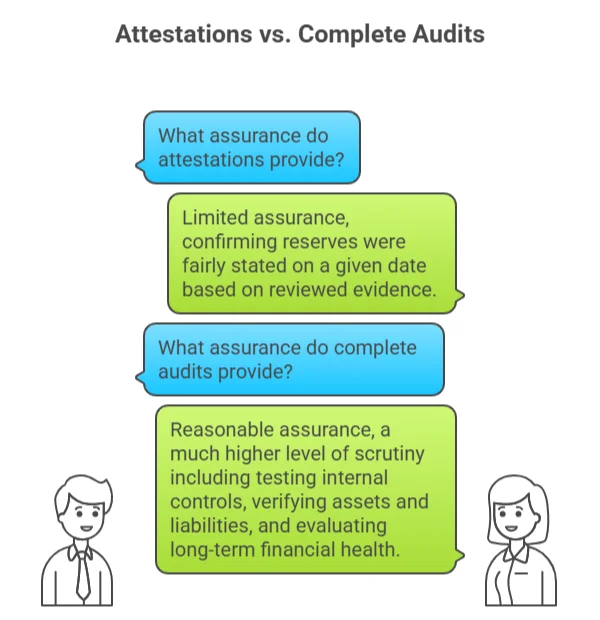
The biggest distinction lies in depth and scope.
Attestations provide limited assurance, they confirm that, based on reviewed evidence, the reserves were fairly stated on a given date.
Complete audits, on the other hand, provide reasonable assurance, a much higher level of scrutiny that includes testing internal controls, verifying all assets and liabilities, and evaluating long-term financial health.
In short, an attestation checks what’s there, while an audit examines how it’s managed and whether it’s sustainable.
For example, Circle (USDC) undergoes monthly attestations but has yet to complete a full audit, whereas Tether (USDT) has faced repeated calls from regulators and the cryptocurrency community to transition from attestations to audited financial statements.
Final Thoughts
Stablecoin attestation reports have become a vital component in establishing trust and transparency in digital finance. They help users, investors, and institutions verify that each token, from USDC to USDT, is backed by real, verifiable reserves. Still, they represent only a snapshot, not continuous proof of stability.
As the cryptocurrency economy matures, the demand for real-time verification and full audits will increase, driving higher standards of accountability.
Understanding how to read and interpret these reports enables users to make more informed, safer financial decisions. Ultimately, informed analysis remains the most reliable foundation for confidence in any stablecoin.
Frequently Asked Questions
What Does an Attestation Report Mean?
An attestation report is an independent verification by a certified accounting or assurance firm confirming that a company’s financial claims, such as a stablecoin’s reserves, are accurate and fairly presented as of a specific date.
What Is the Term for the Process of Auditing and Verifying That a stablecoin’s Reserves Match Its Circulating Supply?
The process is called a stablecoin attestation, an independent verification that confirms the issuer’s reserves match the total circulating supply.
What Is the Meaning of Attestation Results?
Attestation results show the independent verifier’s conclusion on whether a stablecoin issuer’s reported reserves accurately match the number of tokens in circulation at a specific point in time.
How Many Days Will It Take for Attestation?
A stablecoin attestation typically takes about 7 to 14 days to complete after the reporting period ends, depending on the issuer’s size, reserve complexity, and the auditing firm’s review process.
What Is Proof of Reserves in Stablecoin?
Proof of Reserves (PoR) in stablecoins is a transparency mechanism that verifies, often through blockchain-based or third-party audits, that the total tokens in circulation are fully backed by real-world assets, such as cash or Treasury bills, held by the issuer.