


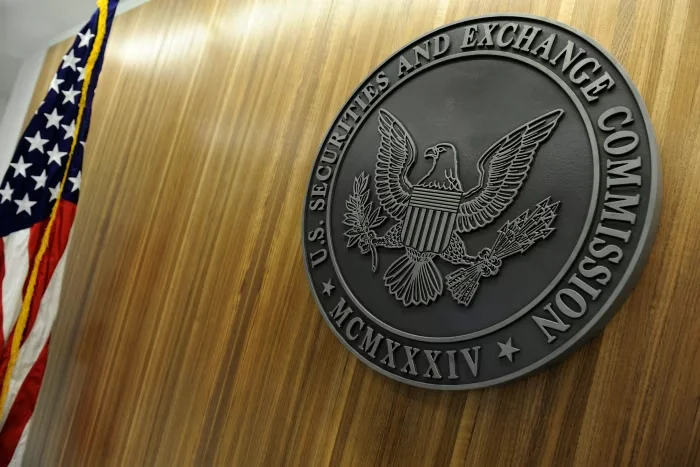
The U.S. Securities and Exchange Commission has released its long awaited “Innovation Exemption,” creating a temporary regulatory pathway for the onchain trading of certain tokenized U.S. stocks.
The order, issued Sept. 17, gives qualifying Tokenized Securities Venues (TSVs) a five year exemption from the federal definition of an exchange. It also provides conditional relief from dealer registration requirements for certain liquidity providers using their own capital in automated market maker pools.
SEC Chair Paul Atkins said the measure is intended to move U.S. capital markets further onto blockchain infrastructure following the Senate’s failure to advance the broader CLARITY Act earlier in the week.
“bring America’s capital markets into the digital age”
The exemption is temporary and conditional, with the SEC requesting public comments as it considers whether more permanent rules will be needed.
KEY TAKEAWAYS
- The SEC has created a five year exemption for qualifying venues to trade tokenized NMS stocks onchain.
- Tokenized shares must provide the same rights and privileges as their traditional counterparts, including dividends and voting rights.
- Synthetic tokens that only provide price exposure to stocks are excluded.
- Third-party tokenization is permitted, but issuers receive an opportunity to object before their shares are listed.
- Trading venues must use public, auditable smart contracts while keeping access to trading permissioned.
- The framework follows the Senate’s failure to advance the CLARITY Act on Sept. 15.
SEC OPENS A PATH FOR ONCHAIN STOCK TRADING
The SEC’s order allows TSVs to bring buyers and sellers together through permissioned automated market makers and liquidity pools without being treated as conventional exchanges under the Exchange Act, provided they meet the exemption’s conditions.
The framework applies to National Market System stocks, generally covering U.S. exchange-listed equities and other securities within the NMS framework. However, it does not give blanket approval for every form of tokenized stock product. A qualifying token must represent the actual underlying security and provide holders with equivalent rights. That includes economic and governance rights such as dividends and voting.
This distinction excludes synthetic products that merely track a stock’s price without representing ownership of the underlying security. The SEC is also requiring TSVs to operate with permissioned access even though the underlying blockchain infrastructure must be public and permissionless. Smart contracts must be publicly available and auditable.
ISSUERS GET A SAY OVER THIRD-PARTY TOKENS
One of the more significant provisions concerns companies whose shares are tokenized by an unaffiliated third party. Before making such a token available for trading, a TSV must notify the underlying stock issuer and provide an opportunity to object. This gives companies a mechanism to prevent their securities from being traded on a TSV under the exemption.
The provision creates a distinction between issuer sponsored tokenization and third-party efforts. Issuer sponsored tokens can qualify when they satisfy the exemption’s requirements, while third-party tokenization faces additional conditions. The SEC’s approach therefore does not simply treat every asset described as a “stock token” as equivalent to an actual share.
FIVE YEARS TO TEST THE MODEL
The exemption is scheduled to remain in effect for five years after publication. During that period, qualifying venues will operate under requirements covering market transparency, recordkeeping, trading limits and technology safeguards.
TSVs must also stop trading a tokenized stock when trading in the corresponding underlying stock is halted on its primary listing exchange. The order imposes limits on the number of securities and trading volume that can be handled under the exemption. Venues must also provide public information about their operations and trading activity.
The SEC said the temporary structure is intended to give the agency and market participants an opportunity to gather information that can inform future regulatory changes. Commissioner Mark Uyeda described the exemption as a way to test new approaches while maintaining investor protection and orderly markets.
MOVE FOLLOWS CLARITY ACT SETBACK
The SEC’s action comes two days after the Senate failed to advance the CLARITY Act, which would have established a broader federal framework for digital assets. The bill received 49 votes in favor and 50 against on Sept. 15, falling short of the 60 votes required to proceed.
Atkins had indicated after the Senate vote that the SEC would use the authority available to it to provide greater regulatory certainty. The Innovation Exemption represents one of the agency’s most significant steps toward permitting blockchain based securities activity under existing securities law. The SEC has also been pursuing other initiatives related to blockchain infrastructure, including proposed changes concerning transfer agents and digital asset markets.
WHAT HAPPENS NEXT
The exemption does not make tokenized stock trading unrestricted in the United States. Firms seeking to operate under the framework must satisfy the SEC’s conditions and provide the required notices before beginning operations. The SEC is also accepting public comments on the exemption and possible modifications. Atkins has said the temporary measure is intended to serve as a bridge toward more durable rulemaking. That leaves the coming years important for determining whether the temporary framework becomes a foundation for broader rules governing onchain securities markets.
CONCLUSION
The SEC’s Innovation Exemption gives tokenized U.S. stocks a defined regulatory pathway for secondary trading on approved blockchain based venues for the first time. The five year framework does not remove securities laws from tokenized markets. Instead, it establishes specific conditions around ownership rights, issuer objections, permissioned access, transparency and market integrity.
With broader crypto legislation stalled in the Senate, the SEC is moving forward through its existing authority. The resulting framework now gives market participants a regulatory environment in which to test whether blockchain based stock trading can operate alongside the traditional U.S. securities market.