


Traditional card payments may seem convenient, but they often cost merchants 2.5%–3.5% per transaction, come with multi-day settlement delays, and expose businesses to chargebacks. Crypto payment APIs are changing that by enabling faster, more efficient transactions, though some providers still charge hefty fees.
This guide highlights the best crypto payment APIs with low fees ranging from just 0.23% to 1%, offering near-instant settlements and smooth cross-border payments. With global retail crypto activity reaching $979 billion in Q1 2026, businesses and developers have never had a better time to explore low-cost crypto payment solutions.
Key Takeaways
- Crypto payment APIs charge modest fees, compared to traditional card processors
- Upay offers tiered pricing and real-time address detection for merchants requiring high-volume processing capacity
- Over 53% of global e-commerce merchants plan to accept crypto payments by 2027
Crypto Payment API Explained
A crypto payment API (Application Programming Interface) acts as a bridge between your website or mobile app and blockchain networks, enabling you to accept, process, and manage cryptocurrency payments without building complex blockchain infrastructure from scratch.
Much like traditional payment processors such as Stripe or PayPal, a crypto payment API simplifies transactions, but instead of handling fiat currencies, it works with digital assets like Bitcoin, Ethereum, and stablecoins.
Many solutions also offer automatic crypto-to-fiat conversion, helping merchants manage volatility and simplify accounting. With developer-friendly documentation, ready-made plugins for platforms like Shopify and WooCommerce, and testing environments, crypto payment APIs make it easier than ever for businesses to expand payment options, serve global customers, and embrace the growth of digital payments.
How a Crypto Payment API Works
When a customer chooses to pay with cryptocurrency, the API manages the entire transaction process behind the scenes:
1. Payment Request: Your website sends a request to the API, specifying the payment amount and the cryptocurrency the customer wants to use.
2. Wallet Address Generation: The API instantly generates a unique wallet address or QR code linked to that specific transaction. The code below shows what the API response looks like at a technical level, based on standard REST API patterns used by crypto payment systems:
POST /v2/payments/addresses
{ “chain”: “ETH”, “asset”: “USDT”, “label”: “order_00245”, “callback_url”: “https://yourshop.com/webhooks/crypto” }
Response: { “address”: “0x742d35Cc6634C0532925a3b844Bc…”, “asset”: “USDT”, “created_at”: “2026-05-18T10:30:00Z” }
Note that the code above is generated automatically and not written manually. The API provider displays the documentation that shows exactly what to send and what to expect back.
3. Payment Verification: After the customer sends the funds, the API monitors the blockchain and verifies the transaction in real time.
4. Settlement: Once the payment receives the required confirmations, the API notifies your system and settles the funds. This notification is known as a webhook and gives you the details of the transaction.
Depending on your setup, it can transfer the crypto directly to your wallet or automatically convert it into fiat currency such as USD, EUR, or GBP.
Types of Crypto APIs
Most crypto payment APIs can be grouped into three main categories: custody type, integration method, and feature scope.
Custody Types
Non-Custodial (Self-Hosted) APIs
Non-custodial APIs, such as NOWPayments and BTCPay Server, give businesses complete control over their funds. Payments settle directly into wallets owned and managed by the merchant, meaning private keys never leave the business’s control. This approach offers greater security, transparency, and financial independence while eliminating counterparty risk.
Custodial APIs
Custodial providers, such as Upay and Coingate, manage wallet infrastructure and private keys on behalf of merchants. This simplifies setup and ongoing operations, making it ideal for businesses seeking a plug-and-play solution. However, merchants must trust the provider to safeguard their assets and maintain platform security.
Integration Methods
Hosted Checkout
Hosted checkout solutions redirect customers to a secure payment page managed by the provider. This is typically the fastest implementation option, requiring minimal development resources. While convenient, the extra redirect step can sometimes impact conversion rates.
Embedded SDKs and Payment Elements
Embedded integrations place payment forms, widgets, or checkout modals directly inside a website or application. This approach provides a smoother customer experience while allowing businesses to maintain greater control over branding and user flow.
API-Only Integrations
API-only solutions offer maximum flexibility. Businesses build their own checkout experience while the provider handles backend functions such as wallet address generation, transaction monitoring, blockchain confirmation tracking, and settlement management.
Feature Scope
Transaction and Invoicing APIs
These APIs focus on core payment processing. They generate unique wallet addresses for each order, monitor incoming transactions, and verify blockchain confirmations before marking payments as complete.
Auto-Conversion and Payout APIs
To reduce exposure to market volatility, some APIs automatically convert received cryptocurrencies into stablecoins or fiat currencies. They can also automate payouts to vendors, employees, affiliates, or bank accounts.
Subscription and Recurring Billing APIs
Recurring billing APIs enable businesses to automate subscription payments using cryptocurrencies and stablecoins, making them suitable for SaaS platforms, membership services, and recurring payment models.
Web3 and Smart Contract APIs
Designed for decentralized applications (dApps) and blockchain-native platforms, these APIs interact directly with smart contracts, decentralized finance (DeFi) protocols, and on-chain services.
Why Fees Matter More Than You Think
A 1% fee sounds small, but if your store processes $50,000 a month, that’s $500 going to your payment provider every single month. That’s $6,000 a year, just in processing fees.
Compare that to Stripe or PayPal, which charge around 2.9% plus $0.30 per transaction. On $50,000 in monthly revenue, the bill climbs to $1,450 or more. That’s nearly three times higher.
US crypto activity also surged by around 50% between January and July 2025 compared to the same period in 2024, according to TRM Labs’ 2025 Crypto Adoption Report. More businesses accepting crypto means more competition among payment API providers, and that keeps fees lower.
The Best Crypto Payment APIs with Low Fees in 2026
A Quick Comparison Table
| Platform | Fee | APR (Annual Percentage Rate) | Rewards | Key Strengths | Compliance & Licensing | Best For |
| Custodial | ||||||
| Upay | FX fees: 0% (markup is applied on foreign purchases) Transaction fees: Starts at 1% on purchases and drops to 0% depending on tier | None | None currently | Multi-coin support, P2P settlement model, fast transfers, flexible architecture | US, Canada, Hong Kong, and Dubai licensed; AML/KYC, GDPR compliant | Global users wanting control + regulated structure |
| CoinGate | FX Fees: 1% standard fee. Transaction fees: 1% | None | Offers cashback on certain crypto assets | Multi-coin support, strong fiat settlement, invoicing tools, merchant services | MiCA licensed (EU, 2025) | EU businesses needing fiat payouts and compliance |
| Non-Custodial | ||||||
| CoinRemitter | FX Fees: 0% Transaction fees: 0.23% fees | None | Up to 75% on Affiliate ProgramAnd between $100 to $10,000 on Bug Bounty Program | Multi-coin support, direct wallet payments, simple integration | Minimal regulatory footprint | Cost-sensitive startups and developers |
| CryptAPI | Transaction fee: 1% per transaction and drops down to 0.25% fee depending on 30 days transaction | None | None | Multi-asset support, simple setup, direct wallet payments, lightweight integration | Minimal compliance layer | Developers and Bitcoin/Ethereum-focused businesses |
| NowPayments | Service fee: 0.5% fee along with a 0.5% exchange fee (if auto-conversion or multi-currency payments are required) | None | Up to 25% on crypto affiliate program | Multi-coin support, easy API integration, instant crypto payouts | Basic global compliance | High-volume crypto merchants needing wide coin support |
| BTCPay Server | Free self-hosting | None | No built-in rewards but merchants can add via third-party integrations like Oshi or Joltz. | Bitcoin + Lightning Network, open-source, self-hosted, no intermediaries | Community-driven compliance | Bitcoin-only merchants and privacy-focused businesses |
| EMCD Pay | Processing fee: 0.5% FX Fee: Depends on specific P2P rate | Coinhold Savings: Up to 14% APR for stablecoins (USDT and USDC) and up to 7.5% APR for mineable coins like BTC, LTC, BCH, and ETH.Staking: Offers up to 7% APR for Solana (SOL) and 3.5% APR for Ethereum (ETH). | Offers rewards via mining, staking, and Coinhold savings account | Multi-asset support, enterprise payment infrastructure, liquidity support | Compliance-focused enterprise framework | Large businesses needing scalable payment rails |
| Plisio | FX Fees: Subject to exchange fees. API Fee:0.5% fee across supported assets | None | Affiliate/Referral Rewards: 25% of transaction fees and 10% of profits from cryptocurrency exchanges made by your referrals.Bug Bounty: Between $200 for low to $15,000 for critical. | Multi-coin support, fast merchant onboarding, simple APIs, conversion tools | Basic compliance coverage | SMEs and fast-launch eCommerce stores |
The following breakdown examines 8 APIs currently available to merchants, beginning with the specific technical features of each platform.
1. Upay
Source: business.upay.com
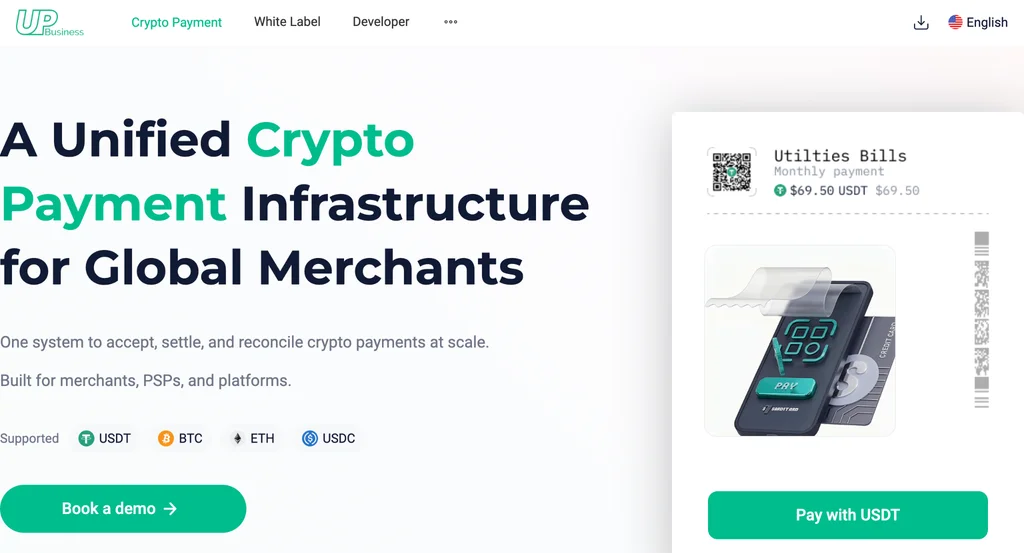
UPay, established in 2023, provides a REST-based gateway designed for merchants with high-volume requirements.
Through its UPay Business API, merchants can accept BTC, ETH, USDT, USDC, and more than 50 cryptocurrencies across multiple blockchain networks while benefiting from instant settlements and automatic crypto-to-fiat conversion.
UPay uses a low-fee infrastructure that aims to process crypto transactions at costs typically below 1% for cross-border payments.
The platform also offers direct peer-to-peer settlement, card issuance, white label customization, and smooth integration via its Business API.
Backed by MSB registrations in the United States and Canada, UPay combines compliance, security, and global reach in a scalable crypto payments solution.
2. CoinGate
Source: coingate.com
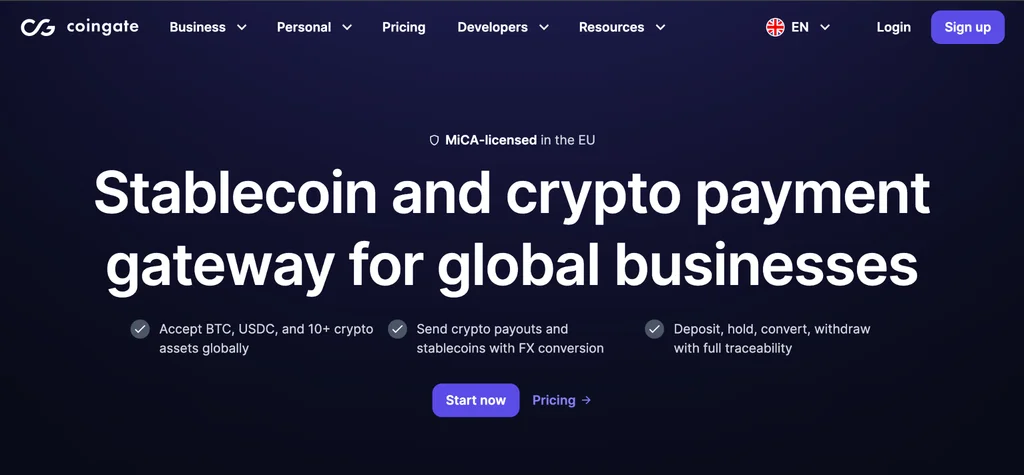
CoinGate is MiCA-licensed in the EU and has processed over 7 million payments across 180+ countries. It offers a REST API that enables merchants to integrate smoothly with Shopify, WooCommerce, and Magento for easy adoption.
As a result, businesses can accept Bitcoin, USDC, and 10+ other cryptocurrencies and then settle directly into bank accounts in EUR, USD, or GBP.
Built-in fiat conversion helps reduce volatility and keeps cash flow predictable, while its White Label solution offers customized branding and virtual ledgers to process crypto assets entirely under their own name.
While its 1% flat fee is higher than some alternatives, its strong regulatory compliance makes it well-suited for businesses in regulated markets.
For Europe-focused merchants seeking MiCA-compliant crypto payments, CoinGate offers a simple, reliable solution.
Read Also: How to Use a Crypto Wallet with a Debit Card
Non-Custodial
3. CoinRemitter
Source: coinremitter.com
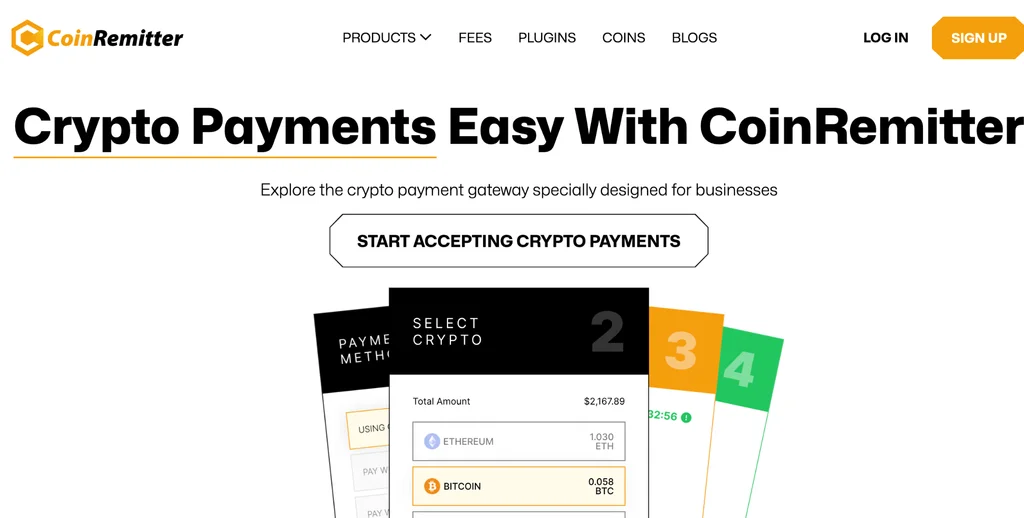
CoinRemitter is a low-cost crypto payment gateway built for merchants that want to accept cryptocurrency payments without sacrificing profits. With a processing fee of just 0.23%, it ranks among the most affordable crypto payment APIs on the market.
The platform supports fast integrations through open-source plugins for WordPress, Magento, OpenCart, and other popular platforms, while instant payment webhooks enable real-time transaction updates.
Businesses can also reduce withdrawal expenses with CoinRemitter’s Gas Station feature, which helps lower gas costs on supported assets such as USDT, ETH, and BNB.
For growing merchants, the Premium plan unlocks additional cryptocurrencies, higher API limits, and advanced tools, making CoinRemitter a scalable and cost-effective solution for global crypto payments.
Read Also: Crypto Payment Solution for SaaS Companies
4. CryptAPI
Source: cryptapi.io
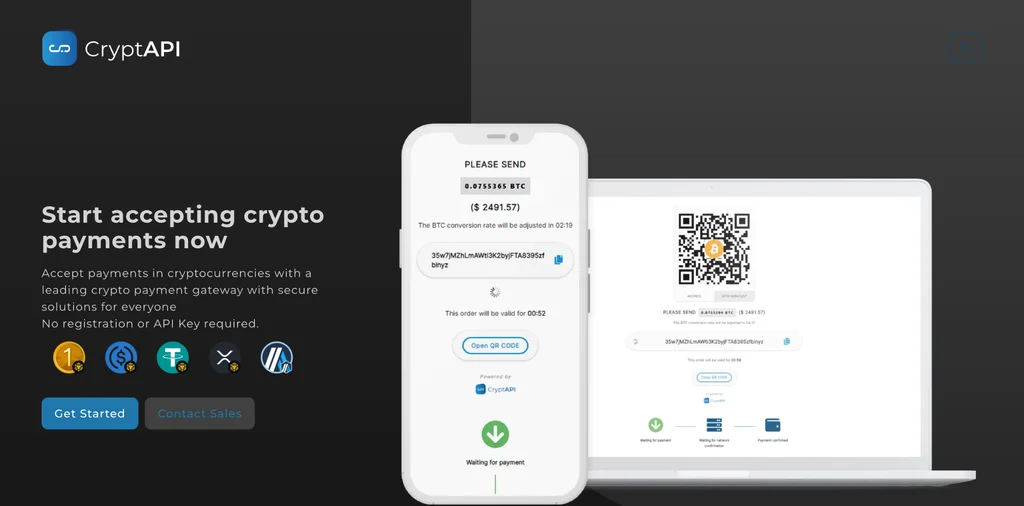
CryptAPI is a non-custodial crypto payment gateway designed for merchants that want to accept cryptocurrency payments without the complexity of traditional processors.
With fees starting at just 0.25% per transaction and no setup or monthly charges, it offers one of the most affordable payment solutions in the market. Payments are automatically forwarded to the merchant’s wallet, eliminating custody risks and improving security.
CryptAPI supports more than 70 cryptocurrencies and tokens across major networks, including Bitcoin, Ethereum, USDT, Tron, Solana, Polygon, and BNB Chain. Note that each coin has minimum transaction thresholds, so check those before going live.
The platform requires no account registration or API keys for basic integrations and provides plugins for popular e-commerce platforms. It is suitable for online stores, SaaS businesses, developers, and merchants seeking a secure and low-fee way to accept crypto payments globally.
5. NowPayments
Source: nowpayments.io
NOWPayments is a crypto payment gateway designed for efficient payment processing. With transaction fees starting around 0.5% and no setup or monthly charges, it offers a cost-effective solution for merchants of all sizes.
The platform supports over 350 cryptocurrencies across major blockchains and includes automatic conversion, allowing businesses to settle funds in their preferred asset. It operates as a non-custodial service, giving users full control of their funds, with optional custody features for added flexibility.
Security is reinforced through tools like two-factor authentication, withdrawal whitelisting, and role-based access controls. With 99.99% API uptime and confirmations typically completed in under five minutes, NOWPayments ensures reliable performance.
It also provides e-commerce plugins, mass payouts, and subscription billing tools, making it suitable for SaaS platforms, freelancers, e-commerce stores, and global businesses seeking fast, borderless crypto payments.
6. BTCPay Server
Source: btcpayserver.org
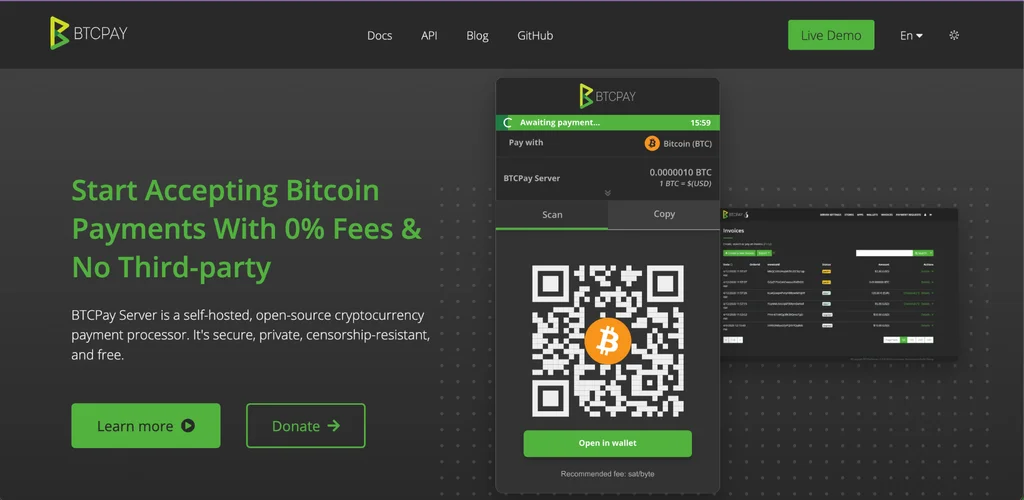
BTCPay Server is a free, open-source, self-hosted payment processor that gives users full sovereignty over their transactions. You pay no processing fees, and no third party ever touches your funds because you run the system on your own server. This makes it one of the most independent payment solutions available.
Setup requires more technical effort than plug-and-play APIs, but the trade-off is zero ongoing fees and complete control over your infrastructure. BTCPay Server supports Bitcoin natively and integrates the Lightning Network for fast, low-cost micropayments.
A freelance developer or small Bitcoin-focused business can run it on a low-cost VPS and eliminate payment processing fees entirely, making it a highly cost-efficient option for technically capable users.
7. EMCD Pay

Source: emcd.io/business/processing
EMCD is a non-custodial cryptocurrency payment gateway that enables businesses to accept payments in over 500 cryptocurrencies with processing fees as low as 0.5%. It gives merchants full control of their private keys while delivering fast, secure, and scalable payment processing through a smooth API integration.
EMCD supports instant wallet-to-wallet transactions and automated fiat conversion, helping businesses reduce exposure to crypto volatility while ensuring smooth global settlements. Its infrastructure also enables near-instant payouts and liquidity swaps with minimal delays.
Built for scalability, EMCD offers fast API tools, white-label solutions, and deep customization for platforms of any size. As part of the broader EMCD ecosystem, it connects payment processing with mining pools, yield products like Coinhold, and crypto payment cards for real-world business spending.
This makes EMCD Pay suitable for fintech startups, Web3 platforms, and global merchants looking to launch their own crypto payment infrastructure quickly.
8. Plisio
Source: plisio.net
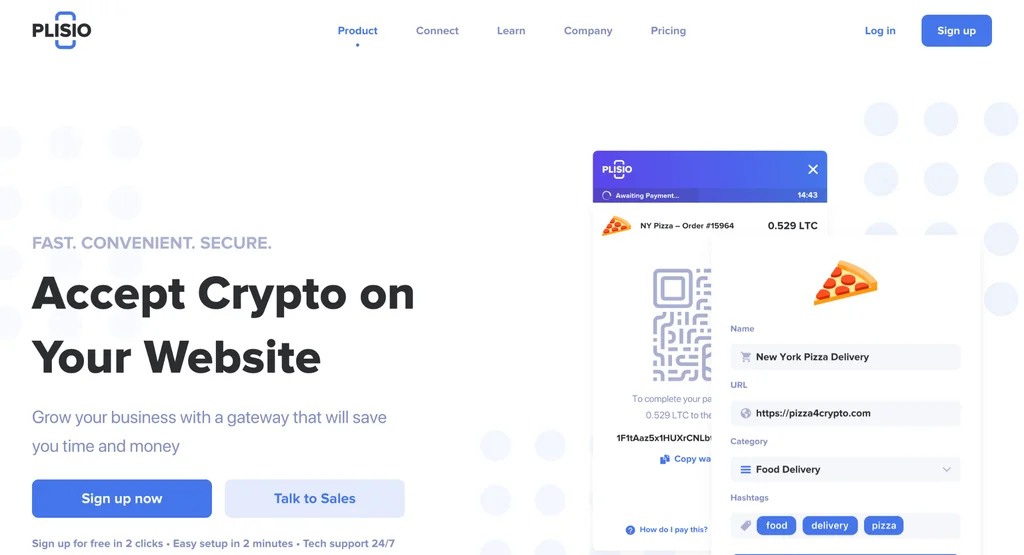
Plisio is a low-fee cryptocurrency payment gateway designed to help businesses accept digital assets with minimal friction and cost. It charges around 0.5% for API transactions and about 1.5% for White Label solutions, making it one of the most competitive options for merchants seeking affordable crypto payment processing.
It supports multiple major cryptocurrencies, including Bitcoin, Ethereum, USDT, USDC, and others, with built-in tools for instant invoicing and mass payouts. Integration is simple via API or plugins for popular e-commerce platforms, while its white label option allows full branding control with no Plisio redirects.
It is also built with security features such as SSL encryption and 2FA, and supports globally compliant operations. Overall, Plisio is suitable for e-commerce stores, freelancers, marketplaces, and global businesses looking for fast, secure, and scalable crypto payment solutions with low fees and customization options.
What to Know Before Picking a Crypto Payment Gateway API
Compliance & Responsibility
“Low-fee” crypto payment APIs often exclude hidden expenses such as gas fees, currency conversion spreads, and settlement delays. Actual costs vary depending on the blockchain, transaction volume, and integration tier, meaning advertised pricing may not reflect real operational expenses.
Technical Reality: Gas fees fluctuate with every block as network congestion changes, while settlement times range from seconds to several hours. High-volume usage can quickly trigger API rate limits, and each smart contract interaction adds extra overhead per transaction. Cost Breakdown: Providers typically charge a base API fee, plus blockchain validator or miner fees, FX spreads for crypto-to-fiat conversion, and optional charges for custody, wallet hosting, or chargeback protection.
Choosing the wrong crypto payment API can cost far more than a small difference in fees. The right setup affects custody, liquidity, compliance, and even how fast you get paid.
1. Custody vs. Non-Custody
Custodial gateways temporarily hold your funds before settlement, while non-custodial APIs send payments directly to your wallet as soon as transactions confirm. If full control matters, non-custodial options like CryptAPI and NowPayments are strong choices.
Upay also operates a direct settlement model for peer-to-peer crypto transactions, ensuring users retain control over their funds. If you want to avoid platform risk and keep assets moving straight to your wallet, non-custodial infrastructure is usually the safer path.
2. Settlement Currency
Not all gateways settle the same way. Some remain crypto-native, while others convert earnings into fiat. Upay supports instant crypto-to-fiat conversion, making it useful for businesses that operate in traditional accounting systems.
If your operations rely on fiat reporting, prioritizing gateways with built-in conversion can simplify reconciliation and cash flow management.
3. Coin Coverage and Network Support
Coverage varies widely across APIs, and more isn’t always better. NowPayments supports 300+ cryptocurrencies, making it one of the most extensive multi-asset gateways. Upay supports 50+ coins for broader transactional flexibility.
The key is alignment, so choose only the coins your customers actually use instead of paying for unnecessary coverage.
4. Compliance and Licensing
Regulation is becoming a defining factor in payment infrastructure. EU-based businesses, in particular, should prioritize MiCA-aligned solutions.
CoinGate secured a full MiCA license in December 2025, strengthening its position in regulated European markets. Meanwhile, Upay operates under Dubai licensing frameworks with AML, KYC, and GDPR coverage.
Regulatory pressure is rising fast as global fines for non-compliance reached $1.23 billion in H1 2025 alone, marking a 417% year-over-year increase. For any serious business, compliance is no longer optional; it’s a core infrastructure requirement.
Frequently Asked Questions (FAQs)
Which low-fee crypto payment API is best for small businesses?
Upay provides one of the entry-level options for businesses, featuring a no-monthly-subscription model and direct integration capabilities.
Does Upay work for e-commerce stores?
Yes, Upay connects to Shopify, WooCommerce, and Magento through custom API integration, and developers can build their own checkout flows, along with Laravel support and a full sandbox environment for testing.
Are crypto payment APIs legal?
Yes, in most countries. The regulatory environment varies by region. CoinGate is MiCA-licensed for EU merchants. Upay is Dubai-licensed with AML/KYC compliance. Always check local regulations before accepting crypto payments in your market.