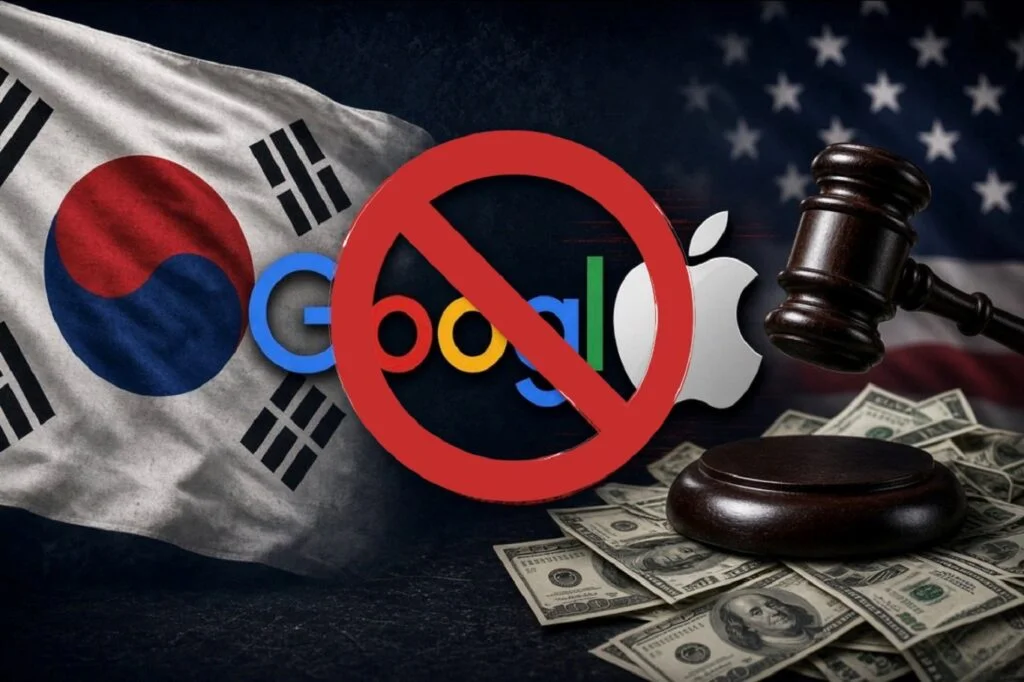
South Korea’s communications regulator has imposed combined penalties of 63.71 billion won on Google and Apple over app-store payment practices.
The October 28 decision includes corrective orders addressing payment choice and app-review procedures. The Korea Media and Communications Commission imposed 42.9 billion won on Google and 20.81 billion won on Apple.
Key Takeaways
- The decision concerns restrictions on developers’ payment options and other prohibited practices.
- The regulator ordered changes to business procedures alongside the penalties.
- Apple disputes the findings and is evaluating its legal options.
- The decision does not establish that developers or customers will immediately pay lower fees.
Alternative Payments Were Available, but With Restrictions
According to Associated Press reporting, the commission found that the companies pushed developers toward their own billing systems while restricting payments through external websites.
Third-party in-app payment options carried a 26% commission and lacked some features available through the companies’ own systems, the regulator said.
The issue illustrates the difference between nominal payment choice and a commercially usable alternative. Allowing another processor may provide limited flexibility if fees and access conditions make switching unattractive.
Regulators Order Changes to App Reviews
The commission’s announcement followed investigations beginning in 2022. Its findings covered forced payment methods, unfair app-review delays and, in Apple’s case, harm to users’ interests.
The action follows South Korea’s 2021 legislation prohibiting app-market operators from forcing developers to use specific payment systems.
Apple told AP that its practices comply with local law. It also defended its billing safeguards against fraud. Google had not responded to AP when the report was published.
Payment Choice Involves More Than a Checkout Button
For developers, moving to an external checkout involves deciding who handles payment confirmation, refunds, recurring charges and customer support.
A payment gateway connects checkout activity with payment processing. A digital wallet or virtual card serves a different role within that transaction. Offering either does not automatically resolve an app store’s distribution requirements.
Subscription businesses also need to consider how changes affect recurring payment arrangements. Replacing a checkout provider can require changes to authorisation, billing records and cancellation processes.
These are operational implications of broader payment choice, rather than additional requirements announced by the commission.
Conclusion
South Korea’s decision challenges restrictions that can make alternative billing difficult to use in practice. The next test is how the corrective orders are implemented and how the companies respond. The penalties alone do not determine the fees developers will ultimately pay.