



Crypto payments are not a niche experiment anymore. They are moving into the mainstream, and the numbers back it up.
Stablecoins alone account for more than 50% of crypto payments processed globally, and total retail crypto payment volume is on track to hit $600 billion by the end of 2026. That is not a trend you can afford to ignore.
So the question is: which cryptocurrencies are actually being used for payments right now? Not five years ago. Not in theory. Right now, in 2026.
This guide breaks it all down. You will learn which coins are driving real payment volume, what makes each one worth considering, and how to pick the right ones for your business or personal use.
Why Crypto Payments Are Growing So Fast
Not long ago, accepting Bitcoin was a novelty. Today it is quickly becoming a competitive necessity for forward-thinking businesses.
Over 25 million merchants are expected to accept at least one form of cryptocurrency by the end of 2026. And nearly 1 in 4 crypto owners worldwide has used digital currency to pay for something in the past 12 months.
Why the momentum?
Because crypto payments cut out the middleman. No bank sitting between the buyer and the seller means faster settlements, lower fees on international transfers, and more control over your money, for merchants, which translates directly into better margins.
For customers, it means more flexibility. Cryptocurrency payment usage in the US is up 43% in 2025 and is tracking toward 88% growth by 2026.
That is not slowing down anytime soon. Whether you are a business deciding which coins to accept, or a consumer thinking about which coin to spend, you need to understand the landscape as it actually stands today.
What Makes a Cryptocurrency Good for Payments?

Not every coin is built for spending. Before we look at the top contenders, here are the five things that actually matter when evaluating a crypto for payment use.
- Transaction speed.
A coffee shop cannot wait ten minutes for a confirmation. The best payment coins settle fast, either natively or through Layer 2 networks built on top of them. - Transaction fees.
Sending $5 of crypto on a congested network can cost more than the purchase itself. Good payment coins keep fees low and predictable. - Transaction fees.
Sending $5 of crypto on a congested network can cost more than the purchase itself. Good payment coins keep fees low and predictable. - Price stability.
A coin that drops 15% between checkout and settlement is a liability for merchants. This is the main reason stablecoins now dominate the payment space. - Merchant acceptance.
The best technology is useless without adoption. Network effects still matter enormously, and some coins simply have more integration
The Most Commonly Used Cryptocurrencies for Payments
The most commonly used cryptocurrencies for payments include:
Bitcoin (BTC)
Bitcoin is the first and most well-known cryptocurrency. It is owned by 71% of all crypto users in 2025 and holds more than 51% of the total market capitalization. When your customer thinks crypto,” they almost certainly think Bitcoin first.
For payments, the old criticism too slow, too expensive, has largely been addressed. The Lightning Network enables near-instant, near-zero-fee Bitcoin transactions.
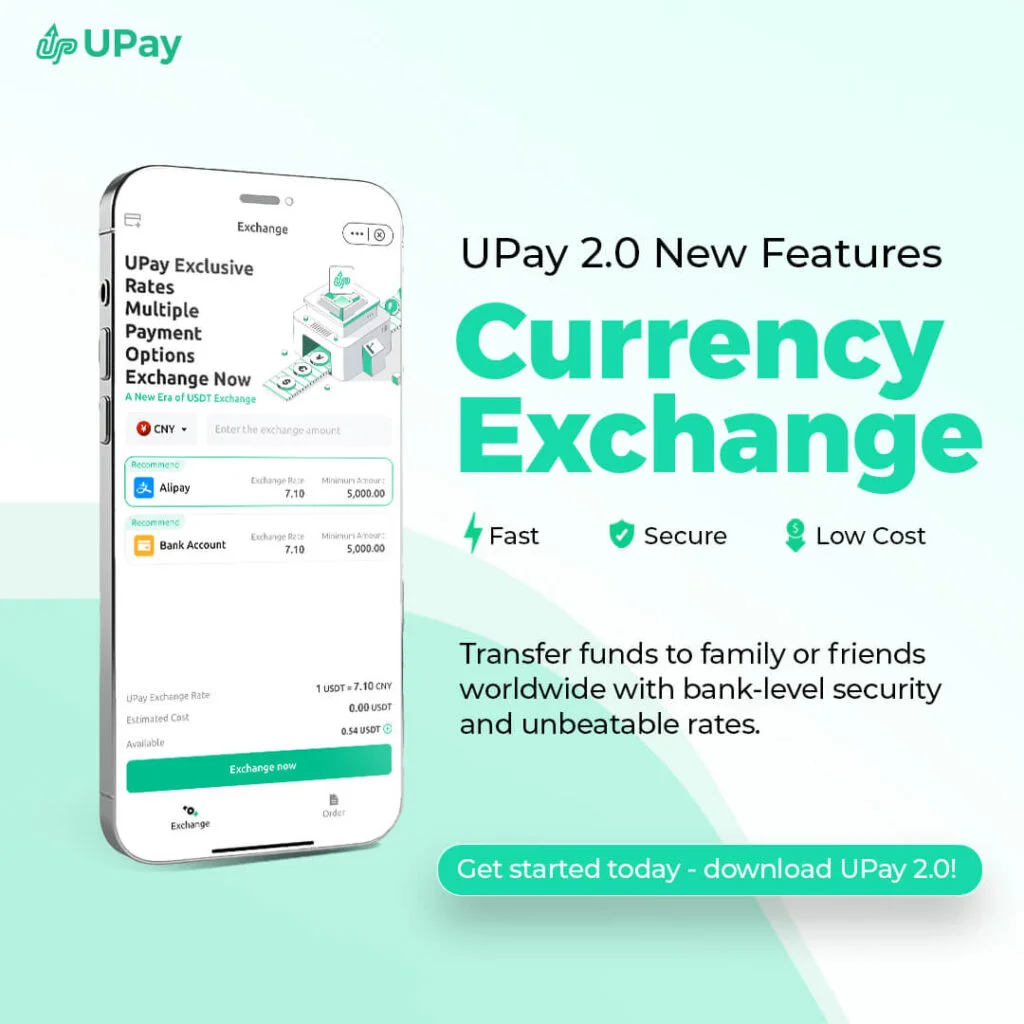
And if you are using a modern payment gateway like UPay, you can enable automatic conversion at the moment of capture, so price volatility never touches your books.
PayPal expanded its crypto checkout to over 30 countries with Bitcoin support, and Visa processed more than $3 billion in crypto-linked card payments.
Bitcoin is not just legitimate, it is expected. Offering it tells your customers you take digital payments seriously.
Tether (USDT)

If Bitcoin is the headline, stablecoins are the engine. USDT and USDC are both pegged 1:1 to the US dollar, which means the volatility problem disappears entirely.
For a merchant, receiving USDT or USDC is functionally the same as receiving dollars, except it settles in minutes, crosses borders without friction, and bypasses the banking system completely.
USDC has grown from 12% to 18% ownership among US crypto holders over the past two years, a sign that the infrastructure is maturing. USDT leads in raw global volume, particularly in emerging markets and cross-border commerce.
If you are just getting started with crypto payments, stablecoins are the logical first step. 1 USDC always equals $1, which also eliminates any capital gains calculation headaches on your end.
Ethereum (ETH)
Ethereum is the backbone of the broader crypto economy, and it works well as a direct payment currency too. It holds roughly 20% of the total market cap and is particularly popular with users aged 25 to 44 who are active in DeFi and digital finance.
Here is the thing about Ethereum that most people miss: even when you are just receiving dollars, you are probably using Ethereum.
Most stablecoin payments and Layer 2 transactions settle back to Ethereum under the hood. A good payment gateway routes this automatically through Layer 2 networks like Base or Arbitrum, keeping fees minimal even during high-demand periods.
Solana (SOL)
Solana has rapidly become one of the most important blockchains for payments due to its extraordinary combination of speed and low cost.
With a block time of approximately 400 milliseconds, the fastest among major blockchains, and transaction fees that cost fractions of a cent, Solana is ideal for high-frequency, everyday payment use cases, including microtransactions and cross-border transfers.
Solana has the third-largest stablecoin ecosystem by market cap, after Ethereum and TRON, with over $11 billion in stablecoins circulating on the network. USDC alone accounts for over 72% of Solana’s stablecoin market.
Visa chose Solana as one of four blockchains for its global stablecoin settlement expansion in 2025, underscoring its institutional-grade credentials.
For merchants and payment processors seeking speed without sacrificing security, Solana is one of the most compelling choices in 2025.
Litecoin (LTC)
Litecoin, often called the silver to Bitcoin’s gold, offers faster transaction times and lower fees. Created by Charlie Lee, a former Google engineer, Litecoin uses the Scrypt hashing algorithm, allowing for quicker block generation and more efficient mining.
With a block confirmation time of 2.5 minutes and a transaction fee of 0.03 cents, Litecoin is ideal for everyday payments. Its larger maximum supply of 84 million coins ensures broader accessibility and affordability.
Businesses like Dell, Newegg, and Overstock accept Litecoin, showcasing its practical application as a decentralized payment solution.
Ripple (XRP)
Ripple’s unique consensus algorithm, the Ripple Protocol Consensus Algorithm (RPCA), allows for fast and efficient transactions. Unlike traditional cryptocurrencies, Ripple achieves consensus through a network of trusted validators, including banks and financial institutions.
Its focus on facilitating cross-border payments makes it a promising solution for international transfers with lower costs. Ripple’s partnerships with financial institutions and payment providers globally enhance its potential.
Bitcoin Cash (BCH)
Bitcoin Cash was created from a hard fork of Bitcoin in 2017 to address scalability issues and improve transaction speed. With larger block sizes of up to 32MB, Bitcoin Cash enables faster and more efficient transactions.
Despite its origins, Dogecoin’s community support and practical use in charitable initiatives highlight its potential as a decentralized payment solution.
However, its volatility and meme-based origin remain points of contention regarding its long-term viability.
It is particularly popular in industries requiring quick and frequent transactions, such as gaming and e-commerce. Bitcoin Cash’s low transaction fees and faster confirmations make it a cost-effective alternative to traditional payment systems.
Major companies like Dish, Microsoft, and CheapAir accept Bitcoin Cash, solidifying its role in decentralized payments.
Crypto Payments in Africa and Emerging Markets
One of the most significant and underreported stories in crypto payments is the adoption happening across Africa and other emerging markets. Traditional cross-border payment infrastructure in these regions is often slow, expensive, and inaccessible to the unbanked.
Stablecoins in particular have changed the equation. With USDC and USDT available on fast, low-cost networks like Stellar and Solana, individuals and small businesses in Nigeria, Ghana, Kenya, and across the continent can
- Send and receive remittances without the 5–10% fees common to traditional money transfer operators
- Hold dollar-denominated savings to protect against local currency volatility
- Pay international suppliers instantly, without waiting for bank wire clearances
The Stellar network’s anchor infrastructure, with over 475,000 access points worldwide, enables off-ramping stablecoins directly into local currencies, including at MoneyGram locations.
UPay’s crypto card extends this access further, allowing users to spend crypto in everyday merchant settings without needing to convert manually.
For anyone operating in or across African markets, crypto payments are no longer a future technology — they’re a working alternative to traditional rails today.
How to Choose the Right Crypto for Your Business?
The honest answer is that the right choice depends on your customers and how you operate. Here is a simple way to think about it.
If you want zero volatility and clean accounting, start with USDT or USDC. If your customers are crypto enthusiasts who hold Bitcoin, add BTC with automatic conversion enabled so price swings never affect your revenue.
If you do significant international business, XRP is worth adding for its speed and institutional reach. If you serve a younger, tech-forward audience, Solana will resonate with them. Most businesses eventually accept a basket of coins rather than just one.
The good news is that a modern crypto payment gateway like UPay does the heavy lifting for multiple coins, automatic conversion, and clean transaction records, so you are not managing a dozen wallets by hand.

Common Mistakes When Accepting Crypto Payments
Accepting a coin without a conversion strategy. If you receive Bitcoin and hold it without a plan, you are exposed to price movements. Enable automatic conversion or, at a minimum, set a clear threshold for when you convert to fiat.
Treating all coins the same. A Solana transaction and a Bitcoin base-layer transaction have completely different fee structures and confirmation times. Know what you are accepting before you advertise it at checkout.
Skipping the tax record-keeping. In the US, UK, and much of Europe, crypto is treated as property. Every payment has a fair market value at the moment of receipt, and that becomes your recorded income.
Your gateway should generate records your accountant can use. If it does not, switch gateways.
Starting with too many coins at once.
Pick two or three, learn what your customers actually prefer, then expand. Complexity for its own sake adds cost without adding value.
Frequently Asked Questions
Is it safe to accept crypto payments for my business?
Yes, with the right setup. Use a reputable crypto payment gateway, enable two-factor authentication on all accounts, and keep clean transaction records.
The blockchain itself is highly secure. Most risks come from poor account hygiene, not from the technology
Do I need to accept multiple cryptocurrencies?
Not at the start. Most businesses begin with one or two coins and expand based on what their customers actually use.
A good payment gateway like UPay makes adding new coins straightforward once you are ready.
Verdict: Start Accepting Crypto Payments with UPay
Your customers are already holding crypto. Now you can accept it without the complexity, the volatility risk, or the technical headaches.
UPay handles Bitcoin, USDT, USDC, Ethereum, XRP, Solana, Litecoin, and more with automatic fiat conversion, clean transaction records, and integrations for Shopify, WooCommerce, and custom APIs.
Sign up at UPay today, it takes minutes to get started.
Disclaimer: This article is intended solely for informational purposes and should not be considered trading or investment advice. Nothing herein should be construed as financial, legal, or tax advice. Trading or investing in cryptocurrencies carries a considerable risk of financial loss. Always conduct due diligence before making any trading or investment decisions.