The Blockchain Paradox encompasses the fundamental, often irreconcilable trade-offs inherent in distributed ledger technology. While blockchain promises decentralization, security, transparency, immutability, and scalability simultaneously, achieving all of these properties at once is technically impossible – optimizing for one typically comes at the expense of others.
The term is most commonly associated with Vitalik Buterin’s “Blockchain Trilemma” but extends to a broader set of tensions that every blockchain system must navigate.
Origin & History
| Date | Event |
| 2009 | Bitcoin demonstrates the decentralization-scalability paradox – strong decentralization but only ~7 TPS |
| 2017 | Vitalik Buterin first articulates the **Blockchain Trilemma** – the impossibility of maximizing decentralization, scalability, and security simultaneously |
| 2016 | The DAO hack exposes the immutability paradox – Ethereum hard-forks to reverse theft, contradicting immutability |
| 2017 | Bitcoin’s block size debate (Bitcoin vs. Bitcoin Cash) crystallizes the decentralization-scalability trade-off |
| 2018 | EOS achieves high throughput (4,000 TPS) but with only 21 block producers, highlighting the centralization trade-off |
| 2020 | DeFi growth exposes the transparency-privacy paradox – all transactions visible, enabling front-running |
| 2022 | Tornado Cash sanctions highlight the decentralization-regulation paradox |
| 2023–2024 | Layer 2 solutions and modular architectures attempt to “solve” the trilemma through layered approaches |
How It Works
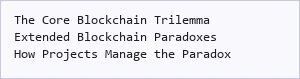
| Property | Description | Sacrifice |
| Decentralization | Many independent nodes validate; no single point of control | Slower consensus, lower throughput |
| Scalability | High transaction throughput and low latency | Requires fewer validators or centralized processing |
| Security | Resistant to attacks, immutable, censorship-resistant | Harder to scale; more nodes needed |
| Paradox | Tension |
| Transparency vs. Privacy | Blockchain’s open ledger enables auditability but exposes all transaction details, enabling surveillance |
| Immutability vs. Error Correction | Once data is on-chain, it can’t be changed – even if it’s wrong, stolen, or illegal |
| Trustlessness vs. Usability | Self-custody and key management provide sovereignty but create user experience barriers |
| Decentralization vs. Governance | Decentralized systems need governance, but governance requires coordination that tends toward centralization |
| Openness vs. Regulation | Permissionless systems enable financial freedom but conflict with legal compliance requirements |
| Energy Security vs. Environmental Impact | Proof of Work provides strong security but consumes massive energy |
| Finality vs. Flexibility | Fast finality prevents double-spending but makes legitimate reversals (fraud, errors) impossible |
| Project | Approach | Trade-Off |
| Bitcoin | Maximizes decentralization + security | Sacrifices scalability (7 TPS) |
| Solana | Maximizes scalability + developer experience | Reduces decentralization (hardware requirements, outages) |
| Ethereum + L2s | Layer 1 provides security + decentralization; L2s add scalability | Adds complexity, fragmentation |
| Cosmos/Polkadot | App-specific chains with shared security | Fragmented liquidity, bridge risks |
| Monero/Zcash | Maximizes privacy | Reduces transparency, regulatory acceptance |
In Simple Terms
- You can’t have everything– every blockchain must choose which properties to maximize and which to compromise
- The trilemma sayspick two: decentralized, scalable, or secure – you can’t fully achieve all three
- Privacy vs. transparency– blockchain’s strength (open ledger) is also its weakness (everyone can see everything)
- Immutability is a double-edged sword– great for trust, terrible when someone sends funds to the wrong address
- Layer 2s try to cheat the paradox– by separating concerns into different layers, but this adds complexity
>Important:No blockchain has “solved” the trilemma – they’ve found different points on the trade-off spectrum. Claims of solving it should be evaluated critically.
Real-World Examples
Example 1: The DAO Hack and Immutability Paradox (2016)
- Scenario:$60 million was stolen from The DAO smart contract due to a code vulnerability
- Implementation:The Ethereum community faced a paradox: maintain immutability (let the theft stand) or fork to reverse it (break the “code is law” principle)
- Outcome:Ethereum hard-forked to return funds (creating Ethereum Classic as the unforked chain), demonstrating that social consensus can override technical immutability
Example 2: Solana’s Scalability-Decentralization Trade-Off
- Scenario: Solana achieves 4,000+ TPS but requires validator hardware costing $350-$1,000/month
- Implementation: High hardware requirements reduce the number of potential validators (~1,900 vs. Ethereum’s ~900,000 validators)
- Outcome:Solana experienced multiple network outages (2022–2023) partly due to centralized infrastructure, illustrating how scalability gains can compromise resilience
Example 3: DeFi Front-Running (Transparency Paradox)
- Scenario: All Ethereum transactions are visible in the mempool before confirmation
- Implementation: MEV bots exploit this transparency to front-run trades, costing DeFi users an estimated $600M+ annually
- Outcome:Projects like Flashbots and encrypted mempools emerged to address the paradox – reducing transparency at the mempool level to protect users
Advantages
| Advantage | Description |
| Design Framework | Understanding paradoxes helps developers make informed architectural decisions |
| Innovation Driver | Attempts to solve paradoxes drive technological breakthroughs (L2s, ZK-proofs, modular chains) |
| Critical Evaluation | Helps users and investors evaluate projects beyond marketing claims |
| Research Direction | Clearly defined trade-offs focus academic and engineering research |
| Honest Discourse | Acknowledging paradoxes promotes realistic expectations for blockchain technology |
Disadvantages & Risks
| Risk | Description |
| Oversimplification | The trilemma can reduce complex engineering nuances to a false trichotomy |
| Marketing Exploitation | Projects claim to “solve the trilemma” without acknowledging hidden trade-offs |
| Analysis Paralysis | Awareness of paradoxes can delay decision-making and adoption |
| Moving Goalposts | Definitions of “decentralized enough” or “scalable enough” vary by stakeholder |
| False Solutions | Some “solutions” merely shift the trade-off to a less visible dimension |
FAQ
Q: Has any blockchain solved the trilemma?
A: No blockchain has fully solved it. Layer 2 solutions, modular architectures, and advances like ZK-proofs have significantly improved the trade-off market, but every system still compromises somewhere. Projects claiming to have “solved” the trilemma typically hide trade-offs in less obvious dimensions.
Q: Is the trilemma a proven theorem?
A: No – it’s an observed engineering heuristic, not a formally proven impossibility theorem. There’s no mathematical proof that all three properties can’t coexist, but decades of practical engineering have consistently shown the trade-off pattern.
Q: How do Layer 2 solutions address the paradox?
A: L2s separate execution (done on L2 for speed/cost) from settlement/security (inherited from L1). This allows the overall system to achieve better scalability while the L1 maintains decentralization and security. The trade-off shifts to complexity and fragmentation.
Q: Which property should a blockchain prioritize?
A: It depends on the use case. A global monetary system (Bitcoin) prioritizes security and decentralization. A gaming platform needs scalability. A privacy coin prioritizes privacy over transparency. There’s no universal right answer.