Bonded Proof of Stake (BPoS) is a variant of Proof of Stake consensus where validators are required to “bond” (lock up) a minimum amount of native tokens as a security deposit before they can propose and validate blocks.
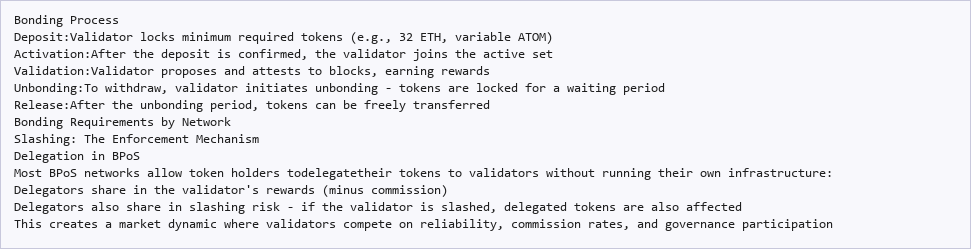
The bonded tokens cannot be freely transferred during the bonding period and are subject to a mandatory “unbonding period” (typically 7–28 days) when the validator wants to withdraw.
If the validator violates protocol rules, their bonded stake is partially or fully destroyed (“slashed”).
This mechanism ensures that validators have significant economic skin in the game, making attacks costly and honest behavior profitable.
Origin & History of Bonded Proof of Stake
| Date | Event |
| 2012 | Peercoin introduces the first Proof of Stake concept (no bonding/slashing) |
| 2014 | Jae Kwon proposes Tendermint with bonded validators and slashing – the first modern BPoS design |
| 2017 | Vitalik Buterin and Virgil Griffith publish Casper FFG – Ethereum’s BPoS-inspired finality gadget |
| 2019 | Cosmos Hub launches with Tendermint BPoS – 180+ validators. |
| 2020 | Polkadot launches with Nominated Proof of Stake (NPoS) – a BPoS variant with nominator-validator matching |
| 2022 | Ethereum transitions to PoS (The Merge). Note: The 32 ETH bonding requirement was introduced with the Beacon Chain in 2020, not The Merge. |
| 2023–2024 | BPoS becomes the dominant consensus mechanism; total bonded stake exceeds $250 billion. |
>“Bonded stake creates skin in the game. If you misbehave, you lose real money. That’s what makes decentralized consensus trustworthy.”– Jae Kwon, Tendermint Creator.
How It Works
| Network | Minimum Bond | Unbonding Period | Slashing Conditions |
| Ethereum | 32 ETH (~$100K+) | Dynamic (dependent on churn limits). | Double signing, extended inactivity |
| Cosmos Hub | Variable (top 180 validators). | 21 days | Double signing, extended downtime |
| Polkadot | Variable (NPoS election) | Governance-adjusted (typically 28 days). | Equivocation, unresponsiveness |
| Solana | No minimum (but practical ~1 SOL) | ~2–3 days (epochs) | Stake-weight-based penalties (governance-refined). |
| Cardano | No minimum (higher pledge earns more rewards) | 2 epochs (~10 days) | No slashing (reward reduction instead) |
| Violation | Typical Penalty | Description |
| Double Signing | 1–100% of bond | Signing two conflicting blocks at the same height |
| Surround Voting | 1–100% of bond | Ethereum-specific: voting that contradicts a previous attestation |
| Extended Downtime | 0.01–1% of bond | Being offline for extended period when expected to validate |
| Censorship | Protocol-dependent | Deliberately excluding valid transactions |
In Simple Terms
- Validators must put up money as collateral– like a security deposit on an apartment
- If they behave honestly, they earn rewards– a return on their bonded stake
- If they cheat or go offline, they lose money– slashing takes away some of their deposit
- The unbonding period prevents hit-and-run attacks– you can’t stake, misbehave, and instantly withdraw
- Regular users can delegate– let a professional validator use your tokens, share the rewards (and risks)
Important: When you delegate to a validator in a BPoS system, your tokens can be slashed if the validator misbehaves. Always research validator reliability before delegating.
Real-World Examples
Example 1: Ethereum Validator Slashing
- Scenario: An Ethereum validator accidentally runs two instances of their validator client simultaneously.
- Implementation: Both instances produce conflicting attestations for the same slot – the protocol detects this as a “double vote” and triggers slashing
- Outcome: The validator loses ~1 ETH initially, plus additional penalties if other validators are slashed simultaneously (correlated penalties can reach 100% of the 32 ETH bond)
Example 2: Cosmos Hub Delegation
- Scenario: An ATOM holder wants to earn staking rewards without running validator infrastructure.
- Implementation: Delegates 1,000 ATOM to a reputable validator charging 10% commission; the delegation is bonded with a 21-day unbonding period.
- Outcome: Earns ~15-20% APY on ATOM (minus 10% commission to the validator); if the validator is slashed for double-signing, the delegator loses 5% of their bonded ATOM.
Example 3: Polkadot Nominated Proof of Stake
- Scenario: DOT holders want to participate in consensus without choosing a single validator.
- Implementation: Polkadot’s NPoS system allows nominators to select up to 16 trusted validators; an algorithm optimally distributes stake across them for maximum decentralization.
- Outcome: Nominators earn rewards from whichever validators are elected to the active set, with automatic rebalancing each era (24 hours).
Advantages
| Advantage | Description |
| Economic Security | Validators risk real capital, making attacks financially devastating |
| Slashing Deterrent | The threat of losing bonded tokens strongly discourages misbehavior |
| Energy Efficient | No mining required – consensus achieved through economic incentives |
| Inclusive | Delegation allows any token holder to participate and earn rewards |
| Quantifiable Security | The cost of attacking the network equals the value of bonded stake at risk |
Disadvantages & Risks
| Risk | Description |
| Capital Lock-Up | Bonded tokens are illiquid during bonding and the unbonding period |
| Slashing Risk | Delegators face slashing risk from validator mistakes (not just malice) |
| Centralization Pressure | Minimum bonding requirements can exclude smaller validators |
| Unbonding Delays | 21–28 day unbonding periods prevent quick reaction to market events |
| Complexity | Understanding bonding, delegation, slashing, and unbonding adds user complexity |
Frequently Asked Questions
What’s the difference between Bonded PoS and regular PoS?
Regular PoS allows validators to participate by holding tokens.
Bonded PoS specifically requires tokens to be locked (bonded) with slashing conditions – creating stronger security guarantees but with less liquidity flexibility.
Can I lose all my staked tokens to slashing?
In extreme cases (coordinated attack involving many validators), yes. For typical single-validator incidents, the penalty is usually 1–5% of the bond.
Choosing reliable validators and diversifying delegations reduces this risk.
Why do unbonding periods exist?
Unbonding periods prevent stake-and-flee attacks where a validator misbehaves and immediately withdraws.
The delay ensures the network has time to detect and penalize violations before the validator can exit.