Understanding your crypto wallet address is one of the most important foundations for anyone getting started with cryptocurrency. Whether you are sending Bitcoin for the first time, receiving a payment from a client, or simply trying to locate where to direct incoming funds, knowing how to find and check it correctly is essential.
A crypto wallet address is the public string you give someone so they can send you funds, and you do not create it by hand: your wallet generates one when you set it up.
To find it, open your wallet or exchange account, go to “Receive” or “Deposit”, pick the asset and the network, and the address appears as text and as a QR code.
This guide covers three of the commonest mistakes behind lost transfers: the wrong network, a missing memo or destination tag, and an address a scammer planted in your history.
Key Takeaways
- Your address is generated during setup, and sharing it cannot let anyone spend your funds, because spending needs the private key.
- Publishing an address is not a theft risk, and it is expensive for privacy: it links your history to the name beside it.
- Bitcoin has four address prefixes in use, 1, 3, bc1q and bc1p, with Taproot the bc1p form.
- Deposits on the XRP Ledger and Stellar usually need a destination tag or memo alongside the address, and leaving it out can strand the funds.
- Address poisoning turns your own transaction history into the trap: Chainalysis traced one campaign in which 2,774 victim addresses sent roughly $69.7 million to lookalike addresses.
Also Read: Safest Crypto Wallets 2026: How to Secure Your Digital Assets
Crypto Wallets 101
A wallet address is your destination on the blockchain: the identifier you share to receive cryptocurrency, and the one you paste when sending. Think of it like a bank account number.
Behind every address sits a key pair. The public key generates the address and can be shared freely. The private key proves ownership and must never be shared.
Formats vary by network. Bitcoin addresses begin “1” for legacy, “3” for P2SH, “bc1q” for native SegWit and “bc1p” for Taproot, live since November 2021. Ethereum addresses are 42-character hexadecimal strings beginning “0x”.
Solana, Tron and BNB Smart Chain each have their own structures. BNB Smart Chain is the network’s current name, and older guides and some exchange screens still call it Binance Smart Chain.
Addresses carry error detection, which is why a typo usually fails safely rather than sending money nowhere. Bitcoin’s bech32m encoding behind “bc1p” is defined in BIP-350, assigned December 2020.
Ethereum does the same with capital letters, a checksum defined in EIP-55 on 14 January 2016, which puts the chance of a mistyped address passing at 0.0247 percent. An all-lowercase Ethereum address carries no checksum, so a typo in one is a valid address nobody controls.
Address Formats at a Glance
| Network | Address starts with | Typical length | Extra field for exchange deposits |
|---|---|---|---|
| Bitcoin | 1, 3, bc1q or bc1p | 34 for 1 and 3, 42 or 62 for bc1 | None |
| Ethereum and EVM chains | 0x | 42 characters | None, but the network must match |
| Solana | No fixed prefix, base58 | 32 to 44 characters | None |
| XRP Ledger | r | 25 to 35 characters | Destination tag, usually required |
| Stellar | G | 56 characters | Memo, usually required |
| Tron | T | 34 characters | None |
Types of Crypto Wallets
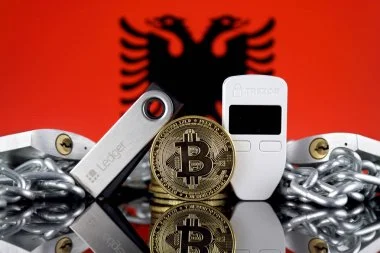
- Hardware wallets: physical devices keeping the private key offline, such as Ledger and Trezor. The right choice for balances you are not spending.
- Software wallets: apps on a computer or phone, such as Exodus and MetaMask. Exposed to whatever compromises the device, so right for everyday amounts.
- Web wallets: reached through a browser, with the keys often held by a third party you have to trust.
- Paper wallets: a printed key pair, offline and now largely superseded.
Paper deserves a note, because older guides still recommend it for large balances. Spending from one means importing the private key into software, which puts it on a connected machine.
The modern equivalent is a hardware wallet with the phrase written by hand or stamped into metal. See crypto cold storage best practices.
How Crypto Wallets Work
Unlike a wallet holding physical money, a crypto wallet holds keys. The coins never leave the blockchain; what the wallet controls is the ability to sign a transaction that moves them.
To send, you sign with the private key and the wallet broadcasts the transaction for miners or validators to confirm. Once confirmed, nobody can reverse it, which is why checking the address matters most.
Factors to Consider When Choosing a Wallet Type
Which wallet suits you depends on how you will use it:
- Security needs: the larger the balance, the stronger the case for a hardware device rather than an app.
- Frequency of use: if you transact often, a software wallet is faster to reach.
- Compatibility: check the wallet handles the exact network you need, not just the ticker symbol.
- Backup and recovery: check how the wallet restores before you fund it, and that the recovery phrase is yours to write down rather than the provider’s to hold.
Creating a Crypto Wallet
- Choose the wallet type from the balance and how often you will use it.
- Download or buy it from the provider’s own site or an official app store.
- Install and set up, letting a hardware device generate the phrase itself.
- Secure the recovery phrase on paper or metal, offline. Never photograph it or type it into a note, an email or any website.
- Test it with a small amount in and back out before trusting it with more.
Security Measures to Consider During the Creation Process
- Secure the device: a passcode, current antivirus, no wallet use on public Wi-Fi.
- Treat every message about your wallet as phishing, and never share the phrase, including with support.
How to Find Your Crypto Wallet Address
Each type shows it slightly differently, always as text and as a QR code.
Software Wallets
- Open the wallet app and find the “Receive” or “Account” section.
- If it holds several assets, select the one you want, and the network if asked.
- The address appears as a long alphanumeric string, with a QR code beside it.
Hardware Wallets
- Connect the device and open its companion application.
- Go to “Receive” and select the asset; the address appears on the computer screen.
- Confirm the same address on the device’s own screen. This is the step most people skip, and the one that defeats malware on the computer.
Paper Wallets
The address is printed beside the QR code, separate from the private key. Read only the public side, and leave the private key alone.
Exchange Accounts
On an exchange, the deposit address sits under “Deposit” or “Fund”. Select the asset, then the network, and it generates an address for that combination.
Tips on Ensuring the Accuracy of the Wallet Address
- Copy and paste rather than typing a long string by hand.
- Use QR codes where you can: scanning removes the copying step altogether.
- Test with a small amount before any large or first-time transfer.
- Verify on the device screen, checking the whole string rather than the ends.
- Use a fresh address per payment where the wallet offers it.
An all-uppercase bc1 address is the same address; a mixed-case one is invalid.
Address Poisoning: The Scam Built Around Your Own History
This attack needs no malware and no leaked phrase, only that you copy an address from recent transactions instead of its original source.
The scammer notes which addresses you send to often, generates addresses until one matches the first and last few characters of your real counterparty, then sends you a transfer from that lookalike so it lodges in your history beside the real one.
Chainalysis traced one campaign running from 28 February to 4 May 2024 in which attackers created 82,031 potential seeded addresses, and 2,774 victim addresses sent $69,720,993 to them. Only 0.03 percent of the fake addresses received more than $100.
The largest single hit was about $68 million in wrapped bitcoin on 3 May 2024, and it was unusual: the victim negotiated and the money came back in ether six days later, though the scammer kept $3 million of price appreciation. Chainalysis puts the whole campaign’s net at $1.49 million.
How to Defend Against It
- Never copy an address out of your transaction history. Go back to the invoice, the message or the deposit page.
- Read the middle of the address. The attack is built to survive a check of the first and last four characters.
- Use your wallet’s address book. A saved, labelled contact cannot be poisoned by an incoming transfer.
- Ignore anything that arrives unasked. A tiny unexplained deposit is one opening move; on EVM chains the commoner one is a zero-value or fake-token transfer that delivers nothing.
Networks, Memos and Destination Tags
Address poisoning is deliberate theft. The other two causes of loss are ordinary mistakes, preventable once you know their shape.
Why the Wrong Network Loses Funds
A ticker is not a network. USDT exists as an ERC-20 token on Ethereum, a TRC-20 token on Tron and a BEP-20 token on BNB Smart Chain, each a separate contract on a separate ledger.
It is worse on EVM-compatible chains, because the same 0x address is valid on all of them. Send BEP-20 tokens to an address that only monitors Ethereum and the transfer confirms, then sits unwatched.
The rule is short: pick the network first, generate the deposit address for it, then copy.
Memos and Destination Tags
Some networks give an entire exchange one address and separate customers with a second field. On the XRP Ledger that is the destination tag, which the XRP Ledger documentation describes as indicating “the beneficiary or destination for a payment”, formatted as a 32-bit unsigned integer.
If the receiving account requires one, a payment without it is rejected and must be resent.
If it does not, the payment arrives with nothing to say whose it is, and what happens next is the exchange’s policy rather than the network’s. Crypto.com’s help centre says failure to include the tag or memo “would lead to loss of funds and it’s irreversible”. Treat the second field as required whenever the deposit screen shows one.
Stellar does the same with memos. The Stellar documentation lists MEMO_TEXT up to 28 bytes, MEMO_ID as a 64-bit unsigned integer, and MEMO_HASH and MEMO_RETURN as 32-byte hashes. Exchanges want the ID or text form.
The distinction worth remembering: an address you control never needs a memo. A pooled exchange address usually does.
Using Your Crypto Wallet Address

To receive, share the address as text or a QR code and wait for confirmation. To send, paste the recipient’s address, set the amount and fee, review, and authorise.
On sharing it publicly, the answer has two halves. Nobody can spend from your address without your private key, so publishing it is not a theft risk in itself. What it changes is how much attention you attract.
Crypto wallets are pseudonymous, not fully anonymous: your address is not tied to your identity by default, but every transaction is permanently recorded on a public ledger.
Once an address is linked to your real name, your history becomes traceable, you become worth phishing, and you hand anyone the exact string to generate a lookalike of.
So share it freely with people who need to pay you, and think twice before posting it beside your name.
Also Read: Safest Crypto Wallets 2026: How to Secure Your Digital Assets
Wrapping Up
Getting an address is the easy part. Using one safely comes down to three habits: check the whole address rather than its ends, match the network first, and never copy an address out of your history.
FAQs
How Do I Get a Crypto Wallet Address?
Create a wallet with a reputable provider, whether a hardware device, a mobile app or an exchange account, and an address is generated for you during setup.
Can Someone Steal My Crypto With My Wallet Address?
No. The address alone only lets people send to you. Someone with your private key or recovery phrase can take everything, which is why you never share those.
What Are the Security Risks of Sharing My Crypto Address?
Nobody can spend from it. The exposure is the cost: targeted phishing, address poisoning and clipboard hijacking malware, plus the loss of privacy when an address is published beside your name.
Are Crypto Wallets Anonymous?
They are pseudonymous, not fully anonymous. Your address carries no identity by default, and once it is connected to you, your whole transaction history becomes traceable.
Can I Get My Crypto Back From a Scammer?
Usually not. A confirmed transaction cannot be reversed, so recovering funds sent to a scammer is very difficult and often impossible. Report it to your national reporting body and to your exchange or card issuer through its own app. Treat anyone offering to recover the funds for a fee paid up front as the second scam.
What Is an Example of a Cryptocurrency Wallet Address?
A legacy Bitcoin address looks like this: 1BvBMSEYstWetqTFn5Au4m4GFg7xJaNVN2. Modern wallets usually give you a bc1q or bc1p address instead.
UPay’s crypto card spends from your UPay wallet balance, so you are not pasting an address every time you pay.