



In 2026, cryptocurrency continues to shape how people save, trade, and move money across borders. However, taxation remains one of the biggest challenges for crypto users around the world.
While many countries now tax crypto through capital gains tax, income tax, or special digital asset rules, a small number of countries stand out. These places offer zero or near-zero tax on personal crypto activities, making them attractive to investors, traders, and long-term holders.
These countries are often called crypto tax havens or crypto-friendly jurisdictions.
They are especially appealing to people from high-tax or unstable economies, including Nigeria and other parts of West Africa. Reasons include:
- Lower or zero crypto taxes
- Simple residency options
- Short travel distance (for example, Lagos to the UAE)
- Growing crypto ecosystems with exchanges, banks, and payment support
This guide explains where crypto is tax-free in 2026, what “tax-free” really means, and what you should consider before relocating.
Key Takeaways
- Tax benefits usually apply to personal (non-business) activities—frequent trading may trigger income tax in some places.
- Global reporting via the OECD’s Crypto-Asset Reporting Framework (CARF) ramps up transparency from 2027, but it doesn’t introduce new taxes.
- Relocation requires genuine residency (often 183+ days/year), and you must navigate home-country exit rules, visas, cost of living, and lifestyle factors.
- Always consult a qualified tax advisor because rules can shift based on your nationality, activity level, and exact residency status.
What Does “Crypto Is Tax-Free” Really Mean?
The phrase “crypto is tax-free” is often used loosely in headlines and guides, but it rarely means completely zero taxes in every scenario. Instead, it typically refers to jurisdictions where individual investors (not businesses or professional traders) face no capital gains tax (or very low/no income tax) on profits from buying, holding, selling, trading, staking, or mining cryptocurrencies for personal purposes.
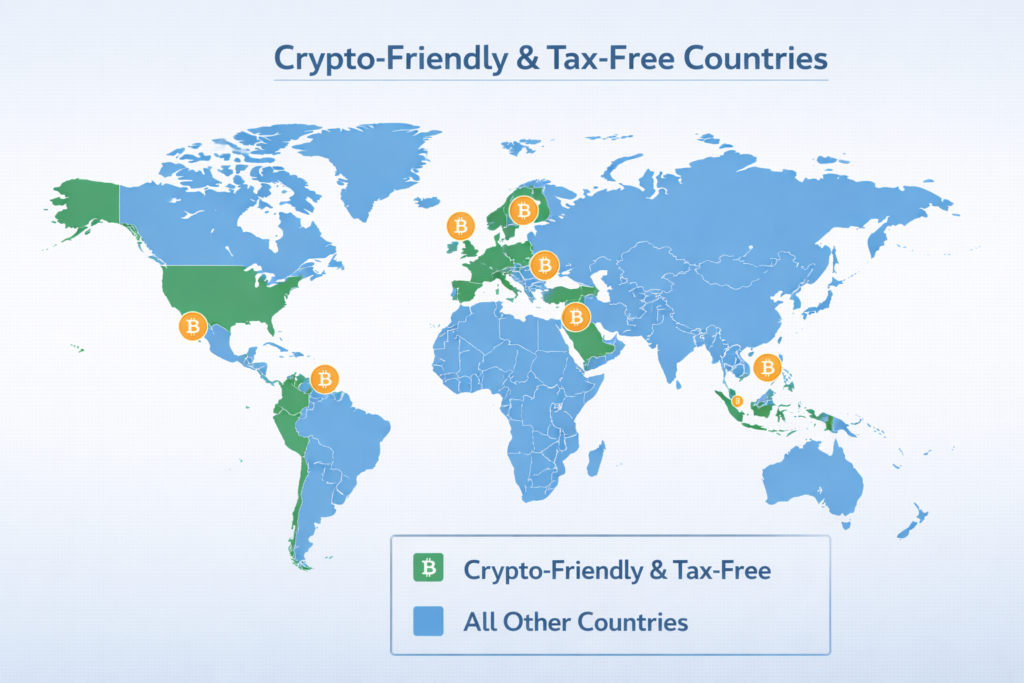
“Crypto tax rules differ widely across countries, and understanding them is essential before making any financial or relocation decisions.’
Countries Where Crypto Gains Are Currently Not Taxed
In some countries, crypto capital gains are not taxed for individuals. This usually means that profits made from selling or holding cryptocurrency are not subject to capital gains tax, as long as the activity is not treated as a business.
Below are countries commonly recognised as crypto tax-free for individual capital gains, with important context for each:
United Arab Emirates (UAE)
The UAE has no personal income tax and no capital gains tax for individuals. Crypto trading, holding, and long-term investing are generally tax-free, which is why cities like Dubai and Abu Dhabi have become major global crypto hubs.
Crypto activities are regulated through authorities such as VARA and ADGM, but profits are not taxed at the individual level.
Portugal
Crypto gains are not taxed for individuals, provided crypto trading is not your main professional activity. Business-related crypto income may still be taxed.
Singapore
Singapore does not have a capital gains tax. Crypto profits from long-term investing are tax-free for individuals, but frequent or professional trading may be treated as taxable income.
Germany
Crypto gains are tax-free if the asset is held for more than one year. Selling within one year may be taxed, depending on the amount and circumstances.
Switzerland
Private individuals generally do not pay capital gains tax on crypto. However, wealth tax may apply, and professional traders are taxed differently.
El Salvador
Bitcoin is legal tender, and crypto gains are not taxed. This applies to both locals and foreign investors.
Cayman Islands
There is no income tax and no capital gains tax. Crypto gains are fully tax-free for individuals.
Bermuda
Does not tax capital gains and has established clear digital asset regulations. Crypto gains are tax-free for individuals, and the country actively supports regulated crypto businesses.
Malaysia
Crypto gains are not taxed for casual investors. However, frequent trading or crypto-related business activity may be classified as taxable income.
Belarus
Under specific legal frameworks, particularly within the High-Tech Park regime, crypto gains for individuals are exempt from tax. Regulations may change, so ongoing verification is important.
“Several countries do not charge capital gains tax on crypto for individuals, but conditions often apply.”
Important note:
“tax-free” usually refers to capital gains for individuals, not all crypto activity. Mining, staking, salary payments, or business income may still be taxed. Tax laws can also change, so local advice is always recommended.
Important Warnings Before Choosing a Crypto Tax-Free Country
Before making decisions based on crypto tax benefits, it is important to understand that “tax-free” does not mean risk-free or rule-free. Below are key warnings every crypto investor should consider.
Tax Residency Matters More Than Location
You are usually taxed based on where you are a tax resident, not where your exchange or wallet is located. Simply holding crypto in a tax-free country does not automatically make your gains tax-free if you are still resident elsewhere.
Rules Can Change Quickly
Crypto tax laws are evolving. A country that is tax-free today may introduce taxes or reporting rules in the future. Always check the most recent regulations.
Business and Professional Trading Is Often Taxed
Even in tax-free countries, crypto income earned as a business, job, or frequent trading activity may be taxed. Casual investing and professional trading are often treated differently.
Reporting Requirements May Still Apply
Some countries require you to declare crypto holdings or transactions, even if no tax is due. Failure to report can still result in penalties.
Wealth, Exit, or Indirect Taxes
Some jurisdictions have no capital gains tax but may apply wealth taxes, exit taxes, or indirect fees that affect crypto holders.
Banking and Off-Ramping Challenges
Being in a tax-free country does not always mean easy access to banks or crypto-to-fiat services. Some banks still restrict or closely monitor crypto activity.
Regulatory and Compliance Risks
Countries with relaxed tax rules may still enforce strict compliance, KYC, or licensing requirements. Non-compliance can lead to account freezes or legal issues.
Relocation Is a Serious Decision
Moving to another country for tax reasons involves visas, residency rules, cost of living, and legal obligations. Crypto tax benefits should never be the only factor.
“Crypto tax-free does not mean rule-free, and misunderstanding residency rules can lead to penalties.”
Tax Residency Rules You Must Understand
Crypto taxes are usually based on tax residency, not citizenship, and not where your crypto wallet or exchange is located. Understanding tax residency rules is critical before assuming your crypto gains are tax-free.
You Are Taxed Where You Are a Resident
Most countries tax individuals based on where they are legally considered a tax resident. Even if a country is crypto tax-free, you will not benefit unless you are officially a tax resident there.
The 183-Day Rule (Common but Not Universal)
Many countries use the 183-day rule, meaning you become a tax resident if you spend more than 183 days in the country within a year. However, this rule is not universal. Some countries use additional criteria.
Centre of Life and Economic Ties
Some tax authorities look beyond days spent and assess where your life is actually based, such as:
- Where you have a permanent home
- Where your family lives
- Where you work or earn income
- Where your main bank accounts are
You can still be considered a tax resident even if you spend fewer than 183 days in a country.
Exit Tax and Previous Residency Obligations
Some countries impose exit taxes when you leave, or may continue taxing you for a period after relocation. You may need to formally deregister or prove you have ended tax residency.
Dual Tax Residency Risks
It is possible to be considered a tax resident in more than one country. This can create double taxation issues unless a tax treaty applies.
Tax Treaties Can Help, But Are Complex
Double taxation agreements (DTAs) determine which country has the right to tax you. These treaties vary widely and often depend on residency, income type, and economic ties.
Crypto Activity Timing Matters
When you realise gains matter. Selling crypto before establishing tax residency in a tax-free country may still be taxable under your previous residency.
Proof and Documentation Are Important
Authorities may require proof of residency, such as visas, rental agreements, utility bills, or residency certificates.
Final Thoughts
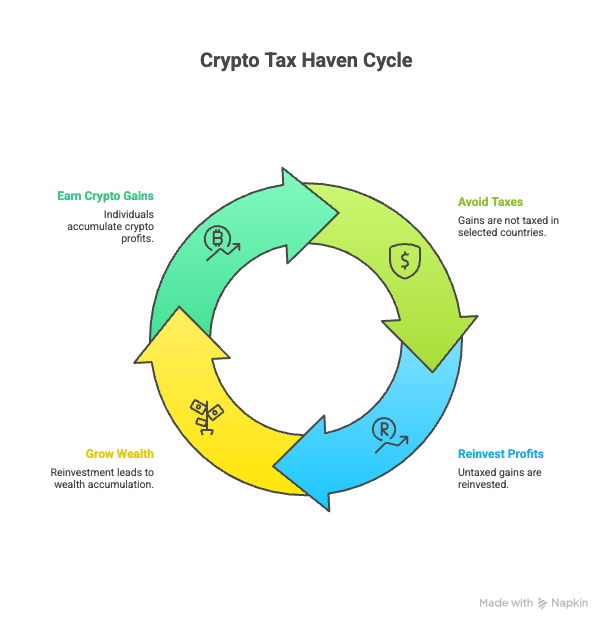
Crypto tax-free countries can offer clear advantages, but they are not a shortcut to avoiding taxes. The most important factor is not where your exchange is based or where your wallet is stored, but where you are legally a tax resident.
Many countries offer a generous or zero capital gains tax on crypto, especially for individual investors. However, these benefits usually come with conditions such as residency requirements, activity limits, reporting obligations, and changing regulations. What is tax-free today may not remain so in the future.
If you are exploring crypto tax-friendly jurisdictions, the right approach is planning, not assumptions. Understand local laws, establish proper residency, keep clear records, and consider professional advice where necessary. Crypto tax planning works best when it is done legally, transparently, and with a long-term view.
Used correctly, crypto-friendly tax systems can support growth and flexibility. Used carelessly, they can lead to compliance issues and unexpected liabilities. Knowledge and preparation remain your strongest tools.
FAQs
Are crypto gains completely tax-free in these countries?
In most cases, only capital gains for individuals are tax-free. Income from mining, staking, salaries, or running a crypto business may still be taxed. Always check the specific rules of each country.
Do I have to live in a country to benefit from its crypto tax rules?
Yes. You usually need to be a tax resident in that country. Simply using an exchange or wallet based there does not make your crypto gains tax-free.
Can I move to a tax-free country and sell my crypto immediately?
It depends. If the gains were realised before you became a tax resident, they may still be taxed by your previous country. Timing and residency status are very important.
Do tax-free countries still require crypto reporting?
Yes, some countries require you to declare crypto holdings or transactions even if no tax is due. Failure to report can still lead to penalties.
Can crypto tax laws change in these countries?
Yes. Crypto regulations are evolving globally. A country that is tax-free today may introduce taxes or stricter rules in the future, so staying updated is essential.