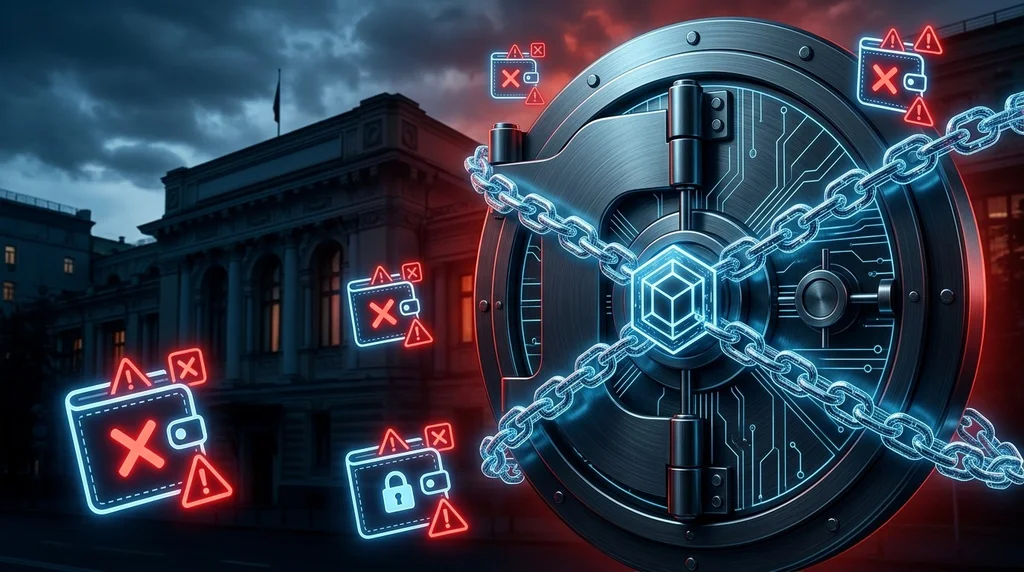
The Bank of Russia has added about 2,600 cryptocurrency wallet addresses linked to suspected illegal financial activity to a monitoring system used by banks and law enforcement agencies.
According to the central bank’s first half 2026 review of illegal financial market activity, more than 1 billion rubles in cryptocurrency had been attracted through the identified addresses. The wallets were connected to companies, projects, individual entrepreneurs and other entities showing signs of unlawful financial activity.
The move expands Russia’s use of blockchain transaction data within conventional compliance and enforcement systems, allowing financial institutions and authorities to assess client risk and investigate transactions connected to flagged addresses.
Key Takeaways
- The Bank of Russia added about 2,600 crypto wallets linked to suspected illegal financial activity to a shared monitoring system.
- More than 1 billion rubles in crypto had been attracted through the flagged addresses.
- The central bank identified 2,891 entities showing signs of illegal financial activity during the first half of 2026.
- More than 74% of identified financial pyramid schemes used cryptocurrency to attract funds.
- Illegal lending cases doubled year over year to 999, with some operators offering loans denominated in USDT.
Bank of Russia Adds Crypto Wallets to Monitoring System
The flagged wallet addresses were added to an information system available to banks, law enforcement agencies and other authorized bodies. The database is used for client risk assessments, financial investigations and broader anti-money laundering controls. This does not necessarily mean every transaction linked to one of the addresses is automatically proven to be criminal. Rather, the wallets are associated with entities the regulator says show signs of illegal financial market activity.
The central bank also reported that banks applied restrictive measures to more than 500 payment details connected to suspected illegal operations during the first half of the year. Authorities initiated more than 330 administrative cases based on information supplied by the regulator, while access to more than 11,800 online resources connected to suspected illegal financial operators and pyramid schemes was restricted.
Crypto Remains Common in Pyramid Schemes
Cryptocurrency continued to feature heavily in suspected investment fraud. The Bank of Russia said more than 74% of the financial pyramids it identified during the first half of 2026 used crypto to attract funds. Other schemes relied mainly on foreign payment services or cash. Organizers used more than 940 websites, around 120 Telegram channels and more than 2,500 social media pages to reach potential victims.
Many schemes promoted cryptocurrency investments, mining opportunities or investments in supposedly profitable data centers. Others offered digital tokens marketed as being linked to the price of physical assets such as gold. The regulator identified 929 entities showing signs of financial pyramid activity and another 379 suspected of illegally soliciting investments. Combined, pyramid and pseudo investment projects declined by about 44% from the first half of 2025.
Illegal Crypto Lending Rises
While suspected pyramid schemes declined, illegal lending moved in the opposite direction. The number of identified illegal lenders increased to 999 during the first half of 2026, compared with 467 during the same period a year earlier. Among the products identified were so called crypto loans.
Some operators offered borrowers loans denominated in Tether’s USDT stablecoin or ruble loans calculated using a fixed crypto related exchange rate outside the formal financial system. The Bank of Russia said it continued to receive complaints connected to these services, while websites linked to illegal lending operations were repeatedly blocked and replaced by new domains.
Russia Expands Crypto Compliance Oversight
The latest wallet monitoring effort fits into Russia’s broader push to bring more digital asset activity under formal supervision. The country has been developing rules for crypto exchanges, brokers, custodians and other intermediaries while maintaining restrictions on the use of cryptocurrency as a domestic means of payment. At the same time, regulated crypto related products are gradually expanding for professional investors.
Moscow Exchange, for example, has introduced indexes linked to assets including Bitcoin, Ethereum, Solana, XRP, Tron and BNB, although direct spot cryptocurrency trading is not part of its existing offering. The contrast reflects Russia’s broader approach: allowing selected digital asset activity within regulated channels while increasing enforcement against unlicensed operators, scams and suspicious payment flows.
Separate Scam Campaign Uses Fake Concert Tickets
The central bank’s report comes as Russian cybersecurity researchers continue to identify new fraud campaigns involving cryptocurrency. Security company F6 recently reported finding at least 10 fake websites impersonating ticket platforms for Kanye West concerts in Russia. Some of the sites requested payment exclusively in cryptocurrency, while others sought phone based transfers. F6 also identified several Telegram bots connected to the campaign.
The incident illustrates how crypto continues to be used as a payment method in fraud schemes because transfers can be difficult to reverse once funds are sent.
Conclusion
The Bank of Russia’s decision to flag 2,600 crypto wallets shows how digital asset monitoring is becoming more closely integrated with traditional banking compliance and law enforcement systems.
More than 1 billion rubles flowed into the identified addresses, while crypto remained the preferred fundraising method for the majority of suspected pyramid schemes detected by the regulator. At the same time, the data shows that the risk landscape is shifting rather than simply shrinking. Pyramid-related activity declined, but illegal lending doubled, and scammers continue to adopt new channels and payment methods.
For Russian financial institutions, the expanded wallet database provides another tool for assessing suspicious transactions. For users, it reinforces the growing importance of dealing with verified platforms and treating investment schemes that demand crypto-only payments with caution.