


The crypto market never really slows down. It just shifts. Every cycle, a new wave of low-cap tokens shows up promising 10x, 50x, even 100x returns. Some deliver. Most disappear. A few were never real projects to begin with.
That’s the reality around shitcoins in 2026.
The upside is obvious. Small market cap. Early narratives. Retail momentum. When timing aligns, the returns can be aggressive. But the downside is just as clear: rug pulls, fake communities, recycled whitepapers, manipulated liquidity, and founders who vanish the moment volume spikes.
This guide is not about hype. It’s about filtration. We’ll look at what actually makes a shitcoin worth considering in this cycle, how to spot structural red flags before you commit capital, and how to approach these high-risk plays without gambling blindly. If you’re going to speculate, you should at least do it with a framework.
Let’s get into it.
EXTREME RISK WARNING: This content is for educational purposes ONLY and is NOT financial advice. According to DappRadar’s 2025 report, the Web3 ecosystem lost nearly $6 billion to rug pulls in 2025, a 6,499% increase from the same period in 2024. The overwhelming majority of that ($5.5B) stemmed from the Mantra (OM) token collapse. Never invest more than you can afford to lose entirely.
Key Takeaways
- 95%+ of shitcoins fail: survivorship bias makes it look easier than it is; you hear about FARTCOIN, not the 10,000 coins that went to zero the same week
- Rug pulls are accelerating: $6B stolen in Q1 2026 alone, average time-to-rug is now just 12 days
- DOGE, SHIB, and PEPE are the “safest” options: not safe, just less likely to disappear overnight than random Pump. fun tokens
- Celebrity coins are traps: TRUMP, HAWK TUAH, and LIBRA all showed insider-advantage patterns; retail buyers lost while insiders profited
What Is a Shitcoin?
A shitcoin is a cryptocurrency with little to no fundamental value or clear use case, created primarily for speculation or as a joke. These tokens typically have low prices, high supply, and are driven by hype, memes, or celebrity endorsements rather than technology or utility. While some like Dogecoin have achieved lasting success, most fade to zero within weeks or months.
The term emerged around 2015 from Bitcoin maximalists who labelled all altcoins “shitcoins.” Today, the total meme coin market has matured into a recognisable (if volatile) asset class.
According to Binance market data, the total meme coin market cap rebounded above approximately $47.7 billion in early January 2026, up from around $38 billion at the end of 2025. At its December 2024 peak, that figure had touched $137 billion, before a sharp correction wiped out more than half the market in weeks.
Understanding the terminology before diving in matters:
| Term | What It Means | Example |
| Shitcoin | Low or no value, purely speculative | Thousands of tokens |
| Meme Coin | Based on an internet meme or joke | DOGE, PEPE, WIF |
| Rug Pull | Intentional theft by the development team | $HAWK, $LIBRA |
Why People Buy Shitcoins (And Why Most Regret It)
The psychology is straightforward: the dream of turning $100 into $1 million is real, for a tiny fraction of buyers. FARTCOIN went from $0.000004723 to a peak of $2.61, a roughly 55 million percent gain. The ai16z token reportedly delivered over 100,000% returns in under two months. WIF (Dogwifhat) surged tens of thousands of percent in the months after it launched on Solana in late 2023.
These stories are not fabricated. But they represent the top 0.01% of outcomes, and they dominate social media while the losses stay quiet.
“Scammers are increasingly using social engineering and compromised celebrity accounts to promote fraudulent tokens. This has contributed to hundreds of millions in memecoin-related losses, and the tactics are getting more sophisticated, not less.”
The math most people ignore: if 1,000 people buy a random shitcoin, roughly 1-2 catch a 100x gain, 50-100 break even or see small profits, and 900+ lose between 50% and 100% of what they put in. The house wins in aggregate, every time. That doesn’t mean there is no legitimate case for calculated speculation in established meme coins; it means you need to understand what game you’re actually playing.
Top 5 Shitcoins to Watch in 2026
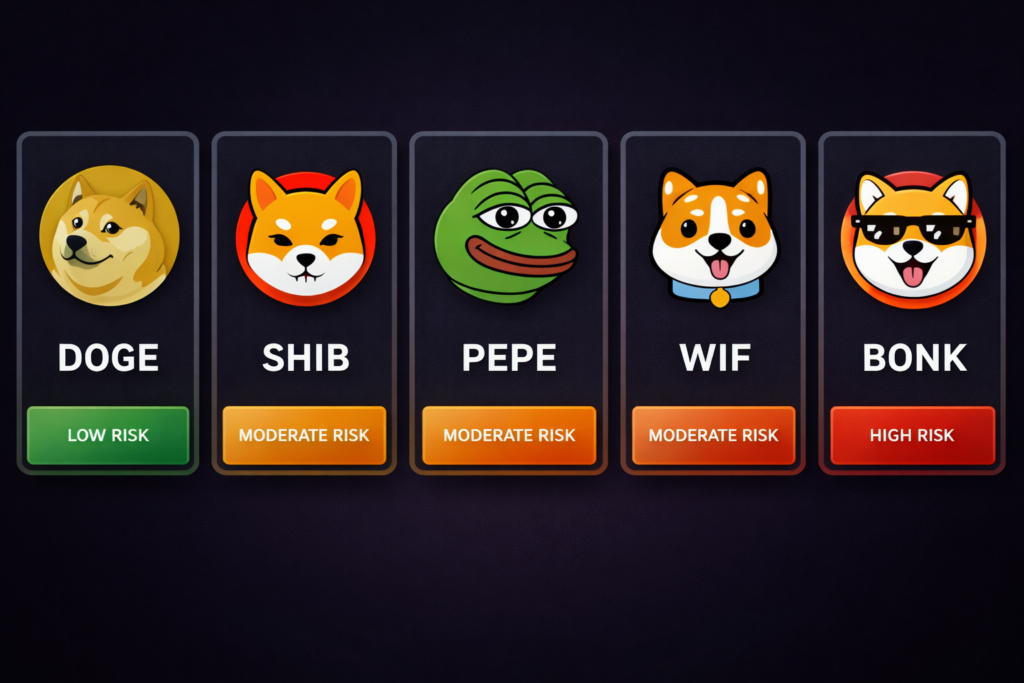
These are listed by relative safety, but all carry extreme risk. None of this is a buy recommendation. Market caps and prices shift daily; always cross-reference with live data from CoinGecko or CoinMarketCap before making any decision.
1. Dogecoin (DOGE): The Original and Most Liquid Meme Coin
| Chain | Dogecoin (Litecoin fork, Proof-of-Work) |
| Risk Level | Low-Medium (relative to other shitcoins) |
| Where to Buy | Binance, Coinbase, Kraken, Robinhood, most major exchanges |
The original meme coin, launched in December 2013 as a joke by Billy Markus and Jackson Palmer, DOGE has outlived hundreds of competitors and multiple bear markets. It is the only meme coin that genuinely cannot be rug-pulled: it runs on its own proof-of-work blockchain, there is no developer wallet, no insider allocation, and no central team controlling the supply. That structural reality sets it apart from virtually every other shitcoin on this list.
In 2025, Grayscale received approval for a Dogecoin Trust, a meaningful signal of institutional acknowledgement, even if it stops short of a formal ETF. Tesla and SpaceX both accept DOGE for merchandise. Elon Musk continues to reference it publicly, which historically causes single-tweet price moves of 10-20%.
The honest negatives: DOGE is inflationary by design, with 5 billion new coins minted every year. There is no development roadmap and virtually no active engineering. The price remains heavily tied to Elon Musk’s posting behaviour rather than any fundamental metric. It peaked at $0.73 in May 2021 and has never come close since. For context, reaching $1 would require a market cap of roughly $144 billion, a level that only Bitcoin and Ethereum have historically sustained.
For a beginner who wants meme coin exposure without dealing with decentralised exchanges or smart contract risk, DOGE is the lowest-friction option. Just understand you’re betting on culture and celebrity, not technology.
Read Also: FPI in Crypto Explained: From Investment Flows to Stablecoins
2. Shiba Inu (SHIB), The Ecosystem Meme Coin
| Chain | Ethereum (ERC-20) |
| Risk Level | Medium |
| Where to Buy | Binance, Coinbase, Uniswap, Crypto.com |
SHIB has invested more in infrastructure than almost any meme coin in history. Shibarium, its Layer 2 blockchain, launched in 2023 and processes transactions at a fraction of Ethereum’s gas cost. ShibaSwap provides decentralised trading within the ecosystem. There is an active and documented burn mechanism that removes tokens from circulation. The project is CertiK-audited.
None of this changes the underlying reality that SHIB’s value is driven by speculation rather than utility-driven demand. Its circulating supply is measured in quadrillions, reaching even $0.0001 would require a market cap larger than the entire crypto market at current sizes. The burn rate, while real, would take decades to meaningfully impact price at its current pace.
That said, SHIB is genuinely the second-largest meme coin by market cap with deep exchange liquidity. It is extremely unlikely to disappear overnight. Treat it as a medium-risk lottery ticket with a credible ecosystem behind it, not an investment in the traditional sense.
3. PEPE, Pure Meme, No Pretence
| Chain | Ethereum (ERC-20) |
| Risk Level | High |
| Where to Buy | Binance, Uniswap, OKX, Bybit |
PEPE launched in April 2023 with no roadmap, not because the team was disorganised, but because having no roadmap was the point. Based on Matt Furie’s iconic internet character Pepe the Frog, the token leaned entirely into meme culture without making any promises. It has zero transaction taxes, no hidden utility claims, and a deflationary model that slowly burns supply.
It became the third-largest meme coin by market cap through nothing but community momentum, which is both its greatest strength and its primary risk. When sentiment shifts, there is no utility case to fall back on. As of late February 2026, PEPE was trading at approximately $0.00000346 per token with a market cap of around $1.45 billion, a significant pullback from its late 2024 highs of close to $9 billion. This kind of 80%+ drawdown from peak is completely normal for high-risk meme coins and should be expected, not a surprise.
4. Dogwifhat (WIF), Solana’s Flagship Meme Coin
| Chain | Solana |
| Risk Level | Very High |
| Where to Buy | Raydium, Jupiter, Binance, OKX |
“Just a dog wearing a hat” turned into a multi-billion dollar asset by mid-2024, becoming the defining success story of Solana’s meme coin era. The token’s appeal was exactly its simplicity: no promises, no whitepaper, no roadmap. Just community momentum and the right timing on the right chain.
WIF’s rise also reflected a broader structural shift: Solana’s transaction costs of around $0.00025 compared to Ethereum’s $5-50 made it the natural home for speculative meme trading. The speed of confirmations created a better experience for retail traders who were moving in and out of positions quickly.
The risk is equally extreme. WIF has experienced drawdowns of 85-90% from its peak, which is typical for Solana meme coins outside of bull market windows. The token has no utility, no development team actively building, and its price is entirely driven by market sentiment. If Solana’s broader ecosystem loses momentum, WIF follows.
5. BONK, Solana’s Community Airdrop Token
| Chain | Solana |
| Risk Level | High |
| Where to Buy | Raydium, Jupiter, Coinbase, Binance |
BONK launched in December 2022 via a massive airdrop to Solana community members, developers, NFT holders, and active users. That distribution model built genuine grassroots credibility because a large portion of holders got in at essentially zero cost, reducing the standard insider-dump pressure that plagues most new tokens.
Since launch, BONK has maintained active burn mechanics, introduced staking, and secured listings on major centralised exchanges, including Coinbase, a threshold many meme coins never clear. BonkDAO burned 100 billion tokens in late 2024, and the community-governed treasury continues to make decisions on allocation.
It remains deeply speculative. But among second-tier meme coins, BONK has a clearer community ownership story and more transparent governance than most of its peers on Solana. That doesn’t mean the price will go up; it means the project is slightly less likely to vanish overnight.
The Most Dangerous Category
The $TRUMP token was launched on January 17, 2025, three days before President Trump’s inauguration. It hit an all-time high of approximately $73-74 per token on January 19, reaching a peak market cap that briefly exceeded $27 billion. Two Trump-affiliated entities, CIC Digital LLC and Fight Fight Fight LLC, retained 80% of the 1 billion total supply, with only 200 million tokens offered publicly at launch.
As of March 2026, $TRUMP trades at approximately $3.57, a drop of over 95% from its all-time high. A March 2025 Financial Times analysis found the project netted at least $350 million through token sales and trading fees. Former Trump White House Communications Director Anthony Scaramucci publicly called it “Idi Amin level corruption,” saying any foreign entity could effectively deposit money into the US President’s accounts with two clicks.
“The timing of this launch cannot be a coincidence. It comes just after Trump’s campaign ended, and just before he formally takes office and is fully subject to federal ethics rules.”
The $HAWK token tells a similar story, though the mechanics differed. Launched on December 4, 2024, on Solana by viral internet personality Hailey Welch, the token surged to a market cap of approximately $490 million within fifteen minutes of launch. Then it collapsed by over 90% within hours.
On-chain analysis published by Halborn Security found that 97% of the total supply was initially held by just ten wallets, with only 3% available to the public. Early wallet holders sold large quantities immediately after launch, netting an estimated $3 million while ordinary buyers watched the price crater. A class-action lawsuit was filed in New York on December 19, 2024, alleging unregistered securities sales. Welch cooperated with the SEC and FBI investigation and was eventually cleared of personal wrongdoing in early 2025, though the case highlighted how little protection retail buyers have in these launches.
These are not outliers. The pattern, large insider pre-allocation, hype-driven public launch, insider exit, retail loss, appears in the majority of celebrity-associated token launches. Celebrity association is not a safety signal. In practice, it has been a reliable predictor of the opposite.
How to Spot a Rug Pull Before It Costs You
According to DappRadar’s 2025 analysis, rug pull incidents actually decreased by 66% year-over-year in early 2025, but losses increased by 6,499%. The scams are fewer in number but far more sophisticated and devastating when they occur. CoinLaw’s research indicates that BSC (Binance Smart Chain) hosted approximately 71-76% of all rug pull scams in 2024 due to low deployment costs, though Solana’s share is rising. Knowing what to look for before you buy is the most valuable skill in this market.
Read Also: 10 Signs an Airdrop Is a Scam and How To Avoid Them
Red Flags That Should Stop You Completely
An anonymous development team is the clearest warning sign available. According to multiple security researchers cited in CoinLaw’s rug pull statistics database, the overwhelming majority of documented rug pulls, consistently reported at 80-92% across different analytical frameworks, involve teams with no verifiable identities. If you cannot find a real person with a verifiable professional history behind a project, treat it as a scam until proven otherwise.
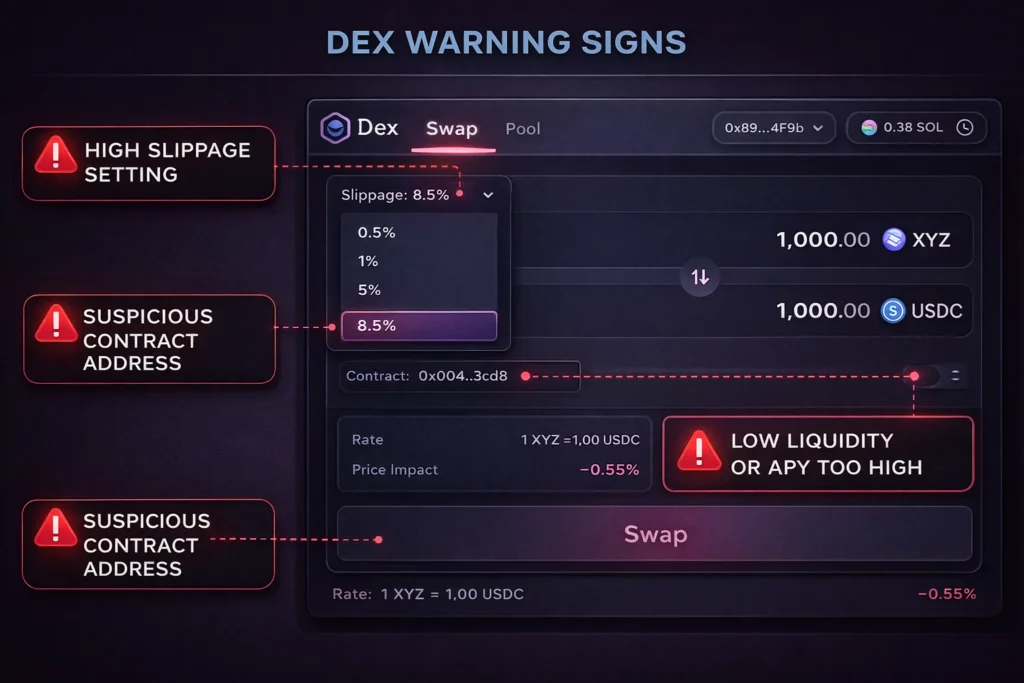
Unlocked or short-term locked liquidity is the mechanical enabler of most hard rug pulls. When developers can withdraw liquidity at will, they can and regularly do. Before buying any DEX-traded token, check
Before buying any DEX-traded token, check DexTools or DexScreener for the lock status. Liquidity should be locked for a minimum of six months by a credible third-party locker, and you should verify that directly on the locker’s platform, not just trust a screenshot in a Telegram group.
Token concentration in a small number of wallets is equally dangerous. Use Etherscan for Ethereum tokens or Solscan for Solana tokens to look at the holder distribution tab. If the top 10 wallets control more than 50-60% of the total supply, that level of concentration gives insiders the ability to crash the price at will.
A missing or unverified smart contract audit removes the one technical layer of protection available to buyers. Real audits are verifiable on the auditor’s own website. Go directly to
Real audits are verifiable on the auditor’s own website, go directly to CertiK.com or TrailOfBits.com and search for the project name. Do not rely on a PDF linked from the project’s own Telegram. Fake audit documents are common. CoinLaw data suggests that around 27% of rug pull scams in 2024 involved AI-generated or falsified audit reports.
Honeypot contracts, tokens that allow you to buy but prevent selling, are detectable before you commit funds. Use
Honeypot contracts, tokens that allow you to buy but prevent selling, are detectable before you commit funds. Use Honeypot.is or Token Sniffer to test any contract address before purchasing. If the tool flags that selling is disabled or that there are hidden fees above 10%, walk away.
Yellow Flags That Warrant Scepticism
Celebrity endorsements without verifiable involvement, not just a tweet, but documented operational participation, have consistently preceded losses for retail buyers. A large Telegram or Discord group that shows high member counts but low-quality, repetitive messages is almost always inflated by bots. A contract deployed less than seven days ago means there is minimal transaction history to analyse. Promises of “guaranteed returns” or specific price targets are illegal in regulated markets for a reason: no one can guarantee them, and anyone claiming otherwise in crypto is either ignorant or deceptive.
“Rug pulls are becoming less frequent but far more devastating when they do occur. The scams are increasingly sophisticated, often orchestrated by teams with polished branding and well-planned narratives.”
How to Buy Shitcoins: The Safe-Practice Process
This is a high-risk segment of crypto. So the process is not about “how to ape in fast.” It’s about how to reduce obvious mistakes.
Most people lose money in shitcoins because they skip structure. They buy emotion. The safe-practice process is about friction, verification, and risk containment.
We’ll break it down cleanly.
For Established Coins (DOGE, SHIB, PEPE)
The simplest approach for coins listed on major centralised exchanges is to create a verified account on Coinbase or Binance, fund it via bank transfer, and purchase directly in the spot market. Use a limit order rather than a market order, with low-liquidity assets; market orders can fill at prices significantly worse than expected. Once you’ve purchased, consider withdrawing to a personal wallet rather than leaving funds on the exchange.
For Solana Meme Coins (WIF, BONK, and Others)
Download Phantom Wallet from phantom.app only, not from an ad link, not from a third-party site. Write your seed phrase on paper and store it somewhere physically secure. Never photograph it, email it, or type it anywhere digital. This is not optional advice.
Buy SOL on Coinbase or Binance and withdraw to your Phantom wallet address. Double-check the address character by character; malware can silently replace clipboard content with an attacker’s address. Send a small test transaction first before transferring a larger amount.
Navigate to Raydium.io or Jup.ag directly, and verify the URL carefully. Obtain the official contract address for your target coin from CoinGecko or CoinMarketCap, not from Telegram or Twitter. Paste that address into the DEX search field.
Connect your wallet, set slippage between 1-5% for established coins and up to 10% for more volatile ones. If a token requires 12%+ slippage to execute, it likely has hidden token taxes built into the contract, a serious red flag.
Gas fee reality check: Buying PEPE on Uniswap during peak Ethereum network hours can cost $30-50 in gas on a $200 trade. Solana transactions typically cost under $0.01. For smaller positions, the chain you use matters significantly to your actual returns.
Tax Implications You Cannot Ignore
Every sale, swap, or spend of a shitcoin is a taxable event under IRS rules, and this applies to crypto-to-crypto swaps, not just sales for cash. Swapping DOGE for PEPE on a DEX is a taxable disposal of DOGE. The IRS classifies cryptocurrency as property, meaning standard capital gains rules apply.
Positions held for less than one year are taxed at your ordinary income rate, which can reach 37% at the federal level. Positions held for more than one year qualify for long-term capital gains rates of 0-20% depending on income. This distinction matters significantly if you’re an active trader; frequent short-term trades in shitcoins can create substantial tax bills even when your overall portfolio hasn’t grown.
Rug pull losses can be claimed as capital losses, but only once the loss is realised, meaning you’ve sold the token or it has become provably worthless. Airdrops are treated as ordinary income at the fair market value on the date received. Record keeping is not optional: you need the date, cost basis, and proceeds for every transaction. Tools like
Tools like Koinly, CoinTracker, and ZenLedger automate the tracking process and generate the reports needed for IRS Form 8949. Failure to report is not a minor oversight; the IRS has increased crypto enforcement significantly in recent years, and penalties include back taxes, interest, and potential audit. Consult a qualified crypto tax professional before filing.
FAQ
Are shitcoins worth buying in 2026?
That depends entirely on your definition of “worth.” If you’re treating a small allocation as high-risk speculation, the equivalent of a casino budget, money you’ve already mentally written off, then the established meme coins like DOGE, SHIB, and PEPE represent a calculable gamble with the potential for significant returns.
If you’re looking for an investment in any traditional sense, the answer is no. The 95%+ failure rate, the rug pull environment, and the complete absence of fundamental value make shitcoins unsuitable as a meaningful wealth-building vehicle.
What is a rug pull, and how does it work?
A rug pull is when the developers or insiders behind a token project drain the liquidity, sell their holdings, or disappear with investor funds, leaving token holders with worthless assets and no recourse. Hard rug pulls happen instantly when developers withdraw all liquidity from a DEX pool, causing the token price to collapse to zero.
How do I check if a shitcoin is a scam before buying?
Start by checking the developer team; anonymous teams with no verifiable identities are responsible for the overwhelming majority of documented rug pulls.
Then, verify liquidity lock status on DexTools or DexScreener: liquidity should be locked for at least six months by a third-party locker. Check the holder distribution on Etherscan or Solscan.
If the top 10 wallets hold more than 50-60% of the supply, that’s a serious concentration risk. Run the contract address through Honeypot.is to confirm you can actually sell the token. If an audit exists, verify it directly on CertiK’s or Trail of Bits’ official website; do not trust project-provided PDFs.
What is the difference between a hard and soft rug pull?
A hard rug pull is immediate and technical: the developers have built a backdoor into the smart contract, or they remove all liquidity from the exchange pool at once, causing the price to drop to near zero instantly. A soft rug pull is gradual: the founders slowly sell their large pre-allocated holdings over weeks or months, depressing the price incrementally while maintaining the appearance of an active project.
Can I legally trade shitcoins in the US?
Yes, trading established meme coins like DOGE, SHIB, and PEPE is legal in the US on regulated exchanges. However, many shitcoins, particularly those that promise profits based on the efforts of a development team, may qualify as unregistered securities under the SEC’s application of the Howey test. The $HAWK case in 2024 and ongoing SEC scrutiny of celebrity-backed tokens make this an evolving legal area. This is not legal advice; if you’re uncertain about the status of a specific token, consult a qualified attorney.
How are shitcoin profits taxed?
The IRS classifies all cryptocurrency as property. Every sale, swap, or spend creates a taxable event. Short-term gains (assets held under one year) are taxed at your ordinary income rate, which can be as high as 37% federally. Long-term gains (held over one year) qualify for preferential rates of 0%, 15%, or 20% depending on your income bracket. Crypto-to-crypto swaps are taxable at the time of the swap, not just when you convert to cash. Use a crypto tax tool like Koinly or CoinTracker to track every transaction, and consult a tax professional before filing.
Should a beginner buy shitcoins?
If you want meme coin exposure as a beginner, DOGE on Coinbase is the lowest-friction option with the least technical risk. Starting with established coins and learning the tools gives you a foundation before you take on the higher-risk end of the market.
What tools should I actually use when trading shitcoins?
DexTools and DexScreener for liquidity analysis and lock verification. Honeypot.is or Token Sniffer for smart contract safety checks. Etherscan or Solscan for holder distribution and on-chain transaction history. CertiK.com to verify audit reports directly. Koinly or CoinTracker for tax tracking. CoinGecko and CoinMarketCap for market cap and price data. These tools together cover the most common vectors for losses before you commit any capital.
Conclusion
The shitcoin market in 2026 is a different kind of beast than it was in 2021. The number of scam incidents is actually falling, but the average loss per incident is rising sharply as more sophisticated actors build more elaborate schemes. The Mantra collapse alone wiped out more than $5.5 billion. Celebrity tokens that launched with enormous hype have consistently handed 80%-95%+ losses to late buyers. The market is not getting safer; it’s getting more dangerous in ways that are harder to spot.
That said, established meme coins like DOGE, SHIB, and PEPE have demonstrated multi-year staying power that the vast majority of shitcoins never achieve. They are not investments in any meaningful sense, but for a small allocation of genuinely disposable capital, they represent a clearer-than-average bet within a very high-risk asset class.
If you take one thing from this guide, make it this: the tools and verification steps described in the rug pull section are not optional extras for cautious investors. They are the bare minimum due diligence that separates informed speculation from uninformed gambling. Checking liquidity locks, verifying audit reports, and testing contract addresses on Honeypot.is takes about ten minutes. Those ten minutes have saved countless investors from total losses.
The $6 billion in rug pull losses recorded in 2025 represent real people who didn’t run those checks. Don’t be among them.
This article is for educational purposes only. UPay may earn a commission from some linked platforms. The author holds small positions in DOGE, PEPE, and WIF for research purposes (less than 1% of portfolio). This is NOT financial advice. Consult a qualified financial advisor before investing.