



Not everyone wants a room full of noisy ASICs, rising electricity bills, and the constant worry of mining equipment becoming outdated.
For many, cloud mining offers a simpler path to earning cryptocurrency without owning or maintaining hardware.
But convenience comes with a catch; not every platform delivers what it promises.
What is Cloud Mining?
Cloud mining is a method of mining cryptocurrencies such as Bitcoin without purchasing, operating, or maintaining specialized mining hardware.
Instead, you rent computing power from a third-party provider that manages the mining equipment and infrastructure on your behalf.
Traditional cryptocurrency mining often requires significant upfront investment in hardware, electricity, and technical expertise.
It removes many of these barriers by allowing individuals to participate in mining operations remotely through online platforms.
In exchange for a fee or mining contract, users receive a share of the mining rewards generated by the provider’s equipment.
Read Also: Top 7 Crypto Technical Analysis Bots.
How does Cloud Mining Work?
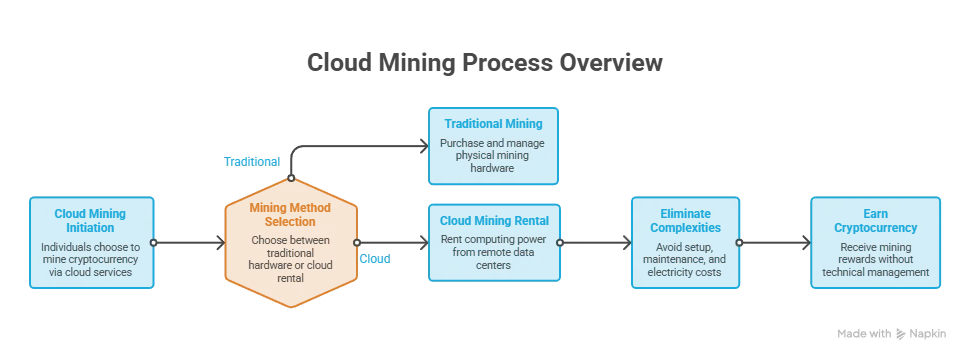
The process generally follows these steps:
- The mining providers operate large mining farms. These facilities contain specialized machines dedicated to validating transactions and securing blockchain networks continuously.
- You then purchase a mining contract. The contract determines the amount of hash power, contract duration, and associated service fees.
- Furthermore, the provider mines cryptocurrency on your behalf using the computing power included in your contract. The leased computing power contributes to mining activities within the provider’s broader mining infrastructure.
- Mining rewards are then distributed proportionally based on your purchased hash power. Daily maintenance fees, which cover electricity, cooling, and other operational costs, are deducted before users receive their earnings.
During periods of low crypto prices or high mining difficulty, these fixed fees may exceed the mining rewards, causing users to incur a daily loss.
Read Also: Coin Ticker: The Three Letters That Speak for a Whole Crypto Project.
Types of Cloud Mining
Cloud mining operates through different service models, and understanding each type helps users choose suitable investment approaches carefully today.
1. Hosted Mining
Hosted mining involves renting or purchasing physical mining hardware that is installed and maintained in professional data centers.
In this model, the provider owns the facility while the user effectively leases a dedicated mining machine remotely online.
For example, you may pay for a Bitcoin mining rig hosted in Iceland or another low-cost energy region.
The provider handles electricity, cooling, repairs, and uptime, while you receive mining rewards based on machine performance output.
2. Hash Power Leasing
Hash power leasing allows you to buy a portion of a mining farm’s total computational power instead of hardware.
This is one of the most popular mining models because it requires no physical equipment or maintenance involvement.
For example, you may purchase 10 TH/s of Bitcoin mining power from a large mining pool provider.
The provider allocates that computing power across mining operations, and you earn proportional rewards based on contribution levels.
3. Virtual Hosted Mining
Virtual-hosted mining involves renting a Virtual Private Server (VPS) from a general cloud computing provider, such as Amazon Web Services (AWS), Google Cloud, Microsoft Azure, or LayerStack. You then manually install and configure your own cryptocurrency mining software on that virtual machine.
For example, you may rent a VPS, install mining software, and connect it to a mining pool to begin mining remotely.
However, this approach is generally not recommended because VPS infrastructure is not designed for cryptocurrency mining. It is often unprofitable, and many cloud providers prohibit mining under their acceptable use policies.
Read Also: What Does 5x Mean in Crypto?
Benefits of Cloud Mining
1. Low Entry Costs
It eliminates the need to purchase expensive mining rigs, which can cost thousands of dollars upfront.
For example, Bitcoin mining hardware like ASIC machines can be financially inaccessible for beginners entering the crypto market.
With cloud mining, you can start with smaller investments by purchasing short-term or low-capacity mining contracts online.
2. No Maintenance or Technical Work
You do not need to manage hardware, replace parts, or handle overheating and electricity issues in mining setups.
For instance, traditional miners often deal with noisy rigs, high electricity bills, and constant equipment maintenance challenges daily.
Their providers handle all operational tasks, allowing you to focus only on contract selection and earnings tracking.
3. Accessibility and Convenience
Cloud mining can be accessed from anywhere in the world using only an internet connection and a basic device.
For example, you can participate in mining activities hosted in data centers located in other countries without leaving your home.
This makes it an attractive option for individuals who want passive exposure to cryptocurrency mining without technical barriers.
4. Passive Income Potential
It allows you to earn rewards passively as mining operations continue in the background without active involvement.
For example, you may receive periodic payouts based on the hash power you rent, although the amount will vary depending on network conditions and your provider’s fee structure.
However, profitability varies depending on cryptocurrency prices, network difficulty, and provider fee structures over time.
Risks and Challenges
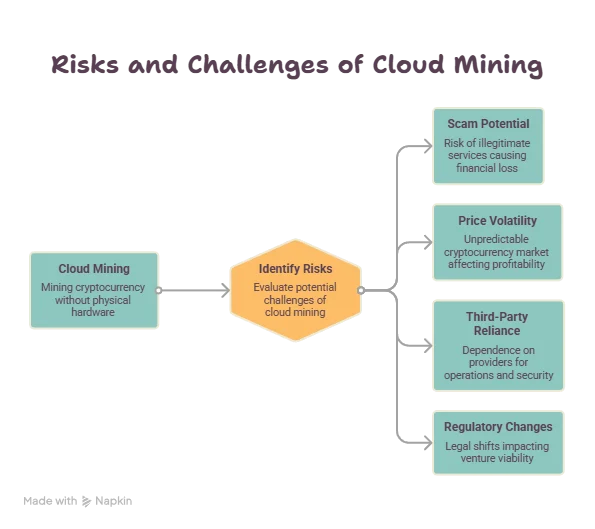
1. Scam and Fraud Risks
One major risk here is the presence of fraudulent platforms that disappear after collecting user funds.
For example, some websites promise guaranteed Bitcoin returns but shut down operations once enough investors deposit money.
These schemes often use unrealistic profit claims and referral incentives to attract users without any real mining infrastructure.
2. Low or Unstable Profitability
Cloud mining profits are not guaranteed and depend heavily on market conditions and mining difficulty at any given time.
For instance, a sudden drop in Bitcoin price can significantly reduce or eliminate expected returns from contracts.
High maintenance fees and service charges may also reduce payouts, making profitability lower than many users initially expect.
3. Lack of Control and Transparency
When it comes to it, you typically have no direct control over mining operations or visibility into actual hardware performance or locations.
For example, you may not be able to verify whether the provider is actually mining cryptocurrency or simply displaying simulated returns on its dashboard.
This lack of transparency makes it difficult to assess whether earnings are generated from real mining activities or internal accounting.
4. Contract Limitations and Restrictions
Contracts often come with fixed terms that limit flexibility and may restrict early withdrawal or changes.
For example, you might be locked into a 12-month contract even when market conditions become unfavorable.
Some contracts also include hidden fees or complex payout structures that reduce overall earnings over time significantly.
Read Also: Money Flow Index (MFI): A Simple Guide for Traders.
How to Choose a Reliable Mining Platform?

1. Check Company Transparency
A trustworthy provider should clearly display information about its mining farms, operations, and leadership team publicly online.
For example, reputable providers typically disclose details about their business operations, mining infrastructure, ownership, and contract terms, allowing you to verify the company’s legitimacy through independent sources.
Thus, if a platform provides little or no verifiable information about its operations, ownership, or mining activities, it should be treated as a potential red flag.
2. Review Pricing and Fee Structure
You should also carefully examine contract pricing, maintenance fees, and payout structures before committing any investment funds upfront.
For instance, some platforms advertise low entry costs but charge high daily maintenance fees that reduce net earnings.
Transparent providers clearly outline all costs so you can calculate realistic profit expectations before purchasing contracts.
3. Check Independent Reviews and Reputation
It is also important to research user feedback on forums, review sites, and crypto communities before selecting a provider.
For example, platforms frequently mentioned on trusted crypto forums are generally more reliable than unknown websites with no history.
You should also treat consistent negative reviews about delayed payments or withdrawal issues as serious warning signals.
4. Evaluate Payout Systems and Terms
Reliable platforms should offer clear payout schedules, supported cryptocurrencies, and verifiable transaction histories for user earnings.
For instance, weekly or daily payouts with blockchain proof provide more confidence than vague or delayed payment systems.
You should also confirm whether there are minimum withdrawal limits or hidden conditions affecting access to funds.
5. Avoid Unrealistic Profit Promises
Any platform guaranteeing fixed or extremely high returns should be approached with caution and strong skepticism immediately.
For example, claims of guaranteed daily profits in volatile crypto markets are usually unrealistic and financially misleading.
Legitimate mining returns always fluctuate based on network conditions, difficulty levels, and cryptocurrency price movements over time.
Cloud Mining vs. Buying Crypto: Which Is Better?
This is the comparison most articles avoid. Buying and holding Bitcoin directly involves no maintenance fees, no counterparty risk, no contract terms, and no minimum withdrawal thresholds.
If Bitcoin’s price increases, your returns mirror that increase exactly, no fee drag, no platform risk. It adds operational complexity, contract lock-in, and a daily fee structure that reduces net returns.
What it offers in return is the mining experience itself, participation in the proof-of-work system, daily income rather than price appreciation, and the specific satisfaction of generating cryptocurrency through computational contribution rather than purchase.
For most retail investors in 2026, direct Bitcoin purchase is financially simpler and likely more profitable over a 12-month horizon after accounting for fees.
It makes most sense for investors who specifically want the mining mechanism, not just the returns.
Frequently Asked Questions
Do I need technical skills to start cloud mining?
No. Most platforms handle the technical side, so you only need to choose a contract and monitor your earnings.
Is cloud mining profitable?
Yes, cloud mining can be profitable, but it is not guaranteed. Earnings depend on market prices, fees, mining difficulty, and contract terms.
Can beginners use cloud mining easily?
Yes. It is designed to be beginner-friendly since it removes the need for hardware setup and technical maintenance.
Conclusion
It is essentially a way to participate in mining by renting computing power from remote data centers instead of owning hardware.
This approach makes mining more accessible because it removes the need for expensive equipment, technical setup, and ongoing maintenance responsibilities.
However, accessibility does not automatically translate into guaranteed profits or consistent returns.
Therefore, it is important to also recognize that outcomes depend on market conditions, provider fees, mining difficulty, and platform credibility.
These factors can significantly affect overall earnings. So, while cloud mining can offer a simpler entry point into the crypto mining space, it should always be approached with careful research and realistic expectations.