Two years ago, buying Bitcoin through a regular brokerage account sounded almost like a contradiction. Today, it’s just another ticker.
Spot Bitcoin and Ethereum ETFs opened that door in 2024, and since then, the crypto ETF market hasn’t just grown, it’s gone through a few distinct phases, and 2026 looks nothing like the launch year everyone remembers.
This year alone has brought a wave of new altcoin ETFs covering everything from Solana and XRP to Dogecoin and Chainlink, a regulatory shake up that’s made it dramatically faster for new funds to list, and the long-awaited arrival of staking rewards inside a regulated ETF wrapper, something that simply didn’t exist before.
At the same time, flows have been choppier than the early hype suggested, with outflow streaks and price swings testing just how committed institutional money really is.
If you’ve been holding a Bitcoin or Ethereum ETF, considering one of the newer altcoin products, or just trying to make sense of the headlines, this guide walks through what’s actually shifted the fees, the fund flows, the regulatory changes, and the risks that come with all of it.
No predictions dressed up as certainties, just a clear look at where things stand right now.
Key Takeaway
- IBIT now holds roughly 45% of the spot Bitcoin ETF market, with most demand consolidating around the largest, most liquid funds rather than spreading evenly across issuers.
- Dozens of altcoin ETFs launched this year, but only a few names, like XRP and Solana, have actually pulled in meaningful institutional money.
- Morgan Stanley’s 0.14% Bitcoin ETF fee undercut every existing fund, pushing real price competition among issuers for the first time.
- ETFs remove the hassle of wallets and exchanges, but they don’t change the underlying volatility that comes with holding crypto.
What Are Crypto ETFs?
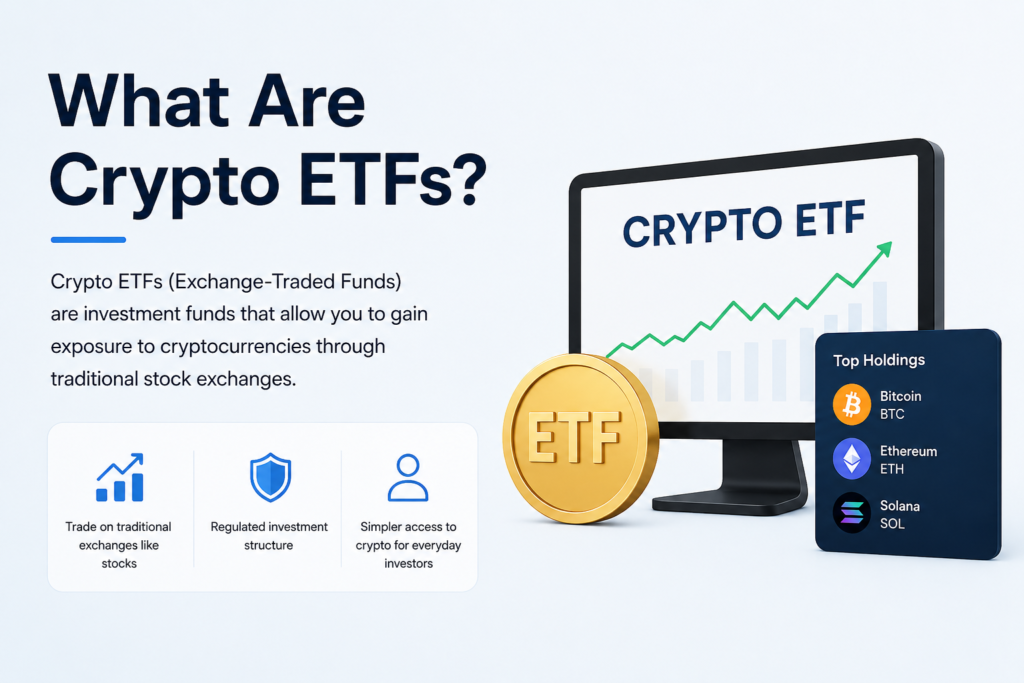
A crypto ETF is a fund that trades on a regular stock exchange, just like shares of Apple or an S&P 500 index fund, but its value is tied to the price of a cryptocurrency.
Instead of opening an account on a crypto exchange, sending money, and storing your coins in a wallet, you buy shares of the ETF through a normal brokerage account.
The simplest way to think about it: a crypto ETF is a middleman. The fund does the work of holding the actual digital asset (or, in some structures, derivatives tied to it), and investors just hold a share of that fund.
When the price of the underlying asset goes up or down, the value of the ETF share moves with it. This matters because it bridges the gap that used to be pretty separate, traditional brokerage investing and crypto markets.
Someone with a regular 401(k) account or a brokerage app like Fidelity or Schwab can now get exposure to Bitcoin or Ethereum without ever touching a crypto exchange.
Why Crypto ETFs Matter for Investors
- Easier access: buy crypto exposure through a regular brokerage account, no exchange sign-up or wallet setup needed, and it even opens the door for accounts like retirement plans that can’t hold crypto directly.
- No wallet management: a regulated custodian handles the storage, so you’re not personally responsible for private keys or seed phrases.
- Fits into a normal portfolio: crypto ETFs show up in the same accounts and statements as your other investments, making it easy for advisors and institutions to treat crypto as a real portfolio line item.
How Crypto ETFs Work
The mechanics behind a crypto ETF are a little more involved than a typical stock ETF, mostly because of how the underlying asset has to be sourced, stored, and verified.
The Role of ETF Issuers and Fund Managers
- Every crypto ETF has a sponsor, a company like BlackRock, Fidelity, or Grayscale that creates and manages the fund.
- The sponsor sets the fund’s strategy, chooses the custodian that holds the crypto, and handles day-to-day administration.
- Authorized Participants (APs), typically large broker dealers, are the only entities that can create new ETF shares or redeem existing ones.
- When demand rises, an AP delivers bitcoin or cash to the trust in exchange for a “basket” of new shares, often tens of thousands at a time
- This creation and redemption process is what keeps the ETF’s market price closely aligned with the actual value of the crypto it holds.
How Crypto Assets Are Held and Managed
- Most spot crypto ETFs split custody into two pieces: a specialized crypto custodian and a traditional cash custodian. Coinbase Custody Trust Company has served this role for major funds like iShares Bitcoin Trust, holding the digital asset in offline cold storage (iShares).
- A traditional institution like Bank of New York Mellon often serves as cash custodian and trust administrator, handling cash management, accounting, and shareholder records
- Some newer entrants use more than one custodian for redundancy. Morgan Stanley’s proposed Bitcoin Trust named both Coinbase Custody and BNY, mirroring standards other large asset managers use (CoinMarketCap).
- The bulk of holdings sit untouched in cold storage, with only a portion moving into internet-connected wallets temporarily during share creation or redemption.
- Custody insurance exists but isn’t unlimited, coverage is typically shared across a custodian’s multiple clients and may not cover every potential loss (CoinMarketCap).
Bitcoin ETF Trends
Bitcoin ETFs started this whole category, and they’re still the biggest part of it. But a few clear shifts have shown up this year in where the money’s going, what issuers charge, and who’s now in the business of issuing these funds.
IBIT’s Growing Market Share and What’s Driving Consolidation
One of the biggest trends in the Bitcoin ETF market has been the rapid growth of large funds, particularly those that attracted strong investor demand after spot Bitcoin ETFs launched.
BlackRock’s iShares Bitcoin Trust (IBIT) keeps pulling further ahead of the pack. It now holds around $70.6 billion in assets and roughly 45% of the spot Bitcoin ETF market.
It also became the fastest ETF in history to hit $70 billion, doing it in 341 trading days, about five times faster than the previous record holder, SPDR Gold Shares, which took 1,691 days.
Fee competition among bitcoin spot ETFs
For a while, the two biggest funds, IBIT and FBTC, both charged 0.25%, while smaller issuers used lower fees to compete: Grayscale’s Bitcoin Mini Trust at 0.15%, and BITB/ARKB around 0.20 – 0.21%.
Then Morgan Stanley reset the floor. Its Morgan Stanley Bitcoin Trust (MSBT) launched at a 0.14% fee, the lowest in the market, undercutting IBIT by 11 basis points.
For a $10 million allocation, that gap works out to about $11,000 in annual savings, meaningful for an advisor managing client money at scale, less dramatic for a smaller retail account, where the same gap might only be a few dollars a year. Either way, issuers are now genuinely competing on price, which wasn’t really true in the first year or two of this market.
What “cost basis support” means for retail readers
Every Bitcoin ETF purchase happens at whatever price Bitcoin is trading that day. Average all those purchase prices together since launch, and you get a rough sense of what ETF investors paid overall, that’s the cost basis.
Analysts like Bitwise’s Andre Dragosch point to this aggregate cost basis as a structural support level, since it reflects the price US ETF investors paid to get in.
The idea is that large holders are reluctant to sell near breakeven, so when Bitcoin’s price drifts back toward that average, buying interest tends to pick up.
Also Read: Decentralized AI: Benefits, Challenges, and Top Projects Explained
Ethereum ETF Trends
Ethereum ETFs share the same basic structure as Bitcoin ETFs, but they haven’t moved the same way at all in 2026. A different price story and a genuinely new product feature, staking have set this category apart.
Why ETH ETFs are behaving
Ether has been down around 28% year-to-date, compared to roughly 20% for Bitcoin, (ETF Database) and that gap shows up directly in fund flows. Bitcoin ETFs have mostly held their ground through the volatility, while Ethereum ETFs have seen more uneven demand.
The narrative around Ethereum has also shifted. Tokenization and stablecoins, once seen as more niche blockchain use cases, have become some of the market’s most mainstream themes, and Ethereum sits at the center of a lot of that activity. That’s kept long-term interest alive even while short-term price action has been rough.
The Ethereum staking ETF question
For most of 2024 and 2025, “will Ethereum ETFs ever offer staking” was one of the biggest open questions in the market. As of mid 2026, that question has basically been answered.
The holdup wasn’t really about whether staking itself was risky, it was a legal classification problem. For years, the SEC’s stance was that staking rewards could resemble a securities offering, which made issuers cautious about building staking into ETF structures.
Regulators also had to work through more technical concerns: Ethereum enforces an “unbonding” period of nine to fifty days before staked assets can be withdrawn, which meant funds couldn’t stake everything and still meet daily redemption requests. That liquidity mismatch needed a real structural answer before any fund could responsibly offer staking.
Which issuers are positioning for staking approval
Grayscale was first to offer staking, launching on ETHE in October 2025 and paying out $9.4 million in rewards by January 2026.
BlackRock followed with ETHB in March 2026, staking 70–95% of holdings and paying out 82% of rewards per month.
Fidelity, Franklin Templeton, Invesco, 21Shares, and VanEck all have staking amendments pending, with approvals expected through the rest of 2026.
Gross ETH staking yield runs about 3.1–3.3%, but after fees, shareholders typically net 1.9–2.6%, worth checking per fund rather than assuming the headline rate (Everstake).
The Altcoin ETF Wave
Bitcoin and Ethereum got the headlines for two years. In 2025 and 2026, the action moved to everything else.
The list has grown fast. The first wave hit in late October 2025 with Solana, Litecoin, and Hedera launching almost simultaneously, followed weeks later by XRP and Dogecoin, then Chainlink in early December.
Since then, the lineup has expanded further to include Avalanche, Polkadot, HBAR, and most recently BNB and Hyperliquid.
As of mid-2026, the U.S. market spans 11 spot Bitcoin ETFs, seven XRP ETFs, several Solana ETFs, a Dogecoin ETF, and a Polkadot ETF that launched in March 2026. Sui has a filing in motion but hasn’t launched yet.
Polkadot, BNB, and Litecoin have all crossed the finish line. Polkadot launched in March 2026, BNB followed with VanEck’s VBNB, and Litecoin’s LTCC began trading in 2026 after the SEC and CFTC formally classified the asset as a commodity.
Avalanche is further back, Bitwise filed a spot Avalanche ETF in September 2025, but as of mid-2026 it’s still working through registration rather than trading.
How to Evaluate a Crypto ETF Before Investing
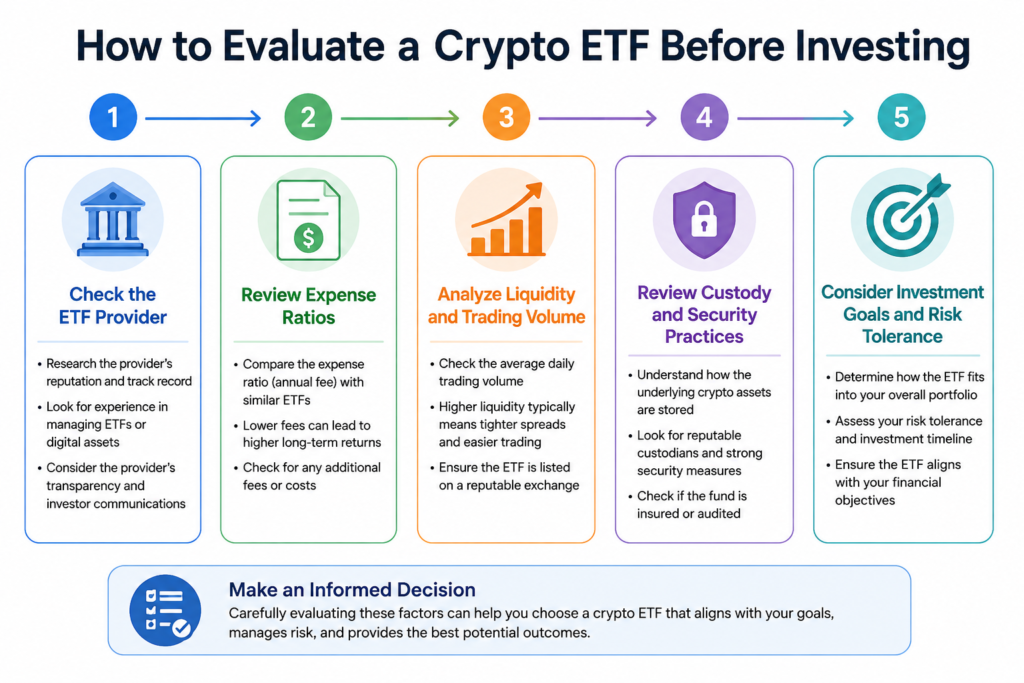
With lots of crypto ETFs now on the market, picking one isn’t as simple as just choosing the asset you want. Here’s what’s actually worth checking before you buy.
Check the ETF Provider
The issuer behind a fund matters more than people often assume. A name like BlackRock or Fidelity brings institutional grade infrastructure, deep pockets, and a track record across other products, which tends to translate into smoother operations and better liquidity.
Smaller or newer issuers aren’t automatically worse, but they carry more uncertainty around how the fund will be managed during stress periods
Review Expense Ratios
Expense ratios determine how much of your return gets eaten by fees every year, and they vary more than you’d expect even among funds tracking the same asset.
That said, the cheapest fund isn’t always the right choice if it sacrifices liquidity or comes from a less established issuer. Treat the fee as one input, not the deciding factor.
Analyze Liquidity and Trading Volume
A fund’s trading volume affects how easily you can buy or sell without moving the price against yourself.
Higher-volume ETFs tend to have tighter bid-ask spreads, which matters more than people realize if you’re trading in and out rather than buying and holding.
Review Custody and Security Practices
Since the fund is responsible for safely holding the actual crypto, it’s worth knowing who the custodian is and how they store it. Reputable funds use regulated custodians with cold storage, insurance coverage, and clear audit trails, but coverage limits and shared-policy details vary by provider
Consider Investment Goals and Risk Tolerance
Beyond the fund mechanics, the more important question is whether this exposure actually fits what you’re trying to do. Someone looking for long-term, low-cost exposure has very different priorities than someone trading short-term volatility or chasing a staking yield.
Risks and Challenges of Crypto ETFs
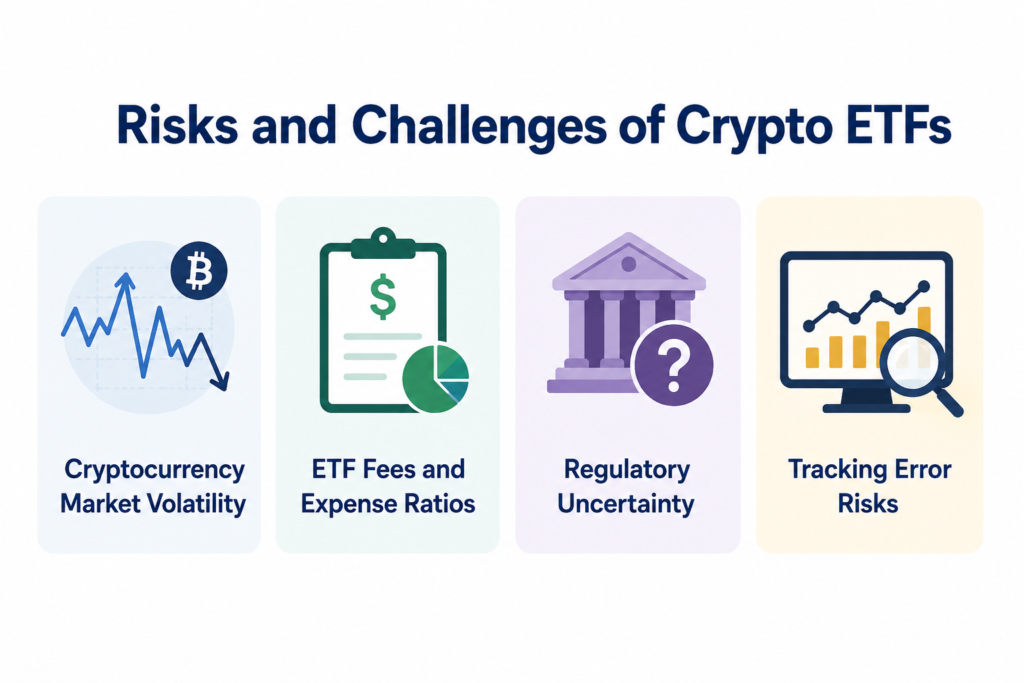
Crypto ETFs solve a lot of practical problems, but they don’t make crypto investing risk-free. A few things are worth understanding clearly before putting money in.
Cryptocurrency Market Volatility
A crypto ETF still moves with the underlying asset, and these assets are known for sharp swings. Bitcoin and Ethereum have each seen drawdowns of 20-30% or more within a single year. Wrapping crypto in an ETF changes how you access it, not how much it moves. Anyone buying in should expect the same volatility they’d get holding the coin directly.
ETF Fees and Expense Ratios
Even the lowest-fee Bitcoin and Ethereum ETFs charge somewhere between 0.14% and 0.25% annually, with some funds running as high as 1.50%. These fees come out of the fund automatically, typically by selling small amounts of the underlying asset over time. Over a multi-year hold, the gap between a cheap fund and an expensive one adds up.
Regulatory Uncertainty
Crypto ETF rules have moved fast, and they can keep moving. Staking approvals, new asset listings, and classification decisions have all shifted direction within months in 2025 and 2026 alone. A favorable rule today doesn’t guarantee the same treatment next year.
Tracking Error Risks
A spot ETF aims to mirror the price of the underlying crypto, but it rarely does so perfectly. Fees, fund operations, and trading costs all create small, steady gaps between the ETF’s return and the actual asset’s price movement.
Conclusion
Crypto ETFs aren’t a novelty anymore, that conversation ended back in 2024. What’s left to track now is which funds are actually winning, how fast regulation keeps changing the rules, and whether the newer altcoin products have real staying power.
A few patterns stand out: Bitcoin ETFs have consolidated around a handful of large funds, Ethereum got a genuine upgrade with staking, and most altcoin launches still haven’t found real demand outside a few names like XRP and Solana.
None of this changes the fact that crypto is still volatile, and an ETF doesn’t fix that, it just makes access easier. Whether any specific fund fits you still comes down to your timeline and how much risk you can actually sit with.
FAQs
What is a crypto ETF?
A crypto ETF is a fund that trades on a regular stock exchange but tracks the price of a cryptocurrency, or a basket of them. Instead of opening a crypto exchange account, you buy shares through a normal brokerage account, and the fund handles holding the actual asset.
Are crypto ETFs safer than holding crypto directly?
They remove the burden of managing private keys and wallets, since a regulated custodian holds the asset instead. That doesn’t eliminate risk entirely, custody and regulatory risks still exist, but it does shift the operational burden away from you.
Why have crypto ETF inflows slowed in 2026?
Bitcoin and Ethereum prices have both pulled back this year, and that’s weighed on sentiment and flows. Some of the slowdown also reflects capital rotating into newer altcoin and staking-enabled products rather than leaving the category entirely.
Can crypto ETFs pay staking rewards?
Yes, as of 2026. Grayscale’s Ethereum fund started distributing staking rewards in late 2025, and BlackRock launched a staking-enabled ETF in March 2026, after regulators clarified that staking rewards aren’t securities.
What’s the difference between a spot ETF and a futures-based ETF?
A spot ETF holds the actual cryptocurrency, so its value tracks the live price directly. A futures-based ETF holds contracts instead, which can drift from the spot price over time due to the cost of rolling those contracts forward.
Why do some altcoin ETFs have so little money in them?
An ETF makes an asset easier to buy, but it doesn’t create demand that wasn’t already there. Several altcoin ETFs launched into thin investor interest, while others tied to assets with stronger institutional narratives, like XRP and Solana, have pulled in far more.