


Definition
A bull market is a financial market condition characterized by a sustained period of rising asset prices, strong investor confidence, positive economic sentiment, and broad optimism about future returns. While no single universal threshold defines a bull market, the most widely used convention — particularly for equities — is a rise of 20% or more from a recent significant low, sustained over a meaningful period, following a prior 20% decline. The term applies not only to stock markets but to any tradeable asset class: bonds, real estate, currencies, commodities, and increasingly to cryptocurrencies, where extended upward cycles are often called “crypto bull runs.”
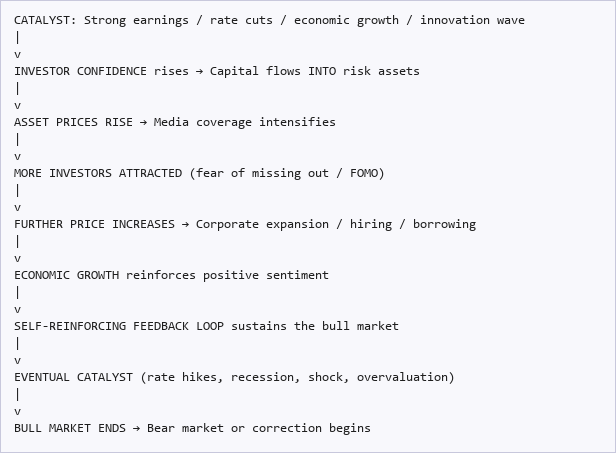
The defining characteristics of a bull market extend well beyond simple price appreciation. They typically include rising corporate earnings and revenue, low or declining unemployment, expansionary economic growth (positive GDP), accommodative monetary policy (low interest rates), high consumer and business confidence, and robust capital inflows into equity and risk assets. Bull markets create a self-reinforcing feedback loop: rising prices attract more investors, whose buying pushes prices higher, which attracts further capital — a dynamic that can sustain a bull market for years before a catalyst eventually breaks the cycle.
From a historical perspective, bull markets are the natural dominant state of well-functioning economies over long time horizons. The US stock market has spent approximately 78% of the time in bull market conditions since 1932, with the average S&P 500 bull market lasting approximately 1,011 days (around 2.8 years) and delivering average gains of around 114%. However, individual bull markets vary enormously: the 2009–2020 bull market lasted 134 months (11 years) with a gain of approximately 400%, while some post-crash recoveries have lasted only a few months. Understanding bull markets — their causes, characteristics, and eventual endings — is foundational knowledge for any investor navigating financial markets.
Read Also: Node
Origin & History
| Date | Event |
| 1700s | The terms “bull” and “bear” emerge in London’s early stock markets; the most common explanation is that bulls attack by thrusting horns upward (rising prices) while bears swipe paws downward (falling prices) |
| 1920s | The “Roaring Twenties” bull market sees the Dow Jones Industrial Average rise from approximately 64 points in August 1921 to 381 points by September 1929 — a gain of nearly 500% — driven by post-WWI industrialization and widespread retail stock speculation |
| October 29, 1929 | “Black Tuesday” ends the Roaring Twenties bull market; the DJIA loses 12% in a single day, triggering the Great Depression bear market |
| 1949–1966 | Post-WWII bull market runs for approximately 17 years, driven by economic reconstruction, baby boom demographics, and industrial expansion |
| 1982–1987 | A powerful bull market begins as Fed Chair Paul Volcker’s rate hikes finally break inflation, unleashing pent-up economic energy; the DJIA rises approximately 250% before the October 1987 “Black Monday” crash |
| 1987–2000 | The longest and largest bull market in S&P 500 history runs for approximately 4,494 days (12+ years) with a total gain of approximately 582%, driven by the technology revolution and internet boom |
| March 9, 2009 – February 19, 2020 | The second-longest US bull market on record begins at the trough of the Global Financial Crisis, lasting 134 months with an S&P 500 gain of approximately 400%, ended by the COVID-19 pandemic shock |
| October 2022 – present | A new S&P 500 bull market begins after the 2022 bear market trough; by early 2026, equity markets continue to trade in positive bull market territory from the October 2022 lows |
“The stock market is a device for transferring money from the impatient to the patient.” — Warren Buffett, Chairman and CEO of Berkshire Hathaway — a reminder that bull markets reward long-term conviction over short-term speculation.
How It Works
| Characteristic | Bull Market | Bear Market | Correction |
| Price direction | Rising (+20% or more from trough) | Falling (-20% or more from peak) | Falling (-10% to -20%) |
| Investor sentiment | Optimistic, confident, greedy | Pessimistic, fearful, defensive | Uncertain, cautious |
| Economic backdrop | Typically expanding GDP, low unemployment | Often contracting GDP, rising unemployment | Mixed; may not coincide with recession |
| Duration (S&P 500 average) | ~1,011 days | ~286 days | Weeks to a few months |
| Typical response | Buy and hold; growth investing | Defensive positioning, bonds, cash | Wait-and-see; selective buying |
| Crypto analog | “Bull run” (BTC new highs, altcoin season) | “Crypto winter” (prolonged declines) | “Crypto dip” (temporary pullback) |
In Simple Terms
- Prices are generally going up and people are optimistic.A bull market is the financial world’s version of a sustained period of good news: stocks (or crypto) keep rising, businesses are profitable, people are employed, and investors feel confident putting their money to work.
- The name comes from how a bull attacks — horns upward.The bull/bear market terminology dates back to 18th-century London stock markets; a bull thrusting its horns skyward perfectly captures rising prices, just as a bear swiping its paws downward captures falling ones.
- Bull markets last longer than bear markets on average.Since 1932, the average S&P 500 bull market has lasted approximately 3.8 years and returned around 114%. The average bear market lasts only about 286 days. History favors patience over panic.
- They can be driven by fundamentals or exuberance — or both.The 1990s bull market was partly justified by genuine technology innovation but also inflated by irrational exuberance; the 2009–2020 bull was partly driven by near-zero interest rates from central banks as much as by real economic growth.
- No bull market lasts forever.Every bull market in history has eventually ended — usually through a combination of overvaluation, rising interest rates, geopolitical shock, or economic recession. Recognizing the signs of an aging bull (elevated valuations, slowing growth, rising rates) is as important as enjoying the ride.
Real-World Examples
| Scenario | Implementation | Outcome |
| 2009–2020 US equity bull market | Following the March 2009 GFC trough, the Federal Reserve cut rates to near zero and deployed QE; corporate earnings recovered steadily; the S&P 500 climbed from ~676 points to ~3,386 at peak | The longest modern bull market in US history: 134 months, ~400% gain, average annual return of ~18.27%; ended March 11, 2020 when COVID-19 triggered a 34% crash in 23 trading days |
| 2020–2021 crypto bull run | Bitcoin rises from ~$3,800 in March 2020 to an all-time high of ~$69,000 in November 2021 — an 1,800%+ gain in 20 months — driven by institutional adoption, pandemic stimulus, and DeFi/NFT excitement | One of the most dramatic bull runs in any asset class in history; followed by the 2022 crypto bear market with Bitcoin declining ~77% from peak |
| 1987–2000 tech bull market (longest in S&P 500 history) | Driven by the PC revolution, internet commercialization, and global economic expansion; S&P 500 rises from 1987 post-crash lows for approximately 4,494 days | A total gain of approximately 582% — the largest and longest on record; ended when the dot-com bubble burst, with the S&P 500 falling ~49% from peak to trough (2000–2002) |
Advantages
| Advantage | Detail |
| Wealth creation and compounding | Sustained price appreciation allows investments to compound significantly; the 2009–2020 bull market turned a $10,000 S&P 500 investment into approximately $50,000 |
| Easier fundraising for businesses | Rising markets make it cheaper for companies to raise capital through IPOs and share issuances, fueling innovation, hiring, and economic expansion |
| Improved consumer confidence | Rising portfolio and asset values (the “wealth effect”) encourage consumer spending, which drives further GDP growth |
| Better conditions for crypto adoption | Bull markets in crypto attract developers, builders, and institutional interest, funding new projects and expanding the ecosystem’s infrastructure |
| Portfolio growth for long-term investors | Investors who remain in the market through full bull-bear cycles historically achieve strong long-term returns even accounting for drawdowns |
Disadvantages & Risks
| Risk | Detail |
| Overvaluation and asset bubbles | Extended bull markets can push valuations to irrational levels (P/E ratios, crypto market caps), creating bubbles that devastate latecomers when they burst |
| FOMO-driven poor decision-making | The fear of missing out draws in inexperienced investors near market peaks, who buy at high prices and are then most exposed when the bull market ends |
| Complacency about risk | Prolonged bull markets breed overconfidence; investors reduce diversification, take on leverage, and neglect downside protection |
| Sudden and rapid reversals | Bull markets can end abruptly — the 2020 COVID crash erased 34% of S&P 500 value in just 23 trading days; crypto bull runs can reverse in days with 40–50% drops |
Risk Management Tips:
- Maintain a diversified portfolio across asset classes rather than concentrating entirely in the bull’s best performer
- Rebalance periodically to lock in gains and prevent overexposure to the most appreciated assets
- Avoid using leverage or margin during late-stage bull markets when risk/reward skews unfavorably
- Set predetermined rules for taking profits rather than chasing the top — even experienced investors cannot reliably time exact bull market peaks
- In crypto bull runs specifically, separate short-term trading positions from long-term core holdings to avoid panic-selling quality assets
FAQ
How do you know when a bull market starts?
Technically, a bull market is confirmed after prices rise 20% from a recent significant low — but this can only be verified in retrospect. In practice, analysts often identify the start only after several months of sustained gains with improving economic data. The October 2022 S&P 500 low, for example, was only widely recognized as a new bull market beginning after sustained 2023 gains confirmed the reversal.
Do cryptocurrency markets follow stock market bull and bear cycles?
Partially, but with important distinctions. Crypto markets often amplify broader risk-on/risk-off trends (performing very well in stock bull markets and selling off heavily during financial stress). However, crypto also has its own internally driven cycles — particularly Bitcoin’s four-year halving cycle — which can produce crypto bull markets somewhat independently of equity market conditions.
Can UPay users benefit from crypto bull markets?
Directly, yes. UPay users who hold Bitcoin, Ethereum, or other crypto assets through the platform benefit from price appreciation during bull runs. UPay’s ability to instantly convert crypto to fiat or spend directly through merchants means users can flexibly manage their exposure — spending gains, converting to stablecoins, or holding through the cycle based on their own financial goals.
What typically ends a bull market?
Most bull markets end due to some combination of: central bank rate hikes making borrowing expensive and reducing corporate profits; recession fears reducing earnings expectations; extreme overvaluation creating a fragile market vulnerable to any shock; or an external black swan event (pandemic, geopolitical crisis, financial system stress). The 2020 bull market ended by pandemic; the 2000 bull by tech overvaluation; the 2007 bull by the subprime mortgage collapse.