


Robinhood has taken a significant step toward expanding its presence in blockchain-based finance with the launch of the public testnet for Robinhood Chain, a new Ethereum Layer 2 network built using Arbitrum technology.
Alongside the testnet rollout, the company has confirmed Chainlink as the network’s primary oracle infrastructure, signaling a strong focus on data integrity and real-world asset tokenization.
Key Takeaways
- Robinhood has launched a public testnet for its Ethereum Layer 2 network, Robinhood Chain, built on Arbitrum technology ahead of a planned mainnet release later this year.
- Chainlink has been selected as the oracle infrastructure provider, supplying secure and reliable off-chain data for advanced tokenization and financial applications.
- The testnet offers Ethereum-compatible development tools, early infrastructure integrations, and access to test assets including stock tokens for experimentation.
- The network is designed to support financial-grade decentralized products such as tokenized real-world assets, lending platforms, and perpetual futures exchanges.
Robinhood Moves Deeper Into Onchain Financial Infrastructure
The newly introduced Robinhood Chain is designed to support financial applications that connect blockchain technology with real-world and digital assets.
By launching a public testnet, Robinhood is giving developers early access to the network’s infrastructure, allowing them to experiment, build decentralized applications, and test integrations before the planned mainnet release later this year.
The company is positioning the chain as a platform for financial-grade decentralized products such as tokenized asset marketplaces, lending protocols, and derivatives platforms including perpetual futures exchanges.
Built on Arbitrum’s scaling framework, the network aims to offer Ethereum compatibility while improving performance and reducing transaction costs—two key challenges developers face when building financial applications on public blockchains.
Johann Kerbrat, Robinhood’s Senior Vice President and General Manager of Crypto and International, highlighted the strategic importance of the testnet launch:
“The testnet for Robinhood Chain lays the groundwork for an ecosystem that will define the future of tokenized real-world assets and enable builders to tap into DeFi liquidity within the Ethereum ecosystem.”
Developer Tools and Early Ecosystem Integrations
The public testnet provides developers with entry points to the network, access to documentation, and compatibility with widely used Ethereum development tools. These features are intended to reduce onboarding friction and allow developers already familiar with Ethereum or Arbitrum to transition easily into building on Robinhood’s infrastructure.
Several major infrastructure providers have already begun integrating with the network. These include Alchemy, Allium, LayerZero, TRM, and Chainlink. Their involvement suggests that Robinhood is prioritizing interoperability, data services, cross-chain communication, and compliance capabilities from the earliest stages of network development.
Robinhood has also outlined additional features developers will gain access to in the coming months.
These include testnet-specific assets such as stock tokens for integration testing and direct testing capabilities through the Robinhood Wallet. These tools are expected to help developers simulate real-world financial use cases and ensure applications are stable before production deployment.
Chainlink Selected as Oracle Backbone
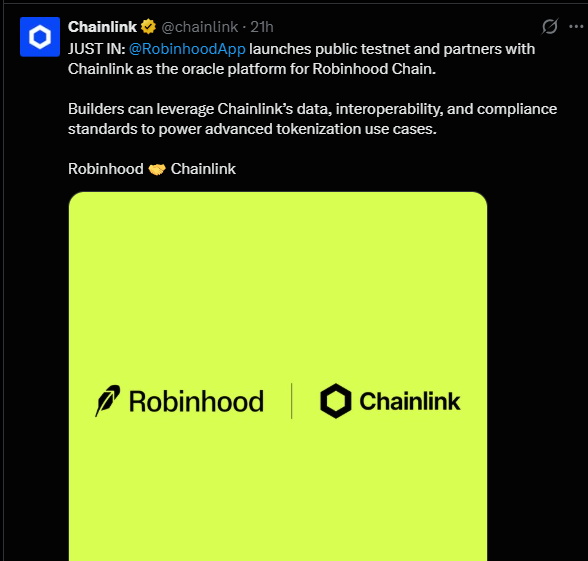
A key announcement tied to the testnet launch is Robinhood’s decision to use Chainlink as the network’s oracle provider. Oracles play a critical role in blockchain ecosystems by enabling smart contracts to access off-chain data, including market prices, financial metrics, and external APIs.
Chainlink’s decentralized oracle network operates through independent node operators that source and verify data before delivering it to smart contracts. Its reputation system helps ensure that data remains reliable, which is particularly important for financial products that depend on accurate pricing and settlement mechanisms.
The network’s native token, LINK, serves as the payment and incentive mechanism within the oracle ecosystem.
Smart contracts pay node operators in LINK for data services, while node operators stake the token to participate in fulfilling data requests. With a maximum supply capped at one billion tokens, LINK remains central to maintaining data quality and network security.
The integration with Chainlink is expected to strengthen Robinhood Chain’s ability to support complex tokenization projects, including those tied to traditional financial assets. This aligns with broader industry trends that are pushing tokenized securities, commodities, and other real-world assets onto blockchain networks.
Steven Goldfeder, Co-Founder and CEO of Offchain Labs—the team behind Arbitrum—emphasized the potential impact of the collaboration:
“With Arbitrum’s developer-friendly technology, Robinhood Chain is well-positioned to help the industry deliver the next chapter of tokenization and permissionless financial services.”
Focus on Security, Compliance, and Scalability
Robinhood has stressed that the network is being developed with regulatory and institutional considerations in mind. The chain supports self-custody and seamless asset bridging, features that are increasingly important as financial institutions explore blockchain-based settlement and asset management solutions.
By combining Arbitrum’s scaling technology with established infrastructure providers and oracle services, Robinhood is attempting to create an environment suitable for both decentralized developers and traditional financial entities entering the blockchain space.
Looking Ahead to Mainnet Launch
The testnet phase will allow Robinhood and its partners to identify performance issues, refine network stability, and expand ecosystem participation. It also gives developers time to test applications and ensure compatibility with Robinhood’s wallet and infrastructure stack.
The company has indicated that additional partners and institutional participants are expected to join during the testnet period as preparations continue for the mainnet rollout. If successful, Robinhood Chain could place the brokerage firm among major financial players building proprietary blockchain infrastructure aimed at bridging traditional finance with decentralized markets.
With tokenization gaining traction among both crypto-native firms and traditional financial institutions, Robinhood’s latest move signals a growing competition to build networks capable of supporting regulated, large-scale financial applications on blockchain rails.