


Deja de usar sitios de minería de criptomonedas gratuitos que ya no funcionan: 7 que sí funcionan.

Most free crypto mining offers you will see in 2026 are sign-up bonuses from cloud mining sites nobody had heard of a year ago, promoted through paid press releases. Some pay a few cents and stop, others exist to get you to deposit. Real free mining exists, but it is a shorter, plainer list than the ads suggest. Either you use hardware you already own and pay the electricity, you play a game funded by other players, or you collect a new token whose value is not settled yet. We checked every site below against public information as of November 18, 2026, and removed six that most lists still recommend. Here are seven free crypto mining sites that still work, what each one really costs you, and how much to expect. Quick picks Looking for phone apps instead? See our guide to the best crypto mining apps for Android. Free Crypto Mining Sites Compared “Free” means no upfront payment. Four of the seven still cost you electricity. Site How you earn What it really costs you Pays in Best for NiceHash Sell your PC’s hashing power to buyers Electricity and GPU wear BTC Gamers who want Bitcoin Kryptex Desktop app mines the best-paying coin Electricity, GPU wear, 1% to 3% pool fee BTC, LTC, ETH, USDT One-click setup on Windows unMineable Mine with your PC, get paid in a coin you pick Electricity, 1% mining fee The coin you choose Picking your payout coin Salad Rent your idle PC to AI and compute jobs Electricity Salad Balance (gift cards, games, cash rewards) Earning without touching crypto Pi Network Tap once a day in the app Nothing PI No PC, no money Rollercoin Play mini-games to earn virtual hashrate Time; paid upgrades are pushed hard BTC, ETH, DOGE and others People who enjoy the game ECOS Bitcoin cloud mining contracts Trial offers vary; paid contracts from $99 BTC A small, legitimate paid start Limits and fees change often. Check each site’s current terms before you start. Read also: Tips on how to convert crypto to cash. How Free Crypto Mining Actually Works Mining costs real money. Machines draw power, data centers charge rent, and Bitcoin’s network is dominated by specialized ASIC machines that a laptop cannot compete with. So when a site offers mining for free, someone else is covering that cost. Ask who. Every free option falls into one of four groups: That last group is where most of the scams live, which is why the bonus-heavy sites you see advertised everywhere are not on our list. The 7 Best Free Crypto Mining Sites in 2026 1. NiceHash: Best for selling your PC’s power for Bitcoin How you earn: sell hashing power · Cost: electricity and GPU wear · Pays in: BTC NiceHash has run a hashrate marketplace from Slovenia since 2014. Install its free QuickMiner or NiceHash Miner software and your graphics card’s power is sold to buyers on the market. You are paid in Bitcoin whatever algorithm your card is running, and miners using a NiceHash mining address get payouts every four hours once they pass the threshold. Because prices come from a live market, it is the clearest way to see what your hardware is actually worth. An old or weak GPU earns very little, and in many countries the electricity costs more than you make. Pros Cons Our take: The first thing to try if you own a gaming PC. Run it for a day and compare the payout with your power cost. 2. Kryptex: Best one-click PC miner How you earn: a desktop app mines for you · Cost: electricity, GPU wear and pool fees · Pays in: BTC, LTC, ETH or USDT. Kryptex is a free Windows app that benchmarks your hardware and mines whichever coin pays best at the moment. You never touch algorithms or pools. Withdrawals go out in BTC, LTC, ETH or USDT; Bitcoin withdrawals start at 0.00025 BTC with a fixed 0.00003 BTC fee. The Kryptex Android app shows hashrate and temperatures and lets you request payouts from your phone. Pool fees run about 1% on most modes and up to 3% on its Bitcoin PPS+ pool. Pros Cons Our take: The easiest way to turn an idle gaming PC into crypto. Watch your power bill for the first month. 3. unMineable: Best for choosing your payout coin How you earn: mine with your CPU or GPU · Cost: electricity and a 1% fee · Pays in: a coin you choose unMineable lets you mine with your own hardware and get paid in a coin of your choice, including coins that cannot be mined at all. Behind the scenes it mines a proof-of-work coin and pays you the same value in the coin you picked. You can switch payout coins without reinstalling anything, and pause whenever you like. The fee is a flat 1% plus network fees. Minimum payouts differ by coin; for Bitcoin it is 0.00075 BTC. Some users report that payout minimums for certain coins were raised partway through, so withdraw as soon as you can. Pros Cons Our take: Useful if you want to build up one particular coin. If USDT or USDC is on its list, choose it and the route to spending gets short. 4. Salad: Best if you want cash, not crypto How you earn: rent your idle PC to compute jobs · Cost: electricity · Pays in: Salad Balance Salad started out mining crypto on gamers’ PCs and now mostly rents idle machines to AI and rendering customers. You install the app, let it run while you are away, and earn Salad Balance to spend in its storefront on gift cards, games and other rewards. Salad says more than 450,000 GPUs have earned on its network and it has paid out over $7 million. It is not crypto mining anymore, and that is the point: no tokens and no price swings. If you simply want something back from an idle gaming PC,
El Banco Mundial explora los pagos en USDC con Citi y Circle.
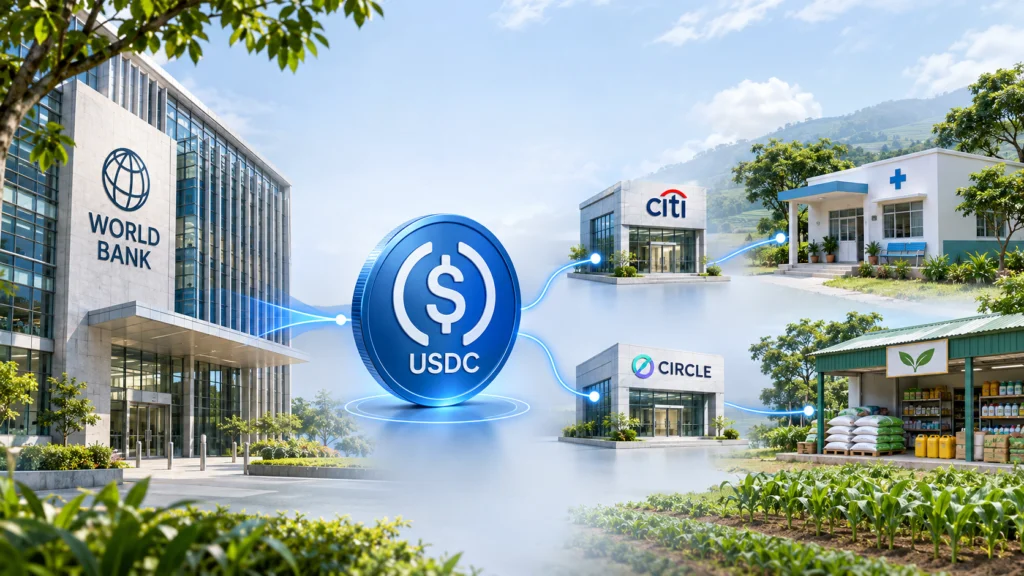
El Grupo del Banco Mundial anunció el 17 de noviembre que explorará la posibilidad de utilizar criptomonedas estables reguladas vinculadas al dólar para pagos y liquidaciones financieras con Citi y Circle. The initiative will examine how blockchain infrastructure could help development funding move alongside existing banking arrangements. This is an exploration, with no public launch date. Governments, contractors and project beneficiaries cannot yet assume they can choose USDC for World Bank payments. The practical question is whether a different payment route can reduce delays and costs while making funds easier to use. Key Takeaways What the Partners Will Examine The World Bank’s announcement describes a model involving intermediaries and connections between payment systems. The proposal does not assume every recipient will hold tokens or manage a blockchain wallet. The Block reported that the initiative builds on FundsChain, the organisation’s existing system for tracing project disbursements. Tracking expenditure and moving money serve different purposes. A ledger can help show where funds went, while a payment service determines how they reach the next recipient. ¿Qué cambiaría para los beneficiarios? Consider a project contractor waiting to buy materials in local currency. Receiving USDC sooner could help only if the contractor can convert or spend it when needed. Exchange rates, conversion charges and access to local banking would still affect the result. The same issue appears in Circle’s planned USDC payments to Move Afrika vendors. Delivering a stablecoin is one part of the payment. Turning it into usable proceeds is another. For a business, a faster transfer is most useful when it brings forward the date it can pay staff or suppliers. The benefit becomes smaller if the money then waits for conversion or a local payout provider. Recipients would also need to understand who handles those steps. A payment involving several providers can become difficult to resolve when the sender sees a completed transfer but the recipient still cannot access the money. What a Useful Trial Should Measure A meaningful comparison would follow each payment from approval to the point the recipient can spend it. That includes processing time, conversion costs, intermediary deductions and manual checks. The distinction between accepting USDC and settling funds to a business provides a useful way to assess the proposal. A blockchain confirmation can establish that tokens moved. It does not establish that the recipient has local currency available. The trial would also need clear records for payments that fail, arrive partially or need to be returned. Finance teams must reconcile the amount approved, sent and received, especially when several organisations handle a project’s funds. A useful result would show the complete cost and time against the existing payment route. Faster blockchain settlement alone would provide an incomplete comparison. Eligibility Comes Before Availability The World Bank says the initial exploration will involve countries where digital assets are supported and permitted. Country participation and payment arrangements therefore remain to be established. Businesses assessing stablecoin payments across borders should separate technical reach from eligibility. A network may carry a token internationally while an organisation still needs an approved provider, account or conversion arrangement. The announcement also does not establish that participating recipients will receive USDC directly. Intermediaries could connect the blockchain transfer to conventional banking and local payouts. Conclusion The World Bank’s work with Citi and Circle puts stablecoin disbursements into a significant development finance use case. The next evidence to watch is a defined trial: who participates, how recipients receive usable funds and whether the complete payment costs less or arrives sooner.
Las 8 mejores aplicaciones de criptominería para Android en 2026

Descubre las 6 mejores aplicaciones de minería de criptomonedas para Android en 2026. Compara características, eficiencia y facilidad de uso para maximizar tus ganancias de minería.