




Let’s be honest, no one enters crypto hoping to lose money. You buy a coin with excitement. You watch the charts. You imagine profits. Then the market turns, prices drop, and suddenly your portfolio is deep in the red. What once felt like a smart move now feels like a mistake.
For many investors, that’s where the story ends: frustration, regret, and the feeling that money has been wasted. But here’s the truth most people never learn: In crypto, losses don’t always mean failure. Sometimes, they can actually save you money.
When used correctly, crypto losses can reduce your tax bill, protect your future profits, and improve your overall financial position. What looks like a setback today can become a powerful advantage tomorrow, only if you know how the system works.
The problem is that crypto taxes are rarely explained in simple language. Most guides are filled with legal terms, confusing rules, and “one size fits all” advice that leaves everyday investors more confused than confident.
As a result, many people either overpay their taxes or miss out on deductions they legally deserve. Because in crypto, it’s not just about how much you make. It’s about how much you keep.
Key Takeaway
- Crypto losses only count for tax purposes when you sell, trade, or dispose of an asset. If you’re simply holding a coin that has dropped in value, that loss cannot be used until it is realized through a transaction.
- Every dollar of realized crypto loss can offset a dollar of capital gains from crypto, stocks, or other investments. This reduces your taxable income and helps you keep more of your profits.
- If your losses are greater than your gains, you can use part of the excess to reduce your salary or business income and carry the rest forward to future years.
- Accurate transaction records, proper cost basis tracking, and timely year end reviews are essential. Without them, you may lose deductions, face penalties, or overpay taxes unnecessarily.
What are Crypto Losses?

In crypto investing, losses are often seen as pure failure, money gone, opportunities missed, and portfolios shrinking. But from a tax perspective, losses are not always bad news. When handled correctly, they can become one of the most powerful tools for reducing what you owe the government.
Crypto losses are the money you lose when you sell a cryptocurrency for less than what you originally paid for it. In simple terms, it happens when the value of your crypto goes down and you exit the investment at a lower price.
For example, If you bought Bitcoin for $30,000 and later sold it for $22,000, you have a crypto loss of $8,000.
However, not all losses are treated the same way in taxation. The law makes a clear distinction between realized and unrealized losses.
Realized vs. Unrealized Losses
An unrealized loss exists only “on paper.” It happens when your crypto is worth less than what you paid for it, but you haven’t sold it yet.
For example, if your token is down 40% in your wallet but you’re still holding it, that loss is unrealized. It feels real emotionally, but legally, it doesn’t count for tax purposes.
A realized loss happens only when you actually sell, trade, or dispose of the asset. Once you convert it to another crypto, fiat, or use it for payment, the loss becomes official in the eyes of tax authorities. Only at this point can it be reported and used for tax deductions.
Many discussions on platforms like Reddit show that beginners often assume “being down” is enough. In reality, until you sell, the tax system treats your loss as if it doesn’t exist.
Why Selling Is Necessary to Claim Losses
The tax system operates on completed transactions, not potential outcomes. As long as you are holding an asset, its future value is uncertain. It could recover, double, or crash further. Because of this uncertainty, authorities only recognize losses once you close the position.
This is why strategic selling is so important. Sometimes, selling a losing asset before year end is not about giving up, it’s about converting a paper loss into a real tax benefit that can save you money immediately
Why Crypto Losses Can Save You Taxes
Once a loss is realized, it becomes a valuable financial tool. Instead of simply representing money lost, it becomes a legal way to reduce your tax bill.
Losses Reduce Capital Gains Dollar-for-Dollar
The most powerful benefit of capital losses is that they directly offset capital gains. If you made $8,000 in profit from Bitcoin but lost $5,000 on altcoins, your taxable gain becomes $3,000 instead of $8,000.
This is a one to one reduction. Every dollar you lose can cancel out one dollar of profit for tax purposes. This applies not only to crypto gains but also to gains from stocks, ETFs, and other investments in many jurisdictions.
This mechanism is what makes tax loss harvesting such a popular strategy among experienced investors.
Using Excess Losses to Reduce Ordinary Income
What happens if your losses are bigger than your gains?
In many countries, including the US, you are allowed to use a portion of your excess losses to reduce your regular income, such as salary or business earnings.
In the US, this is currently capped at $3,000 per year. So if you had no gains but realized $6,000 in crypto losses, you could:
- Use $3,000 to reduce your taxable salary this year
- Carry the remaining $3,000 forward to future years
Educational bodies like Blockchain Council frequently emphasize that this feature turns losses into long-term tax assets rather than wasted setbacks. For many investors, this is the moment when losses stop feeling useless and start feeling strategic.
Taxable Event

A taxable event is any crypto related action that results in a measurable financial gain or loss. When this happens, tax authorities consider that you have “realized” income, profit, or loss, and they expect it to be reported.
Many investors assume taxes only apply when money enters their bank account, but in crypto, taxation begins much earlier than that. Some taxable events includes:
- Selling Crypto for Fiat
When you sell cryptocurrency for traditional money such as dollars, euros, or naira, you trigger a taxable event. The tax is calculated based on the difference between what you paid for the asset and what you sold it for.
- Swapping One Crypto for Another
Many traders believe that swapping one cryptocurrency for another is tax-free because no cash is involved. In reality, tax authorities treat this as two separate transactions: you sold the first asset and then bought the second.
- Using Crypto for Purchases
Paying for goods or services with crypto is also a taxable event. When you use Bitcoin to buy a phone or pay for travel, the tax system views it as selling your crypto to make that purchase.
- Earning Crypto as Income (Staking, Mining, Airdrops)
Any crypto you receive in exchange for participation, effort, or platform activity is generally treated as income. This includes staking rewards, mining payouts, referral bonuses, and airdrops.
How the IRS Treats Crypto
In the United States, cryptocurrency taxation is governed by the Internal Revenue Service (IRS). Its position on crypto is firm and consistent: digital assets are not considered currency for tax purposes. Instead, they are treated as property, similar to stocks or real estate.
Crypto as Property for Tax Purposes
Because crypto is classified as property, every disposal of an asset is potentially taxable. This includes selling, trading, spending, or gifting in some cases. Gains and losses are calculated the same way they are for other investments: selling price minus purchase price.
This classification is what makes crypto losses valuable, because property losses can be used to reduce taxable income.
At the same time, this rule means investors are responsible for detailed record-keeping. You must know when you bought an asset, how much you paid, when you sold it, and what it was worth at that time. Without accurate records, calculating taxes becomes extremely difficult.
Forms and Reporting Requirements
Crypto reporting standards have become more structured and transparent. Many exchanges now issue Form 1099-DA, which reports users’ digital asset transactions directly to the IRS.
These forms include information on sales, transfers, and sometimes cost basis. This shift means that tax authorities no longer rely only on self-reporting. Much of your trading activity is now automatically visible to regulators.
How Crypto Losses Reduce Your Tax Bill
One of the biggest misconceptions in crypto investing is that losses are “wasted money.” From a tax perspective, this is rarely true.
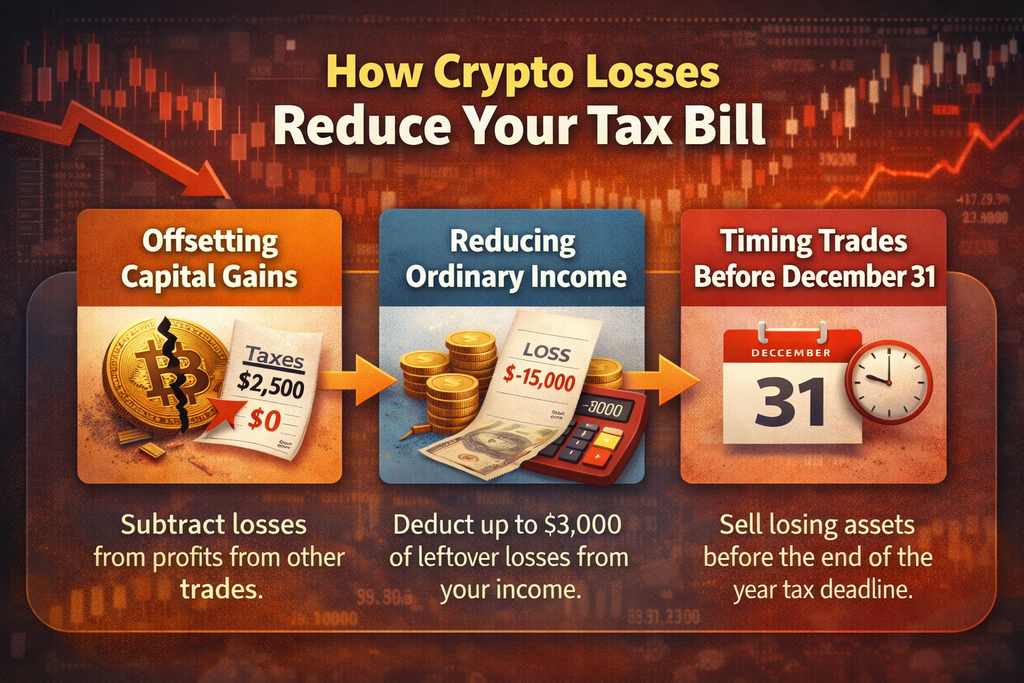
When handled properly, crypto losses can actively work in your favor by lowering how much you owe, sometimes by thousands of dollars. The tax system allows you to use these losses in three powerful ways: offsetting gains, reducing regular income, and planning ahead for future years.
Offsetting Capital Gains
The first and most direct way crypto losses help you is by canceling out your profits. When you make money from investments, the government expects a share.
But before calculating how much tax you owe, it allows you to subtract your losses from your gains. This process is called offsetting.
If you earned $12,000 in crypto profits this year but lost $7,000 on other trades, you are not taxed on $12,000. You are taxed on $5,000.
This reduction happens on a dollar-for-dollar basis, which makes it extremely valuable.
Reducing Ordinary Income
When your total capital losses exceed your total capital gains, most tax systems allow you to use part of that excess to reduce your regular income, such as salary, freelance earnings, or business profits.
In the United States, investors can currently use up to $3,000 of excess capital losses per year to reduce ordinary income. For example, if you had:
- $2,000 in gains
- $8,000 in losses
You would first cancel out the $2,000 in gains. That leaves $6,000 in unused losses. From that, you can deduct $3,000 from your taxable income this year.
If you earn $50,000 from your job, your taxable income may drop to $47,000. This reduction can directly lower the tax you pay on your paycheck.
Timing Trades Before December 31
In most countries, taxes are calculated on a calendar-year basis. This means only transactions completed before December 31 count for that year’s return.
If you are holding assets that are deeply in the red, selling them before year-end can convert paper losses into real deductions. Waiting until January means those losses won’t help you until the following tax year.
For example, selling a losing token on December 28 can reduce this year’s taxes. Selling the same token on January 2 delays the benefit by a full year. That timing difference can matter a lot, especially if you had strong profits during the year.
Practical Considerations & Edge Cases

Using crypto losses to reduce taxes sounds simple in theory. In practice, it comes with technical details, hidden risks, and strategic trade-offs. Small mistakes can erase your tax benefits, while smart planning can multiply them.
Tax Software & Record Keeping
Crypto taxes depend on accurate records, and without them, even valid losses can be hard to claim. Many investors use tools like TokenTax, CoinLedger, and Koinly to track transactions and generate reports.
However, software only works well if your data is complete. You are still responsible for tracking wallet transfers, private trades, and cost basis. If your purchase price is wrong, your tax calculations will also be wrong, making strong record-keeping essential for saving taxes.
Hidden Traps and Mistakes
Many investors lose tax benefits not because of market losses, but because of simple errors. Forgetting to sell losing assets before year-end means the loss remains unrealized and unusable.
Misclassifying transactions, such as reporting staking rewards as capital gains instead of income, can lead to penalties or audits. These mistakes can quietly erase the benefits of careful tax planning.
Risks of Aggressive Strategies
Some investors try to push loss-harvesting too far in hopes of maximizing deductions. While this may work temporarily, it increases the risk of scrutiny from tax authorities.
Agencies like the Internal Revenue Service now receive more data from exchanges and use advanced tools to track transactions. Strategies that once went unnoticed may now trigger audits, especially as governments tighten oversight.
How Carryforward Works
One of the most underrated benefits of capital losses is that they don’t expire quickly. If you can’t use all your losses in one year, you usually don’t lose them. Instead, they are carried forward into the future.
- Unlimited Carryforward in Many Jurisdictions
In many countries, including the United States, unused crypto losses can be carried forward indefinitely. This means if you cannot use all your losses in one year, the remaining amount is saved for future tax returns.
- Strategies for Using Carryforward Effectively
Successful investors use carryforward deliberately rather than leaving it to chance. Losses from down markets can be saved and applied when prices recover, reducing taxes on future profits.
Conclusion
Crypto investing is unpredictable. Prices rise fast, fall harder, and often move in ways no one expects. Along the way, almost every investor experiences losses. But those losses don’t have to be the end of the story.
By learning what counts as a taxable event, how capital losses are calculated, and how they can offset gains and income, you gain control over your tax situation. Instead of reacting to surprise tax bills, you begin planning ahead.
You know when to sell, when to hold, and when to turn a losing trade into a future benefit. Using losses to reduce taxes is not about cheating the system. It is about using the rules legally and wisely.
Offsetting gains, reducing ordinary income, carrying losses forward, and planning around year-end deadlines are strategies available to every investor who takes the time to understand them.
At the same time, this journey requires discipline. Good record-keeping, careful timing, and awareness of changing regulations are essential.
FAQs
Can I use crypto losses even if I didn’t sell my coins?
No. Only realized losses can be used for tax purposes. This means you must sell, trade, or otherwise dispose of the crypto for the loss to count. If your coins are just sitting in your wallet at a lower price, the loss is considered unrealized and cannot reduce your taxes.
Can crypto losses reduce taxes on stock or real estate profits?
In many countries, including the US, yes. Capital losses from crypto can often be used to offset capital gains from other investments such as stocks, ETFs, and property. This allows losses in one area of your portfolio to protect profits in another.
How much of my crypto losses can I deduct each year?
If your losses are higher than your gains, you can usually deduct up to $3,000 per year from your regular income in the US. Any remaining losses can be carried forward to future years until they are fully used.
Can I sell a coin at a loss and buy it back immediately?
In some countries, this may still be allowed, but the rules are changing. Traditional wash sale rules prevent this behavior in stock markets, and similar rules are increasingly being applied to crypto. Even where allowed, buying back immediately resets your holding period, which may increase future taxes.
Do I need special software to report crypto losses?
You are not legally required to use software, but it is strongly recommended. Crypto tax tools help track transactions, calculate cost basis, and generate accurate reports. Without them, manual tracking can become overwhelming and error-prone, especially if you trade frequently.
What happens if I don’t report my crypto losses or gains?
Failing to report crypto transactions can lead to penalties, interest charges, and possible audits. Many exchanges now report user activity directly to tax authorities. Reporting correctly protects you legally and ensures you don’t miss out on valuable deductions.