




The conversation around accepting crypto payments online is no longer about whether businesses should adopt them. For many companies, that decision has already been made. The real challenge is implementing crypto payments in a way that is practical, compliant, and scalable.
Businesses are looking for solutions that integrate smoothly into existing operations without the burden of managing complex compliance requirements or unreliable infrastructure.
This article explores what it takes to accept crypto payments online and how businesses can approach implementation in a way that is efficient, reliable, and sustainable.
Key Takeaways
- Accepting crypto payments requires infrastructure beyond simply sharing a wallet address.
- Compliance, fraud prevention, and settlement systems are essential for reliable crypto transactions.
- Crypto payment gateways simplify integration through APIs, automation, and transaction management tools.
- Businesses can accept crypto payments without holding volatile crypto assets themselves.
Why Accepting Crypto Payments Is Actually Harder Than It Looks
On the surface, accepting crypto sounds simple. A customer has Bitcoin. You want Bitcoin. They send it to your wallet address. Done, right?
Not quite.
In practice, businesses that try to handle crypto payments manually run into the same walls every time:
- Volatility. A customer pays you $500 worth of USDT. By the time it clears and you go to use it, it’s worth $460. For high-volume businesses, those gaps add up fast.
- Address management. If you’re giving the same wallet address to every customer, you lose the ability to match payments to specific orders. Your accounting becomes a nightmare. Your customer service follows.
- Compliance. Depending on where your business operates, accepting crypto without proper KYC and AML processes in place can expose you to serious regulatory risk. “I didn’t know” is not a defense that holds up well with financial regulators.
- Chargebacks and fraud. Crypto transactions are irreversible. That’s a feature, not a bug, but only if you’ve verified who you’re dealing with. Without identity checks, you’re exposed.
- Settlement. If your costs are in dollars and your revenue is coming in as ETH, you need a reliable, low-cost way to convert, ideally one that doesn’t eat into your margins every time.
None of these problems are unsolvable. But they do explain why so many businesses that want to accept crypto haven’t made the move yet. The friction isn’t philosophical, it’s operational.
What You Actually Need Before You Start
Before getting into the implementation process, it’s important to understand what a functional crypto payment setup actually requires. At a minimum, businesses need:
- Unique payment addresses for accurate transaction tracking and reconciliation
- Real-time price conversion to monitor payment values in fiat terms
- Built-in KYC and AML verification during customer onboarding
- A management dashboard for monitoring transactions and resolving issues
- Fiat settlement options to reduce unnecessary crypto exposure
- API integrations that connect smoothly with existing platforms and workflows
If that sounds like a significant amount of infrastructure to manage, that’s because it is. And it’s exactly why most serious businesses no longer build these systems from scratch themselves.
How to Accept Crypto Payments Online
Step 1: Choose the Right Crypto Payment Infrastructure

This is the decision that everything else flows from. You can go three routes:
Option A: Manage everything manually
This involves setting up a crypto wallet, sharing wallet addresses with customers, and manually reconciling transactions. While it may work for very small-scale operations, the process quickly becomes inefficient and difficult to manage as transaction volume grows.
Option B: Use a traditional payment processor with crypto support
Some conventional payment providers now offer crypto payment features as an extension of their existing infrastructure. While convenient, these solutions often come with limited functionality, higher fees, and restricted customization options.
Option C: Use a dedicated crypto payment gateway
This is typically the most scalable and business-friendly approach. Dedicated crypto payment platforms are built specifically to handle payment processing, address generation, real-time conversion, compliance, and settlement automatically.
For serious businesses, Option C is typically the most practical choice. Platforms like UPay Business are built specifically for crypto payment processing, handling infrastructure such as payment routing, compliance, real-time conversion, and settlement at scale.
What makes UPay Business particularly notable is its peer-to-peer payment model, where payments are received directly into the business’s wallet rather than being held by an intermediary.
Step 2: Get Your Compliance in Order
This step trips up a lot of businesses because it feels like a bureaucratic detour. It isn’t. It’s what separates legitimate payment operations from ones that get shut down.
When you accept crypto from customers, you need to know who those customers are. That’s not just good practice, in most jurisdictions, it’s a legal requirement. KYC (Know Your Customer) and AML (Anti-Money Laundering) checks are the baseline.
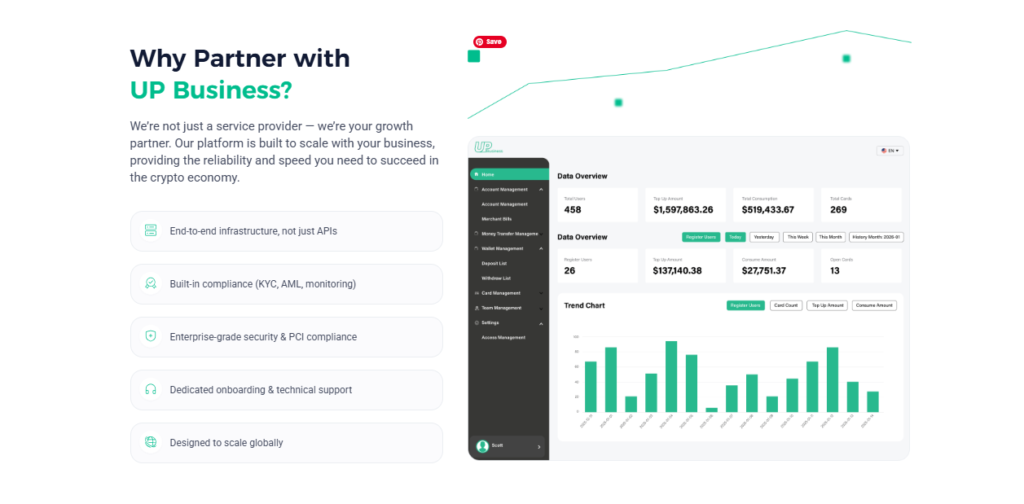
The good news is that if you’re using a platform like UPay Business, this is largely handled for you. Compliance is built into the onboarding process, automated KYC verification, ongoing AML monitoring, and fraud prevention tools run in the background without you having to manage them manually.
UPay itself holds active financial licenses in the USA, Canada, Hong Kong, Lithuania, and the UAE. When you partner with them, you’re operating within a framework that has already cleared regulatory scrutiny across multiple jurisdictions. That’s not a small thing.
Step 3: Integrate the Payment Gateway Into Your Platform
Once you’ve chosen your infrastructure, the technical integration is where the rubber meets the road.
With UPay Business, this happens through their open API. It’s developer-friendly well-documented, clean to work with, and designed to connect to existing platforms without months of back-and-forth. Through the API, your platform can:
- Generate unique payment addresses automatically for each transaction
- Detect the payer’s crypto address in real time to screen for risky funds
- Convert incoming crypto to fiat at the moment of payment
- Push transaction data to your dashboard for reconciliation
- Set custom transaction limits and trigger alerts for unusual activity
For most engineering teams, integration is a matter of weeks, not months. And if your team runs into issues, UPay provides hands-on technical support throughout the process, not just documentation and a helpdesk ticket.
The payment gateway covers a wide range of use cases out of the box: e-commerce checkouts, web payments, mobile payments, game purchases, DApp integrations, and subscription billing.
Related: What is UPay Business? Everything You Need to Know
Step 4: Set Up Fiat Settlement
Here’s something that doesn’t get talked about enough, accepting crypto doesn’t mean you have to hold crypto.
Most businesses want revenue in fiat. Their expenses are in fiat. Their payroll is in fiat. Carrying a volatile asset on your balance sheet introduces accounting complications most finance teams would rather avoid.
UPay Business handles this through real-time crypto-to-fiat conversion. When a customer pays you in BTC or USDT, the gateway converts it to your preferred settlement currency (USD, EUR, or others) at the prevailing exchange rate, and settles to your account. You get the benefit of accepting crypto (wider customer base, lower transaction fees, faster settlement) without the headache of managing a crypto treasury.
For businesses with high transaction volumes, UPay also operates on a tiered fee model, the more you process, the lower the per-transaction cost. That’s a fee structure that actually rewards growth rather than penalizing it.
Step 5: Think About the Card Layer (Optional, But Worth Considering)

If your business model involves paying out to users, freelancers, contractors, affiliates, gig workers, UPay Business offers something most payment gateways don’t: a white-label card issuing program.
Through this, you can issue branded virtual or physical payment cards to your users that are linked directly to their crypto balances. They can spend anywhere Visa or Mastercard is accepted, which is effectively everywhere, and the conversion from crypto to fiat happens at the point of sale.
Why does this matter in the context of accepting crypto payments? Because it closes the loop. You accept crypto from customers, and you can pay out to partners, workers, or users through the same ecosystem. One platform, one integration, no fragmentation.
Cards support multiple currencies (USD, EUR, HKD), work with Apple Pay and Google Pay, and have spending limits up to 100,000 USDT on premium tiers. The whole program runs under your brand and your customers never see UPay on the card.
Step 6: Monitor, Optimize, and Scale
Getting set up is one thing. Running a crypto payment operation at scale is another.
UPay Business gives you a real-time management dashboard that puts everything in one place: transaction history, user activity, compliance status, fraud alerts, and spending controls. You can approve or adjust transaction limits on the fly, track performance across different payment channels, and export data for accounting.
As transaction volume grows, the infrastructure scales with you. The smart order collision avoidance system is built to handle high concurrency without errors, important for businesses that expect spikes in traffic during sales, launches, or seasonal periods.
The Honest Answer to “Is This Worth It?”
If you’re processing $5,000 a month and most of your customers pay by card, crypto payments probably aren’t a priority yet.
But if you’re operating internationally, dealing with customers in markets where crypto adoption is high, running a digital platform with users who hold crypto assets, or building a fintech product that touches payments, the answer is clearly yes. And the gap between “we’re thinking about it” and “we’re live” is smaller than most people assume, especially with infrastructure like UPay Business doing the heavy lifting.
The businesses that will win over the next five years won’t be the ones that figured out crypto payments last. They’ll be the ones that figured it out first, and built it cleanly, with the right infrastructure underneath.
Getting Started with UPay Business
If you want to explore what a crypto payment setup looks like for your specific business, the best starting point is business.upay.best. You can reach the team directly via live chat or email to discuss your use case.
The onboarding process is built to be straightforward: a conversation about your setup, business verification, API integration, and then you’re live. There’s no months-long procurement process or enterprise sales cycle to navigate.
For most businesses, the hardest part isn’t the technology. It’s deciding to start.