Most people who hold USDT are treating it like a waiting room. It sits between trades, a stable place to park value while you decide what to do next.
What almost nobody tells you is that the waiting room has a door, and on the other side of it is a working payment system that covers more of daily life than you would expect.
How to spend USDT in real life is not a niche question for crypto maximalists living off-grid. It is a practical question for anyone who holds stablecoins and wants to know whether they can use them the same way they use a debit card, a bank transfer, or a gift card.
The answer, across most of the world, is yes and this guide is the map.
Read Also: Quick tips on how to convert crypto to cash
What Makes USDT Suitable for Real-Life Spending
Before getting into the practical methods, it helps to understand why USDT is particularly well-suited for everyday spending compared to other cryptocurrencies.
The major advantage is price stability. Bitcoin can lose 10% of its value in a single day. Ethereum can do the same.
If you use a volatile cryptocurrency to pay for something, you are making a financial decision about that asset at the moment of payment, and if the asset rises in value after you spend it, you have effectively paid more than you intended in hindsight.
With USDT, that calculation is simple: one USDT is one dollar. The math does not change between the moment you open your wallet and the moment the payment settles.
USDT also operates across multiple blockchains. You can hold and send it on Ethereum (ERC-20), Tron (TRC-20), Solana, BNB Chain, Polygon, Avalanche, and several others.
This flexibility matters for spending because different payment platforms and merchants prefer different networks.
Tron-based USDT, for example, has very low transaction fees and fast confirmation times, which makes it practical for small, everyday payments. Ethereum-based USDT has broader compatibility but higher gas fees, which can make it less efficient for small transactions.
USDT is also widely supported. More crypto payment processors, debit card providers, exchanges, and merchants accept USDT than almost any other asset outside of Bitcoin and Ethereum. If a platform supports crypto payments, USDT is almost always on the list.
The final advantage is liquidity. If you need to convert USDT to local currency at any point, you can do so almost instantly on any major exchange or through a peer-to-peer platform.
That ease of conversion means USDT functions as a bridge in the crypto market and the traditional financial system, which is exactly what you need for practical everyday spending.
The Easiest Ways on How to Spend USDT with Crypto Cards
The most convenient way to spend USDT daily is through a crypto debit card. These cards work exactly like a regular Visa or Mastercard.
When you make a purchase, the card converts your USDT to local currency at the point of sale. The merchant receives fiat, you spend crypto, with no extra steps.
Here are the main options:
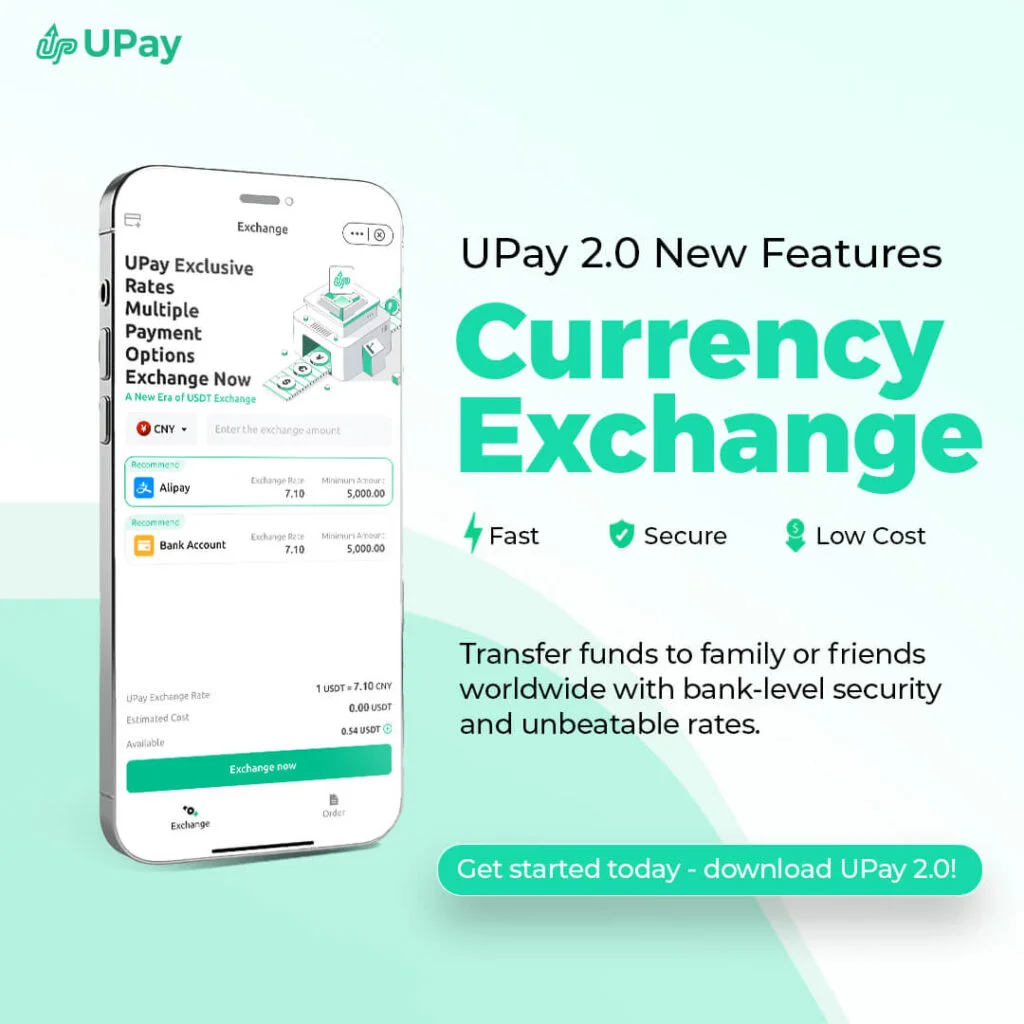
UPay Card connects directly to your UPay account and converts USDT to local currency at each transaction. It works at physical stores, online merchants, and ATMs across a growing number of countries.
For traders and holders already on UPay’s platform, it removes all friction between holding USDT and spending it.
Bybit Card is a Mastercard or Visa depending on your region. It connects directly to your Bybit account, converts USDT to fiat at the time of each purchase, and works wherever Mastercard or Visa is accepted globally.
Crypto.com Visa Card is one of the most widely used crypto debit cards worldwide. It supports USDT through a linked Crypto.com account and earns cashback in CRO tokens on every purchase.
Available in the US, Europe, Australia, Singapore, and other markets.
Wirex Card supports USDT alongside traditional currencies and handles currency conversion automatically. Popular with frequent travelers. Earns Wirex tokens as cashback and operates across Europe and selected markets.
Nexo Card lets you switch between debit and credit mode. In debit mode, spend USDT directly. In credit mode, borrow against your crypto holdings instead of selling. Available to eligible account holders in Europe and Switzerland.
What to compare before choosing a card: supported countries, conversion fees at point of sale, ATM withdrawal limits and fees, inactivity fees, and the cashback structure. Always check the all-in cost, some cards charge a spread on top of the stated fee.
Read Also: Crypto Scams: The SHIELD Guide to Spotting and Avoiding Every Fraud Type.
Paying Merchants Directly with USDT
A growing number of merchants accept USDT directly, no card network involved. You send USDT from your wallet to theirs at checkout via a QR code or wallet address.
Payment processors that make this easy for businesses:
BitPay supports USDT for businesses and converts incoming payments to fiat before depositing to the merchant’s bank account. Integrates with Shopify, WooCommerce, and Magento.
CoinGate supports USDT across major ecommerce platforms. Merchants can choose to receive settlement in fiat, Bitcoin, or the original crypto used for payment.
NOWPayments supports USDT across multiple blockchains and works well for smaller online businesses and freelancers.
Categories where direct USDT acceptance is most common:
- Technology and electronics: Newegg accepts various cryptocurrencies including stablecoins
- VPN and software: NordVPN, ExpressVPN, and Mullvad all accept crypto payments
- Domain and hosting: Namecheap, Hostinger, and Vultr accept USDT
- Gaming and digital content: game credits, NFT platforms, in-game purchases.
To find merchants near you, check Cryptwerk (cryptwerk.com) or search local crypto Telegram and Reddit groups.
Using USDT for Cross-Border Payments
Traditional international transfers take one to five business days and cost 3% to 10% in fees. USDT settles in seconds and costs a fraction of that.
On the Tron network, a USDT transfer costs roughly $1.50 to $4 paying directly with TRX, and under $1 if you stake or rent Tron energy.
Sending $500 or $50,000 costs about the same. A family sending $200 monthly through traditional remittance services pays $10 to $20 in fees each time. The same transfer in USDT costs well under a dollar.
How to send USDT internationally: both sender and receiver agree on a network TRC-20 for low cost, ERC-20 for broad compatibility.
The sender transfers USDT to the receiver’s wallet address. The receiver converts to local currency through a local exchange or P2P platform.
Platforms built for USDT remittances:
- Bitso: operates in Mexico and Latin America, converts USDT to local currency in-app
- Coins.ph: Philippines-focused, converts crypto to pesos for cash pickup or bank transfer.
Read Also: Beyond the Hype: Why Is Bitcoin So Expensive?
Converting USDT to Cash
Centralised exchanges: send USDT to an exchange like Binance, Kraken, or OKX, sell for local currency, withdraw to your bank. Selling is instant; bank withdrawal takes hours to a few days.
Peer-to-peer platforms: list your USDT on Binance P2P or OKX P2P and specify how you want to be paid — bank transfer, mobile money, or cash. The platform holds USDT in escrow until you confirm payment. Useful in markets where exchange fiat withdrawals are limited.
For further reading: Quick tips on how to convert crypto to cash.
Paying Bills with USDT
Spritz Finance (US): connects your crypto wallet and pays US bills directly using USDT. Works for utilities, subscriptions, credit cards, and loans via ACH.
Gift cards via Bitrefill: purchase gift cards for Amazon, Walmart, Netflix, Uber, Starbucks, Spotify, Apple, Google Play, and hundreds more using USDT.
Also sells mobile top-ups for carriers in dozens of countries. This is one of the most practical routes for everyday bill coverage.
CoinCards — similar to Bitrefill, focused on North American and European markets.
Network Fees to Watch
| Network | Typical USDT Fee | Best For |
|---|---|---|
| Solana | Fraction of a cent | Small everyday amounts |
| Polygon | Very low | Small to medium amounts |
| TRC-20 (Tron) | $1.50–$4 (under $1 with energy staking) | Mid-range transfers |
| BNB Chain | A few cents | General use |
| ERC-20 (Ethereum) | $5–$30+ | Large transfers where compatibility matters |
Match the network to the transaction size. For small payments, use Solana or Polygon. For larger amounts where Ethereum’s compatibility is worth the higher fee, use ERC-20.
Safety Rules
Always verify the full wallet address before confirming crypto transactions are irreversible. Use the correct network sending ERC-20 USDT to a TRC-20 address can result in permanent loss.
Keep only spending amounts in a hot wallet, store larger holdings in a hardware wallet. Avoid phishing sites, bookmark the platforms you use regularly and never click wallet links from emails or social media.
Read Also: How Many Crypto Wallets Do You Actually Need?
Conclusion
USDT has already done the hard part it holds its value, moves instantly, and works across more of daily life than most holders ever use.
The infrastructure is here, the cards work, the platforms are built, the only variable left is you.
Pick one method from this guide, test it with a small amount, and build from there. That is how to spend USDT in real life.