




Not everyone who wants exposure to the cryptocurrency market wants to buy and hold Bitcoin or Ethereum directly. Managing a crypto wallet, securing private keys, and navigating exchanges introduces a layer of complexity that many investors prefer to avoid.
For those people, and for anyone who wants to invest in crypto’s growth through familiar financial instruments, cryptocurrency stocks offer a compelling alternative.
Cryptocurrency stocks are shares in publicly traded companies that operate in or around the digital asset industry. Some of these companies mine Bitcoin. Others run crypto exchanges where millions of people trade daily.
Some hold Bitcoin directly on their balance sheets as a treasury asset. Others build the hardware and software that powers blockchain networks. A few are traditional financial giants that have added crypto services to their existing product lines.
Buying shares in these companies through a standard brokerage account gives you indirect exposure to the crypto market without ever touching a digital wallet. When Bitcoin’s price rises, mining companies tend to earn more, exchange volumes tend to increase, and Bitcoin treasury companies see the value of their holdings go up.
That correlation is not perfect, but it is meaningful enough that crypto stocks have become an important category for investors who want to participate in the growth of digital assets through regulated, conventional investment channels.
This article covers every major category of cryptocurrency stock, explains what each type of company does and how it earns money, and lists the most significant publicly traded companies in each category.
It also covers the key risks involved in crypto stocks, how they compare to direct crypto ownership, and how to think about building a position in this sector.
Key Takeaways
- Cryptocurrency stocks are shares in publicly traded companies that operate in the crypto industry, giving investors exposure to digital asset markets through conventional brokerage accounts.
- The main categories of crypto stocks include exchanges, Bitcoin miners, Bitcoin treasury companies, semiconductor manufacturers, payment companies, and blockchain technology firms.
- Coinbase (COIN) is the only major standalone US crypto exchange that is publicly listed, making it one of the most direct ways to invest in crypto trading activity through the stock market.
- MicroStrategy (MSTR) holds more Bitcoin on its balance sheet than any other publicly traded company and functions effectively as an amplified Bitcoin investment vehicle.
- Bitcoin mining stocks like Marathon Digital (MARA) and Riot Platforms (RIOT) are among the most volatile equity investments available, with returns that can amplify Bitcoin’s price movements significantly in both directions.
- Semiconductor companies like NVIDIA have substantial indirect exposure to crypto through demand for graphics processing units used in mining and blockchain development.
What Are Cryptocurrency Stocks and Why Do They Matter?
A cryptocurrency stock is a share in a publicly traded company whose business is directly or meaningfully connected to the cryptocurrency industry.
This is a broad category that covers companies at every point in the crypto value chain, from the hardware manufacturers who build the chips that power mining operations, to the exchanges where people buy and sell digital assets, to the financial companies that hold Bitcoin on their balance sheets as a corporate treasury strategy.
The distinction between owning a crypto stock and owning cryptocurrency directly is important. When you buy Bitcoin or Ethereum, you own the digital asset itself.
Its value rises and falls with the market, you control your own private keys (if you use a self-custody wallet), and you deal with the practical realities of crypto ownership: tax reporting on every transaction, exchange account management, and security considerations.
When you buy a crypto stock, you own a share in a company. You participate in the stock market with all its familiar structures: broker accounts, dividend eligibility, regulatory protections, and straightforward tax treatment for capital gains and losses.
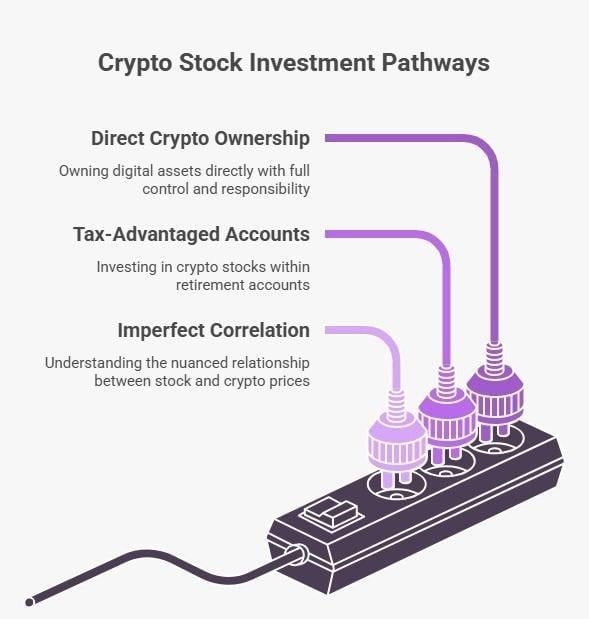
For many investors, particularly those who operate through tax-advantaged accounts like IRAs or 401(k)s in the US or ISAs in the UK, crypto stocks are the only practical way to get crypto exposure within those account structures.
You cannot hold Bitcoin directly in most conventional retirement accounts, but you can hold shares of Coinbase, Marathon Digital, or MicroStrategy through any standard brokerage.
The relationship between crypto stocks and crypto prices is real but imperfect. A Bitcoin mining company’s revenue depends heavily on Bitcoin’s price and the difficulty of mining, but it also depends on electricity costs, hardware efficiency, operational management, and debt structure.
An exchange’s revenue depends on trading volume, which correlates with crypto market activity but also with the exchange’s competitive position, regulatory standing, and product development.
Understanding this nuance is essential to investing in crypto stocks intelligently rather than treating them as simple proxies for crypto price movements.
Crypto Exchanges: The Trading Infrastructure
Crypto exchanges are the platforms where people and institutions buy, sell, and trade digital assets.
They sit at the centre of the crypto economy, processing trillions of dollars in transactions every year and generating revenue through trading fees, withdrawal fees, staking services, and other financial products.
As publicly traded companies, they give investors direct exposure to crypto trading activity without requiring exposure to any specific cryptocurrency.
1. Coinbase Global (COIN)
Coinbase is the largest cryptocurrency exchange in the United States by trading volume and the most significant publicly traded crypto exchange in the world. It listed on the Nasdaq in April 2021 through a direct listing, becoming the first major US crypto exchange to go public. Its ticker symbol is COIN.
Coinbase generates the majority of its revenue through transaction fees on its retail platform, where individual investors buy and sell crypto, and through its institutional platform, which serves hedge funds, asset managers, and corporate clients. It also generates meaningful revenue from staking rewards, custody fees, and subscription services like Coinbase One.
The business is highly sensitive to crypto market conditions. In bull markets, trading volumes surge and Coinbase’s revenue grows rapidly.
In bear markets, volumes drop and revenue falls sharply. The company has worked to reduce this cyclicality by expanding its subscription revenue and institutional services, which provide more consistent income regardless of market conditions.
Coinbase also serves as the custodian for many of the Bitcoin exchange-traded funds (ETFs) that launched in the US in January 2024, including those managed by BlackRock and Fidelity.
This institutional role provides a significant and growing revenue stream that is directly connected to the growth of crypto as an asset class within traditional finance.
In addition to its exchange business, Coinbase operates Base, a layer-2 blockchain network built on Ethereum. Base hosts a growing ecosystem of decentralised applications and generates fee revenue for Coinbase.
This infrastructure role means Coinbase’s business extends beyond exchange fees into blockchain platform economics, which is an important dimension of the company’s long-term growth strategy.
Investors who buy COIN are essentially making a bet on the continued growth of crypto trading activity and Coinbase’s ability to maintain its market position against domestic and international competition.
The stock has historically shown strong positive correlation with Bitcoin’s price, often moving more aggressively in both directions than Bitcoin itself.
Key facts:
- Listed on: Nasdaq
- Ticker: COIN
- Primary revenue: Transaction fees, subscription services, custody
- Revenue model: Highly variable, tied to trading volume and crypto market conditions
- Regulatory status: Licensed as a money services business in the US, operating under ongoing SEC scrutiny
Also Read: Using The Crypto Tracking Spreadsheet in 2026
2. Bakkt Holdings (BKKT)
Bakkt is a digital asset platform that provides crypto trading, custody, and payments infrastructure for institutional and retail clients.
It was originally launched by Intercontinental Exchange (ICE), the parent company of the New York Stock Exchange, which gave it significant institutional credibility at launch. It went public through a SPAC merger in 2021.
Bakkt’s business model focuses on enabling crypto payments and loyalty program integration for enterprises, alongside its trading and custody services.
Its customer base includes financial institutions, merchants, and loyalty program operators looking to integrate digital asset functionality into their platforms.
The stock has experienced significant volatility since going public and has a much smaller market cap than Coinbase. It represents a higher-risk, higher-uncertainty play on the institutional adoption of crypto infrastructure.
Key facts:
- Listed on: NYSE
- Ticker: BKKT
- Primary revenue: Trading fees, custody, platform services
- Origin: Launched by Intercontinental Exchange (NYSE parent company)
3. eToro Group (ETOR)
eToro is a social trading platform that allows users to trade cryptocurrencies, stocks, and other financial instruments.
It operates globally and is particularly popular in Europe and the Middle East. eToro completed its US listing on the Nasdaq in 2025, giving US investors direct access to its shares through standard brokerage accounts under the ticker ETOR.
The platform’s social trading features, which allow users to copy the trades of other investors automatically, differentiate it from traditional exchanges and have driven significant retail user growth.
Key facts:
- Listed on: Nasdaq
- Ticker: ETOR
- Primary revenue: Spread fees and trading commissions
- Key feature: Social trading and copy trading functionality
Bitcoin Treasury Companies: Corporate Bitcoin Holdings
Bitcoin treasury companies are firms that hold significant amounts of Bitcoin on their balance sheets, either as their primary business or as a major component of their corporate strategy.
Investing in these companies gives you indirect exposure to Bitcoin through the equity market, often with characteristics that differ meaningfully from owning Bitcoin directly.
1. MicroStrategy (MSTR)
MicroStrategy, which rebranded as Strategy in 2025, is the most prominent Bitcoin treasury company in the world and one of the most discussed crypto-related stocks in financial markets.
The company began as a business intelligence software firm but transformed its identity starting in August 2020 when CEO Michael Saylor initiated a strategy of converting the company’s cash reserves into Bitcoin.
As of mid-2026, the company, now rebranded as Strategy, holds more Bitcoin than any other publicly traded company, with holdings exceeding 840,000 BTC purchased at an average cost that reflects accumulation across multiple market cycles.
The company finances its Bitcoin purchases through equity raises, convertible bond issuances, and the cash flow from its legacy software business.
The stock functions as an amplified Bitcoin vehicle. Because the company holds significantly more Bitcoin than its equity market cap would imply from the software business alone, and because it uses debt to purchase additional Bitcoin, the stock tends to amplify Bitcoin’s price movements.
When Bitcoin rises, MSTR often rises more. When Bitcoin falls, MSTR often falls more. This amplifying characteristic attracts investors who want magnified Bitcoin exposure through a regulated equity instrument rather than through direct crypto holdings or derivatives.
Key facts:
- Listed on: Nasdaq
- Ticker: MSTR
- Bitcoin holdings: Over 840,000 BTC (as of mid-2026)
- Revenue model: Software subscriptions plus Bitcoin appreciation
- Key characteristic: Amplified Bitcoin exposure through equity and debt-financed BTC purchases
3. Metaplanet (3350)
Metaplanet is a Japanese company that has adopted a Bitcoin treasury strategy modelled closely on MicroStrategy’s approach.
It trades on the Tokyo Stock Exchange and has gained significant attention among Asian investors seeking Bitcoin exposure through a regulated equity. It represents the internationalisation of the corporate Bitcoin treasury model beyond the US market.
Key facts:
- Listed on: Tokyo Stock Exchange
- Ticker: 3350
- Strategy: Japanese Bitcoin treasury company, modelled on MicroStrategy’s approach
4. Semler Scientific (SMLR)
Semler Scientific is a US medical technology company that adopted a Bitcoin treasury strategy in 2024, following the model that MicroStrategy pioneered.
It holds Bitcoin as its primary treasury reserve asset while operating its healthcare technology business. It represents the spread of the Bitcoin treasury concept to smaller and mid-cap companies across different industry sectors.
Key facts:
- Listed on: Nasdaq
- Ticker: SMLR
- Business: Medical technology with Bitcoin treasury reserve
Bitcoin and Crypto Mining Companies
Crypto mining companies use specialised hardware to validate transactions on proof-of-work blockchains, primarily Bitcoin, and earn newly minted coins as a reward for doing so.
They are among the most volatile equities in any market, with returns that can be extreme in both directions. Understanding how mining economics work is essential to evaluating these stocks.
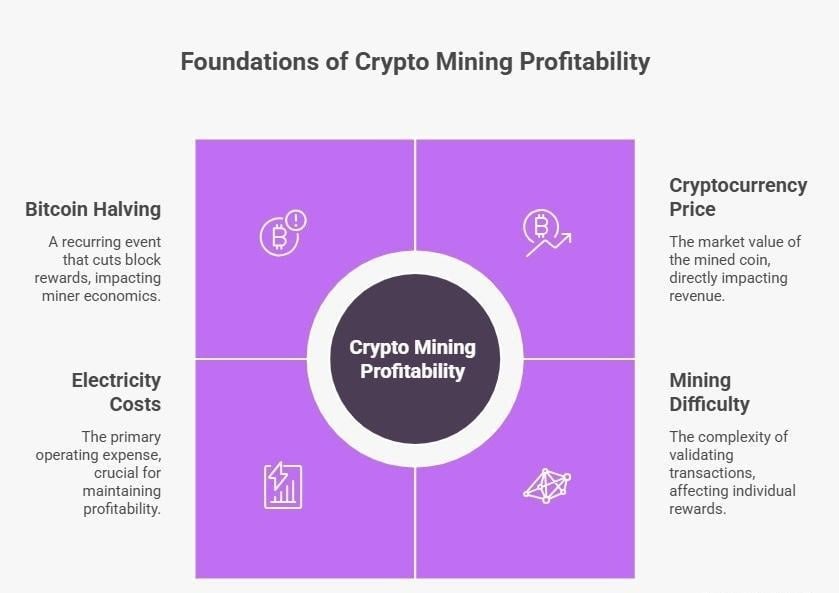
Mining profitability depends on three main variables: the price of the cryptocurrency being mined, the mining difficulty (which adjusts automatically based on how much total computing power is on the network), and electricity costs.
When Bitcoin’s price rises, miners earn more revenue per block. When difficulty rises (because more miners are competing), each miner earns a smaller share of total block rewards.
Electricity is the primary operating cost and the factor that most separates efficient miners from those who struggle to remain profitable.
The Bitcoin halving, which occurs approximately every four years and cuts the block reward in half, is the most significant recurring event for mining economics.
In April 2024, the Bitcoin block reward halved from 6.25 BTC to 3.125 BTC per block.
Miners who survived that transition with efficient hardware and low electricity costs positioned themselves for the subsequent bull cycle. Those with high costs and aging hardware faced significant pressure.
Marathon Digital Holdings (MARA)
Marathon Digital Holdings is one of the largest publicly traded Bitcoin mining companies in the world by hash rate, which measures the amount of computing power dedicated to mining.
The company operates large-scale mining facilities in the US and internationally, with a focus on accessing low-cost electricity to maintain competitive margins.
Marathon’s strategy of retaining a significant portion of its mined Bitcoin rather than selling it immediately to cover operating costs means its balance sheet appreciation is tied to Bitcoin’s price.
This approach amplifies returns in bull markets but creates balance sheet pressure in prolonged downturns.
The company has also expanded into mining Bitcoin for third parties and has invested in energy infrastructure to secure long-term electricity contracts at competitive rates.
MARA is one of the most actively traded crypto mining stocks and often serves as a proxy for investors who want amplified Bitcoin exposure through an equity instrument.
Key facts:
- Listed on: Nasdaq
- Ticker: MARA
- Business: Large-scale Bitcoin mining, BTC treasury retention
- Key metric to watch: Hash rate growth, electricity cost per kilowatt-hour, BTC holdings
Riot Platforms (RIOT)
Riot Platforms is another major publicly traded Bitcoin miner and one of Marathon’s closest US competitors by scale.
It operates large mining facilities in Texas, where it benefits from the state’s deregulated electricity market and participates in demand response programs that allow it to sell electricity back to the grid during peak demand periods, generating additional revenue beyond mining.
The demand response revenue stream is an important differentiator for Riot, since it means the company can generate income even when Bitcoin mining is temporarily less profitable by curtailing its own mining operations and selling power credits to grid operators. This reduces revenue volatility compared to pure-play miners with no alternative income stream.
Key facts:
- Listed on: Nasdaq
- Ticker: RIOT
- Business: Bitcoin mining, electricity demand response programs
- Location: Primarily Texas, with benefit from deregulated electricity market
CleanSpark (CLSK)
CleanSpark is a Bitcoin mining company with a focus on energy efficiency and sustainable power sources. It operates mining facilities primarily in the southeastern United States and has built a reputation for acquiring and scaling facilities efficiently.
CleanSpark has been one of the more aggressive acquirers of mining infrastructure during periods when distressed mining assets become available at attractive prices.
The company’s emphasis on energy efficiency, as measured by its joules per terahash metric (the energy required per unit of mining output), positions it as one of the leaner operators in the sector.
Key facts:
- Listed on: Nasdaq
- Ticker: CLSK
- Business: Bitcoin mining with focus on energy efficiency
- Key differentiator: Sustainable energy sourcing, efficient hardware deployment
Hut 8 Corp (HUT)
Hut 8 is a Canadian Bitcoin mining company that has expanded its operations to include high-performance computing (HPC) services alongside its Bitcoin mining business.
The HPC pivot reflects a trend among mining companies to repurpose their data centre infrastructure for AI computing workloads, which can be more predictable and less volatile than Bitcoin mining revenue.
The diversification into HPC gives Hut 8 a revenue stream that is independent of Bitcoin’s price, which has attracted investors who want crypto exposure with some insulation from crypto market volatility.
Key facts:
- Listed on: Nasdaq
- Ticker: HUT
- Business: Bitcoin mining plus high-performance computing services
- Key differentiator: Revenue diversification through HPC/AI computing
Core Scientific (CORZ)
Core Scientific is one of the largest Bitcoin mining companies by installed hash rate in the United States. It filed for bankruptcy in December 2022 amid the crypto bear market and high debt load, then emerged from bankruptcy in January 2024.
Post-restructuring, the company has a cleaner balance sheet and has invested heavily in expanding its high-performance computing business, signing a significant agreement with AI infrastructure company CoreWeave to convert mining capacity to HPC use.
The CoreWeave agreement made Core Scientific one of the most discussed crypto-adjacent stocks of 2024, as it demonstrated a concrete path for mining companies to monetise their data centre infrastructure for AI computing demand.
Key facts:
- Listed on: Nasdaq
- Ticker: CORZ
- Business: Bitcoin mining and high-performance computing
- Notable: Emerged from bankruptcy January 2024, significant HPC partnership with CoreWeave
Bitfarms (BITF)
Bitfarms is a Canadian Bitcoin mining company with operations in multiple countries including Canada, the US, Argentina, and Paraguay. Its geographic diversification is a differentiator in the sector, since it provides access to varied electricity markets and reduces dependence on any single regulatory environment.
The company focuses on hydroelectric and other renewable energy sources for its mining operations.
Key facts:
- Listed on: Nasdaq
- Ticker: BITF
- Business: Bitcoin mining across multiple countries
- Key differentiator: Geographic and energy source diversification
Cipher Mining (CIFR)
Cipher Mining is a US-focused Bitcoin mining company that operates in Texas and benefits from the state’s electricity infrastructure and demand response programs. It is smaller than Marathon and Riot by hash rate but has positioned itself as an efficient operator with a clear growth strategy in the US market.
Key facts:
- Listed on: Nasdaq
- Ticker: CIFR
- Business: Bitcoin mining, primarily Texas-based
TeraWulf (WULF)
TeraWulf is a Bitcoin mining company with a strong emphasis on zero-carbon energy. It operates primarily at nuclear and hydroelectric power sites, and it has positioned sustainability as a core part of its identity and business model.
As institutional investors increasingly apply ESG considerations to their portfolios, TeraWulf’s clean energy focus has attracted interest from investors who want Bitcoin exposure without the environmental concerns associated with carbon-intensive mining operations.
Key facts:
- Listed on: Nasdaq
- Ticker: WULF
- Business: Bitcoin mining using nuclear and hydroelectric power
- Key differentiator: Zero-carbon mining operations
Mining Stock Comparison
| Company | Ticker | Exchange | Key Differentiator |
| Marathon Digital | MARA | Nasdaq | Scale, BTC treasury retention |
| Riot Platforms | RIOT | Nasdaq | Texas operations, demand response revenue |
| CleanSpark | CLSK | Nasdaq | Energy efficiency and sustainable power sources |
| Hut 8 Corp | HUT | Nasdaq | Bitcoin mining plus HPC/AI services |
| Core Scientific | CORZ | Nasdaq | HPC partnership, post-bankruptcy growth |
| Bitfarms | BITF | Nasdaq | Multi-country operations, renewable energy |
| Cipher Mining | CIFR | Nasdaq | US-focused, Texas efficiency |
| TeraWulf | WULF | Nasdaq | Zero-carbon nuclear and hydro power |
Semiconductor and Hardware Companies
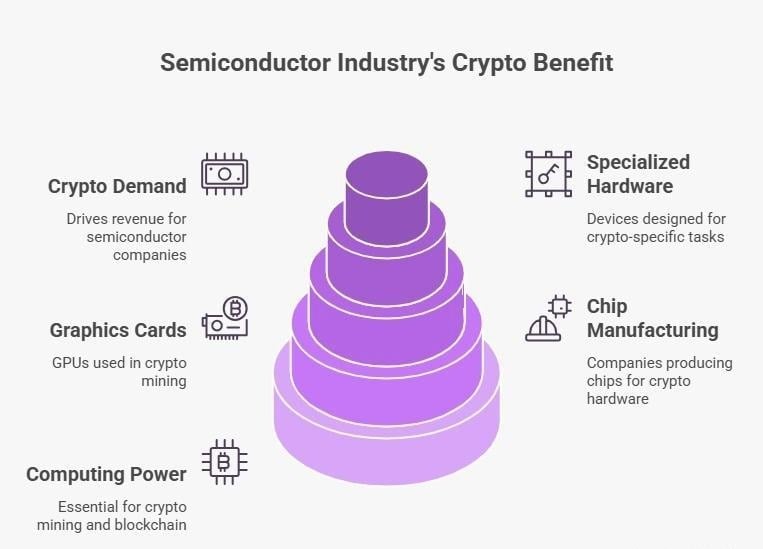
Cryptocurrency mining and blockchain development require significant computing power. The companies that make the chips, graphics cards, and specialised hardware that power these operations benefit from crypto demand, even though crypto is not their primary business.
NVIDIA Corporation (NVDA)
NVIDIA is the world’s largest semiconductor company by market capitalisation and the maker of the graphics processing units (GPUs) that are central to both crypto mining and artificial intelligence applications.
The company does not operate in crypto directly, but it has significant indirect exposure through the demand for its hardware.
During the crypto bull cycles of 2017 and 2021, GPU shortages driven by mining demand caused NVIDIA’s gaming cards to trade at multiples of their retail prices on secondary markets.
NVIDIA has since developed a more complex revenue picture, with its data centre business driven primarily by AI demand now far exceeding its gaming segment.
This means crypto is a smaller proportion of overall revenue than it once was, making NVDA less of a pure crypto play and more of a broader semiconductor and AI investment with meaningful crypto-adjacent exposure.
Key facts:
- Listed on: Nasdaq
- Ticker: NVDA
- Crypto relevance: GPU demand for mining and blockchain development
- Primary business: AI chips, data centre GPUs, gaming graphics cards
Advanced Micro Devices (AMD)
AMD is NVIDIA’s primary competitor in the GPU market and benefits from similar crypto-related demand dynamics.
Its GPUs have been used for Ethereum mining (before Ethereum’s switch to proof of stake in 2022) and continue to be used in various proof-of-work mining operations.
AMD’s data centre business has also grown significantly, though it remains smaller than NVIDIA’s in the AI chip segment.
Key facts:
- Listed on: Nasdaq
- Ticker: AMD
- Crypto relevance: GPU demand for mining and blockchain workloads
- Primary business: CPUs, GPUs, and data centre processors
Bitmain (not yet publicly listed)
Bitmain is the world’s largest manufacturer of application-specific integrated circuit (ASIC) miners, the specialised hardware designed exclusively for Bitcoin mining.
It controls a significant share of the global ASIC manufacturing market through its Antminer product line. Bitmain has attempted to list publicly on multiple occasions but has not yet completed a successful IPO.
It remains privately held as of 2026, but it is worth monitoring for any future listing, as it would be a significant event for the crypto hardware sector.
Canaan Inc. (CAN)
Canaan is a Chinese semiconductor company that designs and manufactures Bitcoin mining ASIC hardware, competing with Bitmain’s Antminer line through its Avalon product line.
It listed on Nasdaq in November 2019, making it one of the few publicly traded ASIC manufacturers. Canaan’s revenue is directly tied to mining hardware demand, which peaks during Bitcoin bull markets when miners are eager to upgrade capacity and falls sharply during bear markets when mining profitability declines.
Key facts:
- Listed on: Nasdaq
- Ticker: CAN
- Business: Bitcoin mining ASIC hardware design and manufacturing
- Revenue sensitivity: Highly cyclical with Bitcoin price and mining profitability
Payment and Financial Services Companies with Crypto Exposure
Several large, established payment and financial services companies have added crypto products to their platforms, giving investors indirect exposure to crypto adoption through companies with diversified revenue bases that provide some cushion against pure crypto market volatility.
Block Inc. (XYZ)
Block, formerly known as Square, is a financial technology company founded by Jack Dorsey, who is also one of Twitter’s co-founders and a prominent Bitcoin advocate.
Block operates Cash App, which allows US users to buy, sell, and hold Bitcoin directly through the app.
Cash App’s Bitcoin revenue is substantial and represents one of the clearest examples of a mainstream financial platform monetising crypto adoption at scale.
Block also operates a dedicated Bitcoin-focused division called Bitcoin Unit (formerly known as TBD) and the hardware wallet company Bitkey, which produces a consumer-grade Bitcoin hardware wallet.
The company’s deep commitment to Bitcoin across its product lines makes it one of the most crypto-aligned mainstream fintech stocks available.
Key facts:
- Listed on: NYSE
- Ticker: XYZ
- Crypto relevance: Cash App Bitcoin trading, Bitkey hardware wallet, Bitcoin Unit development division
- Primary business: Payment processing, merchant services, Cash App
PayPal Holdings (PYPL)
PayPal introduced cryptocurrency buying and selling for US users in 2020 and has expanded its crypto services to include a stablecoin (PayPal USD, or PYUSD) launched in 2023. Users can buy, hold, and pay with select cryptocurrencies through PayPal and Venmo.
The crypto functionality represents a small but growing portion of PayPal’s overall revenue and reflects the company’s strategy to capture value from the growing intersection between traditional payment infrastructure and digital assets.
Key facts:
- Listed on: Nasdaq
- Ticker: PYPL
- Crypto relevance: Crypto buying and selling, PayPal USD stablecoin (PYUSD)
- Primary business: Online payment processing, Venmo
Robinhood Markets (HOOD)
Robinhood is a commission-free trading platform that offers crypto trading alongside its stock and ETF brokerage services.
Crypto has consistently been one of Robinhood’s highest-revenue segments, particularly during bull markets when retail trading activity in digital assets surges.
The company generates revenue from crypto trading through a spread model rather than explicit commissions.
Robinhood has expanded its crypto offerings significantly in recent years, adding more assets, improving its wallet functionality, and targeting more active crypto traders rather than just casual buyers. It also launched a crypto exchange for more sophisticated users.
Key facts:
- Listed on: Nasdaq
- Ticker: HOOD
- Crypto relevance: Crypto trading platform, significant crypto revenue segment
- Primary business: Commission-free brokerage for stocks, ETFs, and crypto
Galaxy Digital Holdings (GLXY)
Galaxy Digital is a crypto-native financial services firm that provides trading, asset management, investment banking, and mining services to institutional and high-net-worth clients.
It is led by Michael Novogratz, a former Goldman Sachs partner and prominent crypto investor. Galaxy trades on the Nasdaq and is one of the most direct ways to invest in a crypto-native institutional financial services business through public equity.
Key facts:
- Listed on: Nasdaq
- Ticker: GLXY
- Business: Crypto institutional trading, asset management, investment banking, mining
- Key figure: Founded and led by Michael Novogratz
Asset Management and ETF-Related Stocks
The launch of spot Bitcoin ETFs in the United States in January 2024 opened a new category of crypto-adjacent investments and strengthened the crypto exposure of several asset management companies that entered the ETF market.
BlackRock (BLK)
BlackRock is the world’s largest asset manager and the issuer of iShares Bitcoin Trust (IBIT), which became the fastest-growing ETF in history by assets under management following its January 2024 launch.
BlackRock earns a management fee of 0.25% per year on the assets in IBIT. As Bitcoin’s price rises and more capital flows into the fund, BlackRock’s fee revenue from this product grows.
Bitcoin ETF fees represent a small fraction of BlackRock’s total revenue, but the symbolic significance of the world’s largest asset manager entering the Bitcoin ETF market has been substantial for the broader institutional adoption of crypto.
Buying BlackRock shares gives you exposure to this growing fee stream alongside all of BlackRock’s other business lines.
Key facts:
- Listed on: NYSE
- Ticker: BLK
- Crypto relevance: Issuer of iShares Bitcoin Trust (IBIT), the largest US Bitcoin ETF
- Primary business: Asset management across all major asset classes
Fidelity Investments
Fidelity is privately held and does not offer a publicly traded stock. However, it is worth noting here because of its significant crypto footprint: it operates Fidelity Digital Assets, a crypto custody and trading service for institutional clients, and it issues the Fidelity Wise Origin Bitcoin Fund (FBTC), one of the major spot Bitcoin ETFs launched in January 2024.
As a private company, investors cannot directly invest in Fidelity, but its presence in the crypto space reinforces the institutional legitimacy of the asset class.
WisdomTree (WETF)
WisdomTree is a publicly traded asset manager and ETF provider that has been active in the crypto space, offering digital asset products in European markets and pursuing digital asset product approvals in the US.
It is a smaller company than BlackRock or Fidelity and represents a more concentrated play on the growth of crypto ETF and digital asset products within traditional finance.
Key facts:
- Listed on: Nasdaq
- Ticker: WETF
- Crypto relevance: Digital asset ETF products in Europe and expanding crypto offerings
- Primary business: ETF provider across multiple asset classes
Blockchain Technology and Infrastructure Companies
Beyond exchanges, miners, and financial services firms, a range of companies build the software, data infrastructure, and business applications that run on or around blockchain networks.
2. Silvergate Capital and Signature Bank (Historical Note)
Both Silvergate Capital and Signature Bank operated specialised payment networks (SEN and Signet respectively) that provided 24/7 fiat payment infrastructure for crypto exchanges and institutional traders.
Both banks collapsed in March 2023 during the banking stress that followed the FTX implosion.
Their failure removed significant infrastructure from the US crypto banking ecosystem and illustrates the specific risks that come with crypto-focused financial companies.
Understanding what happened to these institutions is useful context for evaluating any future bank or fintech that concentrates its business around crypto clients.
3. Iris Energy (IREN)
Iris Energy is an Australian company that operates Bitcoin mining infrastructure and has expanded into high-performance computing for AI workloads.
It is listed on Nasdaq and has followed the same diversification path as Hut 8 and Core Scientific, positioning its data centre capacity for both Bitcoin mining and AI/HPC demand.
Iris Energy’s focus on renewable energy sources aligns it with increasing institutional interest in sustainable operations.
Key facts:
- Listed on: Nasdaq
- Ticker: IREN
- Business: Bitcoin mining and high-performance computing
- Energy focus: Renewable-powered operations
4. Applied Digital (APLD)
Applied Digital is a data centre operator that serves both crypto mining clients and high-performance computing clients. It provides the physical infrastructure layer that miners and HPC operators rent rather than building themselves.
This infrastructure-as-a-service model gives Applied Digital more predictable revenue than a pure mining company and positions it as a pick-and-shovel play on both crypto and AI computing growth.
Key facts:
- Applied Digital listed on: Nasdaq
- Ticker: APLD
- Business: Data centre infrastructure for mining and HPC clients
International Cryptocurrency Stocks
Crypto stocks are not limited to US-listed companies. Several significant crypto-related equities trade on international exchanges, giving investors access to a broader set of opportunities.
1. Hive Digital Technologies (HIVE)
Hive Digital Technologies is a Canadian company that mines both Bitcoin and Ethereum-based assets (before Ethereum’s switch to proof of stake) and has transitioned its GPU mining capacity to high-performance computing for AI workloads. It trades on both the TSX Venture Exchange and Nasdaq, giving it access to both Canadian and US investors.
Key facts:
- Listed on: Nasdaq and TSX
- Ticker: HIVE
- Business: Bitcoin mining, GPU computing for HPC/AI
2. Argo Blockchain (ARB)
Argo Blockchain is a UK-listed Bitcoin mining company that also has a US-listed ADR (American Depositary Receipt). It operates mining facilities in North America and has navigated financial difficulties during the 2022 bear market through asset sales and restructuring.
It is smaller than the major US miners but represents one of the few ways European investors can access a domestically listed crypto mining stock.
Key facts:
- Listed on: London Stock Exchange (AIM), Nasdaq (ARBK)
- Business: Bitcoin mining, primarily North America operations
3. Monex Group
Monex Group is a Japanese financial services company that owns Coincheck, one of Japan’s largest cryptocurrency exchanges.
It provides Japanese investors with exposure to crypto exchange economics through a regulated domestic financial company. Japan has one of the most developed retail crypto markets in the world, making Monex’s crypto exposure meaningful.
Key facts:
- Listed on: Tokyo Stock Exchange
- Business: Financial services including Coincheck crypto exchange ownership
Crypto Exchange-Traded Funds (ETFs) vs. Crypto Stocks
Before investing in individual crypto stocks, it is worth understanding the ETF alternatives available in the market, since they offer a different way to access similar exposure.
1. Spot Bitcoin ETFs
In January 2024, the SEC approved spot Bitcoin ETFs in the United States. These products hold actual Bitcoin in custody and allow investors to gain direct price exposure to Bitcoin through a stock-exchange-listed product.
The major spot Bitcoin ETFs include iShares Bitcoin Trust (IBIT) by BlackRock, Fidelity Wise Origin Bitcoin Fund (FBTC), ARK 21Shares Bitcoin ETF (ARKB), and Bitwise Bitcoin ETF (BITB).
These products have collectively accumulated hundreds of billions of dollars in assets under management since their launch.
Spot Bitcoin ETFs are not the same as crypto stocks. They hold Bitcoin directly, meaning their returns track Bitcoin’s price closely minus the management fee. They do not give you exposure to crypto company earnings, revenue growth, or the operational upside of the underlying businesses.
If you want Bitcoin price exposure as cleanly as possible through a brokerage account, a spot ETF is generally more efficient than a crypto stock.
2. Crypto equity ETFs
Several ETFs hold baskets of crypto-related stocks rather than crypto directly. The Amplify Transformational Data Sharing ETF (BLOK) and the Bitwise Crypto Industry Innovators ETF (BITQ) are examples that provide diversified exposure to a basket of crypto companies including miners, exchanges, and financial services firms.
These products reduce the single-company risk of investing in individual crypto stocks while maintaining exposure to the broader sector.
3. The trade-off
The choice between individual crypto stocks and crypto ETFs depends on your conviction about specific companies and your appetite for single-stock risk.
A concentrated position in MARA or RIOT provides more exposure to a specific mining company’s operational success. A diversified crypto equity ETF smooths out that single-company risk but reduces the potential for outperformance from any individual name.
How Crypto Stocks Perform Across Market Cycles
Understanding how crypto stocks perform relative to Bitcoin across different market conditions helps you set realistic expectations and make better allocation decisions.
1. During bull markets
In strong Bitcoin bull markets, mining stocks typically outperform Bitcoin significantly. This happens because their revenue grows faster than Bitcoin’s price: when Bitcoin doubles, mining revenue roughly doubles, but the increase in profit can be much larger because fixed costs (electricity contracts, hardware depreciation) do not double with revenue.
Bitcoin treasury companies like MicroStrategy also tend to outperform during bull markets because the value of their Bitcoin holdings rises while their share price often trades at a premium to the net asset value of those holdings.
Exchange stocks like Coinbase see revenue surge as trading volumes increase during bull markets, though the relationship is more complex because fee compression (exchanges lowering fees to compete) can partially offset volume gains.
2. During bear markets
Mining stocks typically fall more than Bitcoin during bear markets for the opposite reason: fixed costs remain constant while revenue falls with Bitcoin’s price. Miners with high debt loads or high electricity costs face existential pressure during prolonged downturns.
The bankruptcies of Core Scientific in 2022 and the financial difficulties faced by multiple other miners during the 2022 bear market illustrate how severely operating economics can swing in both directions.
Bitcoin treasury companies like MicroStrategy also fall more than Bitcoin during bear markets because debt-financed positions amplify losses, and the share price can trade at a discount to the net asset value of Bitcoin holdings when sentiment is negative.
Exchange stocks tend to be more resilient than miners during downturns because they generate revenue from trading volume rather than from Bitcoin’s absolute price. However, volumes drop significantly in bear markets, and exchange revenues fall accordingly.
Relative performance summary:
| Market Condition | Mining Stocks | Treasury Companies | Exchanges | Bitcoin Direct |
| Strong bull market | Typically outperform BTC significantly | Often outperform BTC | Outperform, less than miners | Baseline |
| Mild bull market | Outperform BTC moderately | Track BTC closely | Moderate outperformance | Baseline |
| Sideways market | Underperform BTC (fixed costs) | Track BTC or slight discount | Mixed, volume dependent | Baseline |
| Bear market | Significantly underperform BTC | Underperform BTC | Underperform, more resilient than miners | Baseline |
| Severe bear market | Extreme underperformance, some bankruptcies | Large underperformance | Significant underperformance | Baseline |
Risks of Investing in Cryptocurrency Stocks
Cryptocurrency stocks carry both the risks of the underlying crypto market and the additional risks of individual company operations. Understanding these risks is essential before investing.
1. Crypto Market Risk
All crypto stocks are exposed to Bitcoin and broader crypto market conditions. A prolonged bear market reduces mining revenue, exchange volumes, and the value of Bitcoin treasury holdings simultaneously.
Unlike owning Bitcoin directly, a stock can also go to zero if the company behind it fails, which Bitcoin itself cannot do.
2. Operational Risk
Mining companies face specific operational risks: hardware obsolescence (new, more efficient mining machines regularly render older hardware uncompetitive), electricity price increases, data centre outages, and regulatory changes affecting mining operations.
Exchange companies face risks from security breaches, regulatory enforcement actions, and competitive pressures. Every company in this sector has management, balance sheet, and execution risks that Bitcoin itself does not have.
3. Regulatory Risk
Crypto regulation is developing rapidly in all major markets. A regulatory action against a specific company (such as the SEC’s lawsuits against crypto exchanges) can devastate a company’s stock price regardless of Bitcoin’s direction.
New mining regulations, tax changes affecting crypto companies, or restrictions on specific crypto services can materially affect individual crypto stocks in ways that do not affect Bitcoin’s price or direct crypto holdings.
4. Debt Risk
Many mining companies and Bitcoin treasury companies use debt financing. MicroStrategy uses convertible bonds to fund Bitcoin purchases. Mining companies borrow to purchase hardware and fund expansion.
Debt amplifies returns in bull markets but accelerates losses in bear markets and can lead to bankruptcy if debt cannot be serviced during prolonged downturns.
5. Concentration Risk
Investing a large portion of your portfolio in crypto stocks concentrates your risk in a single sector that is already highly volatile.
Within that sector, further concentrating in a single company like a specific miner adds company-specific risk on top of sector risk.
Diversifying across multiple crypto stock categories (miners, exchanges, treasury companies, payment companies) reduces but does not eliminate this concentration.
6. Liquidity Risk
Smaller crypto stocks like Cipher Mining, TeraWulf, and Argo Blockchain trade with lower daily volumes than large-cap stocks. In a market downturn, selling a large position in a thinly traded stock can be difficult without moving the price significantly.
How to Invest in Cryptocurrency Stocks
Investing in cryptocurrency stocks uses exactly the same process as buying any other stock. You need a brokerage account with access to the relevant exchange where the stock trades.
US-listed stocks like COIN, MARA, RIOT, MSTR, CLSK, HUT, CORZ, NVDA, AMD, XYZ, PYPL, HOOD, WULF, and others are accessible through any US brokerage account and through international brokers that provide access to US markets. Platforms like Fidelity, Charles Schwab, Interactive Brokers, TD Ameritrade, and Robinhood all support trading in these securities.
Canadian-listed stocks like Hive (HIVE-TSX) require either a Canadian brokerage account or access through an international broker that supports TSX trading. Some of these also have US-listed versions or ADRs that simplify access for US investors.
Tax treatment of crypto stocks in most jurisdictions is straightforward: they are treated as equity investments. Capital gains on stock sales are taxed according to your country’s standard capital gains rules.
This is generally simpler than the tax treatment of direct crypto holdings, where each trade, payment, or exchange is a taxable event in many countries.
Dollar-cost averaging is a practical approach for building a position in volatile crypto stocks. Rather than committing a large sum at once, investing a fixed amount at regular intervals (weekly or monthly) smooths out the impact of crypto market volatility on your entry price.
Conclusion
Cryptocurrency stocks represent one of the most dynamic and rapidly evolving sectors in public equity markets.
They give investors a range of ways to participate in the growth of digital assets through familiar, regulated investment channels, from the direct Bitcoin price exposure of MicroStrategy’s treasury holdings, to the amplified Bitcoin sensitivity of mining companies, to the trading volume sensitivity of exchange stocks, to the indirect exposure of semiconductor giants like NVIDIA.
The sector is not monolithic. Each category of crypto stock has a distinct business model, a distinct relationship with Bitcoin’s price, and a distinct set of risks.
The key is to match the specific type of crypto stock to your investment goals, risk tolerance, and time horizon.
A long-term investor comfortable with multi-year drawdowns might hold mining stocks through a full cycle.
A more conservative investor seeking crypto exposure might prefer a diversified crypto equity ETF or a small position in a large-cap company like Coinbase or BlackRock. The spectrum of options is wide enough to accommodate both approaches.
Frequently Asked Questions
Are cryptocurrency stocks a good investment?
Whether crypto stocks are a good investment depends entirely on your financial situation, risk tolerance, time horizon, and views on the crypto market’s long-term trajectory. Crypto stocks are among the most volatile investments available in public markets. They can generate exceptional returns in bull markets and devastating losses in bear markets.
What is the difference between buying crypto directly and buying crypto stocks?
Buying crypto directly means you own the digital asset itself. Its value rises and falls with the market, you control your holdings through a private key or exchange account, and tax treatment varies by jurisdiction (often more complex).
Buying a crypto stock means you own equity in a company. You participate through familiar brokerage structures, benefit from regulatory protections that apply to public companies, and face both crypto market risk and company-specific operational risk. Crypto stocks can go to zero if the company fails, which Bitcoin and Ethereum cannot.
Which crypto stock is most closely correlated with Bitcoin’s price?
MicroStrategy (MSTR) has historically shown the highest correlation with Bitcoin’s price among large publicly traded companies, given that its primary asset is Bitcoin and its share price often trades at a premium or discount to the net Bitcoin value on its balance sheet. Bitcoin mining stocks also show high correlation but with more operational variables affecting the relationship.
Can I hold crypto stocks in a retirement account?
Yes. US-listed crypto stocks can be held in IRAs, 401(k)s, and other retirement accounts through any broker that supports those account types.
Spot Bitcoin ETFs like IBIT and FBTC can also be held in retirement accounts, giving tax-advantaged exposure to Bitcoin’s price.
Direct cryptocurrency cannot be held in conventional retirement accounts, though some specialised crypto IRA providers exist.
Do any crypto stocks pay dividends?
Most crypto-focused companies do not pay dividends, as they typically reinvest available capital into growth or Bitcoin acquisition.
Some diversified companies with crypto exposure, like BlackRock and PayPal, do pay dividends, but those dividends come from their broader business operations rather than from their crypto activities specifically.
What happened to crypto stocks during the 2022 bear market?
The 2022 bear market was severe for crypto stocks across every category. Coinbase’s stock fell over 80% from its peak. Mining stocks fell even further, with several companies including Core Scientific filing for bankruptcy. MicroStrategy’s stock fell dramatically as the value of its Bitcoin holdings declined.
Is NVIDIA a crypto stock?
NVIDIA is primarily a semiconductor and AI company, not a crypto company. However, it has significant indirect exposure to crypto through GPU demand for mining operations and blockchain development.
It is more accurately described as an AI and computing company with meaningful but secondary crypto exposure.
What is the smallest crypto stock I can invest in?
Several micro-cap crypto stocks trade on US exchanges with market capitalisations well under $100 million. These include smaller miners and early-stage crypto infrastructure companies. Micro-cap stocks carry very high risk: they are thinly traded, more susceptible to manipulation, and more likely to face existential challenges in a bear market.