A монетный миксер (also called a tumbler, blender, or mixing service) is a tool or protocol that enhances конфиденциальность криптовалюты by breaking the on-chain link between the sender’s and receiver’s addresses. Mixers work by pooling coins from multiple users, shuffling them together, and redistributing equivalent amounts to new addresses – making it extremely difficult for blockchain analysts to trace the flow of funds. Coin mixers range from centralized services (which take custody of funds during mixing) to decentralized protocols like CoinJoin and Tornado Cash that use криптографические методы to mix without trusted intermediaries. While mixers serve legitimate privacy needs, they have become controversial due to their use in money laundering, leading to regulatory crackdowns including the U.S. Treasury’s sanctioning of Tornado Cash in 2022.
Определение
A coin mixer breaks the transaction trail between sender and receiver:
| Аспект | Описание |
| Основная функция | Obscure the connection between sending and receiving addresses |
| Механизм | Pool funds from multiple users, then redistribute to new addresses |
| Тип | Centralized (custodial services) and Decentralized (CoinJoin, Tornado Cash) |
| Также известен как | Tumbler, blender, mixing service, anonymizer |
| Уровень конфиденциальности | Varies from moderate (basic tumblers) to strong (zero-knowledge protocols) |
| Легальное положение | Legal in many jurisdictions but increasingly scrutinized; some protocols sanctioned |
Происхождение и история
“Privacy is necessary for an open society in the electronic age.”
| Время | События |
| 2011 | First Bitcoin mixing services appear on darknet forums as users seek transaction privacy |
| 2013 | BitcoinFog becomes one of the earliest well-known centralized mixing services |
| 2013 | Gregory Maxwell proposes CoinJoin – a trustless, decentralized mixing protocol |
| 2014 | Multiple centralized mixers launch; some turn out to be scams that steal deposited funds |
| 2015 | JoinMarket launches – first practical implementation of CoinJoin with a market-maker model |
| 2018 | Васаби Кошелек launches with built-in CoinJoin mixing (ZeroLink protocol) |
| 2019 | Tornado Cash launches on Ethereum – uses zero-knowledge proofs for non-custodial mixing |
| 2020 | Chainalysis and other analytics firms develop techniques to partially de-anonymize mixer outputs |
| 2021 | Samourai Wallet’s Whirlpool becomes popular for Bitcoin CoinJoin mixing |
| 2022 | U.S. Treasury sanctions Tornado Cash – first time a smart contract protocol is sanctioned |
| 2022 | Tornado Cash developer Alexey Pertsev arrested in the Netherlands |
| 2023 | Roman Storm (Tornado Cash co-founder) charged with money laundering conspiracy in the U.S. |
| 2023 | Bitcoin mixing services face increasing regulatory pressure globally |
| 2024 | Dutch court sentences Alexey Pertsev to 64 months; debate continues over code-as-speech |
Как это работает
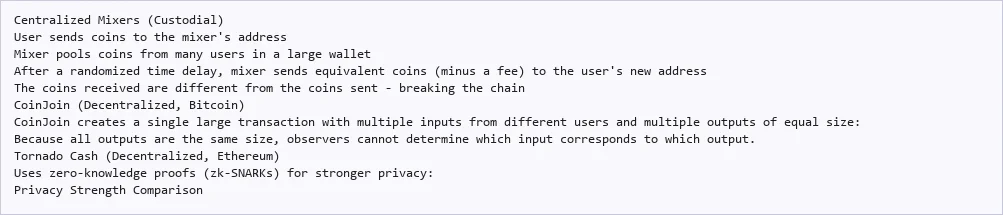
| Плюсы | Минусы |
| Простой в использовании | Requires trusting the mixer (custodial risk) |
| Effective for basic privacy | Mixer can steal funds or be a honeypot |
| <strong>Быструю реакцию на ваши запросы</strong> и стабильное качество нашего ассортимента запчастей | Mixer logs may be subpoenaed |
| Шаг | Разработка |
| 1. Координация | Multiple users agree to create a joint transaction |
| 2. Input submission | Each user provides their input UTXO |
| 3. Output creation | Each user provides a new address; all outputs are the same amount |
| 4. Подписание | Each user signs only their own input (no one can steal funds) |
| 5. Трансляция | The combined transaction is broadcast to the network |
| Шаг | Разработка |
| 1. Сделайте депозит | User deposits a fixed amount (0.1, 1, 10, or 100 ETH) into the Tornado Cash smart contract |
| 2. Note generation | Contract generates a cryptographic “note” (secret) for the depositor |
| 3. Подожди | User waits (longer = better privacy as more deposits accumulate) |
| 4. Снять | User presents the note to withdraw from a completely new address |
| 5. Доказательство с нулевым разглашением | гк-СНАРК proves the user has a valid deposit note without revealing which deposit is theirs |
| Способ доставки | Уровень конфиденциальности | Требуется доверие | Снижение |
| Без смешивания | Ничто | ARCXNUMX | Полная прослеживаемость |
| Centralized mixer | Средняя | High (custodial) | Theft, logs, scams |
| CoinJoin (Wasabi) | Хорошо | Low (non-custodial) | Timing analysis possible |
| Tornado Cash | сильный | None (trustless) | Sanctioned in U.S. |
| Монеты, обеспечивающие конфиденциальность (Monero) | Очень сильный | Нет (встроенный) | Exchange delisting risk |
Простыми словами
- A coin mixer is like a coin laundry for cryptocurrency– you put your identifiable coins in, they get shuffled with everyone else’s coins, and you get back “clean” coins that can’t be traced back to your original transaction.
- Think of it like shuffling identical playing cards– if 10 people each put one identical card face-down on a table, shuffle them all together, and each person takes one back, nobody can prove which card belongs to whom.
- Centralized mixers are like trusting a middleman– you hand your money to someone who promises to give you different money back. This works but requires trust.
- Decentralized mixers use math instead of trust– protocols like CoinJoin and Tornado Cash use cryptography so that mixing happens without anyone having custody of your funds.
- The controversy: privacy vs. crime– mixers protect legitimate privacy (preventing surveillance, protecting business secrets) but are also used to launder stolen funds, creating a major regulatory debate. Важно: While coin mixers serve legitimate privacy purposes, using them may raise red flags with exchanges and compliance teams. Some exchanges will flag or freeze funds that have passed through mixing services. Users should be aware of the legal status of mixing in their jurisdiction before using these tools.
Примеры из реального мира
Scenario 1: Tornado Cash Sanctions (2022)
| Аспект | Описание |
| Сценарий | North Korea’s Lazarus Group uses Tornado Cash to launder over $455 million stolen from crypto protocols |
| Реализация | U.S. Treasury’s OFAC sanctions Tornado Cash smart contract addresses in August 2022, making it illegal for U.S. persons to interact with the protocol |
| Результат | Developers arrested; code removed from GitHub; the crypto community debates whether sanctioning open-source code is constitutional; Coin Center and others challenge the sanctions in court |
Scenario 2: Wasabi Wallet CoinJoin
| Аспект | Описание |
| Сценарий | A privacy-conscious Bitcoin user wants to break the link between their exchange purchases and personal spending |
| Реализация | Using Wasabi Wallet’s built-in CoinJoin feature, the user’s coins are automatically mixed with other Wasabi users in collaborative transactions with equal-sized outputs |
| Результат | After 2-3 rounds of CoinJoin, the user’s coins have an “anonymity set” of 50+, making it extremely difficult for chain analysis to trace them back to the exchange purchase |
Scenario 3: Privacy for Legitimate Business
| Аспект | Описание |
| Сценарий | A company pays contractors in Bitcoin but doesn’t want competitors to analyze their payment amounts and relationships |
| Реализация | The company uses a mixing technique before making payments, breaking the link between their publicly known corporate wallet and individual contractor payments |
| Результат | Competitors cannot use blockchain analysis to determine the company’s contractor network, payment amounts, or business relationships |
Преимущества
| Преимущества | Описание |
| Конфиденциальность транзакций | Breaks the link between sender and receiver addresses |
| Финансовый суверенитет | Protects users from surveillance and data harvesting |
| взаимозаменяемость | Makes all coins equal by removing their transaction history |
| Деловая конфиденциальность | Protects corporate financial operations from competitive analysis |
| Сопротивление цензуре | Enables financial transactions in oppressive regimes |
Недостатки и риски
| Снижение | Описание |
| Юридический риск | Mixing services are illegal or sanctioned in some jurisdictions |
| Пометка биржи | Mixed coins may be flagged or frozen by exchanges and compliance teams |
| Custodial theft | Centralized mixers can steal deposited funds (exit scams) |
| Illicit association | Using mixers may create suspicion even for legitimate privacy needs |
| Incomplete privacy | Advanced chain analysis can sometimes partially de-anonymize mixed coins |
FAQ
Are coin mixers illegal?
The legality varies by jurisdiction. In most countries, using a mixer is not inherently illegal. However, specific mixers may be sanctioned (like Tornado Cash in the U.S.), and using mixers to launder stolen funds is illegal everywhere. Some countries require financial institutions to flag transactions involving mixers.
What is the difference between a mixer and CoinJoin?
A traditional mixer is a custodial service where you send coins and receive different coins back. CoinJoin is a non-custodial technique where multiple users create a single collaborative transaction – no one takes custody of anyone else’s funds. CoinJoin is generally considered safer and more trustless.
Can chain analysis trace mixed coins?
Partially. While mixing significantly increases privacy, advanced chain analysis techniques can sometimes reduce the anonymity set through timing analysis, amount correlation, and other heuristics. However, well-implemented mixing (multiple rounds, equal outputs, proper UTXO management) remains very difficult to trace.
Что случилось с Tornado Cash?
In August 2022, the U.S. Treasury sanctioned Tornado Cash after North Korea’s Lazarus Group used it to launder $455 million in stolen crypto. Developers were arrested, the code was briefly removed from GitHub, and a legal debate erupted over whether sanctioning open-source smart contracts violates free speech.