


In March 2024, BlackRock the world’s $10 trillion asset manager made a decisive move: it launched a money market fund on the Ethereum blockchain. Within 18 months, that fund, BUIDL, grew by over 860% to approximately $2.85 billion, becoming the largest tokenized real-world asset globally.
This is no longer a crypto experiment. It signals a clear shift Wall Street is moving on-chain, and the pace is accelerating. The broader RWA tokenization market reflects this momentum. By September 2025, the market had surpassed $30 billion, marking more than 400% growth in just three years.
Major financial institutions including Goldman Sachs, JPMorgan, Franklin Templeton, and Apollo have all entered the space with tokenized products, further validating its long term potential. Current projections suggest the market could reach $10 trillion by 2030, with more aggressive estimates pushing toward $30 trillion by 2034.
Against this backdrop, the choice of platform is no longer a technical detail, it is a strategic decision. Whether you are an institution exploring the tokenization of a $50 million credit fund, a fintech building infrastructure in this space, or an investor seeking exposure to institutional grade assets, selecting the right RWA tokenization provider will directly impact your regulatory exposure, operational efficiency, liquidity access, and overall outcomes.
Key Takeaway
- Major institutions like BlackRock, Franklin Templeton, and JPMorgan are moving billions of dollars on-chain.
- Regulatory compliance, technology, asset type, and liquidity vary across providers, affecting your access and risk.
- While the industry has crossed $30 billion, challenges like regulation, liquidity, and integration with traditional finance remain.
- Some focus on institutional-grade funds, others on DeFi, credit, or retail accessibility.
What is RWA Tokenization?
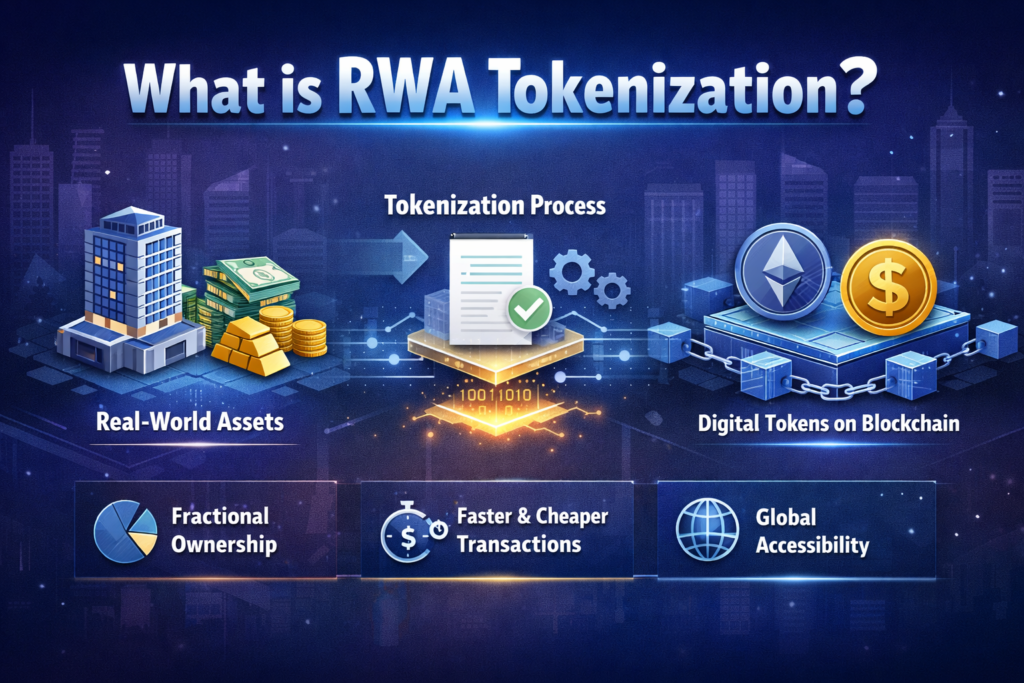
Real World Asset (RWA) tokenization refers to the process of converting ownership rights of physical or traditional financial assets into digital tokens recorded on a blockchain. These tokens represent a claim to an underlying asset and can be traded, transferred, or used within blockchain based financial systems.
In simple terms, tokenization acts as a bridge between traditional finance (TradFi) and blockchain-based finance, enabling assets that previously existed only in offline markets to be represented and managed digitally. Examples of assets that can be tokenized include:
- Real estate properties
- Government or corporate bonds
- Commodities such as gold or oil
- Private credit and loans
- Art, collectibles, and intellectual property
Once tokenized, these assets can be fractionalized, traded globally, and settled almost instantly, often through smart contracts that automate ownership transfers and compliance processes.
The concept is gaining attention across financial markets because it combines the transparency and programmability of blockchain with the economic value of real-world assets, opening a new category of digital assets within the broader crypto ecosystem.
Real World Assets vs. Crypto-Native Tokens
Although both exist on blockchains, RWA tokens and crypto-native tokens differ fundamentally in their source of value and functionality.
RWA tokens represent assets that exist outside the blockchain. The token acts as a digital certificate of ownership or claim over a physical or financial asset. Examples include: Tokenized real estate shares, gold backed tokens, tokenized treasury bonds and private credit or invoice financing tokens.
Crypto native tokens exist entirely within the blockchain ecosystem and do not represent external assets. Their value is typically derived from network utility, governance rights, protocol incentives, scarcity or market demand. Examples include governance tokens, utility tokens, and native blockchain currencies like Ether or Solana.
Why RWA Tokenization is Important in 2026
The importance of RWA tokenization has grown significantly over the past few years. By 2026, the sector is widely regarded as one of the most promising areas in blockchain finance, with major financial institutions exploring its potential.
- Unlocking Liquidity in Traditionally Illiquid Markets
Many real world assets such as real estate or private equity are difficult to trade quickly. Tokenization allows these assets to be fractionalized and traded on blockchain networks, improving market liquidity and accessibility.
- Global Access to Investment Opportunities
Tokenized assets can be accessed by investors worldwide, enabling participation in markets that were previously restricted to high-net-worth or institutional investors.
- Transparency and Programmability
Blockchain technology enables transparent ownership records, automated compliance rules, and programmable asset management through smart contracts.
- Expansion of DeFi Use Cases
Tokenized assets can be used as collateral in decentralized finance applications, allowing investors to borrow, lend, or earn yields against real world value.
These advantages have positioned RWAs as one of the fastest growing segments of the digital asset economy, attracting attention from both crypto projects and traditional financial institutions.
What to Look for in RWA Tokenization Companies
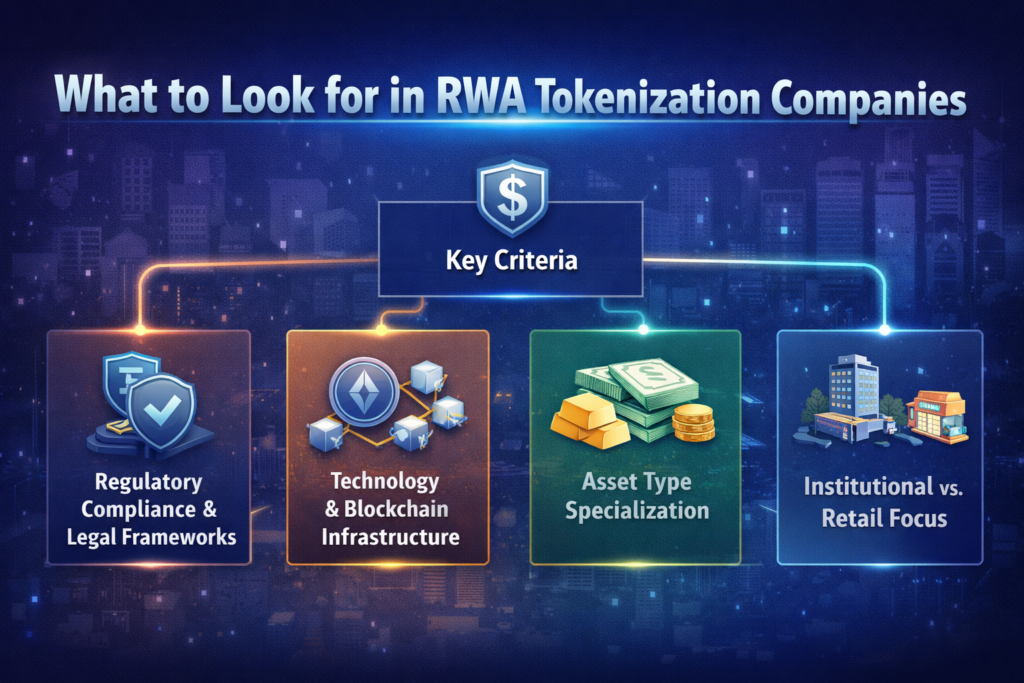
Choosing the right Real World Asset (RWA) tokenization company is critical for asset issuers, investors, and institutions looking to bring traditional assets onto blockchain infrastructure.
Evaluating these factors helps ensure that the tokenization process is secure, legally valid, and capable of supporting real financial activity.
Regulatory Compliance & Legal Frameworks
Regulatory compliance is one of the most important factors when evaluating RWA tokenization companies because tokenized assets often represent legal ownership or financial claims tied to real world assets.
Unlike purely crypto native tokens, RWAs must operate within existing financial regulations to ensure investor protection and legal enforceability.
A reputable tokenization platform typically integrates Know Your Customer (KYC) and Anti-Money Laundering (AML) standards into its onboarding and transaction processes. These procedures verify investor identities, screen participants against financial crime databases, and ensure that tokenized assets are not used for illicit activities.
Technology & Blockchain Infrastructure
The technological foundation of an RWA tokenization company determines how securely, efficiently, and transparently assets can be issued and managed.
At the core of most tokenization platforms are smart contracts, which are blockchain based programs that automate key processes such as token issuance, ownership transfers, compliance checks, and dividend or yield distribution.
To support regulated financial assets, many platforms rely on specialized token standards such as ERC-3643, which is designed for compliant security tokens on the Ethereum network. This standard allows identity verification, regulatory restrictions, and investor permissions to be embedded directly into the token itself.
Asset Type Specialization
Different RWA tokenization companies often focus on specific asset classes, so understanding a platform’s specialization is essential when selecting the right provider. Some companies concentrate on real estate tokenization, enabling property owners to divide buildings or land into fractional shares that investors can buy and trade.
This approach helps unlock liquidity in traditionally illiquid markets and lowers the barrier to entry for property investment. Other platforms focus on financial instruments such as bonds, private credit, and treasury securities.
Institutional vs. Retail Focus
Another key factor to consider when evaluating RWA tokenization companies is whether their platform primarily targets institutional clients or retail investors. Many tokenization providers focus on enterprise level solutions designed for banks, asset managers, and financial institutions.
These platforms often offer sophisticated infrastructure, including regulated security token issuance, compliance automation, asset lifecycle management tools, and integration with traditional financial systems.
Institutional focused platforms emphasize security, scalability, and regulatory alignment, which are essential for managing large financial instruments and attracting institutional capital. They may also provide institutional custody solutions and regulated secondary markets where tokenized securities can be traded.
Also Read: Stablecoin Regulation in 2026: Global Laws, Benefits, and Challenges
Top 10 RWA Tokenization Companies in 2026
| Company | Founded/Launch | Category | AUM/TVL | Key Focus | Core Product/Tech | Blockchains | Target Users | Regulatory Strength | Key Differentiator |
| Securitize | 2017 | Tokenization Platform | $4B+ AUM | Digital securities & funds | Digital Securities Platform (DSP) | Ethereum, Arbitrum, Avalanche, Polygon, Aptos, Optimism, Solana | Institutional | Very High (SEC-registered) | Largest market share, full-stack regulated platform |
| Ondo Finance | 2021 (approx) | DeFi + RWA | $1.2B+ TVL | Tokenized treasuries & yield products | USDY, OUSG, Flux Finance | Ethereum + multi-chain | Institutional + Retail | Moderate-High | Bridge between TradFi and DeFi |
| Chainlink | 2017 | Infrastructure (Oracle) | $20T+ value secured | Data feeds & RWA verification | CCIP, Proof of Reserves, Oracle Network | Multi-chain (Ethereum + others) | Developers, Institutions | High (infra-level) | Core data layer for RWA verification |
| BlackRock (BUIDL) | 2024 (launch) | Asset Manager / Fund | $2.85B+ | Tokenized treasury fund | BUIDL Fund (tokenized MMF) | 7 blockchains | Institutional | Very High | Global asset manager backing |
| Centrifuge | 2017 | Credit Tokenization | $1B+ TVL | Private credit & loans | Tokenized asset pools | Ethereum + 6 EVM chains | Institutional + DeFi | Moderate | Tokenized credit markets |
| UEEx | 2022 | Exchange + Tokenization | 1M+ users (TVL not primary) | Multi-asset trading + RWA | Crypto/stock/RWA unified platform | BSC + others | Retail | Global licenses (FinCEN, FINTRAC) | All-in-one trading + tokenization platform |
| Polymath | 2017 | Security Token Platform | N/A | Compliance-first securities | Polymesh blockchain | Polymesh (native) | Institutional | High | Built-for-purpose compliance blockchain |
| Tokeny Solutions | 2017 | Tokenization Platform | N/A | Real estate & digital securities | T-REX (ERC-3643) | Ethereum | Institutional (EU focus) | High (EU regulated) | Leader in compliant token standards |
| Franklin Templeton (BENJI) | 2021 (blockchain fund era) | Asset Manager / Fund | $420M+ | Tokenized money market fund | BENJI platform | Public blockchain | Institutional | Very High | First US mutual fund on blockchain |
| Maple Finance | 2021 | Credit DeFi | $1.5B+ loans originated | Institutional lending | Undercollateralized lending pools | Ethereum + DeFi chains | Institutional | Moderate | Credit-based DeFi lending |
Securitize
Best for: Professional and accredited investors interested in accessing tokenized private market investments
Founded in 2017, Securitize is one of the leading companies in the real-world asset (RWA) tokenization sector. The platform provides regulated infrastructure that enables financial institutions to issue, manage, and trade tokenized securities on blockchain networks.
As of November 2025, Securitize has facilitated more than $4 billion in tokenized assets under management (AUM) and holds an estimated 20.8% market share, making it the largest player in the RWA tokenization industry.
The company works with major institutional clients such as BlackRock, Apollo, KKR, Hamilton Lane, and VanEck. One of its most notable projects is the BlackRock BUIDL Fund, valued at approximately $2.85 billion, which is currently the largest tokenized real-world asset fund in the market.
Securitize operates with strong regulatory backing as an SEC registered transfer agent, broker-dealer, and Alternative Trading System (ATS) operator, allowing it to support compliant digital securities issuance.
Its platform supports multiple blockchains including Ethereum, Arbitrum, Avalanche, Polygon, Aptos, Optimism, and Solana, providing flexibility for institutions launching tokenized assets.
The company is also preparing to go public through a SPAC merger with Cantor Equity Partners II, at a valuation of around $1.25 billion, reflecting growing institutional interest in tokenized financial infrastructure.
Pros
- Strong regulatory compliance and licensing
- Largest market share in the RWA tokenization sector
- Partnerships with major global asset managers
- Institutional grade infrastructure
- Multi chain blockchain support
- Proven success with large tokenized funds
Cons
- Primarily focused on institutional clients rather than retail investors
- Tokenized assets may have limited secondary market liquidity compared to traditional markets
- Regulatory complexity may limit availability in some jurisdictions
Ondo Finance
Best for: DeFi users seeking stable yield backed by real world assets
Ondo Finance is a crypto native platform focused on bringing institutional financial assets into decentralized finance (DeFi). The company specializes in tokenizing traditional financial instruments particularly U.S. Treasury securities and making them accessible within blockchain ecosystems.
The platform has grown rapidly, reaching over $1.2 billion in total value locked (TVL) across its tokenized asset products. Its flagship offerings include USDY, a yield bearing stablecoin backed by short-term U.S. Treasuries and bank deposits, and OUSG, a tokenized product providing direct exposure to U.S. Treasury securities.
Ondo Finance gained major attention through its integration with the BlackRock BUIDL tokenized fund, which provides institutional-grade backing for its treasury products. This integration allows instant minting and redemption of treasury-backed tokens, improving liquidity and enabling 24/7 blockchain settlement for traditionally slow financial instruments.
Beyond tokenization, Ondo also operates Flux Finance, a DeFi lending protocol that allows users to borrow stablecoins using tokenized U.S. Treasuries as collateral. This creates a bridge between real-world financial assets and decentralized lending markets.
Pros
- Strong integration with institutional assets such as BlackRock’s BUIDL fund
- New treasury-backed products (USDY and OUSG)
- Large and growing DeFi ecosystem integration
- Provides retail access to institutional financial products
- High composability within decentralized finance protocols
Cons
- Regulatory complexity around tokenized securities
- Heavy reliance on traditional financial partners for asset backing
- Yield depends on interest rate conditions in traditional markets
- Competition from other tokenized treasury platforms
Chainlink
Best for: RWA tokenization platforms requiring trusted off chain data
Chainlink is widely recognized as the leading decentralized oracle network powering blockchain applications with real-world data. While it is not a traditional tokenization platform, Chainlink plays a key role in the RWA ecosystem by providing the data infrastructure that allows blockchain networks to securely interact with real world financial information.
Since its launch, Chainlink has facilitated over $20 trillion in on chain transaction value, making it one of the most widely used infrastructure layers in decentralized finance and tokenized asset systems. Its technology enables smart contracts to access external data such as asset prices, market indexes, interest rates, and reserve verification.
In the context of real world asset tokenization, Chainlink helps ensure that tokenized assets accurately reflect the value and backing of their underlying real-world assets. By providing secure data feeds and verification systems, the platform helps maintain trust and transparency in tokenized markets.
Pros
- Industry leading decentralized oracle infrastructure
- Secures and powers trillions of dollars in on-chain transactions
- Provides essential data feeds for tokenized asset pricing
- Enables cross chain interoperability through CCIP
- Proof of Reserves enhances transparency for RWA backed tokens
Cons
- Not a direct tokenization platform for issuing assets
- RWA projects still depend on external custodians for asset backing
- Oracle infrastructure can add additional costs for blockchain projects
- Reliance on external data sources introduces off-chain dependencies
BlackRock
Best for: Institutional investors seeking blockchain-based treasury exposure
BlackRock, the world’s largest asset manager, entered the real world asset tokenization space through its BlackRock USD Institutional Digital Liquidity Fund (BUIDL). The fund represents one of the most significant milestones in the integration of traditional finance with blockchain technology.
Launched in partnership with Securitize, BUIDL is a tokenized U.S. Treasury fund that provides institutional investors with exposure to short term government securities through blockchain-based tokens. The fund has grown rapidly and now manages approximately $2.85 billion in assets, making it the largest tokenized treasury fund in the RWA market.
BUIDL is designed to combine the stability of traditional treasury backed funds with the efficiency of blockchain settlement. Investors can hold tokenized shares representing ownership in the fund, enabling faster settlement, improved transparency, and 24/7 accessibility compared to traditional financial markets.
The fund is deployed across seven blockchain networks, expanding accessibility and allowing institutions to interact with treasury backed assets within multiple blockchain ecosystems.
Pros
- Backed by the world’s largest asset manager
- Largest tokenized treasury fund in the RWA market
- Institutional grade infrastructure and compliance
- Multi chain accessibility for broader adoption
- Strong integration with traditional financial markets
Cons
- Primarily accessible to institutional investors
- Limited retail investor participation
- Dependent on traditional financial infrastructure and regulation
- Less decentralized compared to purely crypto-native platforms
Centrifuge
Centrifuge is a blockchain platform focused on tokenizing real world credit markets, enabling businesses and asset managers to bring private debt and credit assets onto blockchain networks. The project aims to unlock liquidity in traditionally illiquid markets such as invoice financing, trade receivables, and structured credit products.
With more than $1 billion in total value locked, Centrifuge has become one of the leading RWA platforms specializing in credit tokenization. The platform connects borrowers, asset originators, and investors through decentralized infrastructure that allows actual loans to be financed using blockchain based capital.
Centrifuge has also expanded into institutional finance through partnerships with asset managers, including integration efforts with Janus Henderson for tokenized collateralized loan obligations (CLOs). These initiatives demonstrate how blockchain infrastructure can be used to modernize traditional credit markets.
The platform operates across six EVM compatible blockchain networks, enabling broader access to tokenized credit pools and allowing investors to participate in lending markets across multiple ecosystems.
Pros
- Strong specialization in real-world credit markets
- Over $1B in total value locked across lending pools
- Institutional collaborations such as Janus Henderson CLO initiatives
- Integration with decentralized finance lending ecosystems
- Multi chain deployment across EVM networks
Cons
- Credit markets carry inherent default and counterparty risks
- Tokenized credit pools may require detailed due diligence from investors
- Liquidity can be lower compared to traditional DeFi assets
- Regulatory uncertainty around tokenized debt instruments
UEEX
Best for; Crypto traders who want to diversify into tokenized stocks and RWAs
UEEx is an emerging platform that combines a crypto exchange, stock trading platform, and RWA tokenization infrastructure into a single unified ecosystem. Founded in 2022, the platform has grown rapidly, reaching over 1 million users across 110+ countries, supported by multilingual accessibility and a strong global expansion strategy.
What sets UEEX apart is its all-in-one approach, allowing users to trade cryptocurrencies, traditional stocks, and tokenized real world assets within one interface. This eliminates the fragmentation typically seen across multiple platforms and positions UEEX as a hybrid bridge between traditional finance and digital assets.
The platform is also gaining traction due to its low-cost trading model, with fees as low as $0.00025 per transaction, and its new distribution channels such as a Telegram based mini app that has attracted millions of users.
Core Technologies
- Unified Trading Infrastructure
Users can easily trade crypto, tokenized stocks, and RWAs in one dashboard, simplifying portfolio management and reducing the need for multiple platforms.
- Stock Crypto Bridge
The platform offers 87+ tokenized stocks, enabling users to gain exposure to traditional equities through blockchain-based representations.
- High Efficiency Trading Engine
UEEx uses a low-cost, high-speed infrastructure similar to Solana-like efficiency on BSC, enabling ultra low transaction fees and fast execution.
- Payment & Tokenization Integration
Beyond trading, UEEX incorporates payment infrastructure and asset tokenization capabilities, allowing for broader real-world use cases.
Pros
- Retail friendly platform with low minimums and an easy-to-use interface
- Supports multi-asset trading (crypto, stocks, and tokenized RWAs)
- Very low transaction costs, suitable for frequent traders
- Accessible globally across 110+ countries
Cons
- Relatively new platform (founded in 2022), less established than older players
- Limited institutional adoption compared to leading RWA platforms
- Smaller total value locked (TVL) than pure-play tokenization platforms
- Some reported user complaints regarding customer service
Polymath
Best for: Projects requiring built-in compliance and identity layers
Polymath is one of the earliest platforms to focus on security tokenization, helping define how regulated financial assets can exist on blockchain infrastructure.
Founded with the goal of simplifying the issuance of compliant digital securities, Polymath introduced frameworks that allow assets like equities, funds, and debt instruments to be tokenized while meeting regulatory requirements.
A major evolution of the platform is the development of Polymesh, a purpose built blockchain designed specifically for regulated assets.
Unlike general purpose chains, Polymesh integrates identity verification, compliance enforcement, and governance directly at the protocol level, eliminating the need for complex external compliance layers. This ensures that only verified participants can interact with tokenized securities.
Pros
- Pioneer in security token standards
- Purpose-built blockchain (Polymesh) for regulated assets
- Strong compliance and identity infrastructure
- Ideal for institutional-grade tokenized securities
Cons
- Limited integration with DeFi ecosystems
- Smaller adoption compared to multi-chain RWA platforms
- Less accessible to retail investors
- Slower innovation pace compared to newer entrants
Tokeny Solutions
Best for: European institutions and asset issuers
Tokeny Solutions is a Europe-based tokenization platform known for its strong focus on compliant digital asset issuance, particularly within the European regulatory environment.
The company has established itself as a leader in real estate tokenization and institutional asset digitization, helping businesses bring traditional assets onto blockchain networks while maintaining strict regulatory alignment.
At the core of Tokeny’s infrastructure is the T-REX protocol, built on the ERC-3643 standard. This protocol enables the creation of compliant security tokens with built in identity verification, transfer restrictions, and investor eligibility checks. By embedding compliance directly into the token, Tokeny ensures that assets can only be transferred between approved participants.
Pros
- Strong regulatory alignment, especially in Europe
- Built on ERC-3643 (T-REX), a leading compliance token standard
- Proven expertise in real estate tokenization
- Institutional-grade infrastructure
Cons
- Primarily focused on European markets
- Limited DeFi composability
- Lower global visibility compared to top-tier players
- Retail access may be restricted
Also Read: Which Crypto Tax App is Better in 2026? We Tested 8 Platforms
Franklin Templeton(BENJI)
Best for: Institutional investors seeking stable, treasury backed yield
Franklin Templeton, a globally recognized asset manager, entered the RWA tokenization space through its BENJI platform, which powers its blockchain-based money market fund. The firm made history by launching the first U.S. mutual fund on a public blockchain, signaling a major shift toward institutional adoption of tokenized finance.
The BENJI platform enables investors to hold tokenized shares of a money market fund backed by U.S. government securities, combining traditional asset stability with blockchain efficiency. With over $420 million in assets under management, it ranks among the largest tokenized treasury products globally.
From a technology perspective, BENJI uses public blockchain infrastructure to provide transparency, real time settlement, and improved accessibility compared to traditional financial systems. The platform also integrates with regulated financial frameworks, ensuring compliance while enabling digital asset functionality.
Pros
- Backed by a globally trusted asset manager
- First U.S. mutual fund on a public blockchain
- Strong regulatory compliance and institutional credibility
- Stable, treasury backed investment product
Cons
- Primarily focused on institutional investors
- Limited DeFi integration
- Smaller scale compared to BlackRock’s tokenized funds
- Narrow product offering
Maple Finance
Best for: Institutional investors seeking credit based yield
Maple Finance is a blockchain based platform focused on institutional credit markets, bringing undercollateralized lending into decentralized finance.
Unlike traditional DeFi platforms that require borrowers to overcollateralize loans, Maple introduces a system where loans are issued based on creditworthiness and reputation, similar to traditional finance.
Since its launch, Maple has facilitated over $1.5 billion in loans, positioning itself as a major player in tokenized credit markets. The platform connects institutional borrowers such as market makers and trading firms with liquidity providers seeking yield.
At the core of Maple’s infrastructure is its undercollateralized lending protocol, which is managed by pool delegates, professional credit managers responsible for assessing borrowers, structuring loans, and managing risk. This hybrid model blends traditional credit underwriting with blockchain transparency.
Pros
- Strong focus on institutional credit markets
- Over $1.5B in loans originated
- Capital-efficient lending compared to overcollateralized DeFi
- Professional credit assessment through pool delegates
Cons
- Higher risk due to undercollateralized lending
- Exposure to borrower defaults
- Limited accessibility for retail investors
- Dependent on credit evaluation processes
Challenges Facing RWA Tokenization Firms
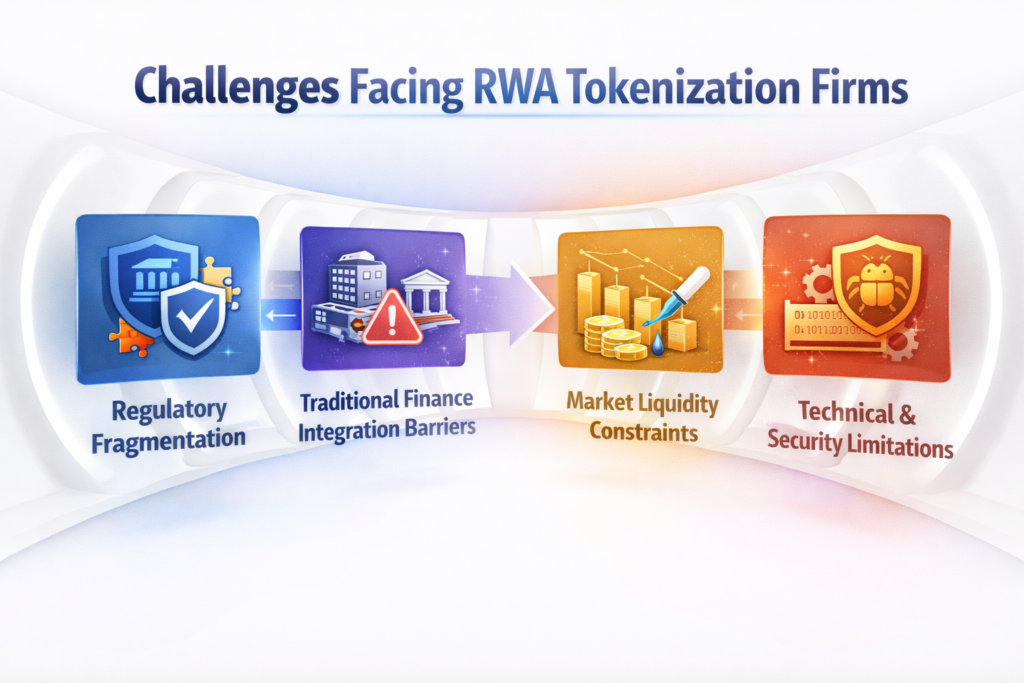
Real-world asset (RWA) tokenization is gaining momentum, but the industry still faces several important challenges. These issues affect how fast the market grows and how widely tokenized assets are adopted.
Understanding these challenges helps investors, institutions, and users see both the opportunities and the risks involved in this evolving sector.
Regulatory Fragmentation
One of the biggest challenges is the lack of a unified global regulatory framework. Different countries have different rules for tokenized assets, and in many cases, those rules are still evolving. This means a tokenized asset that is legally approved in one region may not be allowed in another.
For companies, this creates complexity. They must navigate multiple legal systems, comply with varying requirements, and often limit who can access their products based on location. It also increases costs, since legal and compliance processes must be tailored for each market.
Traditional Finance Integration Barriers
RWA tokenization connects blockchain technology with traditional finance, but these two systems are very different in how they operate. Traditional finance relies on established processes, strict controls, and legacy systems, while blockchain focuses on automation, speed, and decentralization.
Because of this difference, integration is not always smooth. Financial institutions tend to move cautiously, often testing tokenization through pilot programs before committing fully.
Market Liquidity Constraints
Tokenization is often promoted as a way to improve liquidity, but in reality, many tokenized assets still face low trading activity. This is mainly because the market is still developing.
Access to these assets is sometimes restricted to certain types of investors, which reduces the number of participants. In addition, tokenized assets are often spread across different platforms and blockchains, making it harder to create a unified and active marketplace.
Technical & Security Limitations
While blockchain technology provides strong advantages, it also introduces technical and security challenges, especially when dealing with real-world assets.
Smart contracts, which power tokenized assets, must be carefully designed and audited. Any flaws in the code can lead to serious issues, including financial losses. At the same time, tokenized assets depend on accurate real-world data, such as pricing or proof of reserves. If this data is unreliable, it can affect trust in the asset.
Also Read: Best Cryptos to Buy in 2026: A Beginner’s Honest Guide to the Top Coins
Conclusion
Real-world asset tokenization is rapidly transforming finance. Major institutions are already launching tokenized products, and billions of dollars are moving on chain, showing that this is more than just a trend.
Each platform offers different strengths. Some excel in institutional compliance and large-scale funds, while others focus on credit markets, DeFi integration, or retail accessibility. Choosing the right platform depends on your goals, risk tolerance, and type of asset.
Challenges remain, including regulation, liquidity, and technical limits, but these are part of a maturing market rather than insurmountable barriers.
For investors, fintechs, and institutions, the key is understanding the market, evaluating platforms carefully, and positioning to benefit from the growth of tokenized finance. The space is still early, but the potential impact on global finance is clear.
FAQs
What is RWA tokenization?
RWA (real-world asset) tokenization is the process of converting physical or financial assets like real estate, bonds, or treasury funds into digital tokens on a blockchain. This allows for easier trading, fractional ownership, and faster settlement, while maintaining compliance with regulations.
Why are institutions like BlackRock and Franklin Templeton entering RWA tokenization?
Large asset managers are adopting tokenization to increase efficiency, improve liquidity, and broaden investor access. Launching funds like BlackRock’s BUIDL allows institutions to manage large-scale assets on-chain, offering transparency and faster settlement compared to traditional finance systems.
How big is the RWA tokenization market?
By September 2025, the RWA tokenization market surpassed $30 billion, growing over 400% in three years. Analysts project it could reach $10 trillion by 2030, with some forecasts suggesting up to $30 trillion by 2034, as more institutions and investors adopt tokenized assets.
What should investors consider when choosing an RWA tokenization platform?
Key factors include regulatory compliance, asset types supported, liquidity, technology and blockchain infrastructure, and whether the platform focuses on institutional or retail users. Choosing the right provider affects operational costs, regulatory risk, and access to assets.
What challenges do RWA tokenization firms face?
The main challenges include regulatory fragmentation across regions, integration barriers with traditional finance systems, limited market liquidity, and technical or security limitations such as smart contract vulnerabilities and accurate asset verification.
Can retail investors access tokenized real-world assets?
Yes, some platforms like UEEx and certain DeFi protocols provide retail access to tokenized assets, including stocks, credit products, and funds. However, many high-value tokenized assets remain restricted to accredited or institutional investors, depending on regulatory requirements.