




Artificial Intelligence has become one of the most powerful tools redefining how traders interact with the crypto market. From predicting price trends to executing trades at lightning speed, AI in Crypto is transforming data into actionable insights that drive smarter decisions.
It doesn’t just automate, it also analyzes, learns, and adapts to real-time market movements with precision that human traders often can’t match.
With trading bots, predictive models, and sentiment analysis tools, AI is pushing the boundaries of what’s possible in crypto trading. These systems process massive amounts of data, identify profitable patterns, and minimize emotional trading errors.
In this guide, we’ll explore the role, benefits, and uses of AI in crypto trading and how it’s redefining digital finance.
Key Takeaways
- Artificial Intelligence enhances crypto trading by analyzing market data, predicting trends, and executing automated strategies that improve accuracy and efficiency.
- AI strengthens the crypto industry through fraud detection, security monitoring, and intelligent decision-making in decentralized governance systems.
- Integrating AI with cryptocurrency enables smarter trading automation, advanced portfolio management, and improved transparency across blockchain networks.
- The risks of AI in crypto include data bias, overfitting, lack of regulation, and potential security vulnerabilities that require careful oversight and continuous monitoring.
- The future of AI in cryptocurrency is poised to bring predictive analytics, quantum-enhanced processing, and intelligent decentralised finance (DeFi) protocols.
What Is AI and How Does It Apply to Blockchain and Digital Assets?
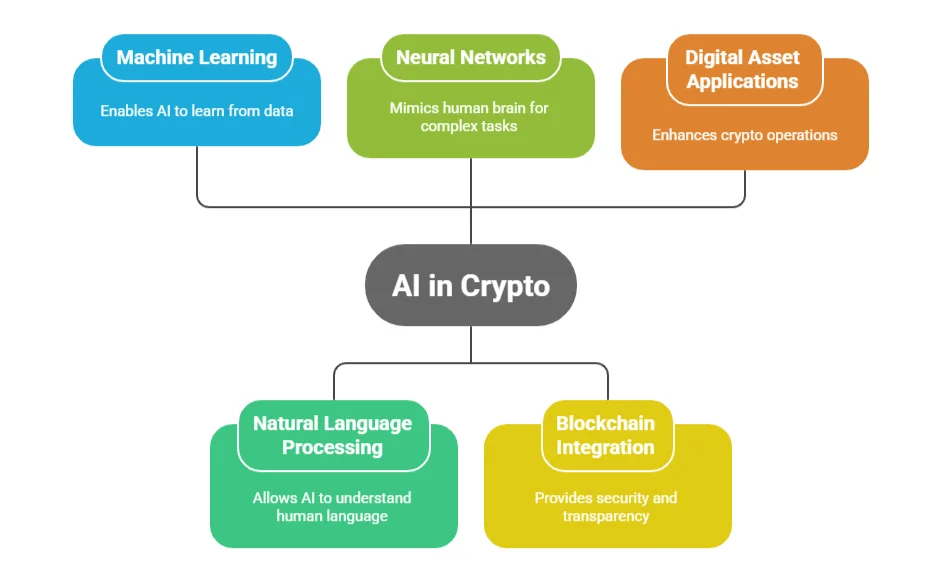
Artificial Intelligence (AI) refers to the use of computer systems capable of performing tasks that typically require human intelligence, such as learning, reasoning, and decision-making.
Through technologies like machine learning, natural language processing, and neural networks, AI systems can analyze large volumes of data, identify patterns, and make predictions with impressive accuracy.
When integrated with blockchain and digital assets, AI becomes a powerful enhancer. Blockchain provides transparency, immutability, and security, while AI adds intelligence, automation, and efficiency.
Together, they create smarter systems that can analyze on-chain data, detect fraudulent transactions, predict price movements, and optimize trading strategies.
In digital assets, AI applications extend to portfolio management, risk assessment, sentiment analysis, and smart contract automation, making crypto operations more precise and reliable.
Read Also: AI Crypto Trading: How It Works, Best Bots & Strategies (2026 Guide)
How AI Enhances Crypto Trading
Artificial Intelligence has become a powerful tool in the crypto market, enabling traders to make data-driven decisions, automate trades, and manage risks more effectively.
By integrating algorithms and predictive analytics, AI transforms complex market data into actionable insights, improving both precision and profitability.
Below, we’ll explore how AI truly enhances the crypto trading ecosystem across various dimensions:
Understanding AI-Based Crypto Trading
AI-based crypto trading uses machine learning and predictive models to analyze market data and make informed trading decisions automatically.
Instead of relying solely on human intuition or manual chart reading, AI systems process thousands of data points, including price charts, trading volumes, social sentiment, and macroeconomic indicators.
By identifying correlations and recurring market patterns, AI tools can anticipate future movements and respond more quickly than human traders. The result is smarter, data-backed trading strategies that continuously improve through self-learning algorithms.
How Algorithms Analyze Market Trends and Sentiment
AI algorithms rely on technical indicators, historical data, and behavioral analytics to understand market momentum. They process real-time information from exchanges, social media, and financial news to gauge investor sentiment.
For instance, if Twitter conversations or Reddit posts reveal growing optimism about Bitcoin, AI systems can detect this sentiment shift early and adjust trading strategies accordingly.
Similarly, they recognize bearish signals from declining trading volumes or price fluctuations. This combination of quantitative and qualitative data allows AI to make more holistic, context-aware trading decisions that go beyond surface-level indicators.
Role of Data Analytics in Predicting Price Movements
Data analytics serves as the foundation for AI-driven trading. Through predictive modeling, AI systems examine past trends to forecast future price actions with remarkable precision. They assess metrics such as moving averages, the Relative Strength Index (RSI), volatility, and liquidity levels.
Machine learning models also employ regression and classification techniques to detect subtle shifts in market dynamics that may precede price reversals or breakouts.
By transforming raw market data into actionable insights, AI enables traders to position themselves advantageously before major movements occur, ultimately improving profitability and reducing human error.
The Role of Crypto Trading Bots
Crypto trading bots are automated software programs that execute trades on behalf of users using preset rules or AI-driven algorithms.
These bots connect to crypto exchanges via APIs, monitor market conditions, and place buy or sell orders when specific criteria are met.
AI-powered bots differ from traditional bots because they continuously learn and adjust based on new market data. They don’t just follow static rules, they evolve, becoming smarter with each trade.
Types of AI-Powered Bots: Arbitrage, Trend-Following, Market-Making Bots
- Arbitrage Bots: Exploit price differences across exchanges to make instant profits.
- Trend-Following Bots: Identify and follow bullish or bearish trends using AI-based analysis.
- Market-Making Bots: Provide liquidity by placing buy and sell orders near current prices, earning profits from bid-ask spreads.
Each bot serves a specific purpose, but all share a common goal, to optimize returns through intelligent automation.
Role of AI in the Crypto Industry
Artificial Intelligence (AI) has emerged as a transformative force in the crypto industry, reshaping how trading, security, fraud prevention, and governance operate.
As blockchain technology continues to evolve, AI complements it by introducing automation, intelligence, and adaptability, three essential components for efficiency and innovation. From enhancing trading precision to securing decentralized networks, AI’s influence spans nearly every corner of the crypto ecosystem.
AI in Crypto Trading
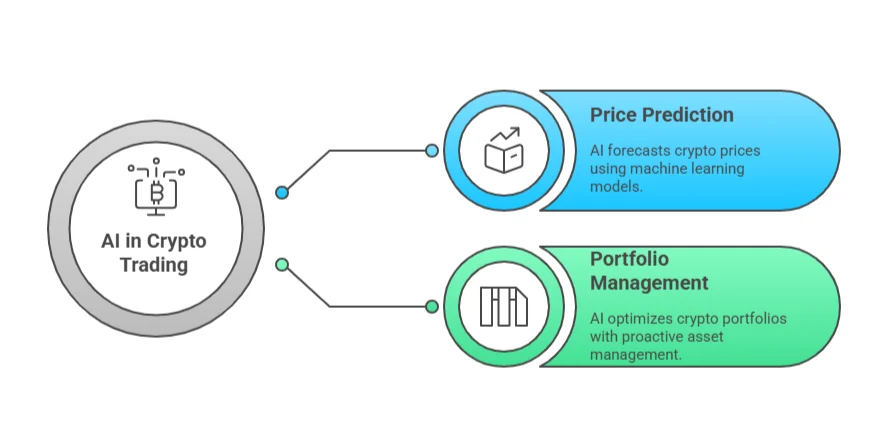
AI has become a core driver of efficiency and profitability in crypto trading. By processing massive datasets in real time, AI can detect price trends, anticipate market shifts, and execute trades automatically, all with minimal human intervention.
How AI Helps in Price Prediction and Portfolio Management
AI’s predictive capabilities are particularly valuable in the highly volatile crypto markets. Using machine learning models, AI analyzes historical data, trading volumes, social sentiment, and even global economic indicators to forecast price movements.
For instance, sentiment analysis tools can assess millions of tweets, news headlines, and blockchain transactions to identify bullish or bearish market behavior.
Beyond prediction, AI plays a critical role in portfolio management. Intelligent portfolio systems automatically rebalance assets, distribute risk, and optimize investments based on market performance.
These systems can identify underperforming assets, suggest alternatives, and help traders maintain diversification, all while operating 24/7. In essence, AI transforms crypto portfolio management from reactive decision-making to proactive optimization.
AI in Fraud Detection
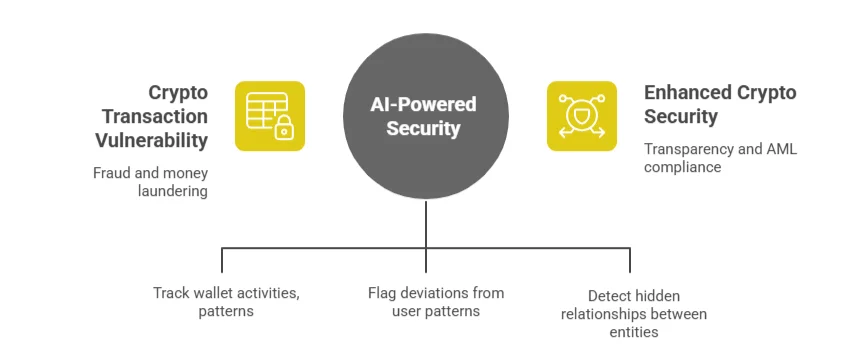
The anonymity and decentralization of blockchain make crypto transactions attractive targets for fraud and money laundering. AI provides a strong line of defense by continuously monitoring and analyzing transaction data for irregularities.
AI helps in:
Detecting Suspicious Transactions and Preventing Scams
AI-powered fraud detection systems track wallet activities, transaction patterns, and network behaviours in real time. When a transaction deviates from typical user patterns, such as a substantial transfer, a sudden spike in activity, or a connection with flagged addresses, AI models can instantly flag it for review.
These tools are particularly effective for crypto exchanges and wallet providers, helping them prevent phishing attacks, pump-and-dump schemes, and fake ICOs. Unlike manual monitoring, AI systems can analyze millions of transactions per second, offering a speed and precision level that’s impossible for humans to match.
Machine Learning Models for Identifying Money-Laundering Patterns
Machine learning (ML) algorithms excel at identifying complex laundering schemes by detecting hidden relationships between entities across multiple blockchains. By comparing on-chain data with off-chain intelligence (e.g., KYC databases), AI can uncover suspicious links between wallets or exchanges.
For example, clustering algorithms group transactions with similar behavioural traits, helping compliance teams identify layered transactions or “smurfing” tactics used to hide illicit funds. As a result, AI enhances compliance with Anti-Money Laundering (AML) regulations and strengthens transparency across the crypto ecosystem.
AI in Security
Security is one of the most critical aspects of the crypto industry, and AI
is playing an increasingly vital role in fortifying it. The combination of blockchain’s immutability and AI’s intelligence provides a multi-layered defense against threats targeting digital assets and infrastructure.
Using AI to Protect Wallets, Exchanges, and User Data
AI enhances digital asset security by continuously scanning for anomalies in user activity, system performance, and access logs. For example, AI can detect if a user’s account suddenly logs in from an unfamiliar IP address or if a wallet begins performing unauthorized transactions.
Crypto exchanges integrate AI-based security tools to identify intrusion attempts, prevent credential theft, and detect unusual withdrawal patterns.
Similarly, AI systems analyze biometric data and behavioral metrics, such as typing speed and login frequency, to authenticate users more securely than passwords alone.
AI-Driven Threat Detection and Vulnerability Monitoring
AI systems can predict and neutralize cyber threats before they escalate. Using predictive analytics, these tools assess network vulnerabilities and monitor blockchain nodes for potential exploits. By learning from previous attacks, AI continuously refines its models to detect new forms of malware, ransomware, and phishing attempts.
Some blockchain projects even employ AI-driven smart contracts capable of pausing or rerouting suspicious transactions until verification is complete. This proactive approach significantly reduces the risk of large-scale breaches and financial losses.
AI in Governance
As decentralized finance (DeFi) and blockchain ecosystems grow more complex, governance has become a key factor in ensuring fairness, efficiency, and sustainability. AI introduces a new dimension of intelligence to blockchain governance by automating decision-making and enhancing transparency.
How Decentralized Autonomous Organizations (DAOs) Can Use AI
DAOs, blockchain-based organizations governed by code and community votes, can use AI to improve operational efficiency. AI tools can analyze proposals, voter behaviour, and financial data to recommend actions that align with the DAO’s objectives.
For instance, AI can evaluate which projects deserve funding based on risk assessments, performance predictions, and community engagement metrics.
Additionally, AI-powered analytics enable DAOs to understand member sentiment and voting trends, leading to more informed governance decisions. This integration creates a dynamic ecosystem where collective intelligence is amplified through machine learning insights.
AI’s Role in Decision-Making and Protocol Upgrades
AI can also streamline blockchain protocol upgrades by analyzing network performance and suggesting optimizations. For example, it can assess transaction speeds, gas fees, and user adoption rates to determine when a protocol needs an update.
Moreover, AI algorithms can simulate the potential outcomes of proposed governance changes, allowing communities to make data-driven decisions rather than relying solely on speculation or bias. This fusion of AI and governance ensures that blockchain networks evolve in a balanced, efficient, and transparent manner.
Advantages of Integrating AI with Cryptocurrency
The integration of Artificial Intelligence (AI) with cryptocurrency is revolutionizing how digital assets are traded, secured, and managed. AI adds intelligence and automation to blockchain operations, making them more efficient, predictive, and transparent.
Below are the key advantages of merging AI with cryptocurrency:
Enhanced Market Analysis and Price Prediction
AI can process massive amounts of real-time and historical market data to identify trading patterns that human analysts might overlook. Through machine learning algorithms, it analyzes factors like volume, volatility, sentiment, and on-chain activity to predict price movements more accurately.
This helps traders anticipate market shifts, manage entry and exit points effectively, and minimize losses caused by emotional or impulsive decisions. As a result, AI transforms crypto trading into a data-driven, insight-rich experience.
Improved Security and Fraud Detection
Crypto transactions, while decentralized, remain vulnerable to hacks and scams. AI strengthens security by detecting unusual wallet activities, phishing attempts, and suspicious transactions.
Machine learning models continuously learn from past threats, improving their ability to identify new attack vectors. Exchanges and wallets now use AI-powered systems to verify identities, flag money-laundering attempts, and monitor transactions in real time, ensuring safer participation in the crypto market.
Smarter and More Efficient Trading Automation
AI enables automated trading bots that execute trades instantly based on pre-set or adaptive strategies. These bots operate 24/7, eliminating delays and emotions from decision-making.
Unlike traditional bots, AI-powered systems evolve by learning from new market conditions, improving strategy performance over time. This automation not only saves time but also ensures that opportunities are captured even when traders are offline.
Better Portfolio and Risk Management
Managing a diversified crypto portfolio can be complex, but AI simplifies it by automatically analyzing asset performance, assessing risk levels, and rebalancing holdings. AI systems recommend optimal allocations based on user goals and market conditions.
They can identify underperforming assets, rebalance investments, and minimize exposure to volatility. This intelligent approach allows investors to maintain stability and maximize returns in unpredictable crypto markets.
Enhanced Transparency and Decision-Making
AI contributes to greater transparency in blockchain governance and ecosystem management. By analyzing on-chain data, AI helps detect irregularities, verify authenticity, and assess protocol performance.
It also supports decentralized autonomous organizations (DAOs) by providing data-driven insights for voting and decision-making. The outcome is a more accountable, transparent, and efficient governance process that aligns with community interests and long-term sustainability.
Risks and Challenges of AI in the Crypto
While Artificial Intelligence (AI) has introduced groundbreaking innovations in cryptocurrency trading, security, and governance, it also comes with notable risks and challenges.
As powerful as AI can be, its effectiveness depends on the quality of data, ethical use, and the systems built around it. Understanding these risks is essential for traders, developers, and investors to make informed decisions when integrating AI into crypto activities.
Data Quality and Bias
AI systems heavily rely on data, and in the cryptocurrency space, this data often originates from unpredictable and volatile markets.
Poor-quality or incomplete datasets can lead to inaccurate predictions or flawed trading strategies. Moreover, data bias can distort AI outputs, causing systems to favour certain assets, exchanges, or behavioural trends.
If the training data is manipulated or unrepresentative of real conditions, AI models may make poor decisions that lead to financial loss or misinterpretation of market sentiment.
Overfitting and Model Dependence
Overfitting occurs when AI algorithms learn patterns too precisely from historical data, making them ineffective in new or changing market conditions. In cryptocurrency trading, where price movements can shift abruptly due to global news or market manipulation, overfitted models may fail to adapt effectively.
Traders relying solely on such models can face unexpected losses. This challenge underscores the importance of continuous retraining and validation of AI systems with updated market data.
Lack of Regulation and Transparency
The use of AI in crypto exists primarily in a gray regulatory area. Many AI-driven trading platforms and bots operate without clear oversight or disclosure of how their algorithms function.
This lack of transparency raises concerns about accountability, especially if AI systems make erroneous trades or expose user data. In the absence of established legal frameworks, users risk losing funds with limited recourse for recovery or dispute resolution.
Security Vulnerabilities and System Manipulation
Although AI enhances security, it can also become a target for exploitation. Hackers can manipulate AI models through data poisoning attacks, feeding them false or misleading data to trigger bad decisions.
Additionally, malicious actors can reverse-engineer algorithms to predict their behaviour and exploit weaknesses in automated trading systems. As AI becomes more embedded in crypto infrastructure, maintaining the security and integrity of these models becomes increasingly complex.
Read Also: How to Pay for Claude AI with a Crypto Card
Ethical and Privacy Concerns
AI systems often analyze vast amounts of user and transaction data, raising privacy concerns. Inadequate handling of this data could lead to breaches of personal or financial information.
Furthermore, there are ethical challenges related to AI decision-making, such as when algorithms execute trades or actions that disadvantage certain users or markets. Ensuring fairness, consent, and transparency in AI-driven crypto applications remains a significant challenge for developers and regulators alike.
The Future of Artificial Intelligence in Cryptocurrency
The integration of Artificial Intelligence (AI) and cryptocurrency is still in its early stages, yet it’s already redefining how digital assets are traded, secured, and governed.
As blockchain technology continues to mature, AI’s role will expand, enabling smarter, faster, and more autonomous financial systems.
The future promises a more interconnected digital world where predictive analytics, automation, and decentralized intelligence drive innovation and decision-making across the crypto market.
Predictive AI, Quantum Computing, and AI-Based DeFi Protocols
One of the most promising developments in crypto is predictive AI, which uses deep learning and advanced modelling to forecast market behaviour with increasing precision.
Future systems will be able to analyze not just price charts but also complex macroeconomic indicators, social sentiment, and global blockchain activity to anticipate major market shifts before they occur. Predictive AI could evolve into a trusted decision-making partner for both retail and institutional investors.
Meanwhile, quantum computing is set to revolutionize both AI and blockchain by exponentially increasing computational power.
Quantum-enhanced AI could process and secure massive crypto transactions at speeds previously unimaginable, while also posing challenges to traditional encryption methods. The emergence of quantum-resistant blockchains will likely become a focus for developers aiming to protect digital assets in the next computing era.
Another emerging frontier is AI-based DeFi (Decentralized Finance) protocols. These intelligent systems will autonomously manage liquidity pools, lending rates, and yield optimization.
By combining AI’s analytical capabilities with DeFi’s transparency, these platforms can dynamically adjust to market volatility, minimize risks, and deliver more sustainable returns, all without human intervention.
The Evolving Synergy Between AI and Blockchain
AI and blockchain complement each other in profound ways. Blockchain ensures data integrity, transparency, and traceability, while AI brings intelligence, automation, and adaptability. Together, they form a foundation for trustworthy and self-improving systems.
In the near future, blockchain networks could serve as decentralized databases for AI models, ensuring they are transparent and tamper-proof. Smart contracts may also evolve into self-learning agreements, capable of adjusting parameters based on performance or real-world conditions.
Moreover, AI can optimize blockchain operations, from energy-efficient mining to transaction routing, making blockchain ecosystems faster, greener, and more scalable.
As interoperability between AI systems and blockchains increases, we can expect new forms of decentralized intelligence where algorithms collaborate across multiple networks, enabling collective learning and decision-making without centralized control.
Long-Term Implications for Investors, Traders, and Developers
For investors, the future will bring AI-driven tools that provide real-time portfolio insights, risk forecasts, and personalized investment strategies. Predictive AI models could help investors understand market cycles with unprecedented clarity, reducing uncertainty in volatile markets.
For traders, AI will act as a constant analytical partner, monitoring hundreds of assets simultaneously, adapting to global news events, and executing trades with precision. The integration of sentiment analysis, quantum processing, and predictive data models will redefine what it means to have a trading edge.
For developers, the rise of AI in crypto will create new opportunities to build intelligent dApps, security frameworks, and decentralized systems. The demand for transparency and ethical AI will prompt developers to design models that are auditable and fair, ensuring accountability in every automated decision.
Final Thoughts
Artificial Intelligence is redefining how cryptocurrency operates, from smarter trading and fraud detection to stronger security and governance. Its integration is making the crypto market more efficient, data-driven, and transparent.
As predictive analytics, automation, and blockchain intelligence continue to advance, investors and developers will gain tools that enhance accuracy and trust in digital finance.
The key is using AI responsibly, combining human judgment with machine precision. With continued innovation and collaboration, AI in crypto will not only improve how assets are traded and managed but also set the foundation for a more intelligent financial future.
Frequently Asked Questions
Is There an AI for Cryptocurrency?
Yes, several AI systems are designed for cryptocurrency, they analyze market data, predict price movements, automate trading, and enhance security across blockchain platforms.
Can AI Predict Crypto Prices?
Yes, AI can predict crypto prices to a certain extent by analyzing historical data, market trends, and sentiment patterns; however, its accuracy is limited by the crypto market’s volatility and unpredictable external factors.
How To Use AI To Make Money in Crypto?
You can use AI to make money in crypto by automating trading with AI-powered bots, using predictive analytics for price forecasting, and employing AI tools for portfolio optimization. These systems analyze real-time market data, identify profitable opportunities, and execute trades faster and more accurately than manual methods, helping you maximize returns while managing risk.
Is AI Good or Bad for Crypto?
AI is primarily suitable for crypto because it enhances trading accuracy, improves security, and automates complex tasks, but it also carries risks, such as data bias, a lack of regulation, and potential system manipulation, if not properly managed.
Which AI Bot Is Best for Crypto Trading?
The best AI bot for crypto trading depends on your goals, but 3Commas, Pionex, and Bitsgap are top choices for their reliability, automation features, and real-time analytics.