



In the cryptocurrency market, not all investors are created equal. Among the countless traders and holders, some stand out , the crypto whales.
These are individuals or institutions holding enormous amounts of digital currency, powerful enough to sway prices with a single move. Their actions can spark sudden rallies, wipe out margin positions, or create waves of panic among smaller traders.
Whales don’t just trade; they shape the rhythm of the market. Some quietly accumulate over months, quietly influencing supply and demand, while others make dramatic, high stakes moves that everyone notices, like the infamous $1.8 billion liquidation cascade in September 2025 or the Trump Tariff Whale in October 2025.
For anyone trading or investing in crypto, understanding whales is essential. Observing their strategies and recognizing their influence can help you make smarter decisions, avoid costly mistakes, and spot opportunities that others might miss. In short, knowing the whales means learning to manoeuvre the waters where fortunes are made and lost.
Key Takeaway
- Individuals or institutions holding massive crypto positions can move markets, trigger liquidations, and create volatility that affects all traders.
- Whales often act during low-liquidity periods, like weekends, to maximize impact, demonstrating the importance of understanding market cycles.
- Some whales quietly accumulate or hold for the long term, while others strategically exploit market conditions; context is key.
- On-chain explorers, whale alerts, and analytics platforms help investors monitor large movements, but interpreting them correctly is essential.
- Managing risk, staying calm during volatility, and avoiding emotional reactions are essential for surviving and thriving alongside whales.
What is a Crypto Whale?

A crypto whale refers to any individual, institution, or organization that holds a very large amount of a particular cryptocurrency, so much that their buying or selling activity can noticeably affect the market.
In simple terms, a whale is someone whose financial “weight” is heavy enough to create waves in the crypto market.
Because blockchains are transparent, large transactions can often be seen by anyone. Platforms such as CoinMarketCap make it easy for traders and analysts to observe major wallet movements.
When a large transfer appears on the blockchain, many people immediately assume that a whale is preparing to buy, sell, or reposition their assets.
The word “whale” is based on an ocean analogy. The crypto market is like a sea filled with different participants. Most investors are small “fish” or “minnows” who can trade freely without affecting prices.
Whales, on the other hand, are so large that when they move, the surrounding market feels the impact. A single major purchase can push prices up, while a large sell off can cause sudden drops.
This is why whale activity is often linked to volatility, speculation, and intense market reactions.
Also Read: Stablecoin Regulation in 2026: Global Laws, Benefits, and Challenges
How Much Crypto Makes a Whale?
There is no single, official amount that qualifies someone as a crypto whale. The definition depends on the cryptocurrency, its total supply, and its market size.
In general, whales are identified by their relative influence rather than a fixed number. A wallet becomes “whale-sized” when its holdings are large enough to affect liquidity and price behavior.
Common thresholds (e.g., 1,000+ BTC; 1% of circulating supply)
Industry references and companies like Ledger commonly point to informal benchmarks. For Bitcoin, wallets holding around 1,000 BTC or more are often considered whales. For Ethereum, this threshold is usually much higher in terms of token count. For smaller altcoins, owning even 1% of the circulating supply can be enough to qualify.
These figures are only guidelines. Market conditions change constantly, and a wallet that qualifies as a whale today may lose that status tomorrow if prices fall or supply expands.
Several factors explain why there is no universal standard. Cryptocurrency prices are highly volatile, meaning the real value of holdings changes daily. Token supplies differ widely across projects. Some coins have limited caps, while others issue billions of tokens.
Differences by cryptocurrency type (BTC vs. ETH vs. altcoins)
In addition, many large wallets belong to exchanges or custodial services, not individuals. The type of cryptocurrency also makes a major difference.
Bitcoin is highly decentralized and widely distributed. As a result, influencing its price usually requires enormous capital. Most Bitcoin whales are early adopters, mining entities, or large institutions.
Ethereum has strong connections to staking, DeFi, and governance. Many ETH whales control large staking pools or liquidity positions, giving them influence beyond simple buying and selling.
Altcoins and meme coins are much more sensitive. Because their market caps are smaller, a relatively modest investment can represent a large percentage of total supply.
Types of Crypto Whales
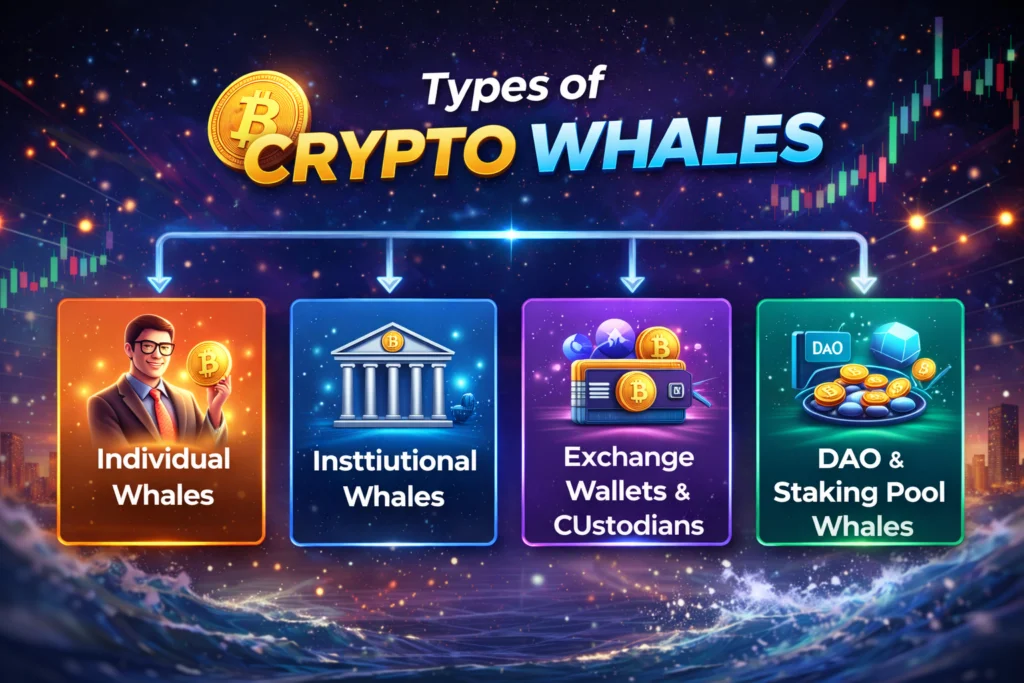
Crypto whales are not all the same. They differ in motivation, structure, and impact on the market. Understanding these differences helps investors interpret whale movements more accurately.
Individual Whales
Individual whales are private investors who have accumulated large crypto holdings over time. Many entered the market early, when prices were low, and held their assets through multiple market cycles. Others built their positions through strategic trading or business success.
These whales often operate quietly. They may spread their funds across multiple wallets to protect privacy and reduce attention. Some prefer long-term holding, believing in the future of blockchain technology. Others actively trade, using their capital to benefit from market swings.
Individual whales may influence prices unintentionally. A simple decision to rebalance a portfolio can create large ripples, even when manipulation is not intended.
Institutional Whales (Funds and Corporations)
Institutional whales are organizations that invest in crypto as part of a formal business strategy. These include hedge funds, venture capital firms, public companies, and asset managers.
Unlike individual whales, institutions usually follow structured investment plans. Their decisions are often based on research, regulations, and long-term goals. When they enter or exit a position, it tends to attract significant media and market attention.
Institutional buying is often seen as a sign of confidence in the market. Large-scale selling, on the other hand, can spark fear and uncertainty. Because of their visibility, institutional whales strongly influence public perception of crypto.
Exchange Wallets and Custodians
Some of the largest wallets on blockchains do not belong to investors at all. They belong to exchanges and custodial platforms that hold funds for millions of users.
These wallets manage deposits, withdrawals, and internal transfers. As a result, they frequently move very large amounts of crypto. To inexperienced observers, these movements may look like whale activity, even when no real buying or selling is happening.
This is why context is essential. A transfer from an exchange to a cold wallet may simply reflect security practices. A movement between internal addresses may be routine maintenance. Not every large transaction signals a market event.
DAO and Staking Pool Whales
In modern crypto ecosystems, some whales are collective entities rather than individuals. Decentralized Autonomous Organizations (DAOs), staking pools, and liquidity platforms often control enormous amounts of tokens on behalf of many users.
These entities influence the market through governance, staking decisions, and protocol participation. When a DAO votes on major upgrades or reallocates funds, the effects can be felt across the network. Large staking pools can also influence validation and reward systems.
Although their funds belong to many participants, their collective size gives them whale level power. In this sense, influence is centralized at the protocol level, even when ownership is decentralized.
Why Crypto Whales Matter

In the cryptocurrency market, price movements are rarely random. Behind many sudden rallies, sharp crashes, or unusual trading patterns, there is often the influence of crypto whales. Because of the size of their holdings, whales play a powerful role in shaping market behavior, investor emotions, and overall stability.
Understanding why whales matter helps you see beyond surface-level price charts and recognize the deeper forces driving market trends.
Market Impact & Volatility
One of the most important reasons crypto whales matter is their ability to move prices quickly and dramatically.
When a whale places a large buy order, it increases demand almost instantly. If there are not enough sellers at the current price, the market is forced upward to find new sellers. This often leads to sudden price spikes that appear “out of nowhere” to ordinary traders.
In the same way, when a whale sells a large amount of cryptocurrency, supply suddenly floods the market. If buyers are limited, prices fall rapidly as sellers compete to exit their positions. This can trigger chain reactions where other traders start selling out of fear, making the drop even worse.
Market Sentiment & Psychological Impact
Beyond numbers and charts, crypto whales strongly influence how people feel about the market.
In crypto, emotions spread quickly. When traders notice a large wallet buying aggressively, many interpret it as a sign of “inside knowledge” or strong confidence. This can trigger excitement and fear of missing out. Retail investors rush in, hoping to ride the same wave.
On the other hand, when a whale moves funds to an exchange or starts selling, it often sparks panic. Many investors assume a crash is coming, even when there is no confirmed reason. This leads to emotional selling, which further pushes prices down.
Liquidity & Order Book Effects
Another key reason crypto whales matter lies in how they affect liquidity and order books.
When whales add funds to the market by placing large buy or sell orders, they can temporarily increase liquidity. This can make trading smoother and reduce short-term volatility, especially in major assets like Bitcoin or Ethereum.
However, whales can also drain liquidity. If a whale removes a large portion of available supply by buying and holding, fewer tokens remain for trading. This makes the market thinner and more sensitive to price changes. Similarly, when a whale sells aggressively, they can exhaust buying interest and leave the market unstable.
The Bigger Picture: Why This Matters to You
Crypto whales matter because they sit at the intersection of money, psychology, and market structure.
They influence how fast prices move, how stable markets remain, how investors feel, and how easily assets can be traded. Their actions can turn calm markets into chaotic ones or ignite powerful rallies in a matter of minutes.
For retail investors, understanding whale behavior is not about copying their moves blindly. It is about gaining awareness. When you know why whales matter, you are better equipped to:
- Avoid emotional trading during sudden moves
- Interpret large transactions correctly
- Recognize manipulation attempts
- Manage risk more effectively
- Stay focused on long term strategy
Major Institutional Whales
| Rank | Entity | Estimated BTC Holdings | Share of Total Supply | Source of Holdings | Market Influence | Key Advantage (Pro) | Key Risk (Con) |
| 1 | Satoshi Nakamoto | ~1,000,000 BTC | ~4.8% | Early mining | Extremely high (inactive) | Strengthens Bitcoin’s scarcity narrative | Risk of massive market shock if coins ever move |
| 2 | MicroStrategy | 580,000+ BTC | ~2.76% | Corporate treasury purchases | Very high | Signals strong institutional confidence | Heavy dependence on Bitcoin price volatility |
| 3 | BlackRock iShares Bitcoin Trust (IBIT) | Estimated 600,000+ BTC (combined exposure) | ~3%+ | ETF inflows | Very high | Boosts mainstream adoption and liquidity | Centralizes BTC under traditional finance control |
| 4 | U.S. Government | 198,000+ BTC | ~0.94% | Criminal seizures | High (periodic selling) | Transparent custody and legal oversight | Government sales can crash prices |
| 5 | Binance (Customer Wallets) | Estimated 500,000+ BTC | ~2.4% | User deposits | Very high | Provides deep liquidity for traders | Custody and regulatory risks |
| 6 | Tesla | Estimated 9,000–11,000 BTC | ~0.05% | Corporate investment | Medium | Corporate adoption visibility | History of sudden buying/selling decisions |
| 7 | Block.one | 140,000+ BTC | ~0.67% | Early accumulation | Medium | Long-term holding stability | Limited transparency on usage |
| 8 | Hut 8 Mining | 10,000+ BTC | ~0.05% | Mining rewards | Low–Medium | Supports network security | Exposed to mining and energy costs |
| 9 | Galaxy Digital | ~40,000 BTC | ~0.19% | Trading and investment | Medium | Professional market-making support | Active trading may amplify volatility |
| 10 | Pantera Capital | Undisclosed (Large Holdings) | N/A | Early fund investments | Medium | Early-stage ecosystem support | Limited public transparency |
In Bitcoin and crypto ownership, a small group of entities controls astonishing amounts of the world’s most valuable digital asset. These large holders aren’t just numbers on a blockchain; they represent the shift of Bitcoin from an experimental asset to a mainstream store of value held by governments, corporations, funds, and legendary early adopters.
Below, we explore the biggest institutional whales shaping the Bitcoin ecosystem, explaining who they are and why their holdings matter.
Satoshi Nakamoto: The Original Whale
At the top of the list sits the most mysterious figure in crypto: Satoshi Nakamoto, the pseudonymous creator of Bitcoin. Satoshi is widely believed to control roughly around 1 million BTC, which has never been moved or spent since these coins were mined in Bitcoin’s earliest days.
This stash alone is worth over $60 billion at current prices, and its untouched status has fueled endless speculation about both Bitcoin’s decentralization and the possible market shock if even a fraction of it were ever accessed.
The existence of this dormant treasury serves as a reminder of how Bitcoin’s initial distribution still influences the market more than a decade after its inception.
MicroStrategy: A Corporate Bitcoin Bet
One of the most well-known proponents of Bitcoin is MicroStrategy, a publicly traded business intelligence firm led by Michael Saylor. Unlike many companies that treat Bitcoin as a small part of their portfolio, MicroStrategy has embraced Bitcoin as its core treasury asset.
By late 2025, the company had accumulated hundreds of thousands of BTC, with some estimates placing its holdings above 580,000 BTC, representing over 2–3% of Bitcoin’s total supply.
This enormous position is part of a long-term “digital gold” strategy, in which MicroStrategy converts corporate capital into Bitcoin to hedge against inflation and currency risk. Its aggressive accumulation has not just made it an institutional whale but a cultural symbol of corporate confidence in crypto.
BlackRock iShares Bitcoin Trust ETF: Institutional Adoption in Action
In 2025, institutional demand for Bitcoin reached new heights with the rise of spot Bitcoin ETFs. The BlackRock iShares Bitcoin Trust (IBIT) emerged as one of the largest Bitcoin holders in the world, accumulating hundreds of thousands of BTC through investor inflows into its ETF product.
Some estimates suggest IBIT alone controls around 600,000+ BTC, making it one of the biggest institutional whales globally. Unlike corporate treasuries or exchange cold wallets, BlackRock’s ETF represents a collective institutional position, a pool of Bitcoin owned on behalf of investors from pensions, endowments, and institutional portfolios.
Its growth reflects both regulatory progress (especially in the U.S. ETF market) and the mainstreaming of Bitcoin as an investable asset class.
United States Government: The State as Whale
Governments rarely enter conversations about Bitcoin ownership, but the United States Government holds a substantial stash, mostly acquired through criminal seizures over the years.
The U.S. government’s Bitcoin reserves are estimated at nearly 198,000+ BTC, making it one of the largest public sector holders in the world.
These coins are typically locked in evidence or long term storage and not actively traded. Still, the sheer quantity underscores how Bitcoin has intersected with law enforcement, regulation, and national asset holdings, blurring the lines between private finance and sovereign finance.
Binance: Exchange Cold Wallet Power
As the world’s largest cryptocurrency exchange by trading volume, Binance holds an enormous amount of Bitcoin in its cold wallets, secure storage for assets belonging to customers on the platform. Exact numbers are hard to verify, but industry analysis places Binance’s Bitcoin holdings well into the hundreds of thousands (often estimated around 500,000+ BTC).
These holdings are not Binance’s own profit assets but rather custody for users. Nevertheless, the concentration of Bitcoin on exchanges like Binance means that when funds are moved, transferred to trading wallets, or repositioned off exchange, price impact can be significant due to the sheer scale of these wallets.
Block.one: Early Accumulator from the ICO Era
Block.one, the company behind the EOS blockchain, is reported by industry sources to have been an early accumulator of Bitcoin during the ICO boom.
While precise, audited numbers are harder to confirm, estimates often place Block.one’s holdings in the ballpark of 140,000+ BTC, reflecting strategic diversification from altcoin ecosystems into Bitcoin.
This makes Block.one one of the largest private corporate holders outside of the traditional financial world.
Hut 8 Mining: The Miner Whale
Among Bitcoin mining firms, Hut 8 Mining Corp. stands out as a major whale. Unlike companies that trade what they mine, Hut 8 has historically held a significant portion of the BTC it earns from block rewards, accumulating over 10,000 BTC.
Mining whales like Hut 8 represent a different type of institutional holder, they hold Bitcoin as operating capital and strategic reserve. During bull markets, this strategy pays off as both Bitcoin price and mining valuation rise together.
Galaxy Digital: Strategic Investment Firm
Founded by Michael Novogratz, Galaxy Digital is a diversified crypto investment firm with substantial Bitcoin holdings. While exact quantities vary depending on market conditions and trading strategies, Galaxy Digital’s BTC stash is estimated at tens of thousands of coins (often around 40,000+ BTC).
Unlike some holders that accumulate and hold exclusively, Galaxy blends investment management, trading, and asset allocation, giving it a unique role among institutional whales.
Pantera Capital: Pioneer Crypto Fund
Pantera Capital was one of the earliest crypto-focused investment funds, launching Bitcoin funds long before many traditional firms entered the space.
Though Pantera does not publicly disclose exact BTC holdings, it is widely regarded within industry circles as possessing significant Bitcoin reserves relative to its fund size and strategy, making it one of the longstanding institutional whales in the ecosystem.
Pantera’s presence illustrates how crypto-native institutional capital has shaped market dynamics from early adoption to present-day accumulation.
Tools & Methods for Tracking Crypto Whales

In today’s transparent blockchain environment, whale activity is no longer hidden behind closed doors. With the right tools and a basic understanding of on-chain data, anyone can observe large transactions in real time. This has transformed how traders analyze markets, manage risk, and anticipate major price movements.
On-Chain Monitoring Tools
On-chain monitoring tools are platforms that scan blockchain networks and report unusually large transactions. They act as early warning systems, alerting the public when major wallets move funds.
Two of the most widely followed services in this space are Whale Alert and WhaleStats.
- Whale Alert focuses on tracking large transfers across multiple blockchains. When millions of dollars’ worth of Bitcoin, Ethereum, or stablecoins move between wallets or exchanges, the platform reports it publicly, often within seconds. Many traders rely on these alerts to stay informed about potential market shifts.
- WhaleStats, on the other hand, goes deeper into analytics. It monitors the largest wallets in different ecosystems and analyzes their holdings, trading behavior, and investment patterns. It is especially popular in altcoin and meme-coin communities, where whale concentration is high.
Blockchain Explorers
Blockchain explorers are another essential method for tracking whale activity. They allow anyone to view transactions, wallet balances, and historical records directly on the blockchain. Using an explorer, you can see:
- How much crypto a wallet holds
- Where funds are coming from
- Where they are being sent
- How often transactions occur
- The timing and size of movements
Trading Platforms Showing Whale Activity
Many modern crypto trading platforms now integrate whale tracking features directly into their interfaces. These include exchange feeds, analytics dashboards, and market activity panels that highlight unusually large trades.
When a massive buy or sell order is placed, some platforms flag it automatically. This allows traders to see when institutional-sized capital enters or exits the market.
These feeds are especially useful during periods of high volatility. They help traders understand whether price movements are driven by small investors or large players. However, relying only on exchange data can be misleading. Some whales trade through over-the-counter (OTC) desks, private deals, or decentralized platforms.
Case studies and Real world Examples
In October 2025, one of the most controversial whale events in crypto history unfolded almost in real time.
On October 10, at exactly 20:50 UTC, President Donald Trump posted on Truth Social announcing a sudden 100% tariff on Chinese imports. Within minutes, panic spread across global markets. Crypto prices plunged, triggering over $19.1 billion in liquidations, the largest wipeout the industry had ever recorded.
But while millions of traders were caught off guard, one massive player appeared perfectly prepared. Investigators on Hyperliquid, a fully on-chain derivatives exchange, discovered a $1.1 billion short position on Bitcoin and Ethereum that had been opened nearly 30 hours before the announcement.
The position was closed shortly after the market crash, locking in more than $150 million in profit. On-chain analyst Eye, later traced the wallets to accounts linked to Garrett Jin, the former CEO of the collapsed BitForex exchange, which had exited in 2024 amid a $57 million scandal.
Arkham Intelligence labeled the wallet the “Trump insider whale,” sparking intense debate across the crypto community.
Although no legal action followed largely due to weak insider trading regulations in crypto, the incident became a powerful reminder of how information, timing, and capital can give whales a massive edge over everyday traders.
September 2025: $1.8 Billion Liquidation Cascade, A Coordinated Whale Attack
On September 22, 2025, crypto markets experienced one of the most dramatic wipeouts of the year roughly $1.8 billion in margin positions were liquidated within a single 24 hour period, according to data from Coinglass and industry observers.
Analysts found that whales exploited weekend liquidity air pockets, when retail trading thins out, forcing stop-losses and automatic liquidations. This cascade effect amplified the crash, showing how whales can strategically hunt retail positions for profit.
The result on September 22 was brutal: as Bitcoin, Ethereum, and other major tokens dipped, the market’s derivatives systems went into auto-liquidation mode, unwinding hundreds of thousands of positions and draining nearly $2 billion from the market’s derivatives side.
How Retail Traders Should React to Whales
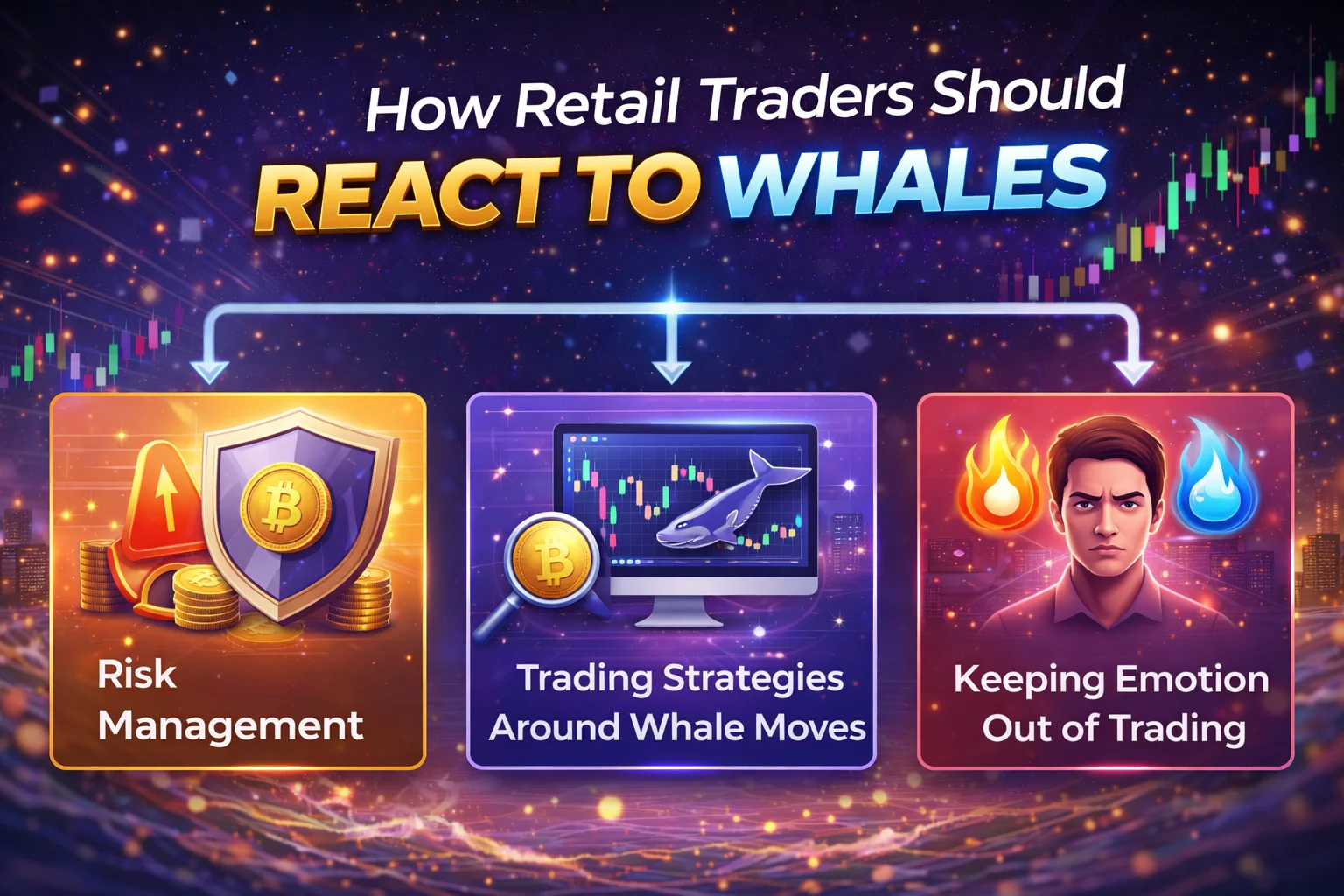
Alt text: Image showing ways retail traders react to crypto whales
Crypto whales are not going away. Their presence is now a permanent feature of digital markets. The key for retail traders is not to fight them, but to learn how to operate wisely in a whale dominated ecosystem. Below are best practices for small investors.
Risk management.
Retail investors should avoid putting large portions of their capital into highly concentrated assets. Diversification across projects, sectors, and strategies reduces exposure to whale driven crashes.
Position sizing is equally important. No single trade should be large enough to cause emotional distress or financial instability. It is also essential to verify information before reacting. Not every large transaction is meaningful, and many “whale alerts” are misunderstood.
Trading Strategies Around Whale Moves
During accumulation phases, prices often move sideways while volume increases. This can signal long-term positioning. During distribution phases, repeated sell-offs and weakening support may indicate upcoming declines.
Some traders position themselves after major whale moves rather than during them. For example, waiting for a price to stabilize after a large sell-off can reduce risk. Others focus on confirmation signals such as volume, trend strength, and market structure instead of reacting to isolated transactions.
Keeping Emotion Out of Trading
Whale activity often triggers fear of missing out, panic selling, or impulsive buying. These reactions usually lead to poor decisions. Successful traders learn to separate emotions from strategy. They rely on predefined plans, clear entry and exit rules, and disciplined execution. Building psychological resilience involves:
- Accepting losses as part of learning
- Avoiding overtrading
- Limiting exposure to hype-driven content
- Focusing on long-term goals
Conclusion
Crypto whales are among the most powerful forces in the digital asset ecosystem. From multi-billion-dollar positions that can move entire markets to strategic maneuvers exploiting thin liquidity, these whales shape price action, market sentiment, and investor behavior in ways ordinary traders rarely experience.
Case studies like the Trump Tariff Whale and the $1.8 billion liquidation cascade illustrate both the opportunity and danger that whales represent, their moves can create extreme volatility, massive liquidations, or sudden rallies, often without warning.
For retail investors, understanding whales is not about competing with them but learning to navigate their influence wisely. This means recognizing patterns, avoiding panic-driven decisions, managing risk through proper position sizing and diversification, and maintaining emotional discipline.
Tools like on-chain trackers, blockchain explorers, and trading alerts can help monitor whale activity, but knowledge and preparation remain the most important safeguards.
Ultimately, whales underscore a central truth of crypto markets: they are high risk, high reward arenas. While whales can create volatility, they also bring liquidity, legitimacy, and long-term confidence. By studying their behavior and approaching markets strategically, smaller investors can survive and even thrive in the same environment that shapes the future of digital assets.
FAQs
What exactly is a crypto whale?
A crypto whale is an individual, organization, or entity that holds a large amount of cryptocurrency, enough to influence market prices with their trades. While there’s no universal threshold, whales typically control hundreds or thousands of Bitcoins, Ethereum, or other major tokens.
How do whales impact crypto markets?
Whales can create price swings, trigger liquidations, or shape market sentiment. Large buys can spark rallies, while massive sell-offs can cause sudden crashes. Even small moves in low-liquidity tokens can have outsized effects.
Are whales always trying to manipulate the market?
Not necessarily. Some whales are long term holders influencing supply slowly, while others may act strategically to profit from volatility. Only a few engage in manipulative tactics like pump-and-dump schemes, and crypto regulations are still catching up to these practices.
Can retail traders track whale activity?
Yes. On chain tracking tools, blockchain explorers, and exchange feeds can reveal large transfers and positions. Platforms like Whale Alert, WhaleStats, and Arkham Intelligence help traders monitor whale movements, although interpreting the signals correctly is key.
How should small investors respond to whale activity?
The best approach is to stay calm, manage risk, and avoid emotional reactions. Diversify holdings, watch liquidity, and use stop-losses wisely. Understanding whale behavior can help retail traders navigate volatility rather than chase or panic from every market move.