
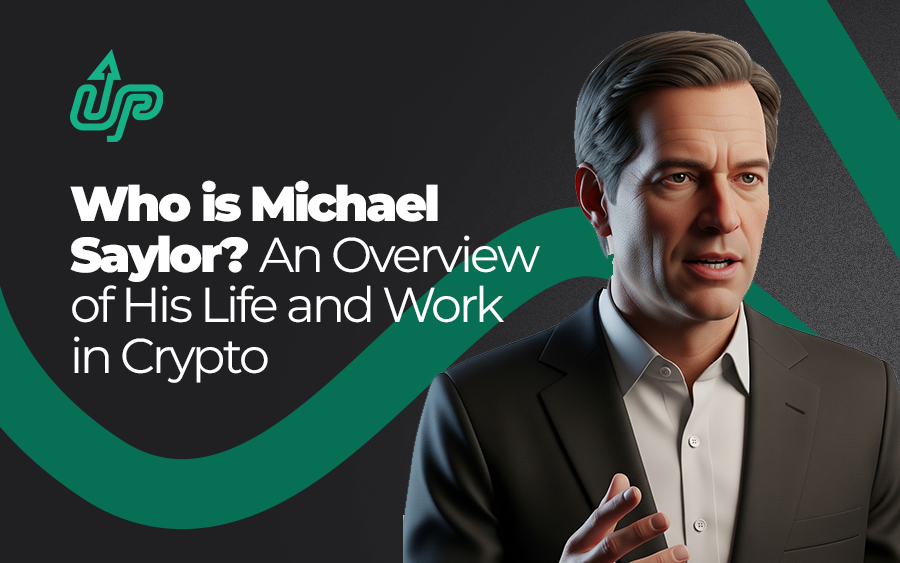
Who is Michael Saylor, and how did he become a leading voice in the Bitcoin space? As co-founder and Executive Chairman of the company now called Strategy, formerly MicroStrategy, he has spent three decades in enterprise software.
In recent years, he has become far better known for steering that company into bitcoin. His story is one of early ambition, public controversy and a very public position in one asset.
Key Takeaways
- Born on 4 February 1965 in Lincoln, Nebraska, he grew up in an Air Force family. Forbes lists his age as 61.
- He took dual degrees at MIT in Aeronautics and Astronautics and in Science, Technology and Society, graduating in 1987, and met co-founder Sanju Bansal there.
- MicroStrategy began in 1989 on a $250,000 DuPont contract and floated on the NASDAQ in June 1998.
- In December 2000 he settled SEC accounting fraud charges without admitting or denying them, paying $8,280,000 in disgorgement and a $350,000 civil penalty.
- The company bought its first 21,454 bitcoins for $250 million in August 2020 and reported 846,000 bitcoins as of 20 September 2026.
- Forbes put his net worth at $4.3 billion on 12 September 2026, 1005th among the world’s billionaires.
The Record, With Dates
| Date | What the record shows | Source |
|---|---|---|
| 14 December 2000 | SEC fraud charges settled, no admission or denial; Saylor pays $8,280,000 and a $350,000 penalty | SEC Litigation Release 16829 |
| 11 August 2020 | First purchase: 21,454 bitcoins for $250 million, fees included | MicroStrategy release, exhibit to its 8-K |
| 31 May 2024 | DC tax consent order for $40,000,000, defendants denying any violation | Superior Court of DC, case 2021 CA 001319 B |
| 5 February 2025 | MicroStrategy rebrands as Strategy; the legal name changes to Strategy Inc on 11 August 2025 | Strategy press releases, 5 February and 14 August 2025 |
| 20 September 2026 | 846,000 bitcoins for an aggregate $63.80 billion, about $75,416 a coin | Strategy Inc 8-K, filed 21 September 2026 |
Childhood and Family Background

(Source: Pinterest)
Michael Saylor was born on 4 February 1965 in Lincoln, Nebraska. His father was a chief master sergeant in the U.S. Air Force, so the family moved often, living on bases across the United States and abroad, including Japan and New Zealand.
In 1976, when he was around 11, they settled in Fairborn, Ohio, near Wright-Patterson Air Force Base.
Washingtonian’s contemporaneous profile records that he “was valedictorian at Fairborn High and was voted most likely to succeed”. The military upbringing gave him habits of discipline he still talks about, and is the thread he reaches for when explaining himself.
Academic Pursuits
Saylor enrolled at MIT in 1983 on a full Air Force ROTC scholarship, reading Aeronautics and Astronautics alongside Science, Technology, and Society, and graduating in 1987.
The engineering gave him the technical grounding. The second degree, about what technology does to the societies that adopt it, explains much about how he argues today.
At MIT he joined Theta Delta Chi, where he met Sanju Bansal, and that friendship became the partnership behind MicroStrategy.
Personal Details
Forbes lists his residence as Miami, Florida, his marital status as Single and his source of wealth as cryptocurrency, and put his real-time net worth at $4.3 billion on 12 September 2026, 1005th in the world.
That figure moves with the bitcoin price and Strategy’s share price, so treat any single number as a snapshot. Saylor says little about his private life, and he is entitled to that, so anything beyond what Forbes publishes is worth treating as unsourced.
Awards and Honors
In 1996 he was named KPMG High Tech Entrepreneur of the Year, and a year later Ernst & Young recognised him as Software Entrepreneur of the Year. MIT Technology Review made him an Innovator Under 35 in 1999.
See also our rundown of the most influential figures in crypto.
Founding and Leadership of MicroStrategy
Establishment of MicroStrategy
In 1989 Saylor co-founded MicroStrategy with Sanju Bansal and Thomas Spahr, on a $250,000 DuPont contract that supplied both capital and office space in Wilmington, Delaware.
It built data mining and business intelligence software using nonlinear mathematics drawn from systems-dynamics theory. Our glossary entry on MicroStrategy covers the business.
The turn came in 1992 with a $10 million contract from McDonald’s, for applications analysing how well its promotions worked. Revenues doubled every year from 1990 to 1996, and by 1994 the headquarters had moved to Tysons Corner.
See also: Who Is Nick Szabo? The Pioneer of Smart Contracts
Public Offering and Expansion
On 11 June 1998 MicroStrategy went public, 4 million shares at $12 each on the NASDAQ under the ticker MSTR, and the price doubled on day one.
By early 2000, at the top of the dot-com boom, Washingtonian put his paper fortune at $7 billion and called him the richest man in the Washington region. Then in March 2000 the company said it would restate two years of results, the stock fell hard, and the SEC opened the investigation that ended in court that December.
Rebranding and Current Role
Two dates matter here and are usually run together. The company rebranded as Strategy on 5 February 2025, then changed its legal name from MicroStrategy Incorporated to Strategy Inc effective 11 August 2025, announced on 14 August “in furtherance of the re-brand”. The SEC’s record for CIK 0001050446 shows Strategy Inc, formerly MicroStrategy Inc.
Earlier, in August 2022, Saylor moved from chief executive to Executive Chairman to concentrate on the bitcoin strategy, and Phong Le became CEO. The 2026 proxy records Le as chief financial officer and treasurer from August 2015 to June 2018, and president and chief financial officer from July 2020 to May 2022.
The split has held: Saylor handles the treasury, Le the operating company.
Bitcoin Advocacy and Investment Strategy
This section digs into how Michael Saylor turned MicroStrategy into the largest corporate holder of Bitcoin and why he did it.
Initial Investment and Philosophy
On 11 August 2020 MicroStrategy announced that it “has purchased 21,454 bitcoins at an aggregate purchase price of $250 million, inclusive of fees and expenses”, roughly $11,653 a coin. Those words are Exhibit 99.1’s; the 8-K body gives the amount as $250.0 million.
In the same release Saylor called bitcoin “digital gold”, and “harder, stronger, faster, and smarter than any money that has preceded it”.
MicroStrategy has recognized Bitcoin as a legitimate investment asset that can be superior to cash and accordingly has made Bitcoin the principal holding in its treasury reserve strategy.
MicroStrategy press release, 11 August 2020
That purchase set the pattern, and a treasury experiment became the business’s defining feature.
Expansion of Holdings
The purchases that followed were funded by issuing securities rather than out of software profits. The company’s case is that issuing above the value of the bitcoin bought leaves shareholders with more bitcoin each.
Strategy reported aggregate holdings of 846,000 bitcoin, acquired for $63.80 billion at an average of $75,416 per bitcoin, inclusive of fees and expenses, as of 20 September 2026.
Strategy Inc, Form 8-K filed with the SEC on 21 September 2026, reporting as of 20 September 2026
That holding is roughly 4 percent of the 21 million bitcoin that will ever exist. The same filing reports a USD reserve of $5.04 billion and $1.05 billion of cash, and records that in the week it covers the company bought 950 bitcoin for $75.7 million, an average of $79,670, and sold no shares under its at-the-market programme.
The weekly cadence is the point: the position is disclosed in writing to the SEC, so you can check it rather than take anybody’s word for it.
Personal Investments

(Source: Michael Saylor’s X)
In October 2020 Saylor said publicly that he had personally bought 17,732 bitcoins for about $175 million, at an average of $9,882 a coin, before the company’s purchases, and told the board to avoid a conflict of interest.
That came from him rather than from a filing, so it is his own statement rather than an audited figure, and he has published no update since.
Read Also: Can You Use Crypto Cards for Gambling?
Controversies and Legal Challenges
Two matters dominate the record, and both settled without admission of wrongdoing.
SEC Investigation (2000)
The sequence is often reported wrongly. MicroStrategy announced its restatement in March 2000; the SEC filed charges on 14 December 2000 and announced the settlement the same day.
The case was SEC v. Michael Jerry Saylor, Sanjeev Kumar Bansal and Mark Steven Lynch, civil action 1:00CV02995 in the District of Columbia. The SEC alleged the company had “materially overstated its revenues and earnings from the sales of software and information services contrary to Generally Accepted Accounting Principles”.
All three consented to injunctions without admitting or denying the allegations. Saylor paid $8,280,000 in disgorgement and a $350,000 penalty, Bansal $1,630,000 and $350,000, Lynch $138,000 and $350,000, per SEC Litigation Release No. 16829.
Tax Fraud Allegations (2022–2024)
In August 2022 the District of Columbia Attorney General sued Saylor, alleging he “lived in the District but pretended to be a resident of Florida” or Virginia “to avoid paying more than $25 million in District income taxes” between 2005 and 2020. The suit also named MicroStrategy, accusing it of helping misrepresent his residency.
The Attorney General’s office said it was the District’s first lawsuit under its amended False Claims Act, which lets whistleblowers report tax fraud.
The Attorney General’s office announced on 3 June 2024 that “Saylor and MicroStrategy will pay $40 million to the District, the largest income tax recovery in District history”. The consent order is explicit about what it does not concede.
Defendants deny that they have violated the District’s tax laws or the FCA. Nothing contained in this Consent Order is or may be construed to be an admission by Defendants of any of the allegations encompassed by the Covered Conduct, any violation of law or regulation, any other matter of fact or law, or any liability or wrongdoing.
Consent order, Superior Court of the District of Columbia, 31 May 2024
Philanthropy and Publications
Saylor Academy
In 1999 he founded the Saylor Foundation, the nonprofit that became Saylor Academy and now brands itself Saylor University on saylor.org.
It publishes hundreds of free college-level courses, taken at the learner’s own pace, with a free certificate of completion. It is a quieter legacy than the treasury.
Literary Contributions

(Source: Goodreads)
In 2012 Saylor published “The Mobile Wave: How Mobile Intelligence Will Change Everything”, arguing that mobile devices had become the universal computing platform and would reshape commerce, healthcare and education.
It reached the bestseller lists of both The New York Times and The Wall Street Journal that year, and shows the habit he now applies to bitcoin: pick one shift and argue it to its limit.
Read Also: Best Places to Spend Crypto in Denmark
Legacy and Impact
Influence on Corporate Bitcoin Adoption
The August 2020 purchase was one of the first substantial corporate bitcoin allocations and changed how boards discuss treasury reserves. Tesla announced a $1.5 billion bitcoin investment in early 2021, and a cohort of listed companies now runs smaller versions.
Bitcoin is a bank in cyberspace, run by incorruptible software, offering a global, affordable, simple, [and] secure savings account to billions of people that don’t have the option or desire to run their own hedge fund.
Vision for Bitcoin’s Future
Saylor’s public case rests on two claims: that a fixed supply makes bitcoin a durable store of value, and that demand grows as institutions accept that.
He has put numbers on where he thinks the price goes over decades. Those are his own forecasts, and nothing in Strategy’s filings commits the company to them.
He has put it more memorably: the magic of bitcoin “isn’t the transfer of money to someone 10,000 miles away”, it is “the transfer of money to someone 10,000 days away”.
Role as a Bitcoin Evangelist
Saylor is often called a Bitcoin evangelist, and has earned the label through sheer volume: conference stages, interviews, podcasts, and an enormous output on social media.
Future Plans and What’s Next for Michael Saylor
Saylor’s stated plan is more of the same, at scale: the company issues common stock and several classes of perpetual preferred stock, then uses the proceeds to buy bitcoin and pay dividends.
He also wants to turn Strategy into a bitcoin-denominated financial institution, and argues the United States would benefit from a strategic bitcoin reserve. Whether any of that happens is unknowable.
FAQs
How many bitcoins does Michael Saylor have?
Two numbers matter. Strategy reported 846,000 bitcoins as of 20 September 2026 in an 8-K filed the next day. Saylor said in October 2020 that he personally owned 17,732 bitcoins bought for about $175 million.
How did Michael Saylor get rich?
From software first. MicroStrategy’s 1998 flotation and the dot-com run made him wealthy on paper, and the 2000 crash and restatement took most of it back. Forbes attributes his current wealth to cryptocurrency and put it at $4.3 billion on 12 September 2026.
Is Strategy the same company as MicroStrategy?
Yes. MicroStrategy rebranded as Strategy on 5 February 2025, changed its legal name to Strategy Inc effective 11 August 2025, and files under that name. The ticker for its class A common stock is still MSTR.
Why does Strategy issue shares to buy bitcoin?
Because its software business does not generate cash on that scale. Selling securities converts market demand for bitcoin exposure into coins, and the company’s framing of why that helps holders turns on the shares trading above the value of the bitcoin behind them.
What happened in Michael Saylor’s tax case?
The District alleged he claimed residency elsewhere to avoid more than $25 million in District income taxes. A consent order signed on 31 May 2024 settled it for $40,000,000, and states that the defendants deny any violation and admit no liability.
UPay’s current cards run on Visa and are issued by partner institutions, topped up from your wallet. Which card you can hold follows your nationality, so read the Help Center’s country list first.