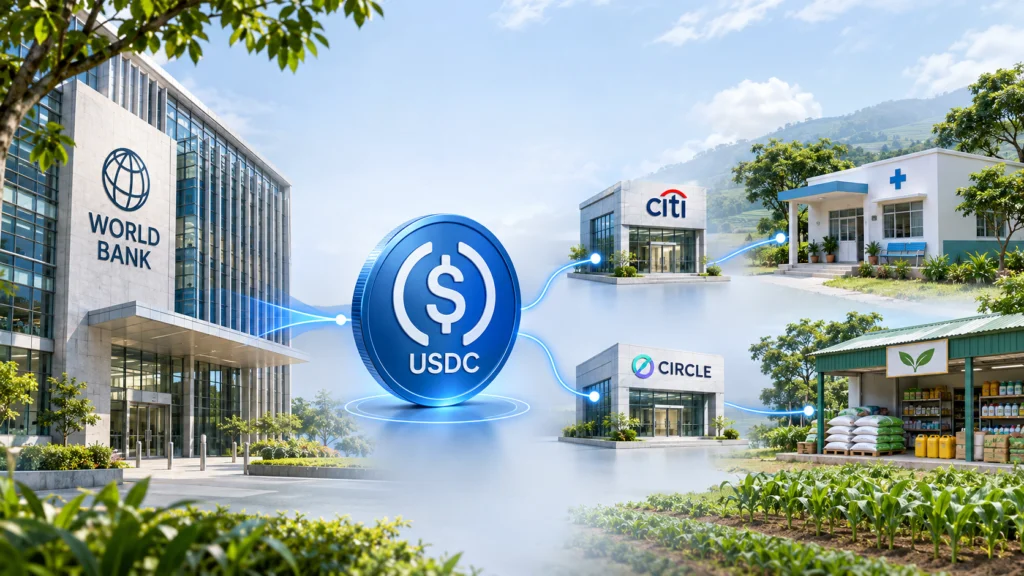
The World Bank Group announced on November 17 that it will explore regulated dollar stablecoins for payments and financial settlements with Citi and Circle. The initiative will examine how blockchain infrastructure could help development funding move alongside existing banking arrangements.
This is an exploration, with no public launch date. Governments, contractors and project beneficiaries cannot yet assume they can choose USDC for World Bank payments. The practical question is whether a different payment route can reduce delays and costs while making funds easier to use.
Key Takeaways
- Citi will contribute connections to banking networks, while Circle will provide infrastructure for minting and settling USDC.
- Initial work will involve borrower countries where digital asset use is supported and permitted.
- The announcement provides no transaction volume, launch date or measured cost saving.
What the Partners Will Examine
The World Bank’s announcement describes a model involving intermediaries and connections between payment systems. The proposal does not assume every recipient will hold tokens or manage a blockchain wallet.
The Block reported that the initiative builds on FundsChain, the organisation’s existing system for tracing project disbursements.
Tracking expenditure and moving money serve different purposes. A ledger can help show where funds went, while a payment service determines how they reach the next recipient.
What Would Change for Recipients?
Consider a project contractor waiting to buy materials in local currency. Receiving USDC sooner could help only if the contractor can convert or spend it when needed. Exchange rates, conversion charges and access to local banking would still affect the result.
The same issue appears in Circle’s planned USDC payments to Move Afrika vendors. Delivering a stablecoin is one part of the payment. Turning it into usable proceeds is another.
For a business, a faster transfer is most useful when it brings forward the date it can pay staff or suppliers. The benefit becomes smaller if the money then waits for conversion or a local payout provider.
Recipients would also need to understand who handles those steps. A payment involving several providers can become difficult to resolve when the sender sees a completed transfer but the recipient still cannot access the money.
What a Useful Trial Should Measure
A meaningful comparison would follow each payment from approval to the point the recipient can spend it. That includes processing time, conversion costs, intermediary deductions and manual checks.
The distinction between accepting USDC and settling funds to a business provides a useful way to assess the proposal. A blockchain confirmation can establish that tokens moved. It does not establish that the recipient has local currency available.
The trial would also need clear records for payments that fail, arrive partially or need to be returned. Finance teams must reconcile the amount approved, sent and received, especially when several organisations handle a project’s funds.
A useful result would show the complete cost and time against the existing payment route. Faster blockchain settlement alone would provide an incomplete comparison.
Eligibility Comes Before Availability
The World Bank says the initial exploration will involve countries where digital assets are supported and permitted. Country participation and payment arrangements therefore remain to be established.
Businesses assessing stablecoin payments across borders should separate technical reach from eligibility. A network may carry a token internationally while an organisation still needs an approved provider, account or conversion arrangement.
The announcement also does not establish that participating recipients will receive USDC directly. Intermediaries could connect the blockchain transfer to conventional banking and local payouts.
Conclusion
The World Bank’s work with Citi and Circle puts stablecoin disbursements into a significant development finance use case. The next evidence to watch is a defined trial: who participates, how recipients receive usable funds and whether the complete payment costs less or arrives sooner.