A 商业发展公司(BDC) is a type of SEC-regulated closed-end investment company in the United States that provides financing (debt and equity) to small and mid-sized private companies. BDCs are similar to private equity firms but are publicly traded and accessible to retail investors. In the crypto context, BDCs have become relevant as some have begun investing in blockchain companies, crypto infrastructure firms, and fintech startups, while DeFi协议 have explored tokenizing BDC-like credit products on-chain.
定义
A 商业发展公司(BDC) is an investment vehicle with specific characteristics:
| 特性 | 描述 |
| 税法法规 | SEC-regulated under the Investment Company Act of 1940 |
| 结构 | Closed-end investment company, often publicly traded |
| 投资重点 | Debt and equity in small/mid-sized private companies |
| Distribution requirement | Must distribute at least 90% of taxable income to shareholders |
| 投资者准入 | Available to retail investors (unlike traditional PE/VC) |
| 杠杆限制 | Debt-to-equity ratio capped at 2:1 |
| 税收待遇 | Pass-through – no corporate-level tax if distribution requirements met |
起源与历史
- 1980年: The US Congress created BDCs through amendments to the Investment Company Act of 1940, designed to encourage investment in small businesses by providing a regulated structure accessible to retail investors.
- 2004-2010: BDCs grew significantly as alternative lending vehicles, particularly during and after the financial crisis when banks reduced small 商业贷款.
- 2018年: Congress passed the Small Business Credit Availability Act, allowing BDCs to increase leverage ratios from 1:1 to 2:1, enhancing their lending capacity.
- 2020-2022: Some BDCs began investing in fintech and blockchain-adjacent companies as the crypto industry matured into a legitimate venture investment target.
- 2023-2024: DeFi protocols explored tokenizing private credit products (similar to BDC structures) on-chain, blurring the line between traditional BDCs and 分散贷款. Platforms like Maple Finance and Centrifuge facilitated institutional-grade credit on blockchain.
运作模式
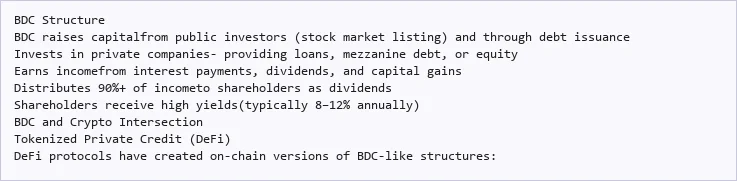
| 路口 | 描述 |
| Crypto company investment | BDCs investing in blockchain startups and infrastructure |
| Tokenized credit | DeFi platforms creating BDC-like credit pools on-chain |
| 金融科技整合 | BDCs funding crypto-adjacent fintech companies |
| 产量比较 | BDC yields compared to DeFi lending yields |
| 监管模式 | BDC structure as template for regulated DeFi lending |
| Traditional BDC | DeFi Equivalent |
| SEC-regulated entity | Smart contract-governed pool |
| Public stock market listing | Tokenized pool shares |
| Professional credit analysis | On-chain credit scoring + off-chain due diligence |
| Quarterly distributions | Continuous yield distribution |
| Bank/institutional custody | Smart contract custody |
简单来说
- A BDC is like a publicly traded bank that lends money to small and medium businesses.
- Anyone can invest by buying BDC shares on the stock market – unlike private equity which requires millions.
- BDCs pay high dividends: (8–12%) because they’re required to distribute most of their income.
- In crypto, the BDC model is being replicated on-chain – DeFi platforms create pools that lend to real businesses and distribute yields to token holders.
实际例子
Example 1: Traditional BDC Operations
- 场景: A mid-sized manufacturing company needs $20 million in expansion capital but can’t access traditional bank lending.
- 实施: A BDC provides a $20 million senior secured loan at 10% interest, funded by its pool of retail and institutional investors.
- 结果: The manufacturer gets growth capital, the BDC earns interest income, and shareholders receive quarterly dividend payments from the interest collected.
Example 2: Maple Finance (DeFi Private Credit)
- 场景: The crypto industry needed institutional-grade lending without traditional banking intermediaries.
- 实施: Maple Finance created on-chain lending pools where pool delegates (similar to BDC managers) perform due diligence and approve loans to institutional borrowers.
- 结果: Billions in loans were originated on-chain, with lenders earning yields similar to BDC distributions – demonstrating that BDC-like structures can work on blockchain.
Example 3: BDC Investment in Blockchain Companies
- 场景: A publicly traded BDC identified blockchain infrastructure as a growth sector.
- 实施: The BDC provided growth debt financing to a blockchain data analytics company, earning interest while gaining exposure to the crypto sector.
- 结果: The BDC’s shareholders gained indirect crypto sector exposure through a regulated, dividend-paying vehicle – without directly holding 波动性较大的加密货币.
优势
| 企业优势 | 描述 |
| 零售通道 | Publicly traded, accessible to any investor |
| 高产量 | 8–12% dividend yields from private credit lending |
| 多样化 | Exposure to private credit markets normally reserved for institutions |
| 调节 | SEC oversight provides investor protections |
| 税收效率 | Pass-through structure avoids double taxation |
缺点与风险
| 坏处 | 描述 |
| 信用风险 | Borrower defaults can impair BDC income and principal |
| 利率敏感性 | Rising rates increase BDC borrowing costs |
| 杠杆风险 | 2:1 leverage amplifies both gains and losses |
| 非流动资产 | Underlying loans may be difficult to sell quickly |
| 复杂 | BDC accounting and valuation can be opaque |
常见问题解答
Are BDCs a good investment?
BDCs offer attractive yields but carry significant credit and interest rate risk. They can be appropriate for income-focused investors who understand the risks. This glossary does not provide investment advice.
How do BDCs relate to DeFi?
DeFi platforms are creating on-chain versions of BDC-like structures – lending pools that fund real-world businesses and distribute yields to token holders. This represents the convergence of traditional private credit and decentralized finance.
Can I invest in crypto through a BDC?
Some BDCs invest in blockchain and fintech companies, providing indirect crypto exposure through a regulated structure. However, most BDCs focus on traditional industries.
What is the difference between a BDC and a REIT?
Both are pass-through investment vehicles. BDCs invest in private company debt/equity. REITs invest in real estate. Both must distribute 90%+ of income and are accessible to retail investors.