


Bermuda Is Building the World’s First Fully On-Chain National Economy, Backed by Coinbase and Circle
Bermuda has taken a decisive step toward redefining how a modern economy can operate, announcing plans to become the world’s first fully on-chain national economy with support from Coinbase and Circle. The initiative, unveiled during the World Economic Forum, goes beyond experimentation. It places blockchain infrastructure and stablecoins at the heart of everyday financial activity across the island. The government’s plan is built around integrating digital assets directly into public services, financial institutions, and daily commerce. Stablecoin payments, tokenized financial tools, and nationwide digital education are no longer side projects. They are being positioned as core components of Bermuda’s financial system. “With the support of Circle and Coinbase, two of the world’s most trusted digital finance companies, we are accelerating our vision to enable digital finance at the national level,” said Premier David Burt, describing the move as a way to reduce costs and expand opportunity for Bermudians. From Early Regulation to Full-Scale Adoption Bermuda’s latest announcement did not come out of nowhere. The island has spent years laying the groundwork for this transition. In 2018, it passed the Digital Asset Business Act, becoming one of the first jurisdictions to establish a comprehensive regulatory framework for cryptocurrency businesses. That early clarity attracted firms like Circle and Coinbase, both of which were licensed under the regime. By 2019, Bermuda had begun accepting U.S. dollar-backed digital currencies for taxes and government fees. In 2020, it even tested its own stablecoin. These steps positioned the country as a regulatory pioneer long before larger economies began debating similar frameworks. The current initiative expands on that foundation. Government agencies will pilot stablecoin-based payments, while banks and insurers integrate tokenization tools into their operations. At the same time, residents and businesses will receive digital finance education and technical onboarding, ensuring that adoption is not limited to large institutions. USDC as Everyday Financial Infrastructure A key element of the on-chain strategy is the use of USDC, the U.S. dollar-backed stablecoin issued by Circle. USDC is already being used by Bermudian merchants, allowing customers to pay digitally while merchants receive funds almost instantly and at minimal cost. This approach addresses long-standing issues in traditional payment systems, such as slow settlement times and high transaction fees. For small businesses, the shift can mean faster access to cash flow and fewer intermediaries taking a cut. Jeremy Allaire, Circle’s co-founder and CEO, framed the initiative as a model for responsible national-level blockchain use. “Bermuda has been a global pioneer in digital asset regulation and continues to demonstrate what responsible blockchain innovation looks like at a national scale,” he said, adding that broader use of USDC can empower both individuals and businesses. Public-Private Collaboration at Scale Coinbase’s role centers on providing digital asset infrastructure and enterprise tools while also supporting education and onboarding efforts. The exchange has steadily expanded its presence in Bermuda, receiving a license from the Bermuda Monetary Authority in 2023 as part of its global growth strategy. Brian Armstrong, Coinbase’s CEO, emphasized that regulation and innovation do not have to be at odds. “Bermuda’s leadership shows what’s possible when clear rules are paired with strong public-private collaboration,” he said, pointing to the island as a working example of how governments and crypto firms can coordinate effectively. That collaboration has already produced tangible results. At recent digital finance forums, attendees were given small amounts of USDC to spend at newly onboarded local merchants. The hands-on exposure helped normalize stablecoin use and encouraged wider participation from businesses, banks, and insurers. A Small Nation, a Global Signal With a population of roughly 73,000 and a GDP estimated at $6.8 billion in 2024, Bermuda is not attempting to compete with major economies on size. Instead, it is positioning itself as a proof of concept. By moving an entire national economy onto blockchain rails, the island aims to show how digital assets can function as everyday financial infrastructure rather than speculative instruments. The long-term promise is lower transaction costs, faster payments, and improved access to global finance for residents and businesses. If successful, Bermuda’s approach could offer a blueprint for other countries exploring how to bring parts of their economies on-chain without sacrificing regulatory oversight or consumer protection. For now, Bermuda has made its ambition clear: blockchain is no longer an experiment on the island. It is becoming the backbone of how money moves.
The Strongest Coinbase Premium Gap Selling in Recent Periods Suggests U.S. Whales, Not ETFs, Are Driving the Current Sell Pressure
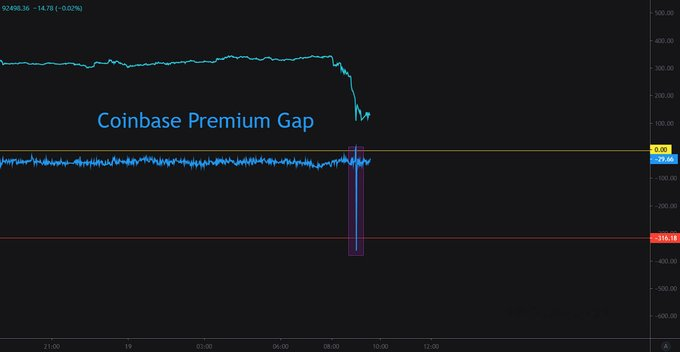
Bitcoin markets are flashing a signal that seasoned traders rarely ignore. The Coinbase Premium Gap—a long-watched indicator of U.S. investor behavior—has slipped deep into negative territory, marking one of its most aggressive selling phases in recent periods. What makes this move striking is not just the magnitude of the gap, but when and how it is happening: much of the pressure is emerging outside ETF trading hours, pointing directly at large U.S.-based holders rather than retail flows or passive ETF investors. This development is reshaping how analysts interpret the current correction and raising fresh questions about institutional positioning in Bitcoin. Key Takeaways A Premium Gap That’s Hard to Ignore The Coinbase Premium Gap measures the price difference between Bitcoin on Coinbase and offshore exchanges such as Binance. Historically, Coinbase has served as a gateway for U.S. capital, particularly institutional money. When Bitcoin trades at a premium on Coinbase, it usually reflects strong domestic demand. When that premium flips negative, it signals selling pressure from U.S.-linked participants. Recent data reviewed by market analyst and Bitcoin commentator Mignolet shows the gap widening sharply to the downside, even during periods when U.S. spot Bitcoin ETFs were not trading. “Selling pressure intensified even when ETF markets were closed, suggesting activity outside traditional ETF structures.” That single observation carries weight. ETFs have become the most visible channel for institutional exposure, but they are far from the only one. The timing alone suggests that large players are using other routes to reduce exposure. Why ETFs Don’t Explain This Move Since the approval of spot Bitcoin ETFs, daily inflow and outflow data has often been used as a proxy for institutional sentiment. But the current market behavior exposes a limitation of that approach. If ETFs were the main driver, selling pressure would align closely with U.S. market hours. Instead, Bitcoin has faced notable sell-side activity during ETF downtime, pointing to alternative execution paths. These include: “Large investors are moving substantial Bitcoin holdings through channels outside conventional ETF structures.” This distinction matters. ETF flows are transparent and easy to track. OTC trades and direct exchange selling by institutions are not. The Coinbase Premium Gap is capturing that hidden activity in real time. Whale Behavior Looks Familiar Seasoned market participants have seen this pattern before. In past cycles, sustained negative Coinbase premiums often appeared when institutions were quietly reducing risk after extended price rallies. During the 2021 bull run, prolonged positive premiums signaled aggressive U.S. accumulation. The opposite is now unfolding. “The scale of selling suggests participation from large, sophisticated investors rather than retail traders.” Retail traders rarely move the premium in a sustained way. Their trades are fragmented and often driven by momentum. What we are seeing instead resembles coordinated selling—measured, persistent, and size-heavy. This lines up with other data points. Blockchain analytics over the past month show increased transfers from known institutional wallets to exchange-linked addresses. At the same time, derivative markets suggest more defensive positioning, with hedging activity picking up and leverage remaining muted. Not Panic Selling — Strategic Repositioning It would be misleading to frame the current move as panic. Unlike past stress events, on-chain metrics do not show a surge in fresh exchange inflows. That detail is crucial. It implies that much of the selling is coming from Bitcoin already sitting on exchanges, not from holders rushing to deposit coins in fear. This is more consistent with planned distribution than emotional exits. Several motivations may be overlapping: “The selling follows traditional patterns observed in previous market cycles.” In other words, this looks like institutions doing what they often do best: adjusting exposure before conditions change, not after. Historical Signals Offer a Warning—and Some Reassurance History gives context, though not certainty. There have been clear moments when a deeply negative Coinbase Premium Gap preceded extended drawdowns. But there is an important difference today. Leverage across derivatives markets is significantly lower than during prior cycle peaks. Exchange balances are also far from historical highs. “Current market structure appears healthier than during previous extreme selling periods.” That does not rule out further downside, but it reduces the probability of disorderly collapse driven by cascading liquidations. Regional Markets Tell a Different Story The sell pressure appears concentrated in U.S.-linked venues. Exchange premium data from Asia and parts of Europe show less aggressive selling, with some regions maintaining neutral or even mildly positive spreads. These differences reflect structural factors: Bitcoin remains a global market, but U.S. capital still exerts outsized influence on price discovery. When American whales sell, the impact ripples outward. Why the Coinbase Premium Gap Matters Right Now Analysts often warn against relying on a single indicator, and that caution applies here as well. Still, the Coinbase Premium Gap offers something many metrics do not: a window into who is acting, not just what price is doing. “The indicator provides valuable insight into geographic and investor-class behavior.” When paired with ETF flow data, on-chain movements, and derivatives positioning, a clearer picture emerges. ETFs are no longer the dominant force shaping short-term pressure. Instead, large U.S. holders operating beyond ETF wrappers are taking the lead. What Comes Next Whether this selling marks a temporary reset or the early stage of a deeper correction remains unresolved. Much will depend on macro conditions, regulatory developments, and whether institutional selling slows or accelerates. What is clear is that Bitcoin’s market structure has grown more complex. ETF flows alone no longer tell the full story. Indicators like the Coinbase Premium Gap are regaining relevance, especially during periods when visible data sources fall quiet. For now, the message from the premium gap is direct: U.S. whales are active, they are selling, and they are doing it outside the spotlight. Markets would be wise to pay attention.
PancakeSwap Approves a Proposal To Adjust Cake Max Supply to 400 Million

PancakeSwap has taken another decisive step in reshaping the long-term economics of its native token, CAKE, after the community overwhelmingly approved a proposal to reduce its maximum supply to 400 million tokens. The decision, finalized through a Snapshot vote that ran between January 16 and January 19, 2026, received unanimous support, reflecting strong alignment between the protocol’s core contributors and its wider user base. The approved proposal trims CAKE’s supply cap by 50 million tokens, down from the previous ceiling of 450 million. With roughly 350 million CAKE already in circulation, the adjustment leaves an estimated 50 million tokens as a remaining buffer. According to the PancakeSwap team, often referred to as “the Kitchen,” this buffer is not expected to be used under normal circumstances, but it provides optional flexibility should unforeseen conditions arise. A Continuation of Pancakeswap’s Deflationary Path This supply reduction did not emerge in isolation. It builds on earlier tokenomics reforms introduced in April 2025, when PancakeSwap implemented CAKE Tokenomics Proposal 3.0. That earlier overhaul retired the veCAKE model and significantly cut daily emissions from around 40,000 CAKE to approximately 22,250 CAKE per day. Since those changes took effect, CAKE’s supply dynamics have shifted meaningfully. The protocol recorded a net burn of about 8.19% of the token’s supply over the course of 2025, shrinking total supply from roughly 380 million at the start of the year to about 350 million today. This marked a continuation of a deflationary trend that has been in place since September 2023, with no immediate signals of reversal. Community members voting on the latest proposal were reminded to consider both the short- and long-term implications of emission adjustments, particularly how they affect incentives, governance, and sustainability. The unanimous outcome suggests that voters largely agree the current framework strikes the right balance. Why 400 Million Is Seen as Sufficient In the proposal documentation and subsequent announcement, PancakeSwap contributors argued that a 400 million maximum supply is more than adequate to support future development and ecosystem expansion. They emphasized that the protocol has alternative resources available before any need to revisit emissions. One such resource is the Ecosystem Growth Fund, which has already accumulated approximately 3.5 million CAKE tokens. This fund is intended to support strategic initiatives, partnerships, and other growth-related activities without placing immediate pressure on token issuance. Because of this, the team stated it is unlikely the protocol would ever need to revert to an inflationary model to fund operations or expansion. The reduction in the supply cap also reinforces PancakeSwap’s broader positioning among major DeFi platforms, many of which are reassessing token issuance strategies amid changing market conditions. By tightening its issuance framework, PancakeSwap signals a focus on long-term value preservation rather than aggressive supply growth. Community Governance in Action The vote itself was conducted via Snapshot, PancakeSwap’s preferred off-chain governance tool, and concluded with 100% approval. While such unanimity is uncommon in large decentralized communities, it highlights how closely this proposal aligned with existing sentiment following the success of Tokenomics Proposal 3.0. The final implementation is straightforward: the protocol will reduce the maximum cap on CAKE’s supply to reflect the new 400 million limit. No immediate changes to circulating supply are required, as the adjustment strictly affects the upper boundary of potential issuance. Broader Implications for Cake Holders For CAKE holders, the decision reinforces the protocol’s deflationary narrative. With emissions already reduced and burns continuing to outpace new issuance, the lowered supply cap further limits long-term dilution risks. While the remaining 50 million buffer technically exists, the PancakeSwap team has made it clear they do not anticipate needing to draw from it under normal operating conditions. As DeFi platforms continue to refine their token models, PancakeSwap’s latest move places it firmly among protocols prioritizing sustainability and disciplined supply management. For now, the community appears confident that the 400 million cap provides enough room for growth without compromising the economic structure that underpins CAKE’s value proposition.